

An RV awning on its own blocks the sun from directly overhead, and that is where most people stop thinking about it. The radiant heat coming off a hot campsite pad, the low afternoon sun raking across your patio chairs, and the glare off the campsite next door all come in from the side, straight into the space you thought was shaded. Add a hanging mesh screen and the same awning becomes a different room.
That is the whole idea behind an RV awning shade. It is a screen that hangs from the utility slot along your roller tube and stakes down to the ground, cutting incoming light and heat while still passing air and daylight. Owners on RV owner forums consistently describe the same effect: a patio that was unusable at midday becomes where the dog sleeps and the coffee gets made. Several of the picks below carry published UV blocking figures between 85 and 95 percent, and a few list measured temperature drops in the 10 to 25 degree range.
What follows is a roundup of the 12 best rv awning shade options we could put in front of a hot-weather camper, split into two families that get confused constantly: hanging mesh screens that zip or slide onto an existing awning, and full replacement canopies for when your original fabric has already failed. Every pick was evaluated on the same criteria, stated up front so you can judge the list yourself.
How we chose: published UV or light blocking percentage, ventilation, drop length against the awning height it is meant to serve, how the screen is removed when wind arrives, whether a complete hardware kit is in the box, warranty length, and the volume of real owner reviews behind the listing. We also favored products that state which awning brands they fit, because sizing and compatibility account for most returns in this category. Some links on this page are affiliate links.
Top 3 Picks for Best Hot-Weather RV Awning Shades in October
If you want the short answer: the Tentproinc mesh screen is the best general choice, the Carefree EZ ZipBlocker is the most refined two-piece design, and the ShadePro Vista is the best value buy for a typical vertical-arm awning.

Tentproinc 16 ft RV Awning…
- 86 percent UV blocking
- 8 ft x 15 ft 3 in fabric
- Fits most 16 ft awnings
- 3-year warranty

Carefree EZ ZipBlocker 15 x 9
- Blocks about 85 percent of light
- Two-piece zip design
- Rolls inside the awning roller
- 5-year warranty
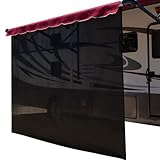
ShadePro Vista Shade 13 x 7
- Blocks about 87 percent of sunlight
- Marine-grade zipper
- Kit includes grommets and stakes
- Fits vertical arm awnings
All 12 RV Awning Shades Compared in 2026
Every product below in one place, with the figures that decide whether it works in summer heat. Drop length is the vertical distance from the roller to the ground; projection is how far the awning reaches out from the RV.
| Product | Specs | Action |
|---|---|---|
| Tentproinc RV Awning Mesh Sun Shade Screen |
|
Check Latest Price |
 Dulepax RV Awning Side Shade 9 x 7 Dulepax RV Awning Side Shade 9 x 7 |
|
Check Latest Price |
| Carefree EZ ZipBlocker 15 x 9 |
|
Check Latest Price |
 ShadePro Vinyl Replacement Canopy 14 ft ShadePro Vinyl Replacement Canopy 14 ft |
|
Check Latest Price |
 RecPro 17 ft Tan Fade Replacement Vinyl RecPro 17 ft Tan Fade Replacement Vinyl |
|
Check Latest Price |
| ShadePro Vista Zipper Shade 13 x 7 |
|
Check Latest Price |
 Xenjum 19.5 oz Heavy-Duty Vinyl 17 ft Xenjum 19.5 oz Heavy-Duty Vinyl 17 ft |
|
Check Latest Price |
 EXCELFU Awning Sun Shade with Zipper 9 x 14 EXCELFU Awning Sun Shade with Zipper 9 x 14 |
|
Check Latest Price |
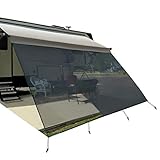 Leaveshade Front Screen 10 x 20 ft 3 in Leaveshade Front Screen 10 x 20 ft 3 in |
|
Check Latest Price |
 RVINGPRO 9 x 15 ft 3 in Zipper Screen RVINGPRO 9 x 15 ft 3 in Zipper Screen |
|
Check Latest Price |
 Shatex 8 x 10 ft HDPE Privacy Screen Shatex 8 x 10 ft HDPE Privacy Screen |
|
Check Latest Price |
 Glamful 21 ft Gray Fade Replacement Vinyl Glamful 21 ft Gray Fade Replacement Vinyl |
|
Check Latest Price |
1. Tentproinc RV Awning Mesh Sun Shade Screen: the Best All-Rounder for Hot Weather
RV Awning Mesh Sun Shade Screen for Motorhome Camper Trailer Sunshade
8 ft x 15 ft 3 in mesh vinyl
Blocks about 86% UV
6.7 pounds
3-year warranty
Pros
- 86 percent UV blocking with an open view
- Quick poly-cord roller bar install
- Stakes and bungee balls in the box
- Helps cut cross-wind when paired with a side shade
- Fits Dometic Carefree Lippert Fiamma and Solera awnings
Cons
- Not compatible with Girard awnings
- No zipper so the whole screen comes off to stow
- Size must match the arm-to-arm measurement
With close to 5,000 owner reviews averaging 4.7 stars, this is the screen most hot-weather campers end up with, and for good reason. The mesh vinyl is a genuinely open weave, so you still see the lake, the site or the fire pit through it while cutting roughly 86 percent of UV. Owners describe the shaded patio as roomy and comfortable on hot days rather than merely tolerable.
Setup is the part that wins people over. A poly-cord along the top edge slides into the awning roller bar in minutes, and the stakes and ball bungees come in the box, so there is no hardware run before you can use it. The 6.7 pound weight means one person can reposition the whole screen when the sun moves.
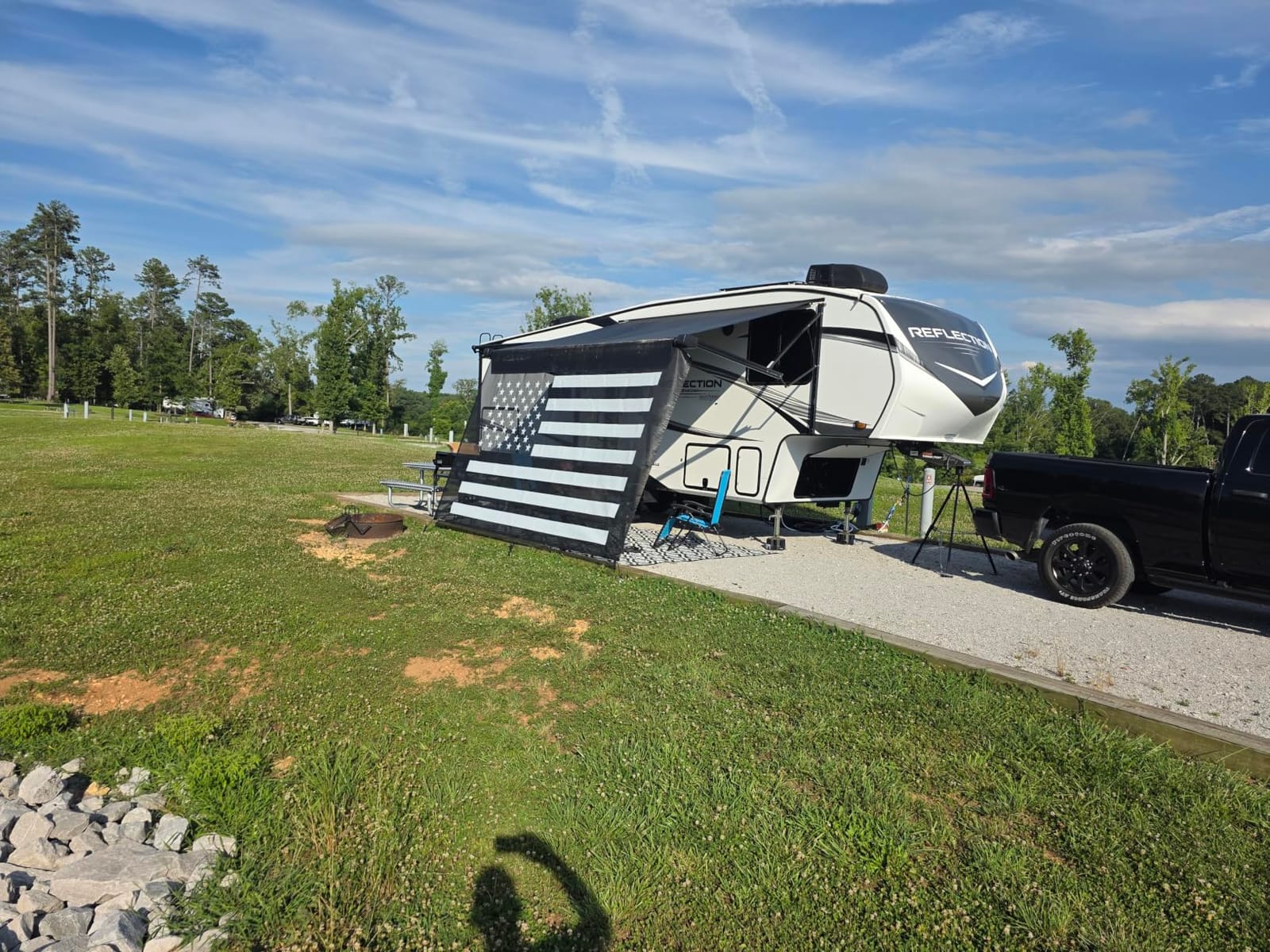
It also does a job people do not expect from a screen. Pair it with a side shade and owners report the cross-wind force under the awning drops noticeably, which matters more in summer when the wind is the reason you wanted shade in the first place. That combination is the single most common setup in the RV camping forums we reviewed.
The real constraint is fit. The actual fabric measures 8 ft by 15 ft 3 in and is cut for a 16 ft awning, so if your measurement is off by a few inches you will fight the corners. It is also the one incompatibility that shows up repeatedly: this screen does not work on Girard awnings, and no amount of stretching changes that.
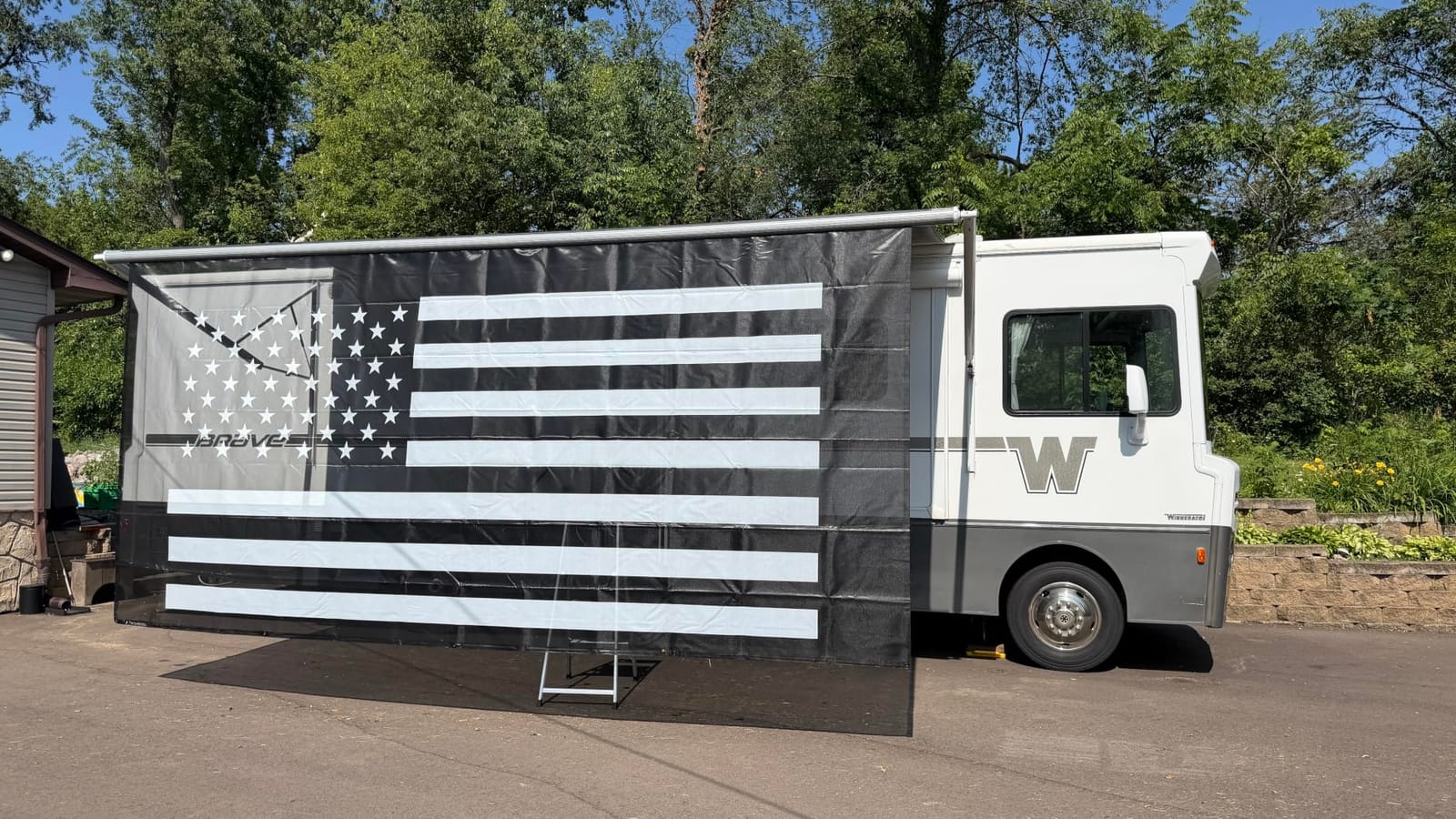
Who should buy the Tentproinc mesh screen
Buy this if you have a 16 ft awning from Dometic, Carefree, Lippert, Fiamma or Solera and you want the most owner-proven screen in the category without deciding between fabric types. It is also the one to pick if you camp in real heat and value a long warranty and a hardware kit that arrives complete.
Who should skip it
Skip it if you own a Girard awning, if you need a screen that can be removed in seconds when a storm arrives, or if your awning is high enough that you cannot physically reach the roller. It is a one-piece design with no zipper, so the entire screen comes off every time you stow the awning, and there is no lower panel to detach while leaving the top attached.
2. Dulepax RV Awning Side Shade: Best for Blocking Low Sun and Neighbors
Dulepax RV Awning Side Shade- 9’X7′ -Second Generation RV Awning Side Shade Screen Significantly Improves Shadew and Privacy.Universal RV Awning Shade Screen with Complete Kits.
9 ft x 7 ft knife-coated polyester mesh
Solid black
1.72 kg
Complete hardware kit
Pros
- Fine coated mesh gives shade plus privacy
- Zips off in seconds for storms
- Complete kit with a one-person install
- Owners report a camper about 10 degrees cooler
Cons
- Some reports of grommets pulling out
- Occasional zipper or stitching failures
- Fabric can run long if the slot pull tab is ignored
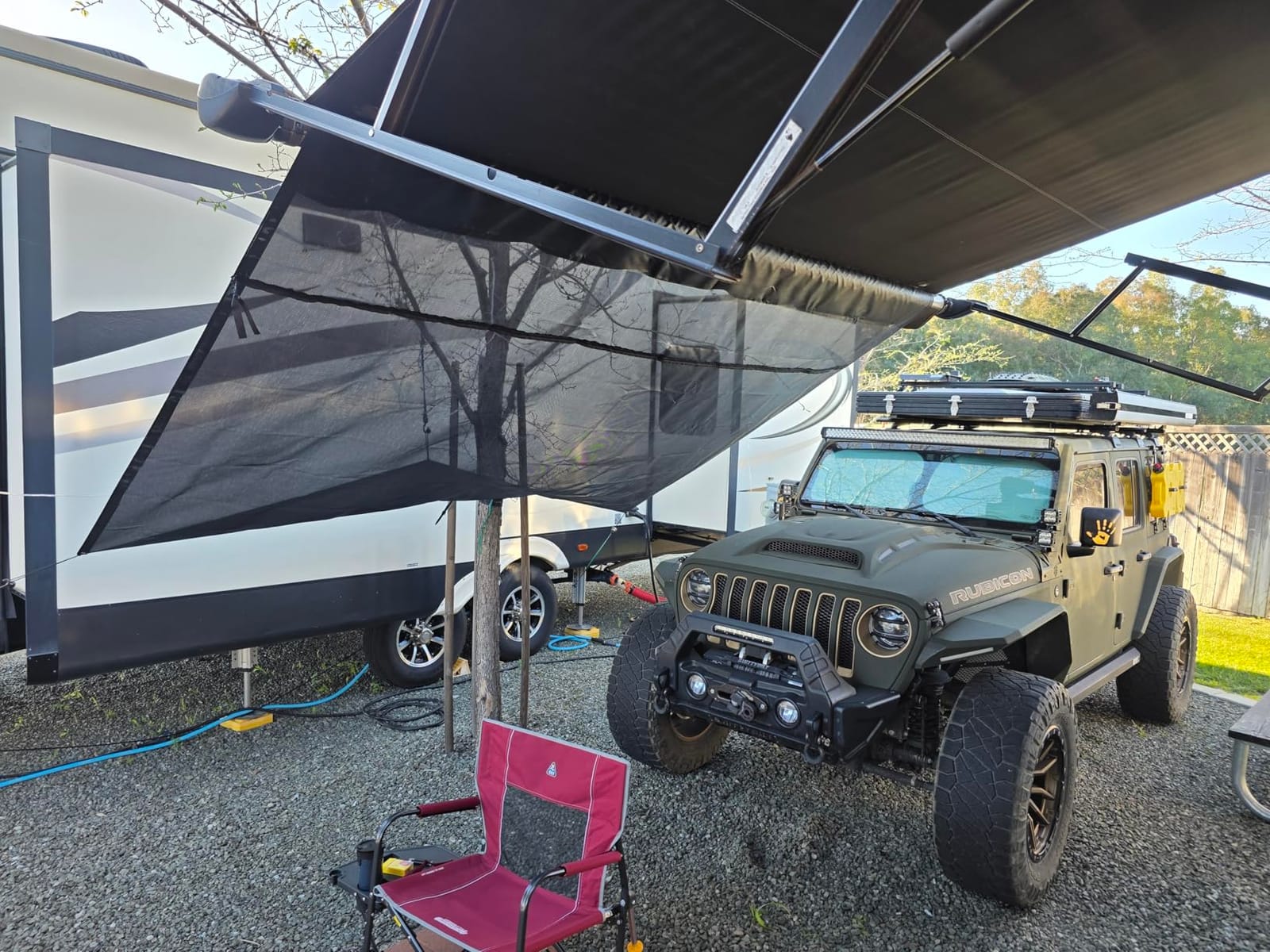
A front screen stops overhead sun, but the heat that actually cooks you at 4pm comes in low and sideways. That is what a side shade solves, and this 9 ft by 7 ft panel is the most reviewed side shade in our group. The hole size in the 7.9 oz coated mesh is roughly a third of what competing brands use, which is why it reads as genuinely dark from outside while still showing a shape from within.
Owners on camping forums describe pairing it with a front screen to build a three-sided shaded box, and several report measuring a camper running about 10 degrees cooler with the side closed. It is also the fastest-moving piece of the setup: the panel zips off in seconds when wind picks up, which is exactly the behavior you want in an afternoon storm.
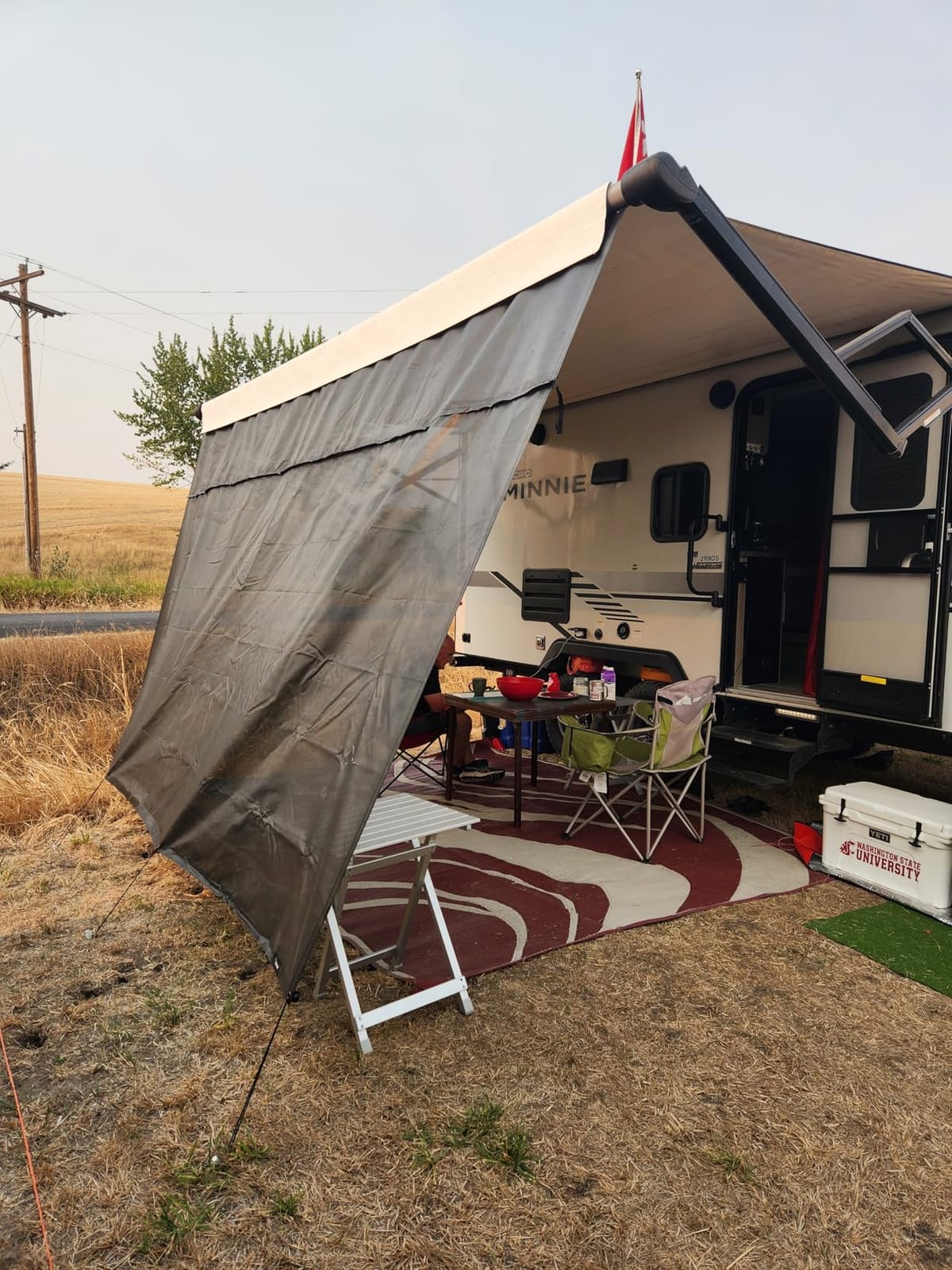
Two details decide whether it fits well. The shade hangs off the awning channel, and if you measure without accounting for the slot pull tab your fabric ends up longer than the space you have, leaving a visible slack gap at the corner. Take the measurement from the end of the channel, not the end of the fabric roll.
The critical minority of reviews is worth hearing. Some owners report grommets working loose from the fabric, and a few report zipper or stitching failure in the first weeks, though at least one of those units was replaced by the seller. If you pull the grommets hard every time you stake out, expect more wear at those points than the star rating implies.
When the side shade is the right answer
Choose this one if your campsite is open on one side, if the sun tracks along the RV wall in the late afternoon, or if you want visual privacy in a crowded park. It is also the cheapest way to add a wind buffer to an existing awning that is already equipped with a front screen.
When it is not
Do not buy a single panel expecting a full enclosure. It is one side, not two, and owners consistently report buying a second unit to close the opposite side. It is also the wrong tool for blocking overhead sun, which is what a front screen or a replacement canopy handles better.
3. Carefree of Colorado EZ ZipBlocker: the Best Two-Piece Design for a 15 ft Awning
Carefree Of Colorado Drop RV Awning EZ ZipBlocker – Black Mesh RV Awning Shade Screen, Canopy Sun Blocker, Camper Accessory for Front Patio (15′ x 9′)
15 ft x 9 ft black mesh
Two-piece zip
16 ounces
5-year warranty
Pros
- Top panel rolls up inside the awning
- Blocks about 85 percent of light
- Fast zipper for storm response
- 5-year warranty
- Neat stitching and premium build
Cons
- Stakes and anchor hardware not included
- Heavy lower panel should be detached before rolling
- Needs a compatible attachment groove
The reason two-piece shades exist is reach. On a 15 ft awning that rolls out to 9 ft, a single-piece screen means climbing a ladder to find the top edge. Carefree split the job: the top panel lives in the roller and stays there permanently, and only the lower panel has to be zipped on and off. Grand Design owners in owner forums are unreserved about this one.
For heat specifically, the open-weave fabric blocks about 85 percent of incoming light while keeping the view, and owners report a noticeable temperature difference under the awning on hot afternoons. The build quality is the other story: hemmed, tightly stitched edges, and a zipper that reviewers describe as heavy duty rather than flimsy.
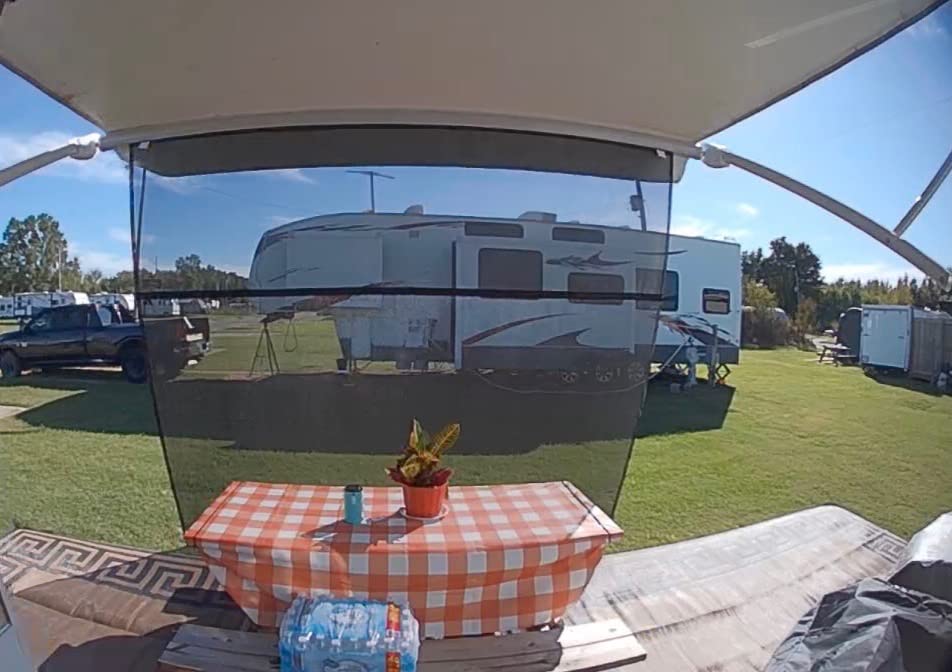
Two operational details matter more than the fabric. First, the lower panel is heavy for its size, so it should come off before you roll the awning, or you are asking the roller to do extra work every time. Second, the kit does not include tie-down stakes or anchor hardware, which is the most repeated request in the reviews and the one gap worth planning around before you leave home.
Fit is specific: this is tailored for 12V RV awnings with an engineered fit, and it requires an awning with a compatible attachment groove. On an awning that has lost its groove to corrosion, the screen will not seat properly no matter how carefully you work it.
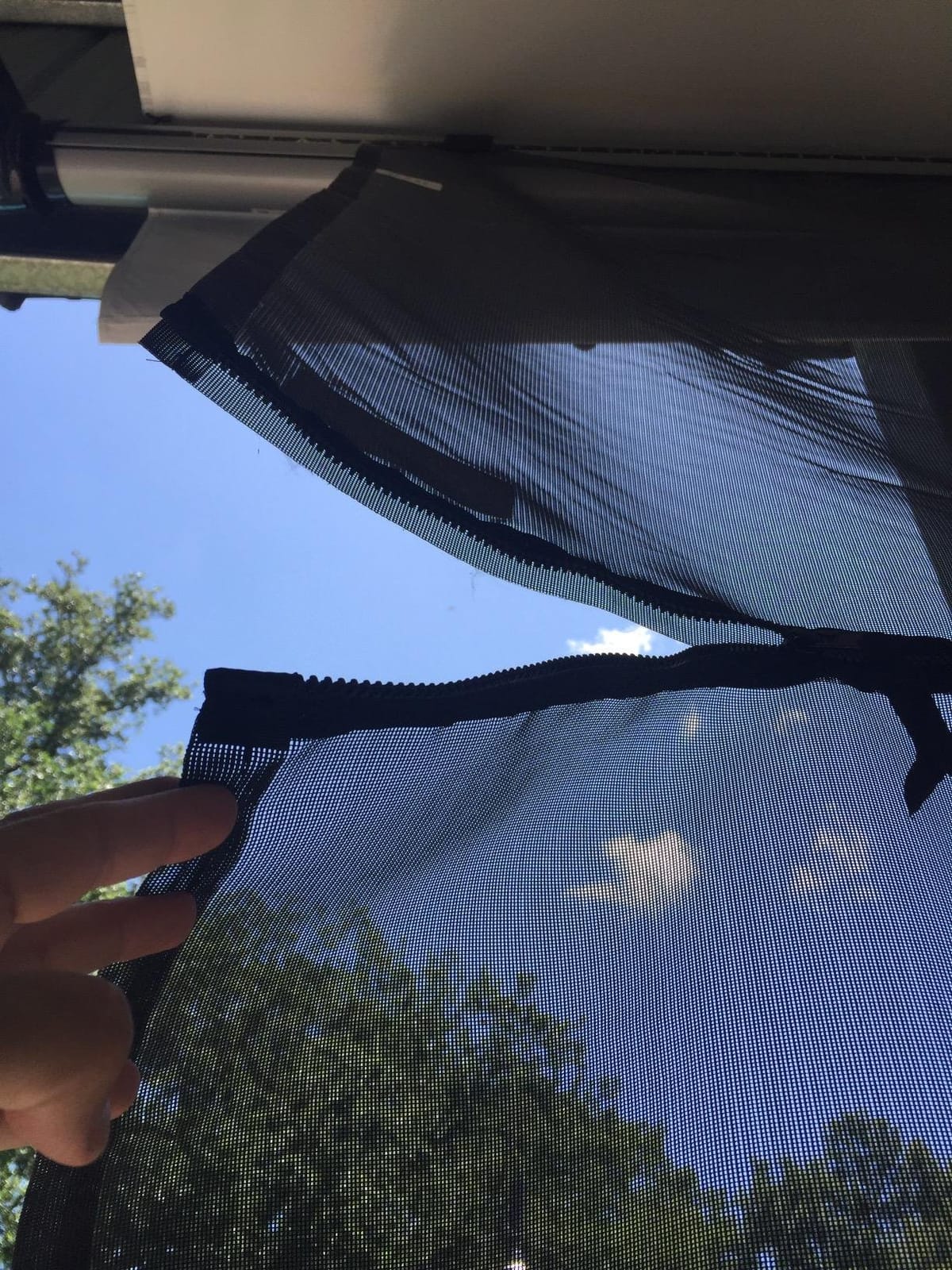
Why the two-piece design wins on high awnings
If your awning end sits high enough that a ladder is uncomfortable or unsafe, this is the pattern that removes the problem entirely. The permanent panel stays in the roller and the moving part is at ground level, so the only time you need height is when you first install the top insert.
Where it disappoints
The absence of stakes is a genuine gap for anyone expecting a complete kit, and the fixed 15 by 9 footprint means it is not a fit for shorter or longer awnings without a different size. If you plan to stow the awning in a hurry with the screen still attached, the detachable lower panel is the feature that makes it viable, not a flaw.
4. ShadePro Vinyl Replacement Canopy: Best for Renewing a Worn Awning
Shade Pro RV Awning Fabric Replacement | Durable Standard Grade Vinyl (14′ [Fabric 13′ 2″], Solid Black) Camper Shade Awning Canopy
13 oz 3-ply premium vinyl
14 ft awning coverage
Cold-crack tested to -20F
22 pounds
Pros
- Heavyweight 3-ply vinyl resists UV and cracking
- Universal fit across major awning brands
- Sewn-in polyrods make install tool-free
- Nearly 8000 owner reviews at 4.7 stars
Cons
- Heaviest item in the group at 22 pounds
- Will not fit awnings with metal covers
- Needs arm center-to-center measuring
Sometimes a shade screen is the wrong purchase, because the problem is not side heat, it is a canopy that has gone chalky, cracked and leaky. ShadePro has made RV awning accessories for more than 45 years, and this 13 oz 3-ply vinyl is the proven answer for that situation. It is the most-reviewed awning product in this roundup by a wide margin.
The fabric is cold-crack tested to -20F and reinforced at the stress points with webbing, which matters in a summer-to-winter rotation where a cheap canopy fails at the folds first. It fits most RV awnings without metal covers, including Carefree, Dometic, Lippert, Carter and Faulkner systems, so the coverage is broad.
Is a replacement canopy the right call for heat
If your awning fabric is still solid but you want more shade than a single hanging panel gives you, replacing the canopy is the higher-impact fix. The fabric sits above your head and shades the whole footprint, while a screen shades one vertical plane. Both work together, but they are not substitutes.
What to watch before you order
Two things. The 22 pound weight is the heaviest in this group and installation takes two people, so plan the manpower. And it will not fit an awning with a metal cover over the roller, so check your awning style and measure arm center to arm center before ordering a size.
5. RecPro 17 ft Tan/Camel Fade Replacement Vinyl: Best Value Canopy Swap
RecPro 17′ RV Awning Fabric Replacement | Tan/Camel Fade Vinyl
16 ft 1 in actual width
Tan camel fade vinyl
140 PSI tensile strength
16 ounces
Pros
- Universal channel fit for a one-piece swap
- Vinyl rated at 140 PSI tensile strength
- Sizes covering 8 to 22 ft awnings
- Flame retardant construction
Cons
- Needs precise arm center-to-center measuring
- Fabric runs about 9 inches under nominal size
- Solid fade colors can show wear over seasons
RecPro fills the middle of the canopy market with a vinyl rated at 140 PSI tensile strength and a universal channel fit that means the swap does not involve cutting or repositioning an external valence. For a camper who wants a straightforward replacement in a color that matches their coach, it does the job without ceremony.
At 16 ounces the roll is far lighter than the heavier replacement fabrics on this list, which makes a solo install plausible for a physically capable owner. Sizes run from 8 ft to 22 ft, so the same brand covers a small trailer and a large motorhome.
How it compares with heavier replacement vinyl
If your priority is a long-life canopy for full-time use or repeated desert sun, a heavier multi-ply fabric is the better bet, and there are two in this roundup that fit that description. If your priority is replacing one faded canopy without turning it into a two-person afternoon job, this lighter vinyl is the efficient choice.
Where sizing trips people up
The nominal size is not the fabric size. A 17 ft awning gets 16 ft 1 in of actual fabric, a gap of roughly 9 inches that is normal and not a defect. Measure arm center to arm center, add the valance allowance, and then pick your length from the published list rather than guessing.
6. ShadePro Vista Zipper Shade: Best Value Screen for Vertical Arm Awnings
ShadePro – Vista Shade – RV Awning Shade Screen – Zipper Sun Screen Installs in Seconds – Solar Mesh Blocks 87% of Sunlight – The Original Camper Sunscreen Shade for Awnings – 13′ x 7′ – Black
13 ft x 7 ft polyester mesh
Blocks about 87% of sunlight
Marine-grade zipper
Hemmed all around
Pros
- 87 percent sunlight cut with the view intact
- Marine-grade zipper removes the ladder problem
- Insert rolls up with the awning
- Hemmed edges resist fraying
- Kit includes grommets stakes and a bag
Cons
- Size must match awning fabric not roller width
- Only suits vertical arm style awnings
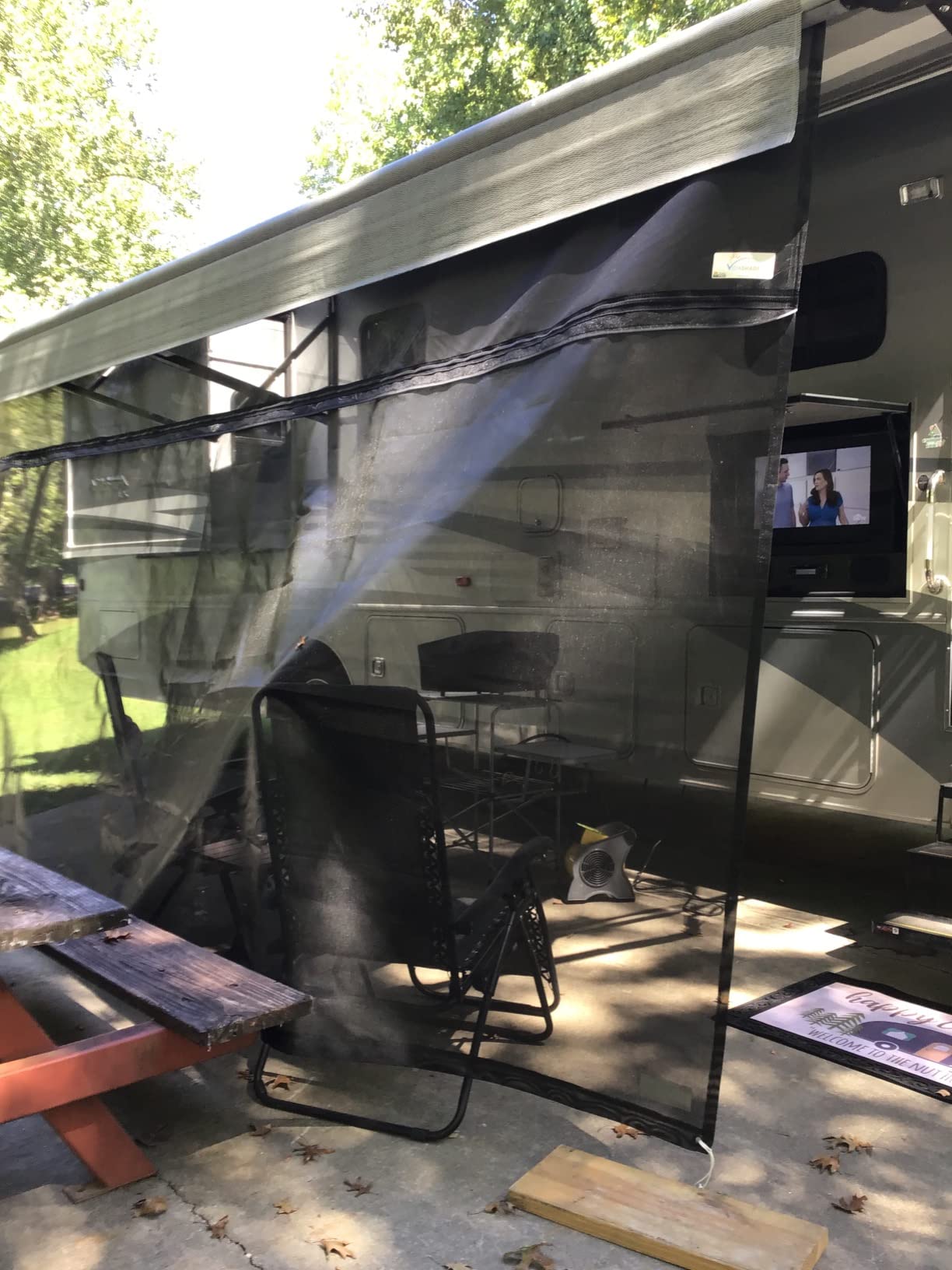
The Vista is the shade most often named as a long-term keeper in owner discussions we reviewed, with multiple owners reporting three or more years of use before replacing anything. At a 4.7-star average over nearly a thousand reviews, that consistency is the story here rather than any single specification.
For hot weather the number that matters is roughly 87 percent of sunlight cut through an open weave, and owners specifically call out the reduction in screen glare on a phone or laptop when working under the awning in the afternoon. The zipper is the reason it works on a taller setup: the lower panel comes off without a ladder.
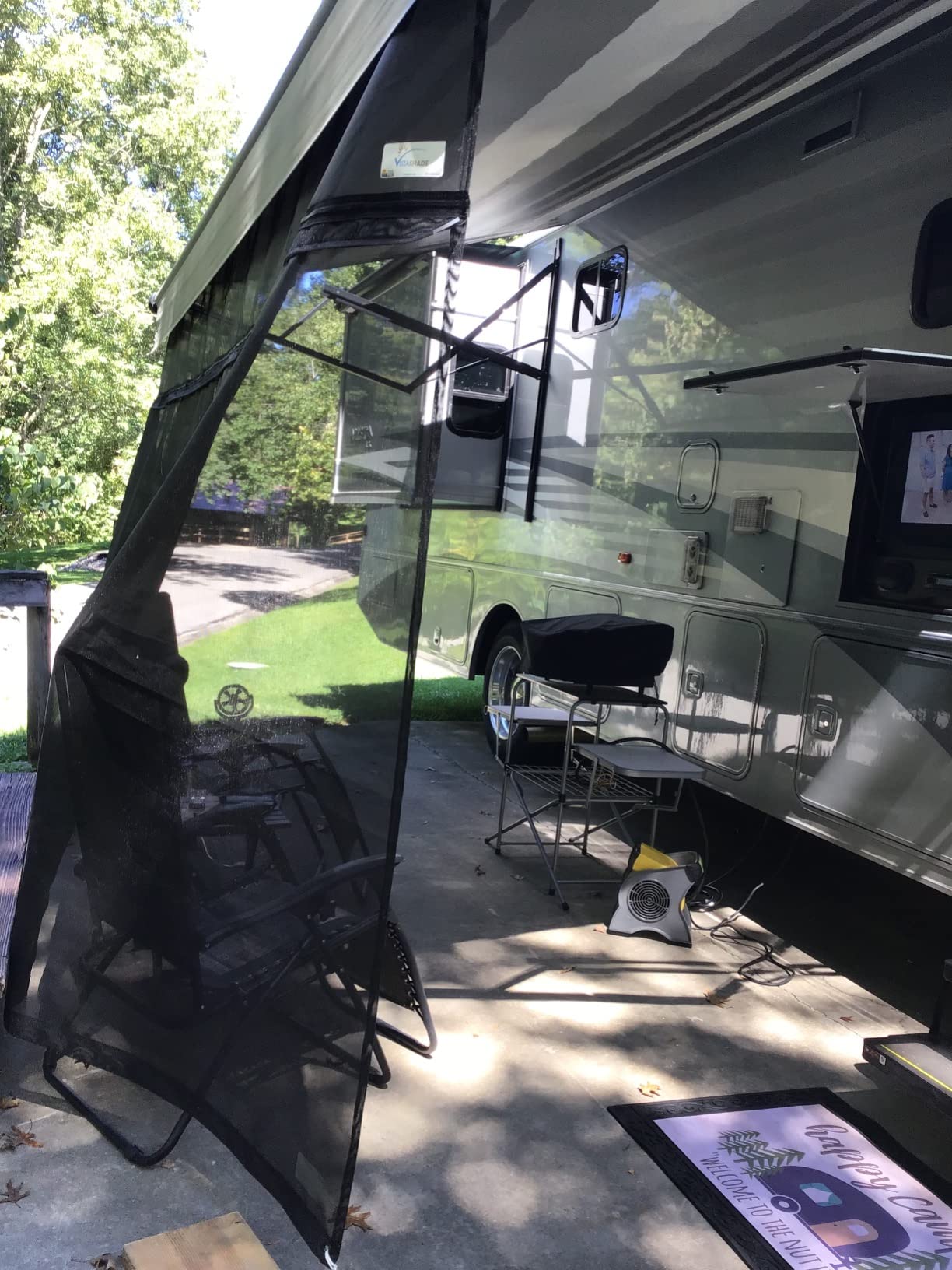
The insert is the piece that stays. It slides into the awning roller and zips on, so once installed the shade is up in one motion. Hemmed edges all the way around take the abrasion that kills cheaper screens at the corners, and the box includes grommets, stakes and a storage bag, so there is nothing to buy separately.
Two limitations are real and worth planning around. The size has to be matched to the awning fabric measurement rather than the roller width, which catches out first-time buyers. And it suits vertical arm style awnings such as the Carefree Eclipse and Travel’r, so if you have a horizontal arm or a Girard system, keep looking.
Why owners keep buying this one
Durability evidence beats a spec sheet in this category, and a shade that is still holding tension after three seasons of desert camping is worth more than a marginally darker mesh that frayed at the hems in one. The included hardware kit removes the other common source of frustration, which is not having the right bungees when the ground is hard.
The point to verify before ordering
Confirm your awning has vertical arms and measure the fabric span. Everything else about this screen is straightforward, but those two checks decide whether installation is a five-minute job or a return. If you want more sun block than 87 percent, look at the Oxford-top design further down this list instead.
7. Xenjum 19.5 oz Heavy-Duty Vinyl Canopy: Best Heavy-Duty Replacement
Xenjum RV Awning Fabric Replacement, 19.5oz Heavy-Duty Weatherproof Vinyl Camper Awning Replacement Universal Outdoor Canopy for RV, Motorhome, Trailer Awnings (Gray Fade, 17′(Fabric 16’2″))
19.5 oz 4-layer vinyl
UPF 50 plus
Freeze resistant to -50F
36-month warranty
Pros
- Heavier than original equipment fabric at about 18 oz
- UPF 50 plus and fully waterproof
- Pre-sewn polyrods speed the install
- Repair patch and 36-month warranty included
Cons
- Awning light bar wiring must be routed manually
- Heavier material can strain older springs
- Box contains fabric and cord with accessories sold separately
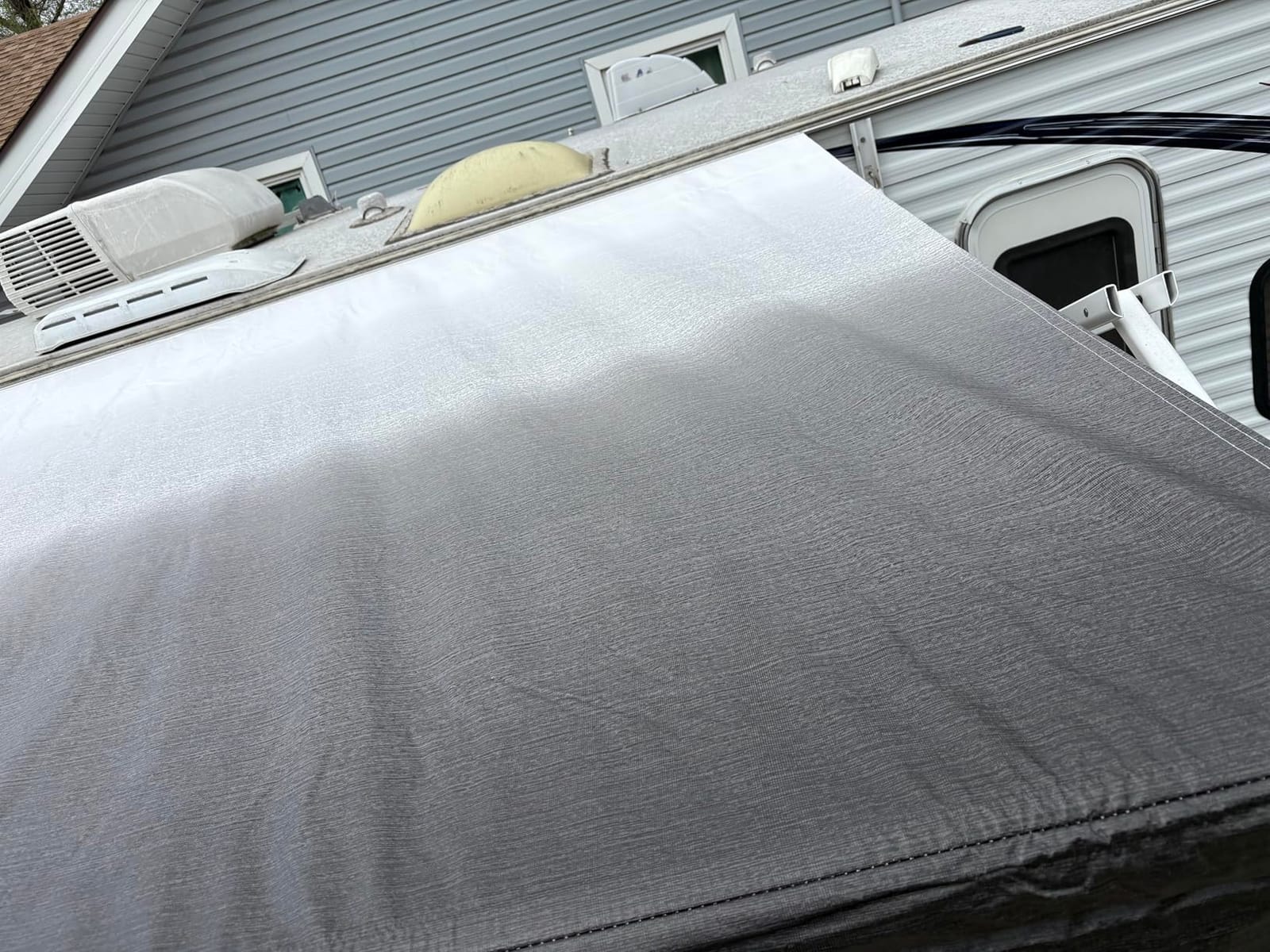
This is the replacement fabric to choose when a lighter canopy has failed you before. Reviewers describe it as noticeably thicker and better made than the original equipment fabric it replaced, and several report it still going years after a cheaper replacement failed in four. The 4-layer construction resists cracking, fading and brittleness in ways that single-layer vinyl does not.
For sustained heat exposure, the published figures are strong: UPF 50 plus UV protection, a 100 percent waterproof barrier, and freeze resistance to -50F for winter storage. The hot-pressing bond along the seams eliminates the needle-and-thread leaks that show up in heavy rain a season after installation.
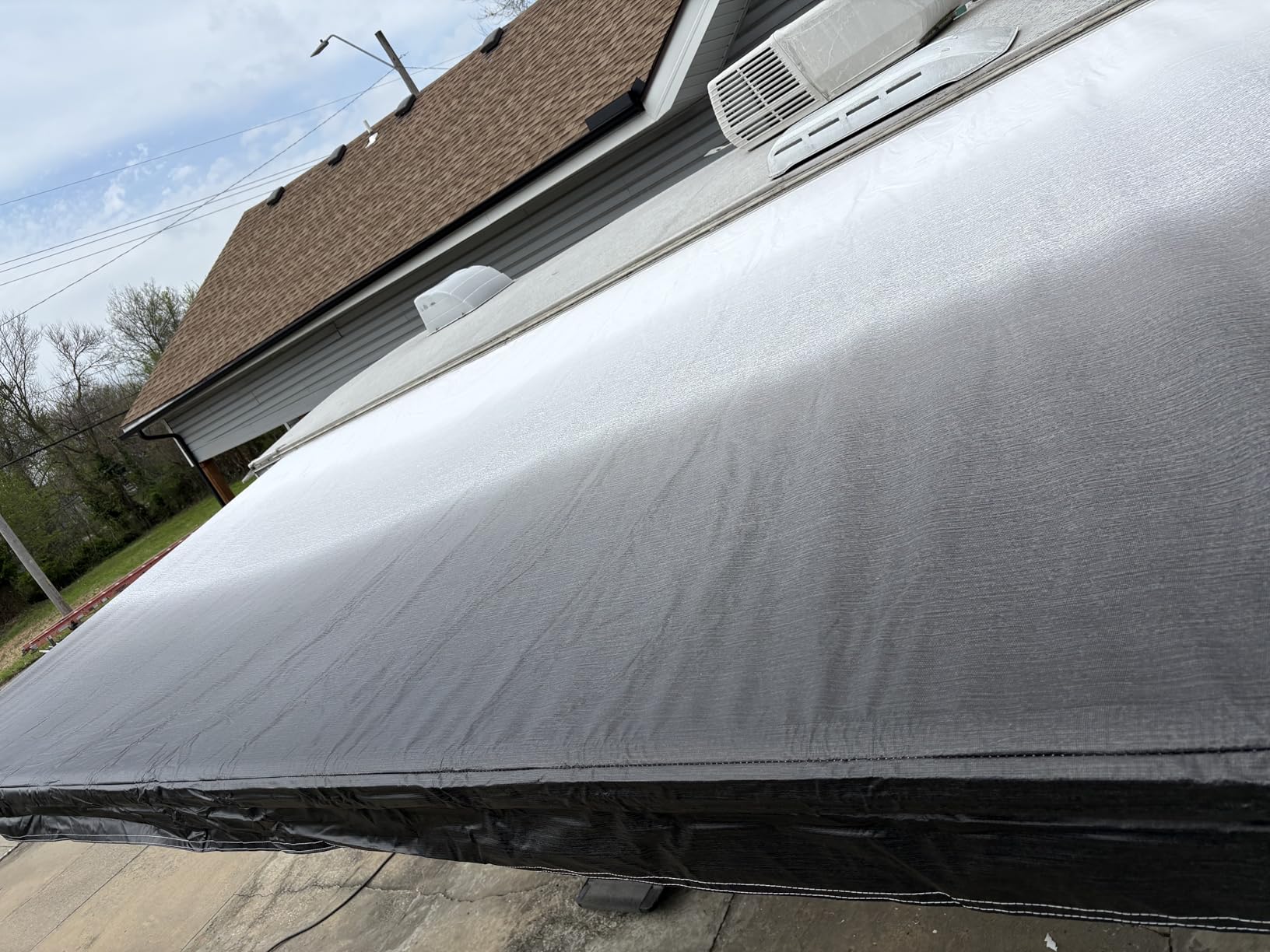
Pre-sewn polyrods make installation faster than threading fabric by hand, which matters on a 17 ft awning where the roll is unwieldy. A pull strap, a repair patch and a 36-month warranty round out the package, and the pull strap is genuinely useful for getting the fabric up over the arms.
The trade-offs are mechanical rather than fabric-related. Awning light bar wiring is not pre-installed, so if your awning has one you will be routing it by hand. The extra weight is also a real consideration on older awnings, where springs and shock absorbers are already tired. And the box contains the fabric and cord, with accessories like the pull strap listed separately, so read the contents before you leave the driveway.
When heavy fabric is the correct answer
Full-time RVers, desert campers and anyone replacing a canopy more than once should be looking at a heavier multi-ply fabric. If your awning has failed twice in a few seasons, the fabric was not the problem the first time and upgrading weight is the change that addresses it.
When it is too much fabric
Skip it if your awning springs or shock absorbers are original equipment and tired, because the weight is real. It is also fixed at 8 ft 6 in of width including the valance, so the size list refers to length only, which is a detail that trips up people reading quickly.
8. EXCELFU Awning Sun Shade with Zipper: Best Fit for a Standard 15 ft Awning
EXCELFU RV Awning Sun Shade Screen with Zipper 9′ x 14′(Fit for 15′ Awning), RV Awning Shade Screen with Zipper Motorhome Trailer Camper Awning Shade Black Mesh Sunscreen UV Blocker Complete Kits
9 ft drop by 14 ft actual fabric
Vinyl coated mesh
Blocks about 86% UV
Zip-off lower panel
Pros
- Zips the lower panel off quickly in wind
- Effective sun and glare blocking
- Vinyl coated mesh with double stitching
- Stakes bungees and bag included
Cons
- Mesh is thin enough that some light gets through
- One report of a zipper breaking early
- Some kits arrive missing a stake or bungee
- Fit depends on arm-to-arm sizing
For the most common awning size on the road, this screen does the fundamentals well. The 14 ft by 9 ft actual fabric fits a 15 ft awning, the vinyl coated mesh is double stitched for cross-wind and rain resistance, and it blocks about 86 percent of UV while still letting a breeze through to lower the temperature under the awning.
The zipper is the feature that shows up most in reviews, because the lower panel detaches when a gust hits and there is no arguing with a screen in the wind. The high-density black mesh also gives daytime privacy while keeping a wide view out, which is a hard combination to find in a lighter fabric.
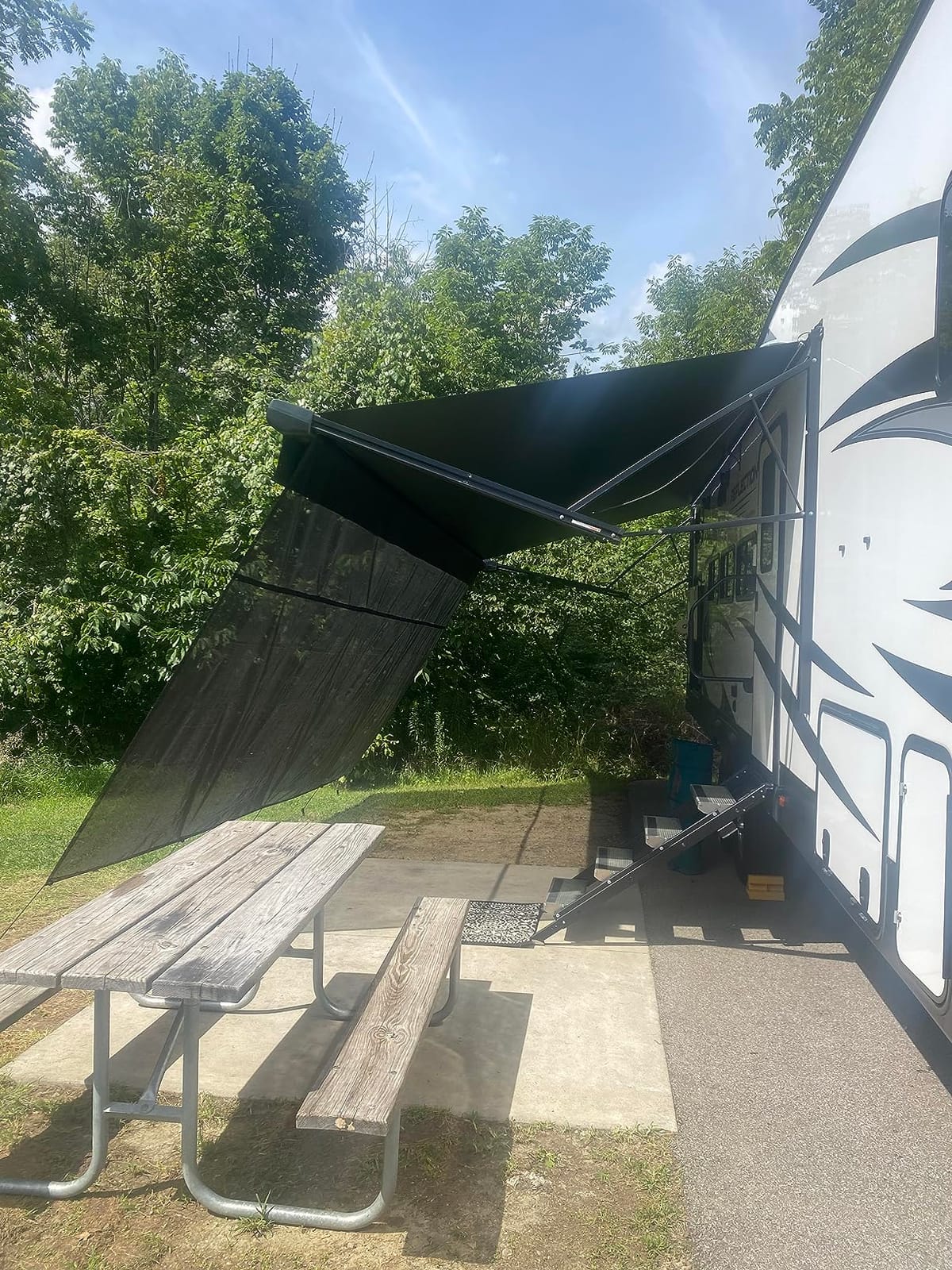
It fits Dometic, Carefree, Lippert, Fiamma and Solera awnings, which covers the large majority of what is on the road today. Stakes, bungees and a storage bag are in the box, so unlike some competitors you are not sourcing hardware at a campground store on arrival.
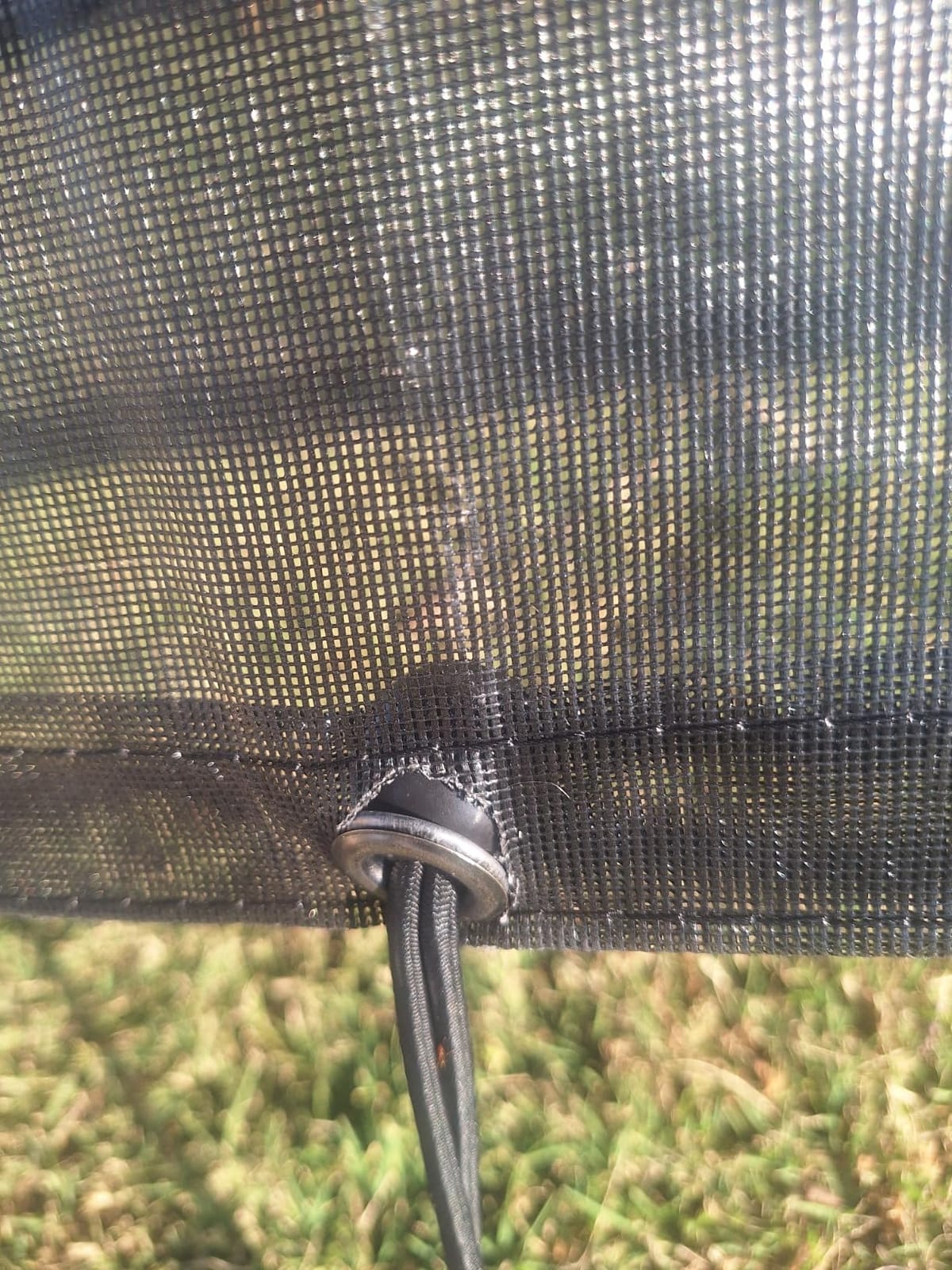
Where it falls short is honest to name. The mesh is thin enough that some users still feel sun through it, which matters if your previous shade was an 87 to 90 percent design. There is also at least one report of a zipper breaking after a couple of uses and reports of kits arriving without a stake or bungee, so check the contents before you drive out of the parking lot.
Should you choose this over a darker screen
Choose it for a standard 15 ft awning where you want quick storm response and a complete kit in the box. Look elsewhere if maximum heat rejection is your priority, because a lighter mesh that lets some light through will never match a denser weave, no matter how good the hardware is.
Getting the fit right
The screen is sized on arm-to-arm measurement, so measure before ordering and account for the valance. A shade that is even a little long will not tension correctly along the bottom edge, and the corners are where you will see the sag first.
9. Leaveshade 10 ft by 20 ft 3 in Front Screen: Best for the Longest Drop
RV Awning Sun Shade Screen Camper Travel Trailer Sunshade 10’X20’3”, Black
10 ft drop by 20 ft 3 in fabric
Double-stitched vinyl coated mesh
10.3 pounds
Claims 15 to 25 degree drop
Pros
- 10 ft drop suits large front patios and tall coach fronts
- Manufacturer claims a 15 to 25 degree temperature drop
- Reduces cross-wind and keeps some rain off seating
- Full kit with 5 stakes bungees and a storage bag
Cons
- Does not fit Girard awnings
- Should not be ordered longer than the awning
- One-piece design needs full removal to stow
- Heaviest screen in the group at 10.3 pounds
This screen has the longest drop in the roundup at 10 ft, and that is the entire reason to buy it. If your awning end sits high, a shorter screen leaves a gap you cannot close, and the low evening sun walks straight through that gap onto your chairs. A 10 ft drop reaches the ground from a much higher coach front or a fifth wheel.
The fabric blocks about 86 percent of UV with an open view and airflow, and the manufacturer claims an immediate 15 to 25 degree temperature drop under the shade. Owners also report it reducing cross-wind and keeping some rain out of the patio sitting area, which extends its usefulness beyond pure sun protection.
The heat case for a longer drop
The drop is not about shade, it is about sealing the space. Every gap between the bottom of the screen and the ground is an open path for low-angle sun and hot reflected ground, and closing it is what makes the patio comfortable in the middle of the day. That is why a longer screen can outperform a darker shorter one in real heat.
Three sizing and handling notes
First, do not order it longer than your awning length, since extra fabric has nowhere to go. Second, it does not work on Girard awnings, the same exclusion that applies to several screens in this category. Third, at 10.3 pounds it is the heaviest screen here, which is worth considering if you plan to move it every time the wind shifts.
10. RVINGPRO 9 ft by 15 ft 3 in Zipper Screen: Best for the Harshest Glare
RVINGPRO RV Awning Shade Screen with Zipper 9′ x 15’3”
600D Oxford top plus 8.11 oz mesh bottom
Over 90% sun blockage
4.73 kg
Zip-off bottom section
Pros
- Solid Oxford top strips the worst midday glare
- Over 90 percent sun block with privacy from below
- Zips off without a ladder
- Owners report roughly 10 degrees cooler
- Four pairs of bungee balls and stakes included
Cons
- Mesh bottom is not as dark as competing screens
- Usually a two-person install
- Fabric can walk out of the roller without an end stop
- One report of a pinhole in the top section
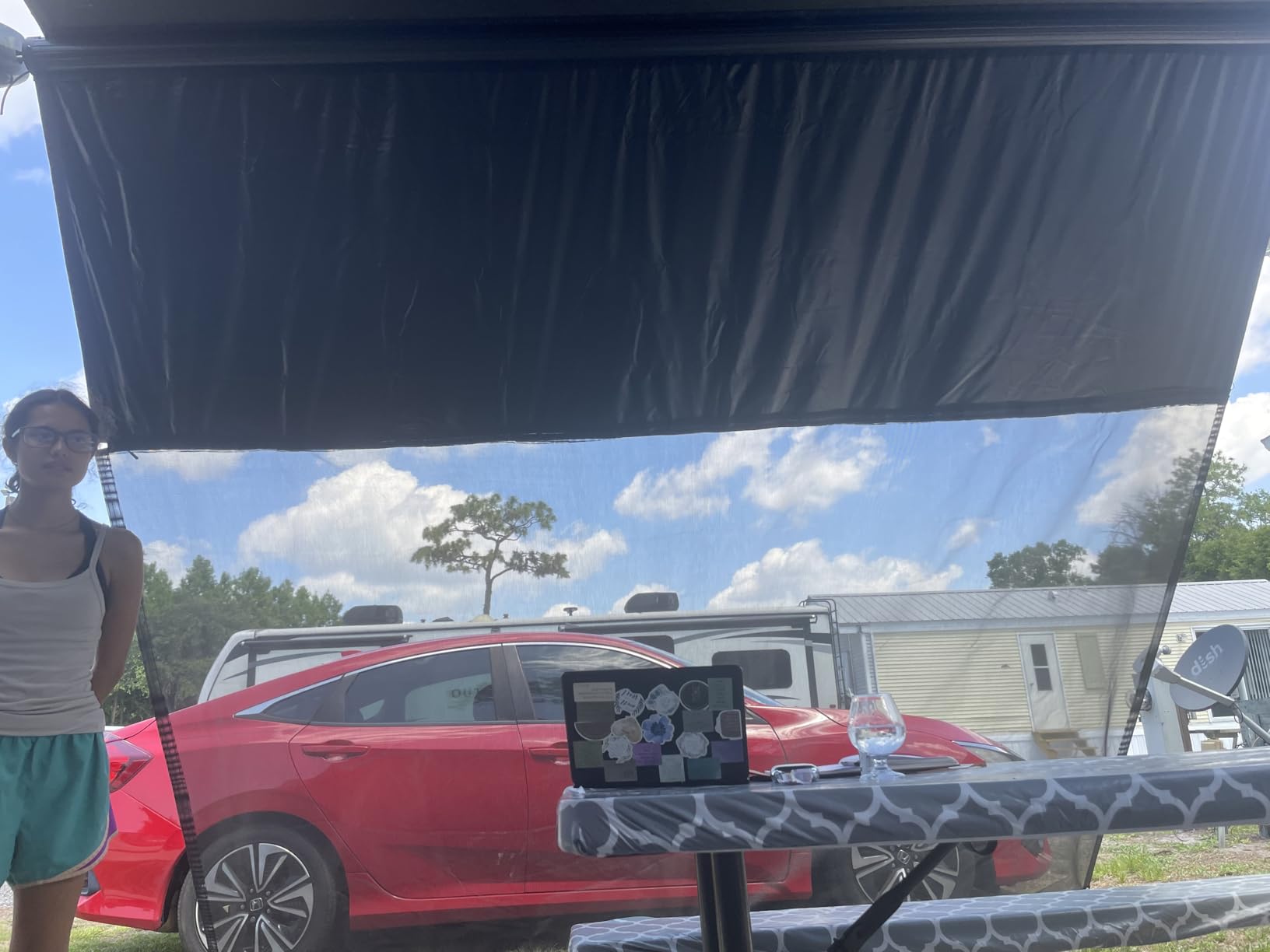
Most mesh screens are one material doing two jobs. This one is built from two, and that is the point: a solid 600D Oxford strip across the top handles the overhead sun that makes you squint, while the 8.11 oz mesh bottom supplies over 90 percent sun blockage and daytime privacy where the view matters. If your complaint is glare rather than heat, that split construction is the answer.
Owners report roughly 10 degrees cooler under the awning once it is up, and the zipper between the two sections means the lower half detaches without a ladder. Setup is claimed at under three minutes, and the box includes four pairs of bungee balls and stakes. Sizes run from 9 ft by 10 ft 3 in up to 9 ft by 20 ft 3 in, so the same design covers small and large fronts.
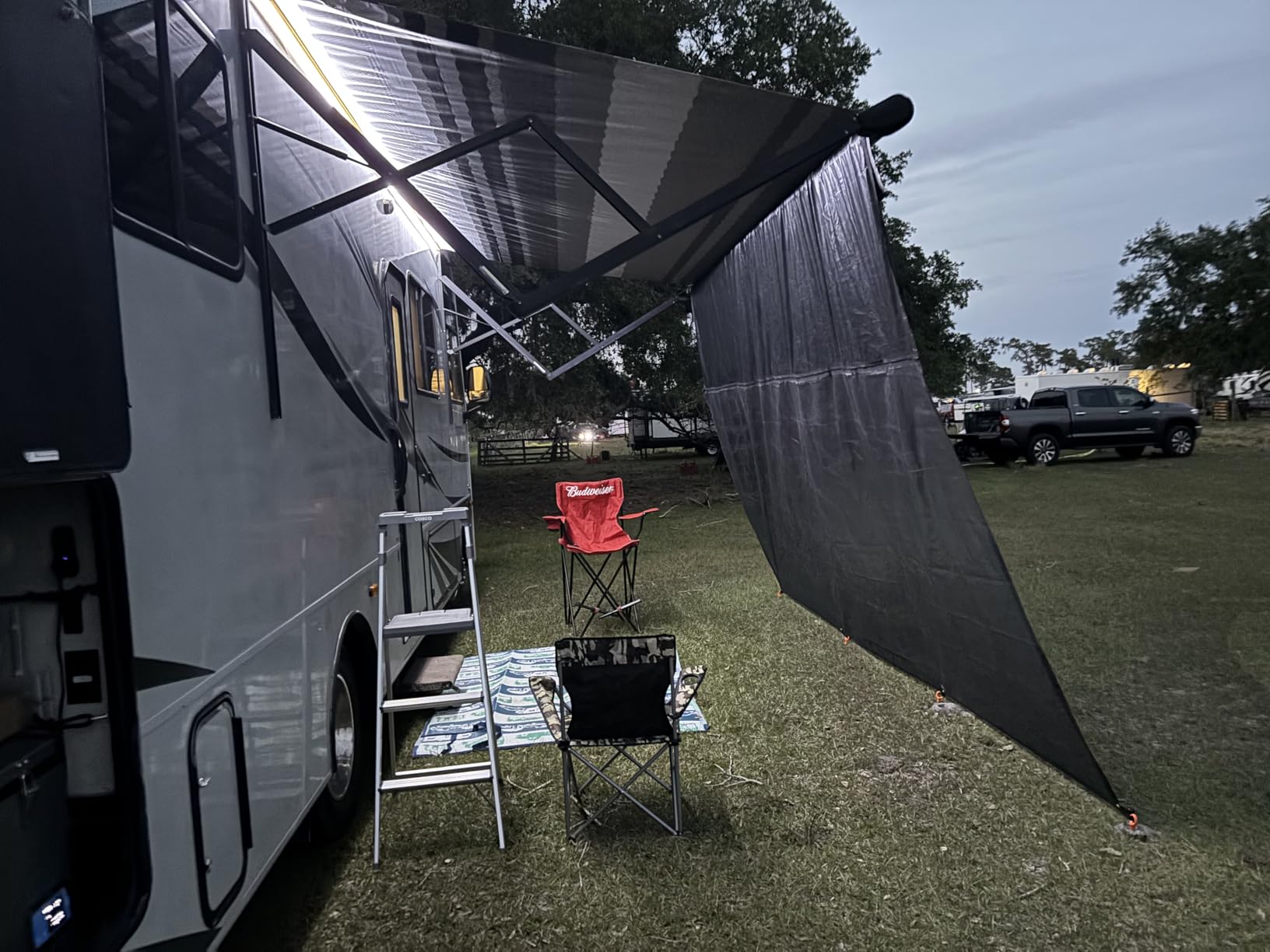
It is worth knowing that the 9 ft dimension is the drop, and the second number is the fabric length, so a 15 ft 3 in panel is built for a larger awning than the 14 ft one earlier in this list. Getting that relationship backwards is the most common ordering mistake with this style of screen.
The negatives are practical rather than quality-related. The lower mesh is not as dark as some competing screens, so expect a lighter look from the outside than a solid black panel. Threading the top section through the awning rail usually takes two people, and the fabric can walk out of the open end of the roller if your awning lacks an end stop screw.
Is a two-material screen worth the extra step
Yes if your primary complaint is overhead glare and screen readability, because no amount of mesh density fixes the light coming straight down at an angle. No if you are simply chasing a darker exterior from the neighboring site, since the mesh half of this screen is lighter than a solid black one.
Before you install
Check for an end stop screw in the roller before you thread anything, because a fabric that walks out mid-pull is a frustrating afternoon. Budget for a second pair of hands on the initial install, and plan to keep the zipper closed whenever the wind is up.
11. Shatex 8 x 10 ft HDPE Privacy Screen: Most Versatile
Shatex 8x10ft RV Awning Shade with 90% Privacy Screen Free Kit, Black
8 ft by 10 ft knitted HDPE
Blocks up to 90% of sun
2 pounds
1 in grommets every 1.5 ft
Pros
- Adds 90 percent shade and privacy at the lowest cost
- Knitted HDPE resists tearing and fraying
- Taped edges and regular grommets
- Bundled bungee balls stakes and hooks
Cons
- Loose weave lets more light through than fitted screens
- Included hooks may not fit every awning rail
- Grommet spacing is sparse across long spans
- Not sized to any specific awning
Not every camper needs a fitted screen with a brand-specific size, and this is the cheapest way to put shade on an awning. The knitted HDPE blocks up to 90 percent of sun while giving 90 percent daytime privacy, and the material lets hot air push out of the fabric rather than trapping it under the awning.
At two pounds it is the lightest item in the roundup by a wide margin, which makes it easy to reposition as the sun moves or to pull down quickly when weather changes. The knitted construction resists tearing and fraying, which is the failure mode that ends most inexpensive shade cloth.
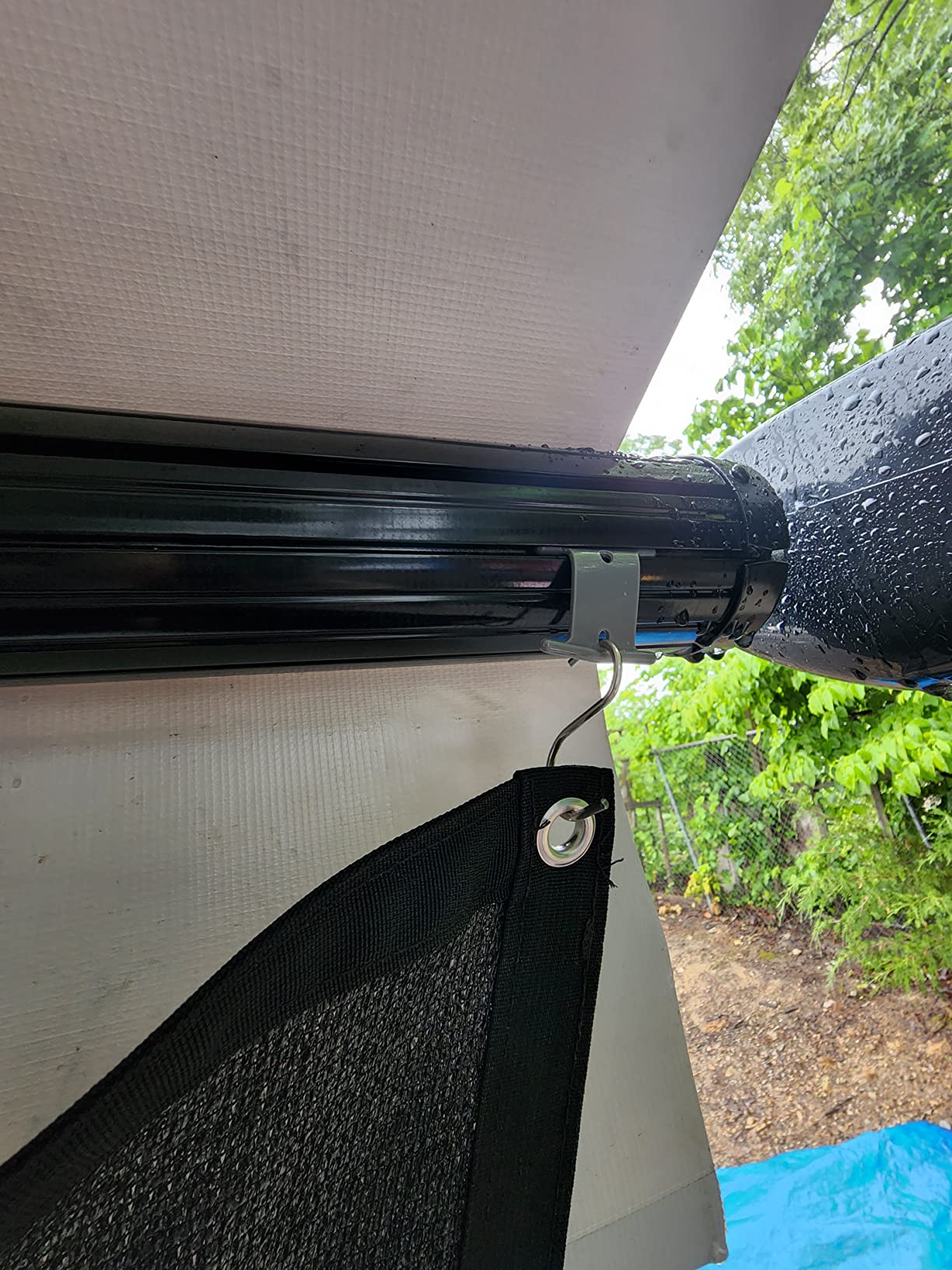
The hardware is better than the price suggests: four bungee balls, four spiral stakes and seven awning hooks, with 1 inch grommets every 1.5 feet along taped edges. That is a real kit rather than a bare panel, and it is why this screen holds together in wind when untaped cloth does not.
The honest limitation is the weave. It is looser than a fitted screen, so more light comes through, and buyers frequently report needing extra hangers or a grommet kit for longer spans because the included spacing runs out. Owners also note the included hooks may not fit every awning rail, so plan on checking before you rely on them.
Who this budget screen suits
It suits campers who want a functional shaded wall for a season without committing to a measured screen, and anyone who moves often and does not want to unclip a fitted panel every time. It also works well as a supplementary panel alongside a proper fitted screen.
Where a fitted screen is worth more
If your priority is maximum heat rejection, a tighter weave will block more than this open knitted HDPE, and you lose the ground seal. It is also not sized to any specific awning, so it will never tension as cleanly as a panel cut for your arm-to-arm span.
12. Glamful 21 ft Gray Fade Replacement Vinyl: Best for the Widest Awnings
21FT RV Awning Fabric Replacement, 20’2″ Fabric, 19.5oz, Gray Fade
19.5 oz 5-ply PVC vinyl
UPF 50 plus and 95% plus UV
Waterproof to 2500mm
18.3 pounds
Pros
- Highest published UV block in the group at 95 percent plus
- 5-ply PVC vinyl rated to 2500mm waterproof
- Cold-crack tested to -30F
- Slide-in tool-free setup with three polycords
- Repair patch included
Cons
- Heavy at 18.3 pounds so install takes two people
- Only a 1-year warranty
- Sizes are based on arm-to-arm measurement
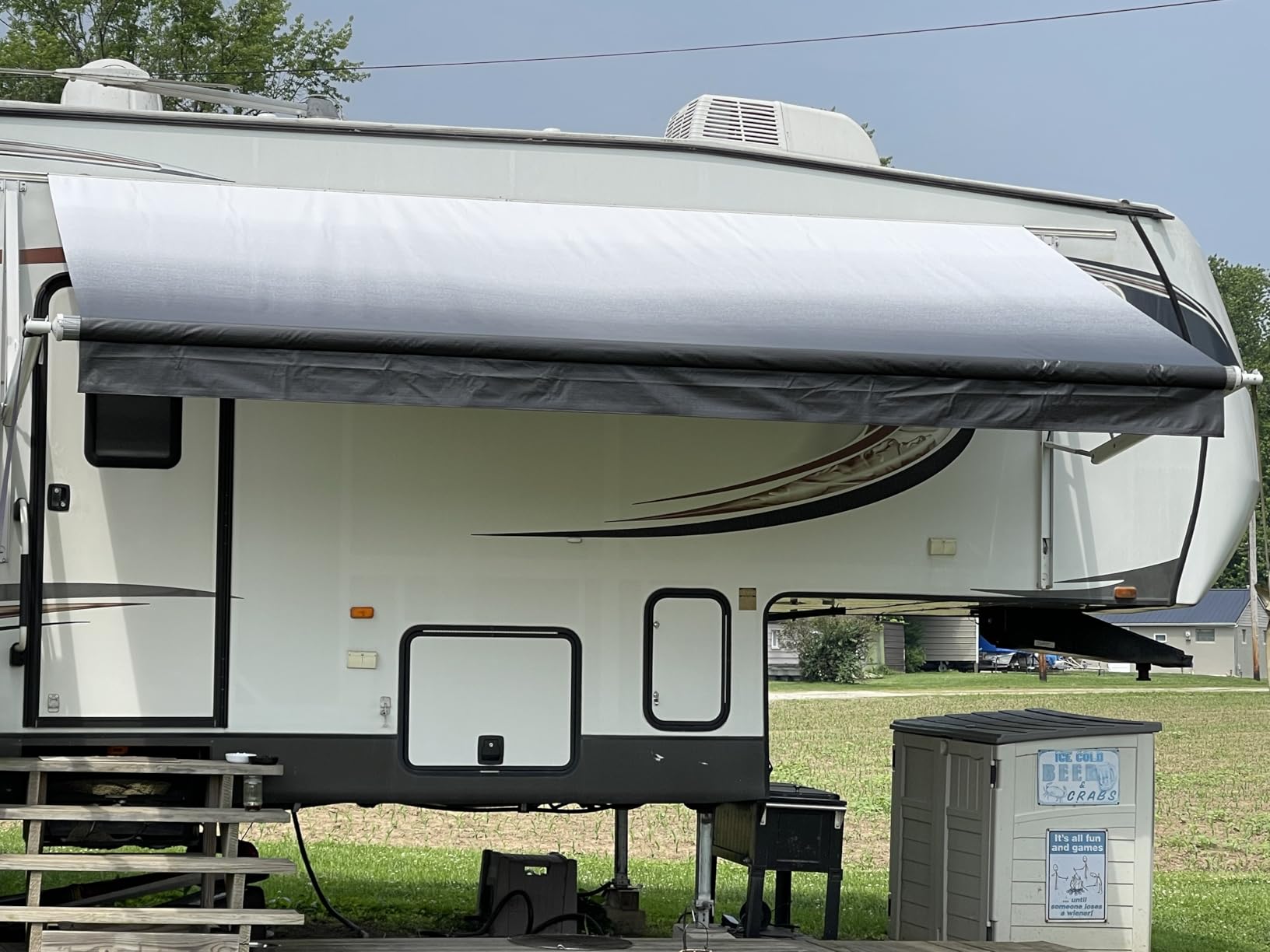
At 4.8 stars across more than 200 reviews, this carries the highest published rating of the group, and the specification sheet backs it up for sustained sun. The 19.5 oz 5-ply PVC vinyl is rated UPF 50 plus with 95 percent plus UV blocking, waterproof to 2500mm, and cold-crack tested to -30F, which is exactly the combination you want in a desert summer followed by a freezing winter.
At 21 ft it covers the widest awnings in this roundup, and the 20 ft 2 in of actual fabric is sized for coaches where a 16 ft panel would leave the corners bare. The fade gray color matches camper graphics, and owners report an easy fit on Carefree systems in about 30 to 45 minutes with two people.
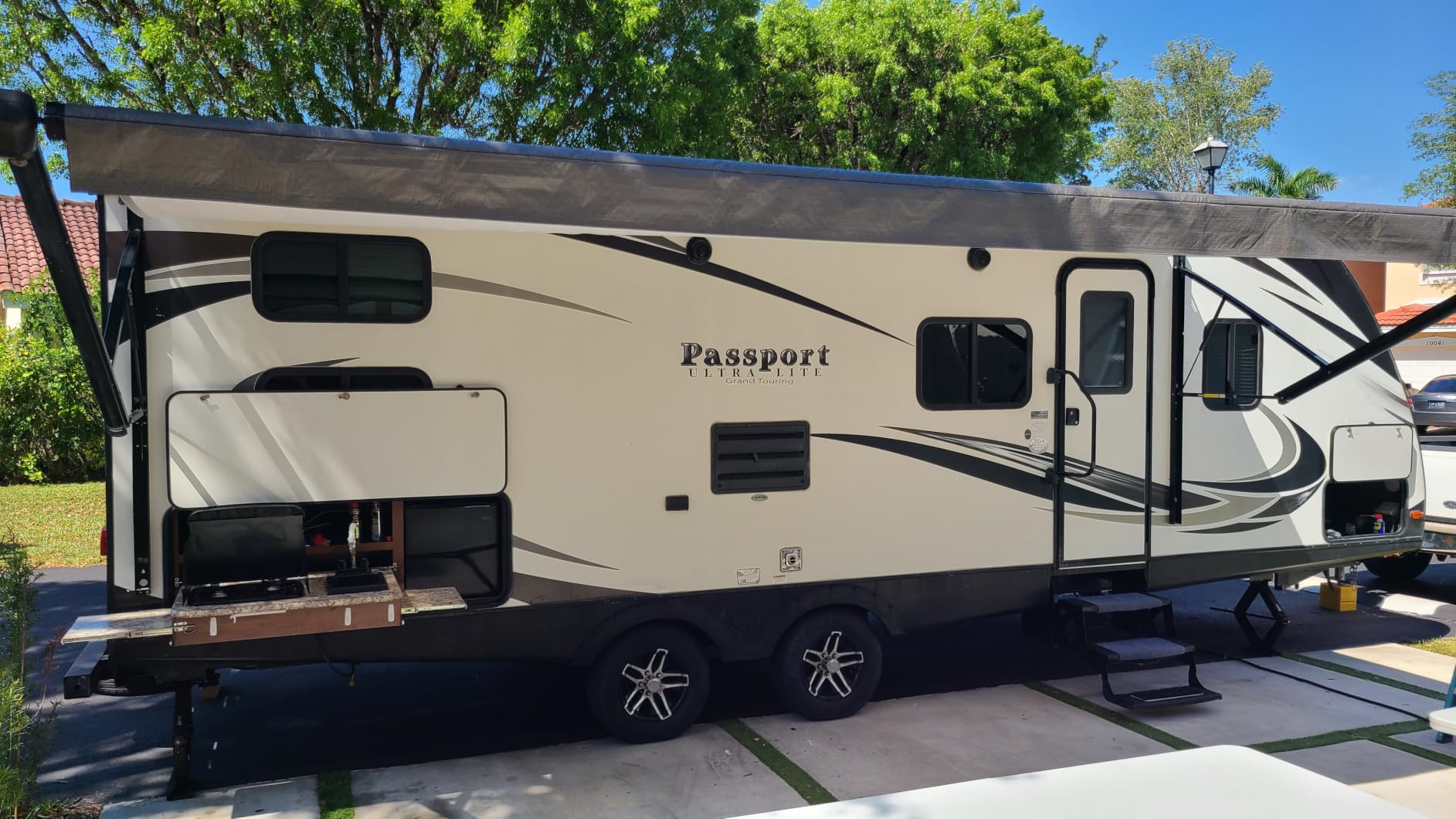
Installation is slide-in and tool-free. Three polycords go in, one into the RV body rolltube slot and two into the extended canopy slot, and the heat-pressed 1.18 inch folded edges resist wind, tearing and abrasion. A repair patch and a pull strap are included, which covers the two accessories that are most often missing from a canopy purchase.
Two caveats are worth stating plainly. The 18.3 pound weight means two ladders and a second person, consistently described as a two-person job in reviews. And the warranty is one year, which is the shortest in this roundup, so treat the fabric spec rather than the warranty as the durability argument.
Why the 95 percent UV figure matters
Higher UV blocking translates directly into less radiant heat absorbed by the fabric and bounced onto you, and 95 percent plus with UPF 50 is the strongest published figure here. For long stays in open desert sun, that gap between 95 and 85 percent is the difference between a patio you use all afternoon and one you use before ten.
Sizing and support considerations
Measure center-to-center between the awning arms, and note the pattern: for a 16 ft awning you select the 16FT size with 15 ft 2 in of fabric. It fits Carefree, Dometic, Lippert, Carter and Faulkner systems. On an awning with aging springs, check the hardware before adding 18 pounds of new canopy.
RV Awning Shade Types Explained: Front, Two-Piece Zipper, Side Shade and Screen Room
Four formats cover almost every use case, and picking the wrong one is the reason some screens get returned. A front shade is a single panel hanging the full width of the awning, usually 7 to 10 ft of drop. It is the most common format and the best value for a camper who mostly wants overhead protection.
A two-piece zipper shade splits that panel into a permanent roller section and a detachable lower section. The extra complexity buys you the ability to remove the moving half from the ground, which is the difference between a two-minute storm response and a ladder. A side shade closes one vertical plane at the end of the awning, blocking low sun and adding privacy, and you need two to fully enclose.
A screen room goes further and turns the awning into an enclosed four-wall space with a zippered door, which changes the problem from shading to usable living space. Replacement canopies are a separate category entirely: they are not a shade at all, but a new roof for your existing awning.
Black vs Gray vs Tan Mesh: Which Color Is Actually Cooler
The common belief is that a light color stays cooler because it reflects heat. In practice, for hanging mesh screens, the color that blocks the most light is the color that makes the shaded space coolest, and that is the dark one. Every high-performance screen in this roundup with a published figure, from 85 to 95 percent, is black, charcoal or gray fade.
The trade-off is light quality. A black mesh gives you the darkest interior, the best privacy and the lowest heat gain, but the view outward is dimmer and the fabric absorbs more solar energy, so the screen itself runs hot to the touch. Light tan or gray fade canopies trade heat rejection for a brighter patio and a color that matches coach graphics, which is why they remain popular as replacement canopies rather than as screens.
For hot-weather camping specifically, we would take the black mesh every time. The difference between a screen you can sit under at two in the afternoon and one you cannot is a fabric choice, not an awning choice. The same logic runs through clothing, which is why our picks for the best hiking pants for hot weather also favor darker, tighter weaves over pale and loose ones.
How to Measure Your Awning Before You Buy
More returns in this category come from sizing than from quality. These are the four measurements that decide whether a screen fits the first time.
1. Arm center to arm center. Measure across the awning at the roller, from the center of one arm to the center of the other. This is the number the size labels refer to, and it is not the same as the fabric width.
2. The fabric width versus the roller width. A shade labeled for a 16 ft awning may ship 8 ft by 15 ft 3 in of actual fabric, which is correct. Buy the size that matches the awning, not the fabric.
3. Roller to ground. This is your required drop. Measure from the bottom of the deployed awning to the ground, and check the ground slopes away, which adds to the drop. Do not order longer than your awning length.
4. Account for the slot pull tab. On channel-style awnings the shade hangs from the end of the channel, so measuring from the roller tube gives you fabric that is too long. Measure from the channel end.
If your measurement falls between two sizes, the smaller one tensions better. Over-sizing is the more common error and it leaves slack corners and extra weight on the roller arms.
How to Install an RV Awning Shade in 5 Steps
Most fitted screens install the same way, in minutes, with the hardware already in the box.
1. Deploy the awning fully and lock the legs before you attach anything. Never work under a partially extended awning.
2. Slide the poly-cord or insert into the utility slot along the roller tube, working from one end to the other. A second person makes this far easier on wide awnings.
3. Zip on the lower panel if the screen is a two-piece design, leaving the zipper closed at the top edge.
4. Stake the bottom corners first, then work along the edge with the bungee balls. Stake into soft ground; on hardpan, use a longer pin or a sandbag.
5. Check tension on every grommet before you walk away. A shade that is not tensioned along the bottom edge will flap and will not seal the low sun.
If your awning has no utility slot, the options owners use are awning hangers on the support arms, large spring clamps, or ratchet straps over the roller. A hardware store trip is worth it before the trip, because hardware lost at a campground is the start of a sagging panel.
Hot-Weather Deployment Rules: Wind, Poles and Roll-Up Timing
A long mesh drop is still a sail. That is the single most consistent warning across the owner forums we reviewed, and it is the one safety point no competitor in this category addresses. The roller arms and springs on an RV awning are rated for the canopy, not for a 9 ft panel of mesh pulling on the same tube.
Use awning poles on long spans. Owners on 20 ft factory awnings recommend poles specifically because a full drop adds leverage on the arms. If you have a wide awning with an electric motor, poles are worth the extra setup time.
Know your limit. There is no published wind rating for any of these screens, so treat gusty conditions as the trigger rather than a number on a spec sheet. When a gust front is visible or the fabric starts snapping, detach the lower panel first and roll the awning second, in that order.
Do not roll the awning with a heavy lower panel attached. It adds weight the roller was not designed to lift repeatedly, and it is the fastest way to wear out a motor or a spring.
Retension after temperature changes. Mesh stretches in heat and tightens in cold, so a screen staked at dawn can be too tight at 3pm. Give the bottom edge a small amount of slack when you set up in the morning.
Keep the fabric dry before rolling. Rolling damp vinyl or mesh into the roller causes mildew that will smell for seasons and can stain the awning fabric above it.
RV Awning Shade vs Replacing the Awning Fabric
These solve different problems and it is worth being decisive. Replace the canopy fabric if your awning is cracked, chalky, leaking at the seams, or visibly degraded. A new canopy shades the entire footprint from above and fixes the failure, and every canopy in this roundup is rated for UV and weather exposure over multiple seasons.
Add a hanging screen if your canopy is in good shape but the sun still beats you sideways. A screen shades a vertical plane, blocks low and late sun, reduces cross-wind, and adds privacy, and it does all of that without touching the awning hardware.
Many owners end up with both: a fresh canopy in a light fade color for the roof, plus a black mesh screen on the sun-facing side. If your awning fabric is failing, fix that first, because a screen hung from a torn awning is solving the wrong problem.
Shade is only half of summer comfort, though. We put together a roundup of the best instant hot water heaters for RV if you want a cold shower to stop being the first thing you do after a hot afternoon under the awning.
RV Awning Shade Buying Guide: 7 Factors That Decide It in the Heat
1. Published UV or light blocking. The numbers in this category range from 85 to 95 percent, and that range is the difference between usable and unusable in the afternoon. Anything at 86 percent or above does real work. Below 85, you are buying privacy more than heat.
2. Mesh openness versus shade factor. A very open weave lets a breeze through and stays cooler to the touch, but lets more light past. A tighter weave shades better and runs hotter. For a camper sitting still under the awning, tighter is better. For one cooking in a 100 degree kitchen, airflow matters more.
3. Drop length against your awning height. Every gap at the bottom is a path for low sun. Measure roller to ground, and remember the ground slopes away from the RV on most sites. Over-ordering adds weight to the roller arms, so this is the one place not to round up.
4. Reach and the zipper question. If you cannot physically reach the top of the screen, a two-piece design is not a luxury. The lower panel zips on at ground level while the top section stays in the roller permanently.
5. Weight on the roller arms. Screens in this roundup run from 2 pounds to 10.3 pounds, and replacement fabrics from 16 ounces to 22 pounds. On a 20 ft electric awning, this is the factor that most often argues for awning poles.
6. Hardware kit completeness. Grommets, stakes, bungee balls, hooks and a storage bag should be in the box. Forum owners repeatedly report kits arriving with more grommets than hooks, causing mid-span sag, so count the parts before you leave.
7. Warranty and brand reputation. Carefree offers 5 years on the EZ ZipBlocker, Tentproinc 3 years, and Glamful 1 year. ShadePro has built RV awning accessories for over 45 years, and its Vista is the most consistently endorsed screen in owner discussions. In a category with modest hardware, longevity of the brand is a reasonable durability proxy.
On brand reputation generally, ShadePro and Tentproinc are the two names that come up most often in owner forums, with Carefree close behind and the Lippert Solera Super Shade specifically recommended for slide-out and high awnings where the drop has to be reached from below.
Care and Maintenance
Dry the screen before rolling it, every time. That single habit prevents the mildew that ends shade screens faster than sun or wind does.
Wash mesh panels with cool water and mild soap, and let them air dry flat. Avoid pressure washers, which push water through grommets and loosen stitching over time.
Check grommets and bungee attachment points each season, and replace any that have pulled rather than pulling harder on them. Store the panel loose in its bag in a dry compartment, not folded tight, so the vinyl and the zipper do not take a permanent crease.
If the heat itself is the problem rather than the sun, breathable layer choices matter just as much, and we cover that separately in our roundups of the best cycling jerseys for hot weather and the best mesh motorcycle jackets for hot weather.
Frequently Asked Questions
What is the best RV awning screen shade?
For most hot-weather campers the Tentproinc mesh screen is the best all-round rv awning shade, blocking about 86 percent of UV with an open view and a 3-year warranty. Carefree’s EZ ZipBlocker is the more refined two-piece option if you want the lower panel to zip off from the ground, and ShadePro’s Vista Shade is the best value pick for vertical arm awnings. All three run about 85 to 87 percent light blocking.
What is too windy for an RV awning?
No manufacturer publishes a wind rating for an awning shade, so use visible conditions instead of a number. Treat any visible gust front, any snapping of the fabric, or a sustained breeze that keeps the panel moving as your limit. Detach the lower panel first, then roll the awning second. On a 20 ft electric awning, add awning poles, because a long mesh drop puts real stress on the roller arms.
What is the best type of RV awning fabric?
Vinyl is the standard choice for a replacement canopy because it blocks UV, sheds rain and resists cracking, and weight is the deciding factor. Standard grade runs about 13 oz and suits most campers. Heavier 19.5 oz multi-ply vinyl lasts longer in desert sun but strains older awning springs and needs two people to install. For hanging screens, coated polyester or mesh vinyl blocks more light than knitted HDPE shade cloth.
How do I measure my RV awning for a shade?
Measure arm center to arm center across the awning at the roller, because that is what the size labels refer to. Then measure roller to ground for your required drop, accounting for ground slope away from the RV. If you use a channel-style awning, measure from the end of the channel rather than the roller tube, or your fabric will be too long. When you fall between sizes, take the smaller one.
How do I install an awning shade without a utility slot?
Three hardware routes work. Awning hangers clip onto the support arms and hold the top edge in place. Large spring clamps grip the arm directly and are the go-to for a temporary side shade. Ratchet straps run over the roller tube and pull the top edge tight. All three need bottom stakes and bungees as well, and it is worth buying the hardware at home rather than at a campground, where a missing bungee leaves a visible sag.
Final Verdict: Which RV Awning Shade Wins in the Heat
The Tentproinc RV Awning Mesh Sun Shade Screen is the best rv awning shade in 2026 for most hot-weather campers, combining roughly 86 percent UV blocking with the largest owner review base in the group, a complete hardware kit and a 3-year warranty. If your awning is too high to reach, move to a two-piece zipper design such as the Carefree EZ ZipBlocker, and add a side shade to kill the low afternoon sun. If your canopy fabric is already failing, replace it rather than hanging a screen over it.
Whichever you pick, measure twice, stake the bottom edge tight, and add awning poles on a wide electric awning before the wind teaches you why.


