

The best 20 gallon air compressor for a home garage is the Klutch 20-Gallon, and the reason is not the number printed on the box. At 4.2 SCFM at 90 PSI with a 75% duty cycle, an oil-free pump and a 175 PSI ceiling, it is the rare budget compressor whose airflow figure matches the job most weekend projects actually ask for, and it did it across 737 owner reviews holding a 4.5 star average.
That matters because tank size is the least interesting number on the spec sheet. A 20-gallon receiver is simply the cushion between cycles, and once your tool pulls air, the only two things that decide whether it stalls are how many cubic feet per minute the pump can deliver at 90 PSI and how long it can run before overheating. Shop for CFM first, pressure second, tank third.
I went through eight 20-gallon compressors that clear a real ownership record, laid their published specifications side by side, and matched those numbers against the tools a home garage actually throws at them. If you want the wider picture on tank sizes, my home garage air compressor guide covers the entry-level options too, and the 60 gallon roundup is worth a look if you run continuous shop loads.
Top 3 Picks for Best 20 Gallon Air Compressors for Home Garages in October

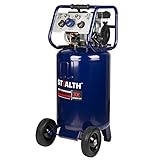
Stealth 20 Gallon Ultra Quiet
- 68 dB claimed
- 5 CFM at 90 PSI
- Limited lifetime warranty
- 150 PSI peak

Craftsman 20 Gallon Oil-Free
- 175 PSI
- 4 SCFM at 90 PSI
- Stainless steel tank
- Two quick couplers
Best 20 Gallon Air Compressors for Home Garages in October
| Product | Specs | Action |
|---|---|---|
| Klutch 20-Gallon 2 HP Oil-Free |
|
Check Latest Price |
| Stealth 20 Gallon Ultra Quiet |
|
Check Latest Price |
| Craftsman 20 Gallon Oil-Free 1.8 HP |
|
Check Latest Price |
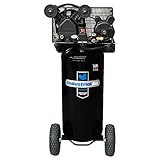 Industrial Air 20-Gallon Belt Driven V-Twin Industrial Air 20-Gallon Belt Driven V-Twin |
|
Check Latest Price |
 California Air Tools 20020AD California Air Tools 20020AD |
|
Check Latest Price |
 California Air Tools 20015HP California Air Tools 20015HP |
|
Check Latest Price |
 California Air Tools 20040CAD 4.0 HP California Air Tools 20040CAD 4.0 HP |
|
Check Latest Price |
 Campbell Hausfeld VT6290 Campbell Hausfeld VT6290 |
|
Check Latest Price |
1. Klutch 20-Gallon 2 HP Oil-Free – Best Overall
Klutch 20-Gallon Air Compressor, 2 HP, 120V, 175 PSI, 4.2 SCFM at 90 PSI
20-gallon vertical tank
2.0 HP oil-free pump
175 PSI max
4.2 SCFM at 90 PSI
75% duty cycle
Pros
- Oil-free pump needs no routine maintenance
- 75 percent duty cycle suits long shop sessions
- Vertical tank footprint is only 19 by 17 inches
- 175 PSI ceiling covers high-demand tools
- 90 pounds is easy to reposition
Cons
- 80 dB is noticeably loud
- Published CFM runs optimistic in some owner reports
- Quality control complaints on a small minority
The Klutch is the pick I keep coming back to because the 75% duty cycle is a published figure rather than a marketing word, and it is the highest duty cycle listed by any single-stage compressor here. That number describes how long the motor can run before it needs to cool, so it is the difference between a compressor that recovers between nailer shots and one that sits there stalling while the pressure switch clicks.
Its 4.2 SCFM at 90 PSI lines up with a framing nailer, a finish nailer, a paint sprayer and short bursts of an impact wrench. An r/GearInUse owner described the same 20-gallon platform as ample for most mid-scale projects and a sensible balance between size and mobility, which matches how it feels in a one-car garage. The 2.0 HP motor carries thermal overload protection, so it shuts itself down rather than cooking itself if you overload it.
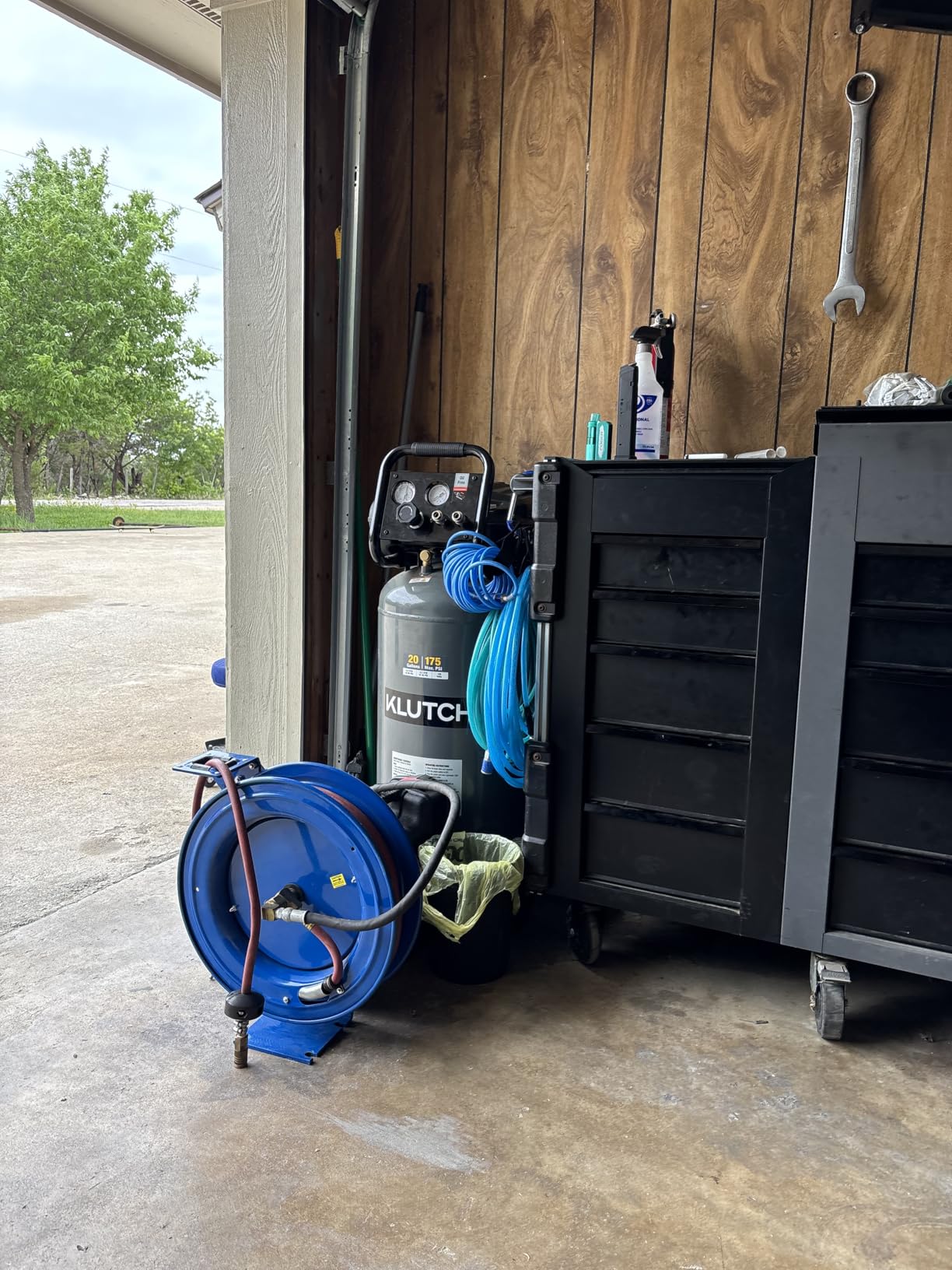
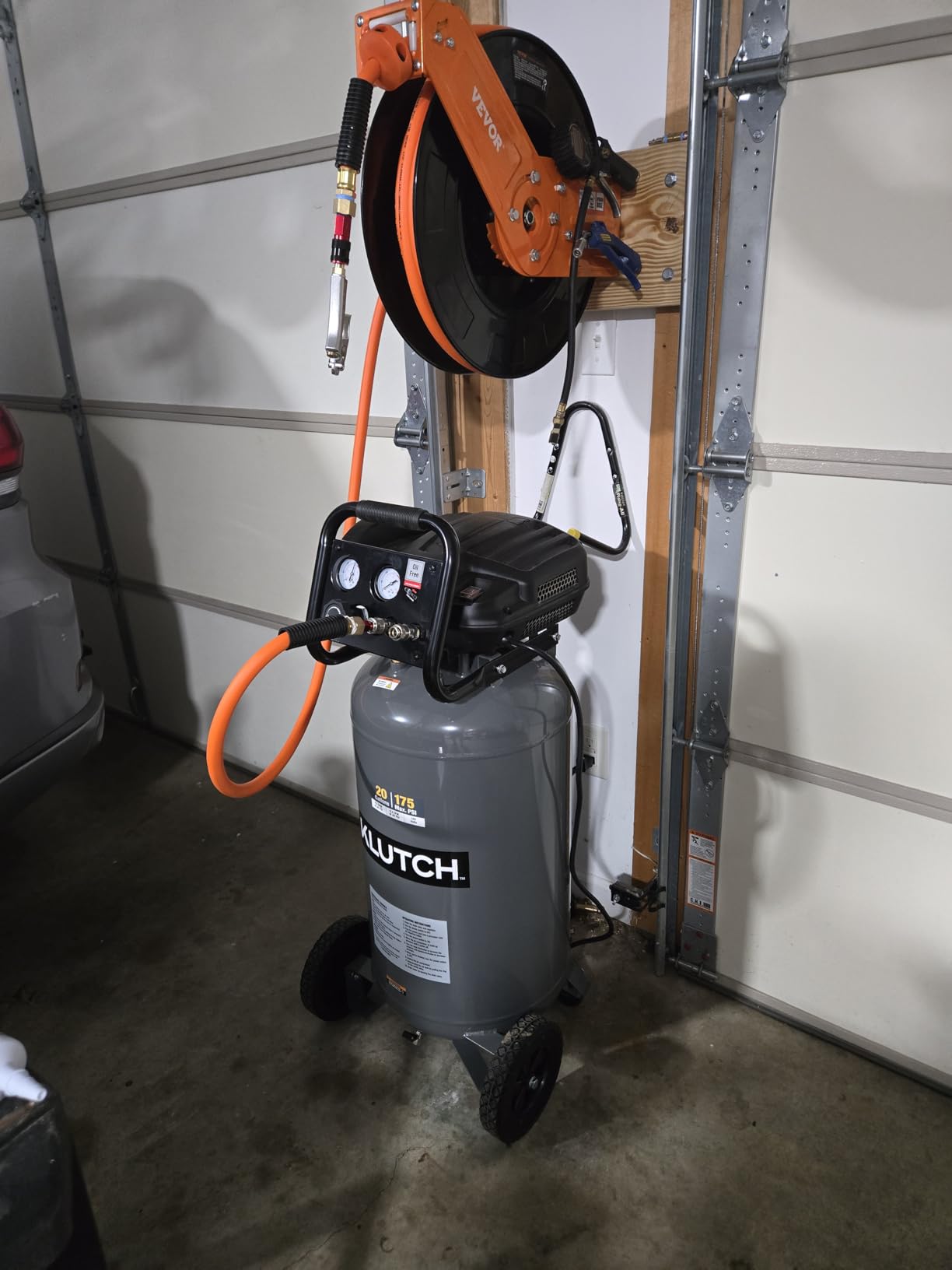
Physically it is a 90-pound vertical package standing 41.5 inches tall on a 19.1 by 17.5 inch footprint, which is one of the smaller floor plans here. Rubber foot stabilizers damp vibration into the slab, and the large rubber wheels plus an ergonomic handle make it simple to roll out from a wall for tire work.
It runs on a standard 120V outlet with a 14 amp maximum draw, so no circuit work is needed. Owners consistently report steady pressure retention and no air loss over long idle periods, and the oil-free pump means there is no oil change to schedule and nothing to carry over into a spray gun.
The 80 dB rating is the honest catch here. That is a compressor you can hear from the next room, which is fine in a detached garage and less fine in a garage attached to a house. A minority of owners also report delivered airflow landing below the published figure, and a small group describe quality control and support failures, including one detailed report of an internally bypassed power switch on a sibling model in the same compressor family.
Who the Klutch suits best
It suits the weekend builder who wants a compressor that can keep up with a nailer for a full afternoon without a dedicated circuit or any maintenance schedule. A 75% duty cycle means a full day of intermittent shop use is realistic, and 175 PSI gives headroom for tools that want more than the bare minimum.
It also suits anyone whose garage floor space is tight, since the vertical footprint is smaller than most of the tall oil-free models here. Running two tools at once is possible but marginal, because 4.2 SCFM is a single-tool budget, not a two-tool budget.
Who should skip the Klutch
Skip it if the compressor sits directly under a bedroom or a wall you share with a neighbour, because 80 dB is a real quality-of-life problem and not a spec-sheet detail. People on r/Tools repeatedly push ultra-quiet platforms for exactly this reason.
Skip it if you plan to run a plasma cutter, a table saw, a large orbital sander or two nailers continuously, because 4.2 SCFM will not carry those loads and the tool will stutter as the tank drains below working pressure. For that class of work, look at a higher-airflow model or a larger tank in the industrial compressor roundup.
2. Stealth 20 Gallon Ultra Quiet – Best for Quiet Garages
Stealth 20 Gallon Ultra Quiet Air Compressor,1.8 HP Oil-Free Peak 150 PSI 68 Decibel, 5.5 CFM @ 40 PSI 5 CFM @ 90 PSI Silent Long Life Electric Air Compressor W/Wheel for Garage
20-gallon alloy steel tank
1.8 HP oil-free motor
68 dB claimed
5 CFM at 90 PSI
150 PSI peak
Pros
- Lowest noise figure among the oil-free units here at 68 dB
- Alloy steel tank and quality tires
- Two quick couplers for fast tool swapping
- Limited lifetime warranty
- Holds pressure over long idle periods
Cons
- 121 pounds is awkward to move
- 150 PSI peak is below competing 175 PSI models
- A minority report early motor failures and hard to reach support
This is the compressor to buy when the machine lives next to where you sleep. The published 68 dB is the lowest noise figure among the oil-free machines here, by a clear margin, and owners who moved up from a conventional piston compressor describe the change as dramatic, with measured readings landing anywhere between 65 and 78 dB depending on where you stand.
Airflow is the reason to pause. It publishes 5.5 CFM at 40 PSI and 5 CFM at 90 PSI from a 1.8 HP oil-free motor, which is a real improvement over the typical 4 CFM budget number and enough for a sprayer, a sander and a framing nailer with room to spare. Owners report holding pressure well over long idle stretches and quick recovery when the tank opens up.
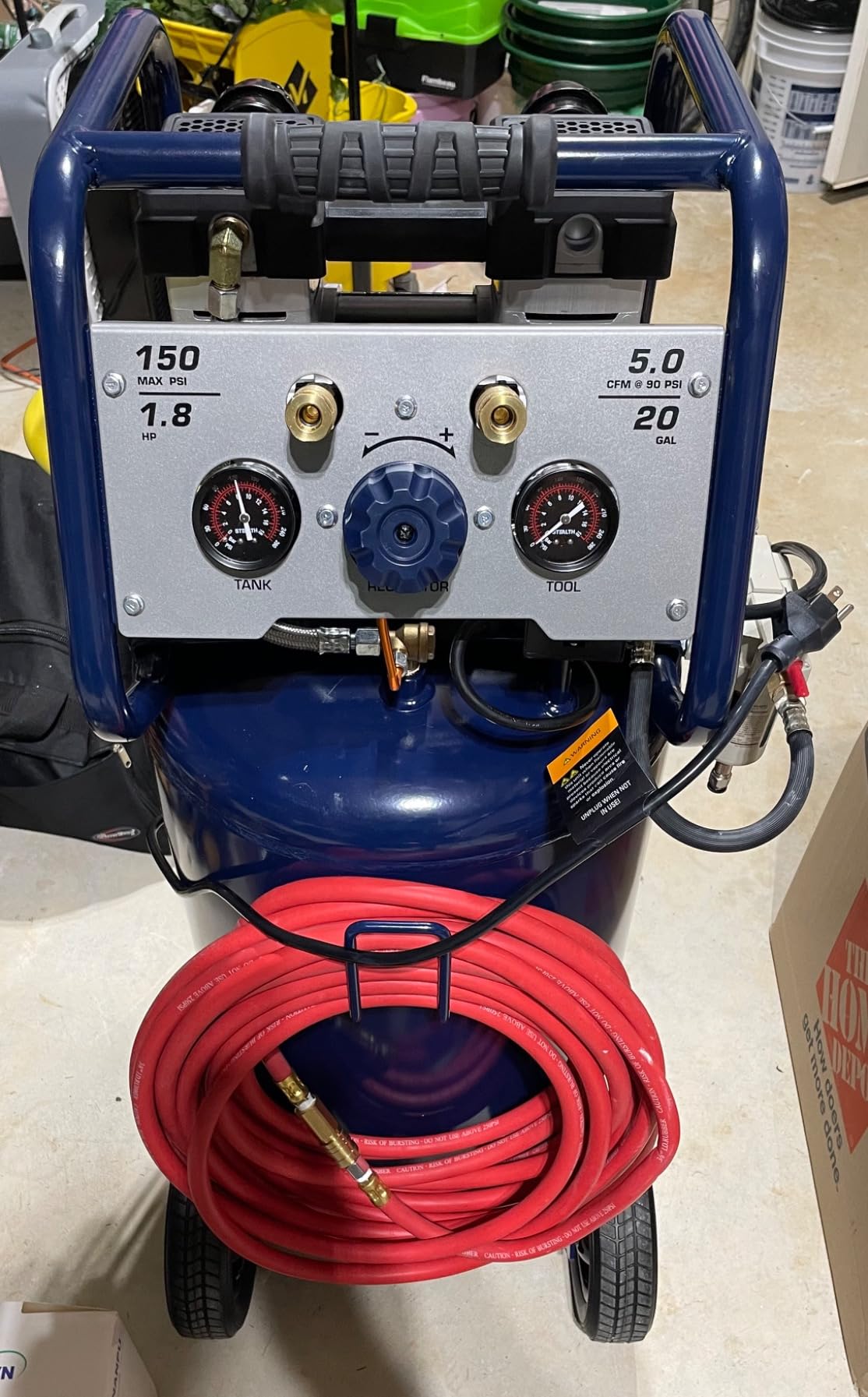
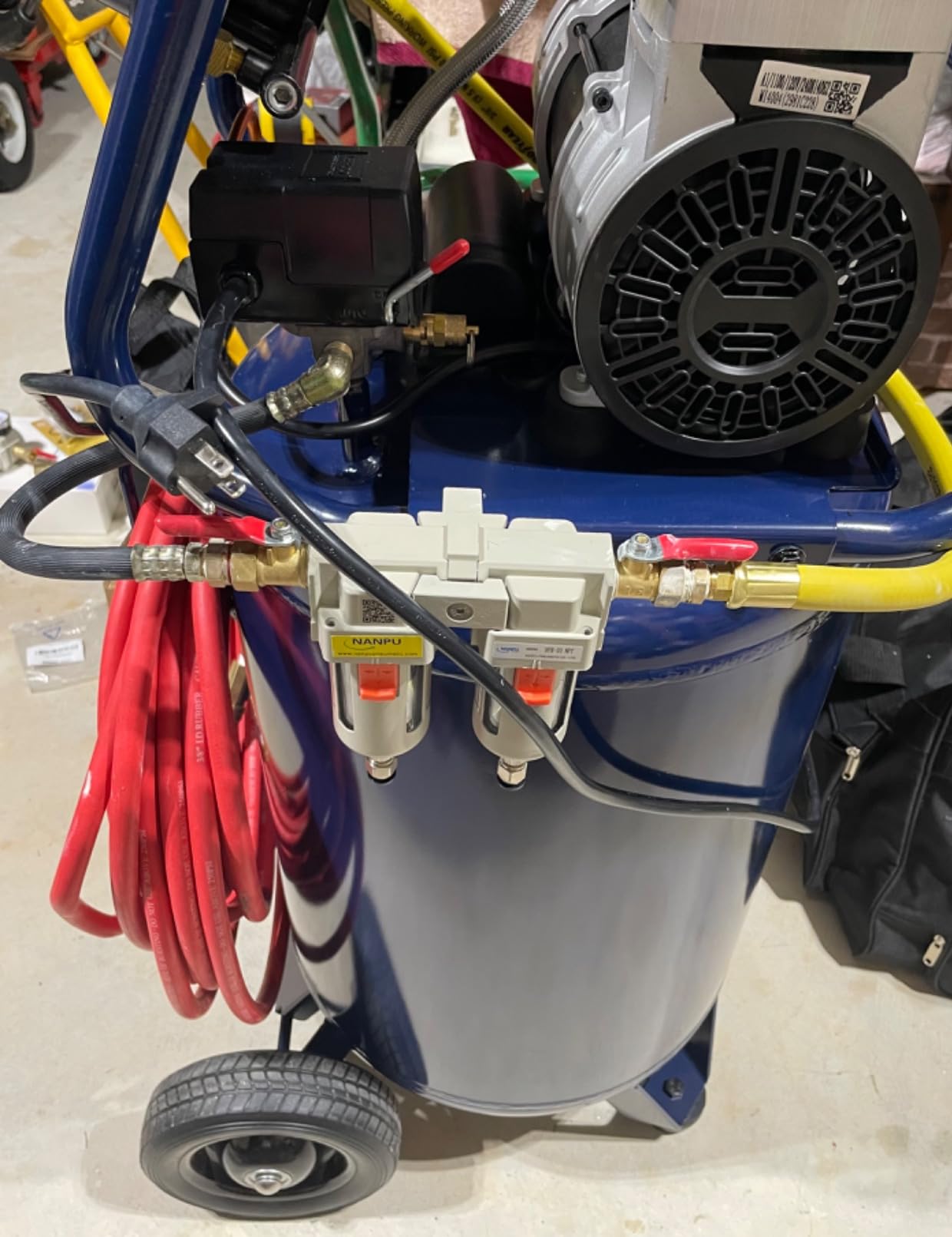
The tank is alloy steel with 8-inch rubber wheels, and there are two quick couplers so you are not swapping fittings every time the job changes. The vertical shape stands 42 inches tall on a 20 by 18 inch footprint, which fits neatly beside a workbench rather than in the middle of the bay.
Two details deserve attention before you commit. The weight is 121.4 pounds, which makes it one of the heavier units in this roundup, and it is genuinely awkward to reposition solo. The 150 PSI peak is also below the 175 PSI ceiling that the Klutch and Craftsman both offer. For most air tools that gap is irrelevant, since nailers and impact wrenches rarely ask for more than 90 PSI.
A minority of reviewers report compressors that failed within weeks and a support contact form that returns errors, so the limited lifetime warranty on paper may not translate into a painless experience if something goes wrong. A few also report that some units will not restart while the tank is still pressurised, which points at the pressure switch or circuit wiring rather than the motor itself.
Who the Stealth suits best
It suits a garage attached to a house, a ground-floor workshop, or any setup where a compressor starting up at seven in the morning is a problem. At a claimed 68 dB you can hold a conversation beside it, which is the test that matters more than the number.
It also suits anyone doing finish work or furniture projects, because the oil-free design keeps oil out of the air line and the two quick couplers make switching between a sprayer and a detail gun painless.
Who should skip the Stealth
Skip it if you need to move the compressor regularly, because 121 pounds is a two-person job on stairs and a fight through a side gate. It also falls short for anyone who needs sustained high pressure, since 150 PSI caps what you can run.
Skip it if support matters more to you than the noise figure, because early failure reports cluster around the same units whose service response was unhelpful. Our pancake compressor guide covers lighter options if weight is the deciding factor.
3. Craftsman 20 Gallon Oil-Free 1.8 HP – Best Value
Craftsman Air Compressor, 20 Gallon Oil-Free 1.8 HP Max 175 PSI Pressure Two Quick Couplers Big Capacity, Red- CMXECXA0232043
20-gallon stainless steel tank
1.8 HP oil-free pump
175 PSI max
4 SCFM at 90 PSI
Pros
- Stainless steel tank resists corrosion
- 175 PSI ceiling for demanding tools
- Two quick couplers and a 6 foot cord in the box
- Ball drain valve and plastic filter included
- Oil-free pump means no oil changes
Cons
- 80 dB noise level
- Only a 1 year limited warranty
- Some buyers find airflow optimistic for heavy tools
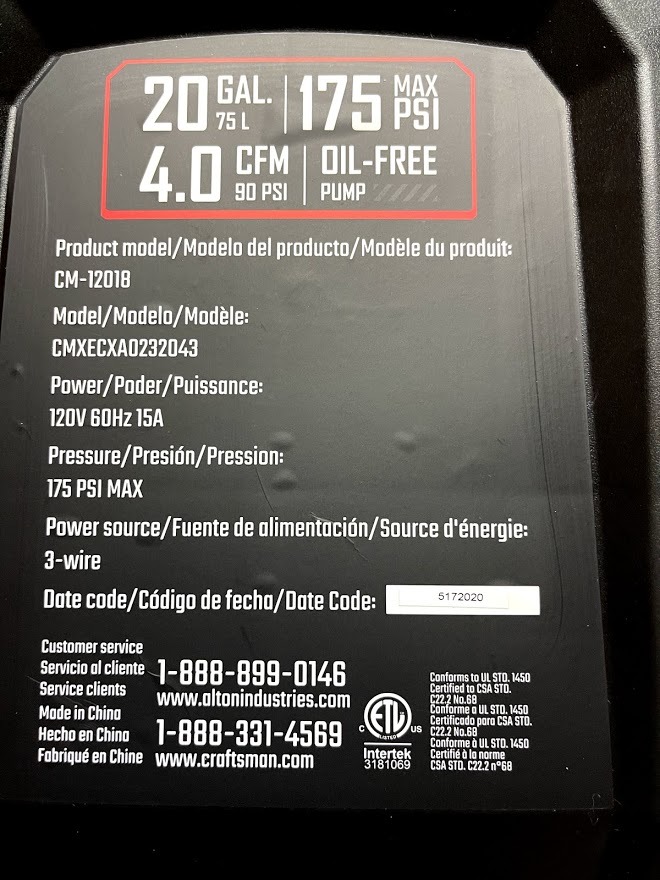
The Craftsman is the pick if you want a known name, a steel tank that will not pit, and a spec sheet that does not ask you to compromise on pressure. It runs a 1.8 HP oil-free pump to 175 PSI and publishes 4 SCFM at 90 PSI, which sits right in the middle of this group and covers the standard home garage tool list.
Owners frame it as a dependable general-purpose shop compressor rather than a specialist. The stainless steel receiver, rubber feet for vibration isolation and an oil-free pump add up to a machine that stays put and stays quiet in terms of maintenance, and the two quick couplers plus a 6-foot cord cover most setups without extra purchases.
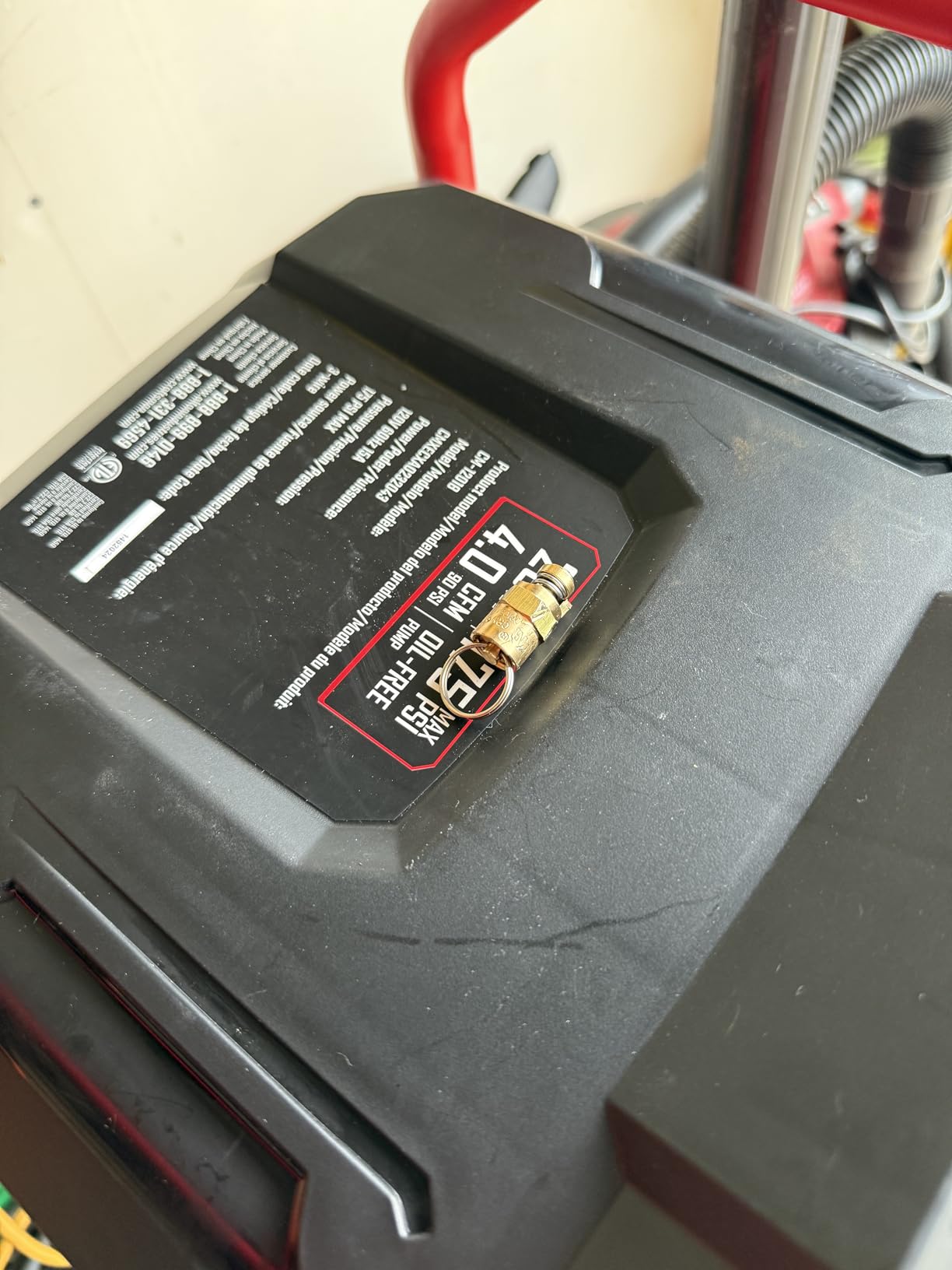
The listed dimensions are 19.1 by 17.3 inches on the base with a 40.9 inch height, so it occupies essentially the same floor square as the Klutch. It ships as a vertical configuration on rubber wheels, which makes it easy to roll clear of a wall when you need the floor for a vehicle.
Everything needed to get running is in the box: two quick couplers, a 6-foot power cord, a ball drain valve, a plastic filter and two rubber wheels. That matters more than it sounds, because the drain valve and coupler quality are where cheaper compressors leak first.
The trade-offs are honest ones. The noise rating is 80 dB, so this is not a machine for a shared wall, and the warranty is a 1-year limited manufacturer and distributor warranty, shorter than the Stealth’s limited lifetime coverage. Some buyers also find the published CFM optimistic when they put a sustained heavy tool on it.
Who the Craftsman suits best
It suits anyone who wants a compressor that handles nailing, spraying, cleaning, inflating and light automotive work without specialising in any one of them. The 175 PSI ceiling is the joint highest among the oil-free vertical units, which gives you margin for tools that want pressure.
It also suits owners who want a stainless tank in a garage where moisture sits in the air, since stainless resists the corrosion that eventually eats a painted carbon steel tank from the inside.
Who should skip the Craftsman
Skip it if noise is the deciding factor, because 80 dB will carry through a thin garage wall and there are quieter options at similar specification levels. Skip it if warranty length is a priority, since a 1-year term is thin against a limited lifetime warranty elsewhere in this list.
Skip it if your work is continuous rather than intermittent. At 4 SCFM and a single-stage pump, a dedicated shop running a plasma cutter or a large sander will outrun it, and the pressure drop under load is the single most common complaint across owner reviews of this class of machine.
4. Industrial Air 20-Gallon Belt Driven V-Twin – Best for Long-Duty Shops
Industrial Air IL1682066.MN 20-Gallon Belt Driven Air Compressor with V-Twin Cylinder
6 HP dual voltage induction motor
V-twin cast iron oil-lubricated pump
5.3 CFM at 90 PSI
65 dB claimed
Pros
- V-twin cast iron pump handles continuous shop loads
- Belt drive runs at low RPM for quiet operation
- Dual voltage motor works on 120V or 240V
- Pneumatic tires roll over uneven ground
- Owners report 7 years of regular use
Cons
- 159 pounds is the heaviest here
- Bottom drain is hard to reach without a kit
- Belt may arrive loose and need tensioning
- Oil changes required and oil is not supplied
This is the one to buy if your garage is really a small shop. The V-twin cast-iron oil-lubricated pump is built around a B-10 style bearing life rather than a consumer electronics duty cycle, and owners report running these for 7 years or more of regular work without drama. It delivers 6.2 CFM at 40 PSI and 5.3 CFM at 90 PSI from a 6 HP induction motor.
It is also the quietest of the two cast-iron machines here, and not because of a marketing claim alone. The belt-driven design turns the pump at low RPM compared with direct drive, which owners describe as a soft purr rather than clatter, and the published noise figure is 65 dB. At that level, air-hungry tools like a plasma cutter run without the compressor pausing.
The motor is the interesting part. It is a 6 HP dual-voltage induction unit, factory wired for a standard 120V outlet and convertible to 240V if you want it, which means you can buy it before you upgrade your garage wiring and still grow into it later.
Who the Industrial Air suits best
It suits people whose air tools are hungry and continuous. Five-point-three CFM at 90 PSI from a cast-iron V-twin is a different class of machine to the direct-drive units above it, and it is the pick here for blasting cabinets, air hammers and shop air tools that run for hours.
It also suits anyone with a serious noise problem in a workshop, because 65 dB claimed and the low-RPM belt drive make it the quietest cast-iron choice in this list. The 2-year limited warranty and UL plus CSA certification add a level of assurance the budget oil-free units cannot match.
Who should skip the Industrial Air
Skip it if you will never change the pump oil. An oil-lubricated V-twin needs break-in oil, scheduled oil changes and periodic checks, and the oil is not supplied, so the ownership experience is a different category from the oil-free machines above it.
Skip it if weight is a constraint, because 159 pounds makes it the heaviest machine here and awkward in a one-car garage. The bottom tank drain is also a genuine annoyance that commonly needs a valve extension kit to reach, and the belt sometimes needs tensioning after unpacking, so allow time to set it up properly.
5. California Air Tools 20020AD – Best for Automatic Draining
California Air Tools 20020AD 2.0 HP Ultra Quiet and Oil-Free Air Compressor with Wheels, 20 Gallon Tank Capacity, 70 dB Noise Level, Electric, Portable, with Automatic Drain Valve
20-gallon alloy steel tank
2.0 HP oil-free dual piston
5.30 CFM at 90 PSI
70 dB
Automatic drain valve
Pros
- Genuinely quiet 70 dB verified in concrete workshops
- Automatic drain valve with adjustable timing
- Oil-free dual piston pump rated past 3000 hours
- Low 14 amp draw on 110V
- Replacement parts shipped even out of warranty
Cons
- 125 PSI maximum is a low ceiling in this group
- Tank to regulator fitting can choke airflow
- Automatic drain purge is louder than the quoted noise level
The 20020AD is the pick when water in your tank is the thing that worries you. It ships with an automatic drain valve that has adjustable frequency and duration plus a test button, and owners in small shops and detail businesses report it ending the moisture problem outright rather than making them remember to drain after every job.
It is also properly quiet at a published 70 dB, verified by owners working in concrete-walled shops, and the 2.0 HP oil-free dual piston pump runs at just 1680 RPM to keep noise and wear down. Airflow is the strongest of the two 2.0 HP California Air Tools models in this list at 6.40 CFM at 40 PSI and 5.30 CFM at 90 PSI.
The 14 amp draw on 110V means it runs on a standard household circuit, and the 115-pound weight with wheels makes it manageable in a garage. Thermal overload protection and pressure control gauges are both standard, and one of the standout details is that customer service has sent replacement parts free even after the 1-year limited warranty expired.
Who the 20020AD suits best
It suits anyone painting, doing upholstery or finishing furniture who has been burned by water spots and oil mist coming out of the line. The auto-drain plus oil-free pump is the cleanest air package among the compact vertical units here, and the free replacement parts policy softens the short warranty considerably.
It also suits a small shop that needs 5 CFM at 90 PSI without installing a dedicated 240V circuit, which makes it a realistic step up from a pancake unit without a rewiring project.
Who should skip the 20020AD
Skip it if you need high pressure. The 125 PSI ceiling is one of the lowest in this roundup, and while most air tools never ask for more than 90 PSI, the gap shows up on high-demand jobs and on spray equipment that wants a steady high-pressure feed.
Two other catches catch people out. The fitting between tank and regulator is a reported airflow bottleneck that cuts real-world CFM below the published figure, and the automatic drain purge is startlingly loud and fires roughly every two minutes at factory settings until you adjust it. Weak transit packaging has also produced units arriving with smashed air filters.
6. California Air Tools 20015HP – Best for High-Pressure Work
California Air Tools 20015HP 1.5 HP Ultra Quiet, Oil-Free, 175 PSI High Pressure Air Compressor with Wheels, 20 Gallon Tank Capacity, 70 dB Noise Level, Electric, Portable
20-gallon alloy steel tank
1.5 HP oil-free two-stage pump
145 to 175 PSI
3.80 CFM at 90 PSI
Pros
- Two-stage pump holds 175 PSI
- Quiet 70 dB with conversational level output
- Only 12 amp draw on a 110V outlet
- Holds pressure for days with no bleed-off
- Excellent protective shipping packaging
Cons
- Lowest published airflow in this group at 3.80 CFM at 90 PSI
- Regulator reported drifting after a few months
- Tall 46.7 inch profile needs planning around
This is the only true two-stage pump in the group, and that single design decision changes how it feels under load. A two-stage pump compresses in two passes rather than one, so it reaches 175 PSI and stays there while the airflow is lower, which is exactly what you want for spray work, high-pressure inflating and tools that labour near their limit.
It runs at 70 dB with a low 1750 RPM motor, and owners who moved up from a compressor that required hearing protection report the same result: they can hold a conversation beside it. The 12 amp draw is the lowest here, so it runs comfortably on a standard 110V outlet even in a garage with nothing else on the circuit.
What you give up is flow. It publishes 4.00 CFM at 40 PSI and 3.80 CFM at 90 PSI, the lowest airflow figure of any compressor here, and that number is the reason this is not the general recommendation. The pump is rated for over 3000 hours and the build is solid, but pairing two low-flow tools on one tank is a mismatch.
One recurring owner complaint is a regulator that drifted or stopped regulating after a few months, and some note that once it stops regulating it holds full pressure continuously, which means the compressor runs far more than it needs to. At 113 pounds with wheels, it is light enough to reposition but stands 46.7 inches tall, the tallest profile here, so measure the bay before you order.
Who the 20015HP suits best
It suits painters and finish workers who need pressure stability more than volume, and anyone working on a circuit where 12 amps is the only option available. Holding pressure for days with no bleed-off means you set the regulator once and forget about it.
It also suits a garage with awkward floor space, since the vertical format trades width for height and needs under 20 inches across, and owners generally report excellent protective packaging, which matters if you are buying from a seller that ships freight.
Who should skip the 20015HP
Skip it if you plan to run sanders, impact wrenches for extended periods or anything that wants more than 4 CFM. At 3.80 CFM at 90 PSI you will hear the pressure switch clicking constantly, and tool stutter under load is the fastest way to resent a purchase.
Skip it if you need two tools at once, because the two-stage architecture deliberately trades airflow for pressure. For that, a single-stage machine with more CFM is the better architecture even at a lower pressure ceiling.
7. California Air Tools 20040CAD 4.0 HP – Best for Maximum Airflow
California Air Tools 20040CAD Powerful 4.0 HP Ultra Quiet and Oil-Free Air Compressor, 20 Gallon Tank, 75 dB Noise Level, White, 220v 60hz, with Automatic Drain Valve
20-gallon alloy steel horizontal tank
4.0 HP oil-free dual piston
10.60 CFM at 90 PSI
220V operation
Pros
- Highest airflow in the group by a wide margin
- Builds full tank pressure in roughly two minutes
- Compact 39 inch horizontal footprint fits under a bench
- Automatic drain valve protects downstream gear
- Quiet for a 4 HP machine
Cons
- Requires a 220V circuit
- 75 dB is louder than the 70 dB models
- Automatic drain purge is louder than the quoted figure
- 125 PSI maximum pressure
Nothing else in this roundup comes close on airflow. The 20040CAD publishes 12.80 CFM at 40 PSI and 10.60 CFM at 90 PSI from a 4.0 HP oil-free dual piston pump turning at 1680 RPM, which is double the airflow of the next-strongest unit in this roundup and the single biggest reason to consider it.
Owners who replaced smaller machines call the jump in airflow the decisive upgrade, particularly for milling machines, blast cabinets and any continuous shop load. Several report building full tank pressure in roughly two minutes, and the automatic drain valve is widely praised for keeping moisture out of downstream equipment.
It is one of two horizontal tanks in this roundup, measuring 39 by 15 by 28 inches. That format is a real advantage under a workbench where a vertical unit would stand up into your headroom, and the low centre of gravity makes the 148-pound weight easier to manage than the number suggests.
The catch is electrical, and it is not a small one. This runs on 220V at 14 amps, so it needs a dedicated circuit that most home garages do not have. It is also the loudest of the California Air Tools models here at 75 dB, and the automatic drain purge is reported as considerably louder than the quoted figure while firing every two minutes at factory settings.
At 125 PSI maximum, it gives up pressure to get flow, which is the correct trade for milling and blasting and the wrong one for high-pressure inflating. If you cannot commit to a 220V circuit, this compressor is simply not installable in your garage as it stands.
Who the 20040CAD suits best
It suits a working shop that runs continuous loads and has a 220V circuit already in place. Ten-point-six CFM at 90 PSI means two hungry tools can run at once, which is the capability every other single-stage machine in this roundup lacks.
It also suits anyone with a bench-mounted layout in mind, since the 39-inch horizontal footprint slides under a workbench where a 45-inch vertical would not, and the auto-drain means downstream milling and blasting equipment stays dry.
Who should skip the 20040CAD
Skip it if your garage has standard 110V wiring only. The dedicated 220V requirement is the reason this unit ends up in a corner of a shop rather than in a home garage, and it is not a detail you can work around with an adapter.
Skip it if you are decorating rather than building, since 125 PSI and 75 dB both point the wrong way for a space where you want quiet and pressure. And skip it if you are still deciding whether you need this much machine, because the airflow here would go unused in a typical weekend DIY load.
8. Campbell Hausfeld VT6290 – Best for Oil-Lubricated Durability
Campbell Hausfeld 20-Gallon Air Compressor, 2 HP, 135 PSI, VT6290
20-gallon ASME horizontal tank
Cast-iron two-cylinder single-stage pump
5.5 CFM at 90 PSI
Dual voltage 120V or 240V
Pros
- Cast-iron B-10 bearing rated up to 5000 hours
- Dual voltage gives circuit flexibility
- ASME code horizontal tank with 10 inch wheels
- Belt drive is quieter than direct drive
- Made in the USA with generous parts support
Cons
- Oil and air coupler not included
- Drain petcock is a weak point
- Published 82 to 85 dBA is loud
- Weak shipping carton causes transit damage
The VT6290 is the oldest design in this group and the one with the most mechanical substance behind it. The cast-iron two-cylinder single-stage pump is rated on a B-10 bearing basis for up to 5000 hours of service, and it flows 6.5 CFM at 40 PSI, 5.5 CFM at 90 PSI and still 4.8 CFM at 135 PSI.
That last number is unusual and useful. Most budget compressors collapse toward zero airflow as pressure climbs, so a machine that still delivers nearly 5 CFM at 135 PSI is one you can actually use for inflating and for tools that are set above 90 PSI, which is more than can be said for several oil-free units here.
The 2 HP motor is dual voltage, running at 15 amps on 120V or 7.5 amps on 240V, so you can start on a standard outlet and move to a dedicated circuit later. It sits in a 37 by 21 by 30.5 inch horizontal format on 10-inch semi-pneumatic wheels with a pull handle, and it is made in the USA with a fully enclosed metal belt guard over the drive components.
It is also the loudest compressor in this roundup on published figures, at 82 to 85 dBA, and it carries the lowest average rating here at 4.0 stars. The recurring negatives are practical rather than mechanical: the drain petcock is a known weak point that owners often replace with a ball valve, the oil and an air coupler are not supplied, and the shipping carton is weak enough that bent handles and cracked gauges are a known arrival condition.
Who the VT6290 suits best
It suits an owner who wants a mechanical machine with a long service life and does not mind an oil change schedule. A cast-iron B-10 pump and an ASME-code receiver are the two things that separate shop-grade hardware from appliance-grade hardware, and this is a straightforward route to them without moving up to a full rotary or screw machine.
It also suits anyone inflating above 90 PSI, because 4.8 CFM at 135 PSI is airflow most compressors here simply do not offer. The dual-voltage motor gives you the option to convert to 240V when you are ready for a dedicated circuit.
Who should skip the VT6290
Skip it if you want zero maintenance or clean air for painting, because an oil-lubricated pump means checking oil level and eventually changing it. Skip it if you are replacing something for the last time and want a quiet machine, since 82 to 85 dBA is loud enough to need hearing protection for long sessions.
Skip it if transit reliability is a concern in your buying situation, because the weak carton is the most common complaint in the reviews. Inspect the handle, gauge and intake filter the day it arrives, and keep the oil and coupler on your shopping list, since neither comes in the box.
How We Chose These 20 Gallon Air Compressors
Eight compressors made the cut out of a much wider search, and the criteria were deliberately mechanical rather than brand-based.
Published airflow at 90 PSI, not at 40 PSI. Marketing favours the flattering 40 PSI number. A compressor that drops from 6 CFM to 3 CFM between those two pressures is not the machine you want when a tool demands 90 PSI.
A real owner record. Every pick here has at least 27 verified reviews and a rating that is averaged from real use, not a handful of listings. Claims we could not corroborate across reviews were dropped.
20 gallons only. Smaller pancake units and 30-gallon-plus machines appear in our pancake roundup and 60 gallon roundup instead. Nothing drifted off size here.
A stated duty cycle or an equivalent engineering figure. Duty cycle is how long the motor runs before it must cool, and it decides whether you can work all afternoon without waiting.
Published noise level, not quiet branding. We recorded the decibel figure and flagged where owners measured something different.
Footprint and weight, checked against a one-car garage. A compressor you cannot move or cannot fit is the wrong recommendation regardless of its numbers.
Honest cons. Where owners report leaks, regulator drift, noisy drain purges, weak packaging or bypassed switches, that goes in the cons rather than being smoothed over.
The honest limit of this analysis: we compared published specifications, aggregated owner reviews and manufacturer documentation rather than running flow meters in a lab. Where published CFM and owner experience disagree, we say so instead of picking a winner.
What to Look for Before You Buy a 20 Gallon Air Compressor
CFM at 90 PSI decides what you can run
Match the compressor to the tool, not the tank to the garage. Here is what the common air tools actually demand at working pressure.
| Air tool | Typical demand at 90 PSI | Runs well on a 4 to 5 CFM 20 gallon unit |
|---|---|---|
| Brad nailer | Under 2 CFM | Yes, easily |
| Finish and trim nailer | 2 to 3 CFM | Yes |
| Framing nailer | 3 to 4 CFM | Yes |
| Spray gun and HVLP detail gun | 3 to 5 CFM | Yes, at the limit |
| Random orbital sander | 5 to 7 CFM | Marginal, watch for stutter |
| Air impact wrench | 8 to 10 CFM for sustained work | Bursts only, not continuous |
| Air hammer and body work | 8 CFM and above | No, look for a larger tank |
| Plasma cutter and blast cabinet | 20 CFM and above | No, wrong size entirely |
Two tools on one compressor is a different question entirely, and it is the most misunderstood point in this category. Add their demands together and compare the total against the compressor’s 90 PSI airflow, not its tank size. Two 3 CFM nailers on a 4.2 CFM compressor will make both of them stutter, no matter how large the receiver.
Single-stage vs two-stage, and the two-tool question
A single-stage pump compresses air once and reaches about 175 PSI, with more total airflow. A two-stage pump compresses twice and delivers higher pressure with a smoother delivery curve, at the cost of airflow. That is the entire trade, and it maps directly onto the picks here: the Craftsman and Klutch are single-stage and high-flow for their class, while the 20015HP is two-stage and trades flow for a steadier 175 PSI.
Choose single-stage if you want the most CFM per dollar and your tools live at or below 100 PSI. Choose two-stage if you paint, inflate above 100 PSI, or run a tool that needs steady pressure more than volume. For simultaneous tool use, single-stage with more CFM is nearly always the better answer.
Oil-free vs oil-lubricated
Oil-free pumps need no oil changes, put no oil mist into your air line and run quieter, which is why six of the eight picks here use them. They also wear faster under genuinely heavy duty, because a dry piston rubbing against a cylinder has no lubrication film to protect it.
Oil-lubricated cast-iron pumps, like the Campbell Hausfeld and Industrial Air here, tolerate long service hours and high pressure. The costs are a scheduled oil change, break-in oil at first start, and the need to run a moisture separator before a spray gun so you are not painting with atomised pump oil.
Tank size versus garage size
Twenty gallons suits a one-car or small two-car garage. A vertical unit occupies roughly 19 by 17 inches of floor and about 41 to 47 inches of height, so it fits beside a bench rather than in the bay. A one-car garage with a low ceiling or a shared wall is the case where orientation decides the purchase, and the two horizontal tanks here are the California Air Tools 20040CAD and the Campbell Hausfeld VT6290.
If your garage is tight, the 20020AD at 20 by 23 inches and the 20040CAD at 39 by 15 inches give you options a vertical cannot. If you are mounting a nailer permanently, remember that a permanently installed frame nailer deserves a dedicated 30-gallon or larger tank, which is the point where our 60 gallon roundup takes over.
Noise in decibels, translated
Decibels are only useful once you know what they sound like in a room. Here is the translation that matters for a home garage.
| Sound level | What it means in a garage | Who it suits |
|---|---|---|
| 65 to 70 dB | A conversation is possible beside it | Attached garages, apartments above, shared walls |
| 70 to 76 dB | Noticeable in an adjoining room, fine in a detached garage | Most home garages |
| 80 dB | Holds a conversation at a shout, dominates a small space | Detached shops, workshop use |
| 82 to 85 dBA | Hearing protection for long sessions | Working shops only |
Forum owners are consistent on this point, and the recommendation that circulates most often on r/Tools is simply to get an ultra-quiet unit regardless of budget, because the compressor runs next to where you live. Owners of the 65 to 70 dB machines in this list routinely describe the change as night and day.
Garage electrical requirements before you buy
Check your circuit before the compressor, not after. Most of these machines run on 120V, and the amp draw is what determines whether you can share that circuit with a welder, a table saw or an electric vehicle charger.
Standard 15 amp outlet. Comfortable only for low-draw machines. The 20015HP at 12 amps is the safest choice here, followed by the 110V California Air Tools models at 14 amps.
15 amp circuit with light sharing. The Klutch at 14 amps and the 20020AD at 14 amps will work, but a breaker trip usually means something else is drawing on the same circuit.
20 amp dedicated circuit. The right answer for most 120V compressors, and it costs very little to add.
Dedicated 240V circuit. Required by the 20040CAD at 220V. Also available on the dual-voltage machines if you want it: the Industrial Air converts to 240V and the Campbell Hausfeld runs at 7.5 amps on 240V.
If a compressor trips your breaker, the cause is nearly always the circuit rather than the compressor. Check that a pressure switch and manual drain are not being mistaken for extra load, that the cord is fully seated, and that no extension cord is running the unit.
Where to spend if you want more capacity
If the table above tells you a 20-gallon unit is not enough, the honest answer is not a bigger 20-gallon compressor, it is a larger tank. Tank size does not add airflow, but it does add the buffer that keeps pressure steady while a pump recovers, which is exactly the pressure drop under load that owners complain about most.
A 30-gallon tank solves intermittent big-airflow tools such as an impact wrench on lug nuts, where the 20-gallon CFM figure is already marginal. Past that, the 50 and 60 gallon machines in our 60 gallon roundup are for plasma cutting, blasting and shop use rather than home garages, and they cost you floor space, weight and portability to get.
Maintenance you can do in ten minutes
Drain the tank after every use. This is the single highest-value habit in compressor ownership, because moisture in a tank rusts it from the inside where you cannot see it. A ball drain valve beats a petcock, and an automatic drain valve beats both because it does it while you are not looking.
For oil-free pumps, watch the intake filter and keep the airflow path clear. For the oil-lubricated units here, check the oil level before every start and change it on the interval the manual states, which is typically far less often than most owners assume. Before storage for a winter, drain the tank fully and run the pump until it is completely empty of air.
Frequently Asked Questions
Who makes the best 20 gallon air compressor?
The Klutch 20-Gallon is the strongest all-round choice here, publishing 4.2 SCFM at 90 PSI with a 75% duty cycle, an oil-free pump and a 175 PSI ceiling across more than 700 owner reviews. For maximum airflow the California Air Tools 20040CAD leads at 10.60 CFM at 90 PSI but needs a 220V circuit, and for a cast-iron pump built for long service hours the Campbell Hausfeld VT6290 is the mechanical choice.
What size air compressor is best for a home garage?
For most single-car and small two-car garages, 20 gallons is the sweet spot. It is large enough that an impact wrench or framing nailer does not empty the tank mid-task, small enough to move with one hand, and narrow enough in vertical form to sit beside a workbench. Step down to 6 or 8 gallon pancake models if you only inflate and run a brad nailer, and step up to 30 gallons or more if you plan to run an impact wrench continuously or install a framing nailer permanently.
Is a 20 gallon air compressor big enough for air tools?
Yes for most home garage air tools, because tank size is a buffer and airflow is the real limit. A 20-gallon compressor with 4 to 5 CFM at 90 PSI runs brad nailers, finish nailers, framing nailers, spray guns and short bursts of an impact wrench without stalling. It struggles with random orbital sanders, sustained impact wrench work, air hammers and plasma cutters, which need 8 CFM or more and usually a larger tank.
How many CFM do I need for air tools?
Add up the demand of everything you want to run simultaneously and compare that total against CFM at 90 PSI, not at 40 PSI. A brad nailer needs under 2 CFM, a finish or framing nailer 2 to 4 CFM, a spray gun 3 to 5 CFM, a random orbital sander 5 to 7 CFM, and an impact wrench 8 to 10 CFM for sustained work. Two tools on one compressor need the sum of both demands, which is where most home units fall short.
What is the most reliable brand of air compressor?
Reliability in this category comes down to the pump and the parts behind it rather than the badge. Owners on r/Tools repeatedly name California Air Tools, Ingersoll Rand and BendPak as brands worth considering, and the build details that recur as positive signals are cast-iron pump castings, ASME-code receivers and copper discharge tubes. A discontinued brand line is a genuine parts risk, so check that replacement parts and a service contact still exist before buying.
Do I need a 240V circuit for a 20 gallon air compressor?
Most do not. Seven of the eight compressors here run on 110V or 120V at 12 to 15 amps, which works on a standard outlet, though a 20 amp dedicated circuit is the safer choice if a welder, saw or charger shares that circuit. The exception is the California Air Tools 20040CAD, which requires 220V. Two machines can be converted or run as dual voltage, the Industrial Air at 240V and the Campbell Hausfeld at 7.5 amps on 240V.
How often should I drain my air compressor tank?
After every use, without exception. Water collects in the bottom of the tank and rusts the interior from the inside, where corrosion is invisible until the tank fails. Manual ball drain valves take a few seconds, and automatic drain valves on the 20020AD and 20040CAD handle it on a timer you can adjust. Before any period of storage, drain the tank fully and run the pump until it holds no air at all.
Which air compressor is the best value for money?
The Craftsman 20 Gallon Oil-Free is the value pick in this group, pairing a 175 PSI ceiling, a stainless steel tank and two quick couplers with a 1.8 HP oil-free pump at 4 SCFM at 90 PSI. The Klutch offers more duty cycle and airflow for a similar outlay, while the Stealth is the quiet option if the compressor sits near where you live. Spending up on a cast-iron pump pays off only if you will do the oil changes.
The Best 20 Gallon Air Compressor for Your Garage
The Klutch 20-Gallon wins this list because it does the arithmetic honestly. A published 75% duty cycle, 4.2 SCFM at 90 PSI, a 175 PSI ceiling, an oil-free pump that needs no maintenance and a 90-pound vertical footprint add up to a compressor that handles a real afternoon of intermittent shop work without a dedicated circuit, and its 4.5 star average across 737 reviews is the best rating of any pick here.
Choose differently only for a clear reason. If the machine lives next to your living space, the Stealth at a claimed 68 dB is the quiet compromise. If you want a machine that runs everything at once and you have a 220V circuit, the California Air Tools 20040CAD is the only one here that can. If you plan to keep this compressor for a decade and will do the oil changes, the Campbell Hausfeld VT6290 has the cast-iron pump to justify that.
Whichever you pick, match it to the airflow your tools demand at 90 PSI rather than to the largest tank on the shelf, drain the tank after every use, and give it a 20 amp circuit if you can. That single habit will outlast any specification on this list.


