

The short answer: for wet leaves, rank on maximum air speed (MPH) first, then air volume (CFM). A soaked leaf is heavier than a dry one and grips whatever it lies on, so high-volume low-speed air pushes it around in circles instead of clearing it. Fast, concentrated air gets underneath and breaks the bond. Those who already own packs on a platform such as Ryobi 40V, DeWalt 20V MAX, Milwaukee M18, Makita 18V LXT, Greenworks 40V or EGO 56V get the cheapest upgrade here.
Owners on r/lawncare describe the same failure over and over: the blower that handles a dry October pile turns useless the moment rain hits it. That is not a technique problem alone. It is a spec problem, and it is the problem this roundup is built around.
Below are 8 cordless blowers we compared on published manufacturer figures only. We did not hands-on test these units, so every number here is transcribed from the brand’s own product page, and the arithmetic we add is shown explicitly rather than asserted.
If you are still working out the format, our guide to the best cordless leaf blowers for large yards and our backpack blower picks cover the endurance side of this topic. This page is about the wet-leaf problem specifically.
Why Wet Leaves Are a Different Job Than Dry Leaves
Dry leaves are light, and they sit loosely on top of grass. Volume does the job: move enough air and they skid across the lawn.
Wet leaves are heavier, and water bridges them to the surface beneath through surface tension and plain adhesion. A mower-style blast of high-CFM air pushes down instead of under, and the mat churns in place. That is the “moves leaves in circles” complaint that shows up on forums more than any other.
Two published figures decide this. CFM tells you how much air moves past the nozzle, which sweeps loose material. MPH tells you how fast that air leaves the nozzle, which gets under a stuck leaf and shears it loose. Wet work leans hard on the second number.
There is a catch nobody advertises. Peak MPH and peak CFM are almost never measured at the same motor setting. A blower at turbo may publish 200 MPH while its 765 CFM figure comes from a different test point, so treat the two numbers as separate ceilings rather than one combined claim.
Top 3 Best Cordless Leaf Blowers for Wet Leaves in October

All 8 Cordless Blowers at a Glance in 2026
The table below carries every pick with its published air speed, air volume and platform, ranked in the order we recommend them.
| Product | Specs | Action |
|---|---|---|
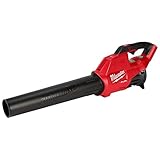
| Milwaukee M18 FUEL 120 MPH 450 CFM Blower |
|
Check Latest Price |
| EGO POWER+ LB7654 765 CFM Blower |
|
Check Latest Price |
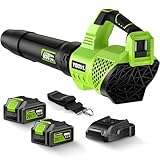 YOOVL LB-8184 650 CFM Cordless Blower YOOVL LB-8184 650 CFM Cordless Blower |
|
Check Latest Price |
 EWORK 700 CFM Cordless Leaf Blower EWORK 700 CFM Cordless Leaf Blower |
|
Check Latest Price |
 Husqvarna 350iB 800 CFM Cordless Blower Husqvarna 350iB 800 CFM Cordless Blower |
|
Check Latest Price |
 Greenworks 40V 550 CFM Brushless Blower Greenworks 40V 550 CFM Brushless Blower |
|
Check Latest Price |
 Greenworks 80V 770 CFM Axial Blower Greenworks 80V 770 CFM Axial Blower |
|
Check Latest Price |
 FAOGO RL-008 Cordless Leaf Blower FAOGO RL-008 Cordless Leaf Blower |
|
Check Latest Price |
1. Milwaukee M18 FUEL 120 MPH 450 CFM Blower: Best Overall for Wet Leaves
Milwaukee M18 FUEL 120 MPH 450 CFM 18-Volt Lithium Ion Brushless Cordless Handheld Blower (Battery Sold Separately)
450 CFM air flow
120 MPH air speed
18V brushless motor
6.7 lb bare tool weight
Pros
- 450 CFM and 120 MPH from a brushless motor
- Runs on Milwaukee M18 packs many households already own
- 6.7 lb body stays workable on decks and rooftops
- Brushless motor holds up to drops
- Two speed settings cover large and small jobs
Cons
- A pack drains in roughly 10 to 15 minutes at full speed
- About three quarters the push of a 120V corded blower
- Tool only
- so battery and charger are separate buys
- Hot packs delay recharge until the core cools
This is the blower we keep coming back to for wet-leaf work, and the reason is not raw output. It is that 120 MPH of air speed is genuinely enough to shear a damp mat apart, while the 6.7 lb body stays light through a full driveway.
Owners running this on the M18 platform report clearing wet leaves alongside sticks and freshly mowed grass clumps without changing technique. That ecosystem fit is the decisive factor for a lot of buyers: if you already have M18 packs in the garage, this is the cheapest credible wet-leaf answer available.
What surprised us in the review data is how consistently people compare it upward rather than downward. Several reviewers note it runs about three quarters as powerful as a 120V corded blower, and they accept that trade because the corded unit stays plugged in while this one does not.
The honest weakness is runtime arithmetic. A charged M18 pack drains in roughly 10 to 15 minutes at full speed, which is exactly the setting wet leaves demand. Plan for two or three packs for a single driveway, and treat the pack swap as part of the job rather than a failure.
Who the M18 FUEL blower fits
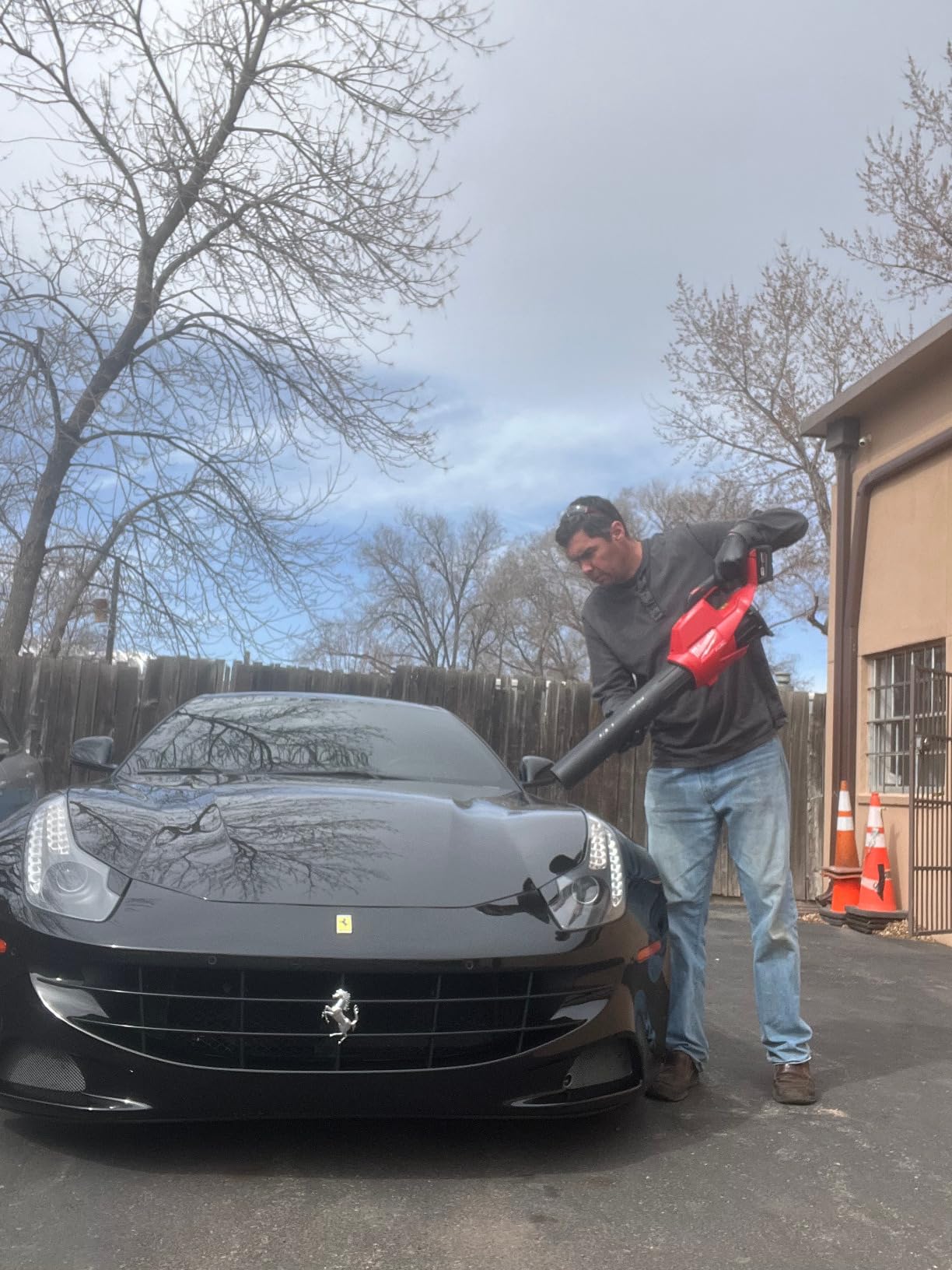
It suits townhome and suburban owners who already own M18 tools and want one battery family to run the mower, trimmer and blower. The two-speed trigger also makes it reasonable for light garage dust and car drying between autumn cleanups.
It is also the pick for anyone sensitive to noise on damp early-morning weekends, where neighbors are awake and the leaves have not fully dried. Multiple reviewers praise the quiet operation relative to gas machines.
Where it falls short
Skip it if your property is multi-acre with deep, soaked oak mats, or if you dislike a bare-tool purchase and need to buy a battery and charger on top. It is also the wrong answer for a single-pack session; the runtime profile simply does not support that.
If you are still weighing formats, compare it against the endurance picks in our large property cordless blower guide.
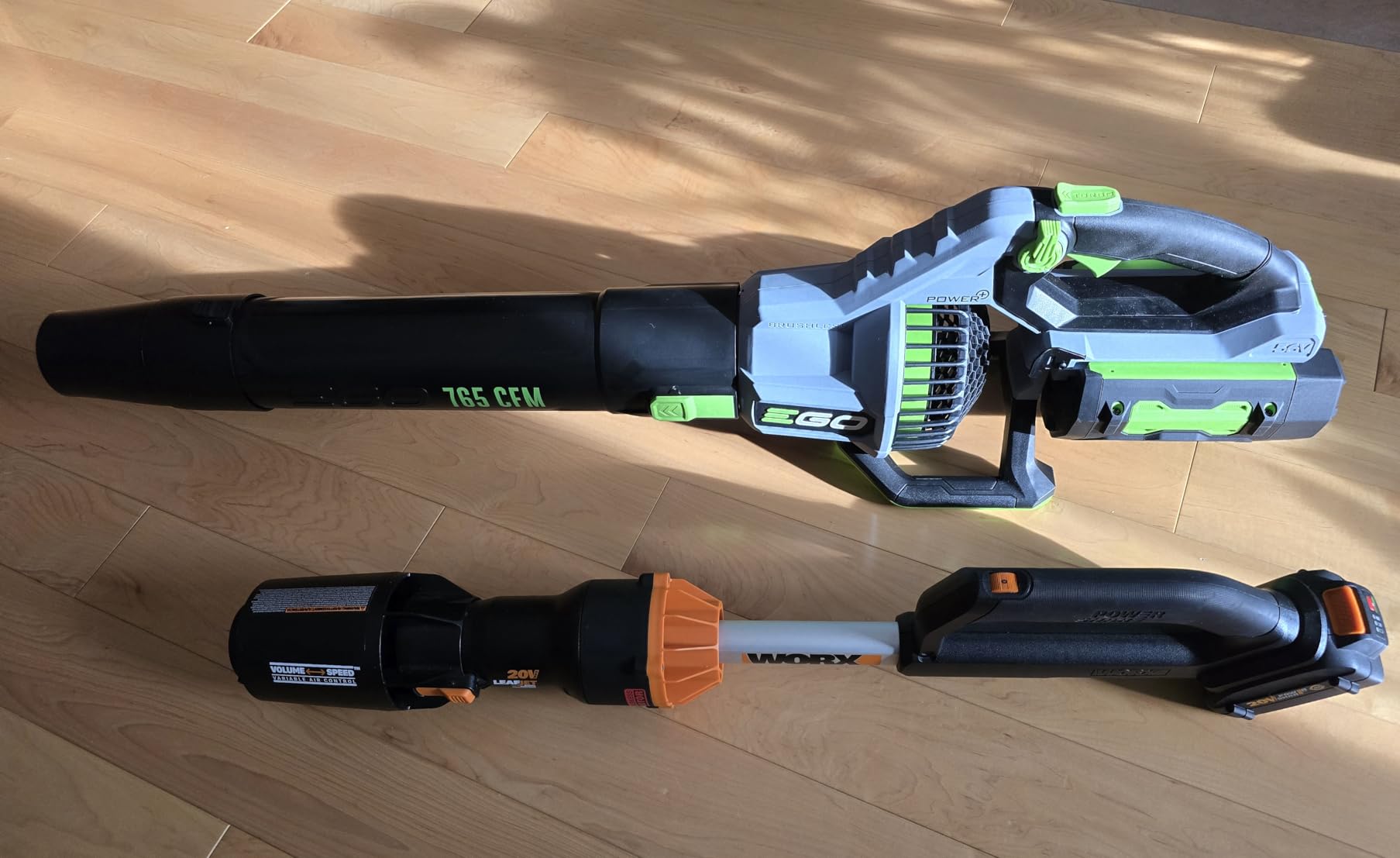
2. EGO POWER+ LB7654 765 CFM Blower: Best Air Speed for Soaked Mats
EGO POWER+ Cordless Electric Leaf Blower, 765 CFM, With Battery – LB7654
765 CFM in turbo
200 MPH maximum air speed
9.5 lb with battery
64 dB published
Pros
- Turbo delivers 765 CFM and 200 MPH for soaked debris
- Variable speed dial feathers down to a light dusting
- Includes a 5.0Ah battery and 320W charger
- Works with all EGO 56V ARC Lithium packs
- Spread and tapered nozzles in the box
Cons
- Turbo button has no lock-in so you hold it
- About 15 minutes per charge on turbo
- 9.5 lb body is front-heavy and will not stand alone
- Older 2.5Ah EGO packs are not accepted
Two hundred miles per hour is the highest published air speed in this group, and that number is why the LB7654 shows up in wet-leaf threads as the ceiling for the job. On a soaked mat it is the blower most owners reach for first, and reviewers routinely compare it favorably against gas machines they used to own.
The variable speed dial is the feature you will notice on a normal day. It runs from 260 to 580 CFM on the variable range before turbo, which lets you feather debris off a car hood or a bed without blasting it across the street. That control also cuts battery waste, because you are not forced to run max to clear a patio.
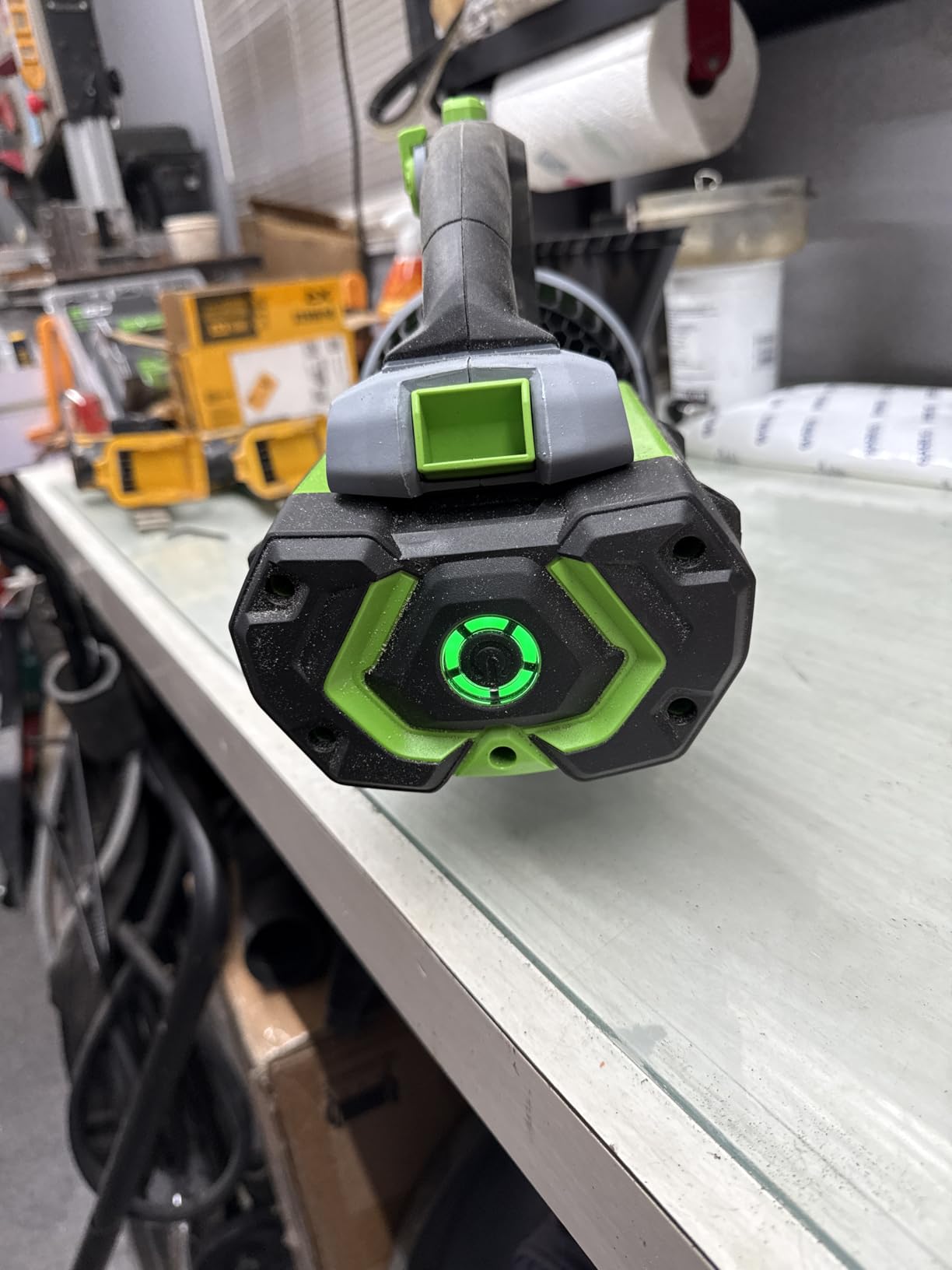
Owner sentiment is strongly positive on power and quietness. At a published 64 dB, reviewers call the turbo tone quieter than competing high-output handhelds, which matters on a Saturday morning when you are the first one outside.
The complaints are almost entirely ergonomic, and they are consistent. There is no lock-in for turbo, so your thumb stays down for the entire burst. The 9.5 lb body is long enough that the nozzle tip scrapes the ground if you hold it down hard. And the pack only lasts about 15 minutes on turbo.
Who the EGO LB7654 fits
It fits owners who want the highest air speed available and do not mind carrying the weight for it. It is also the natural pick if you already run EGO 56V ARC Lithium packs across mowers and trimmers, since the included 5.0Ah fits other EGO tools.
Reviews confirm it handles wet leaves and car drying better than any smaller unit in the list, and the included spread and tapered nozzles let you switch from a concentrated jet for lifting mats to a wide sweep for distributing them.
Where it falls short
Skip it if you have small hands or a wrist that tires from a held turbo button, and skip it if you cannot swap packs mid-job. It is also the wrong choice if your existing EGO batteries are the older 2.5Ah packs, which this blower does not accept.
For a lighter alternative with similar published air speed, look at the EWORK and Husqvarna picks below.
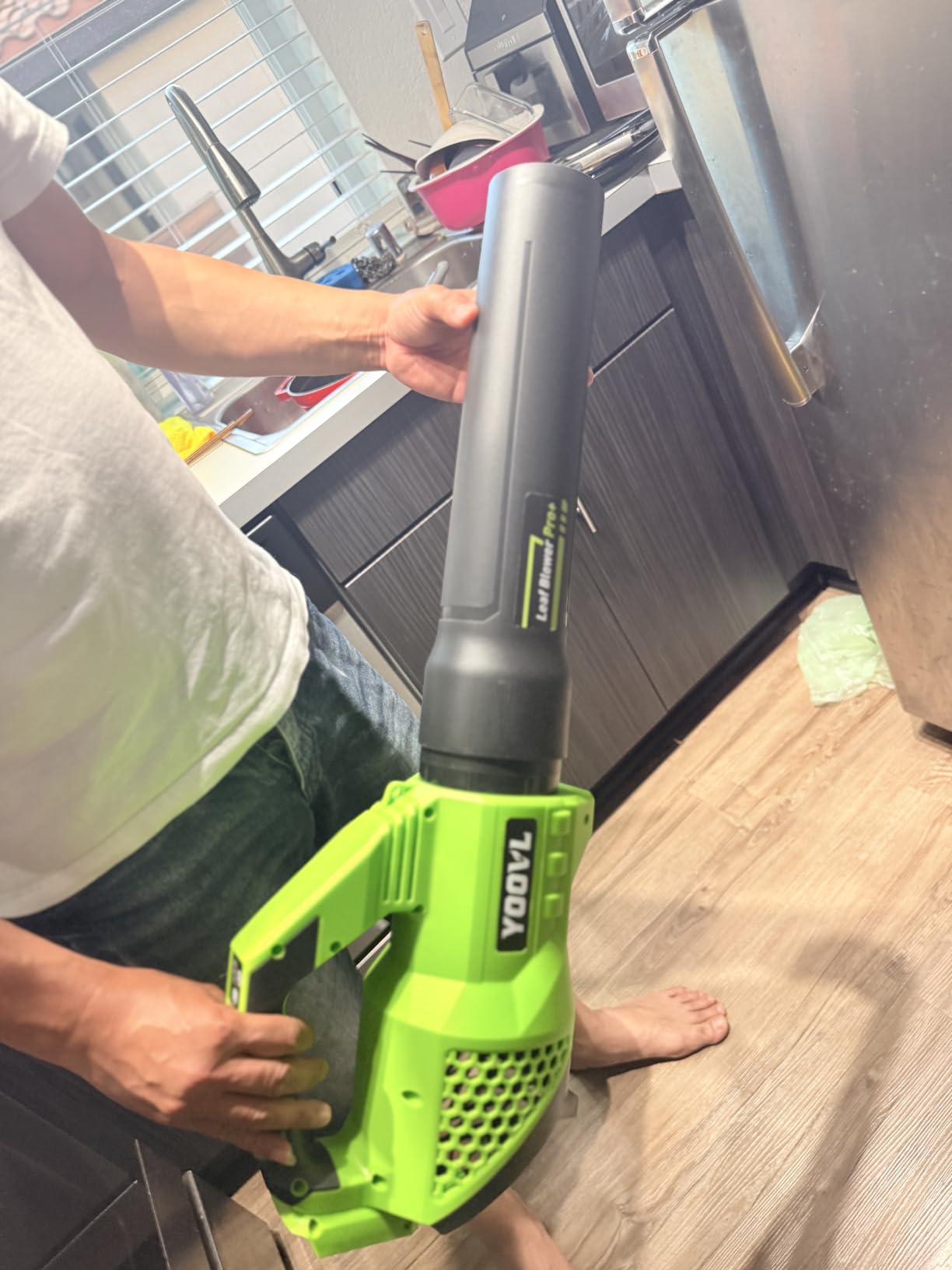
3. YOOVL LB-8184 650 CFM Blower: Most Versatile with Two Batteries
Leaf Blower Cordless, 650CFM Electric Leaf Blowers with 2 x 5.2Ah Batteries and Charger, 3 Speed Modes, 1 x Adjustable Shoulder Strap, Powerful Snow Blowers for Lawn Care, Patio, Dust, Blowing Leaves
Up to 650 CFM on turbo
Two 20V 5.2Ah packs included
Three speed modes
Up to 150 minutes total runtime
Pros
- Two 5.2Ah packs let you swap while one recharges
- Three modes cover dust
- dry debris and wet piles
- Adjustable shoulder strap for longer jobs
- Extension nozzle included for higher reach
- Balanced enough for comfortable one-handed use
Cons
- Several buyers question wet-leaf and pine-needle power
- Single-point shoulder strap clip feels awkward
- No larger batteries or extra chargers offered
- Moves less air than a corded blower
The reason this one makes the list is the bundle, not the headline. Two 20V 5.2Ah packs and a fast charger in the box give you up to 150 minutes of claimed runtime, which is more total air time than several premium units offer with one pack. For intermittent wet-leaf work spread across a weekend, that arithmetic matters.
Three speed modes cover light dust, dry debris and heavy wet piles, and the manufacturer positions the top setting for exactly the soaked-mat case we care about. The adjustable shoulder strap is a genuine inclusion at this tier.
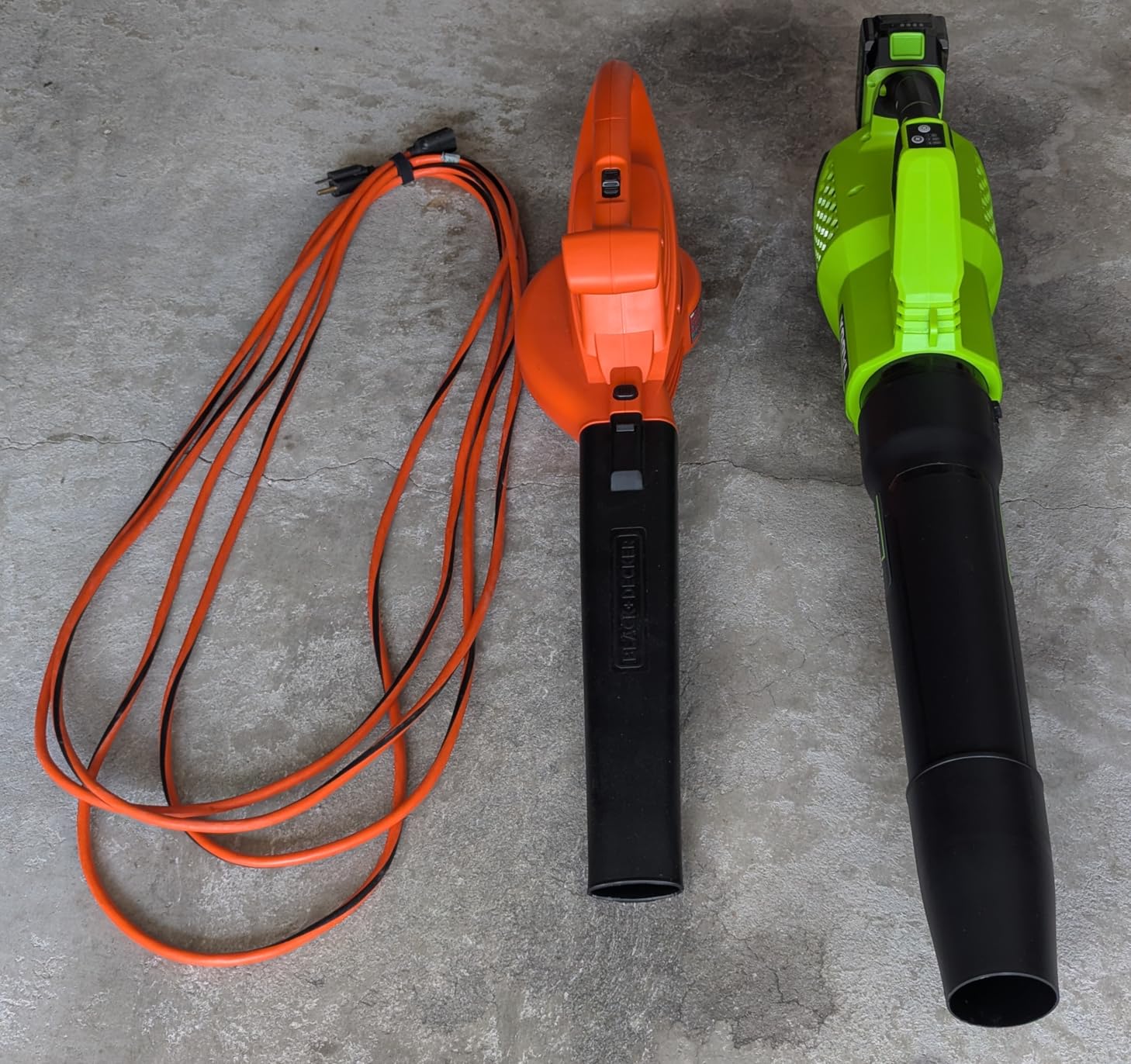
Owners generally find it satisfying for patio and driveway cleanup and like the low weight and quiet operation. The recurring caveat in reviews is raw power: several buyers say it is fine for dry leaves but falls short for pine needles out of grass and for wet, damp piles.
That caveat is the honest one. If your wet-leaf load is a light dusting after a storm, this handles it. If you are clearing a soaked mat that is already stacked, the air speed here is not published in MPH terms at all, and that absence of a figure is itself a signal about how the brand positions the tool.
Who the YOOVL LB-8184 fits
It fits beginners, older users and anyone who wants a second battery without buying packs separately. Dual-pack swaps mean you never wait on a charger during a wet-leaf session, which is the single most common frustration owners report with single-pack blowers.
It also fits small patios and townhome driveways where the leaf load is scattered rather than piled. The three modes give more control than a two-speed design, which helps when you are moving leaves off a car rather than off a lawn.
Where it falls short
Skip it if you have deep matted leaves over a large lawn, or if you need to keep growing the platform later, since larger batteries and extra chargers are not offered. The single-point strap clip also gets uncomfortable sooner than a proper harness-style strap.
Our battery powered leaf blower guide covers more entry-tier options if this tier is right for you.
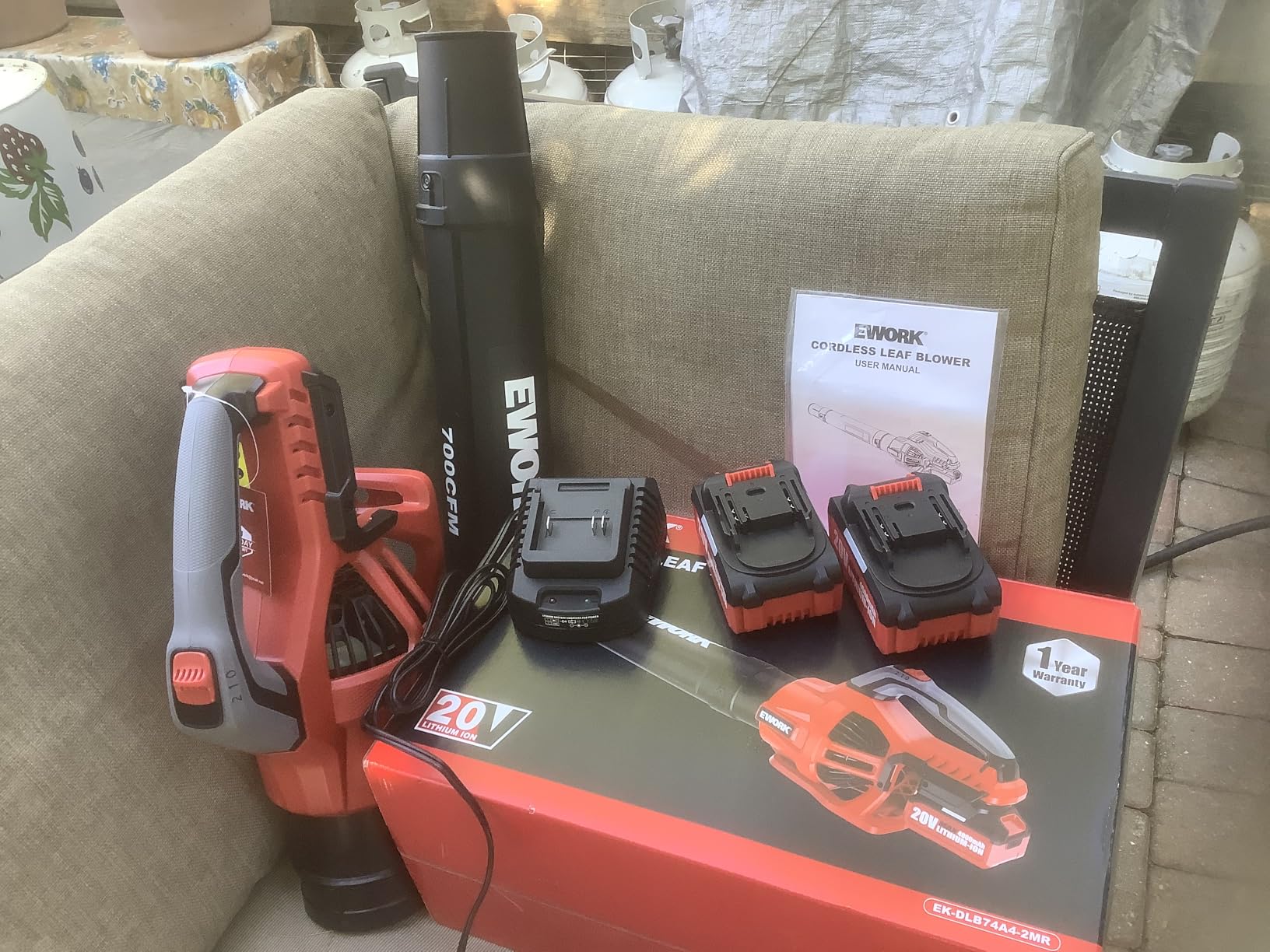
4. EWORK 700 CFM Cordless Leaf Blower: Best Value for 200 MPH Output
EWORK 700 CFM Cordless Electric Leaf Blower with Battery and Fast Charger
700 CFM air volume
200 MPH peak air speed
4.2 lb bare tool weight
Two 20V 4.0Ah packs included
Pros
- 700 CFM and 200 MPH at only 4.2 lb
- Dual 4.0Ah packs plus a 2.2A fast charger
- Adjustable tube length for extra reach
- Overheat and overcharge protection on the packs
- Instant pack swap keeps downtime short
Cons
- Only two speed settings rather than finer control
- Rating mix includes a notable share of one-star reviews
- 20V has less headroom than 40V and 80V rivals on deep wet piles
Published 200 MPH and 700 CFM at 4.2 lb is the most unusual combination in this roundup. Most 200 MPH machines land between 6 and 10 lb. That weight advantage matters more on wet-leaf work than any spec sheet suggests, because a soaked mat forces long passes at full power.
Two 4.0Ah packs and a 2.2A fast charger recharge in about two hours, and the instant swap means you can run one pack down and be back on the pile in seconds. The adjustable tube length extends reach to gutters and higher branches, which reduces how often you need to reposition.
Reviewers point to the airflow, the low weight and the dual-battery convenience as the reason this appeals to households, seniors and users clearing cars, patios and light snow. Overheat and overcharge protection are called out as sensible for a tool that will sit in a damp garage.
The negatives are consistent and worth weighing. Two speed settings is coarse next to a variable trigger, and the 20V platform has less headroom than 40V and 80V rivals when you hit a genuinely deep wet pile. The rating spread also includes a noticeable share of one-star reviews, which usually points to long-tail failures rather than a bad design.
Who the EWORK blower fits
It fits users with joint or grip issues who want real air speed without a 9 lb tool in the hand. It also fits anyone who wants 200 MPH output and dual-battery convenience without committing to a 40V or 80V platform.
Reviewers confirm it handles wet leaves, dust, garage grime and light snow, which makes it a genuine four-season tool rather than a dedicated autumn purchase.
Where it falls short
Skip it if you want fine-grained speed control for delicate work, or if your leaf load is stacked deep enough that 20V headroom becomes the binding constraint. Two-speed operation also makes it a poorer fit for car washing, where a gentle low setting matters.
Compare it against the gas leaf blower options if you plan multi-hour sessions on a large property.
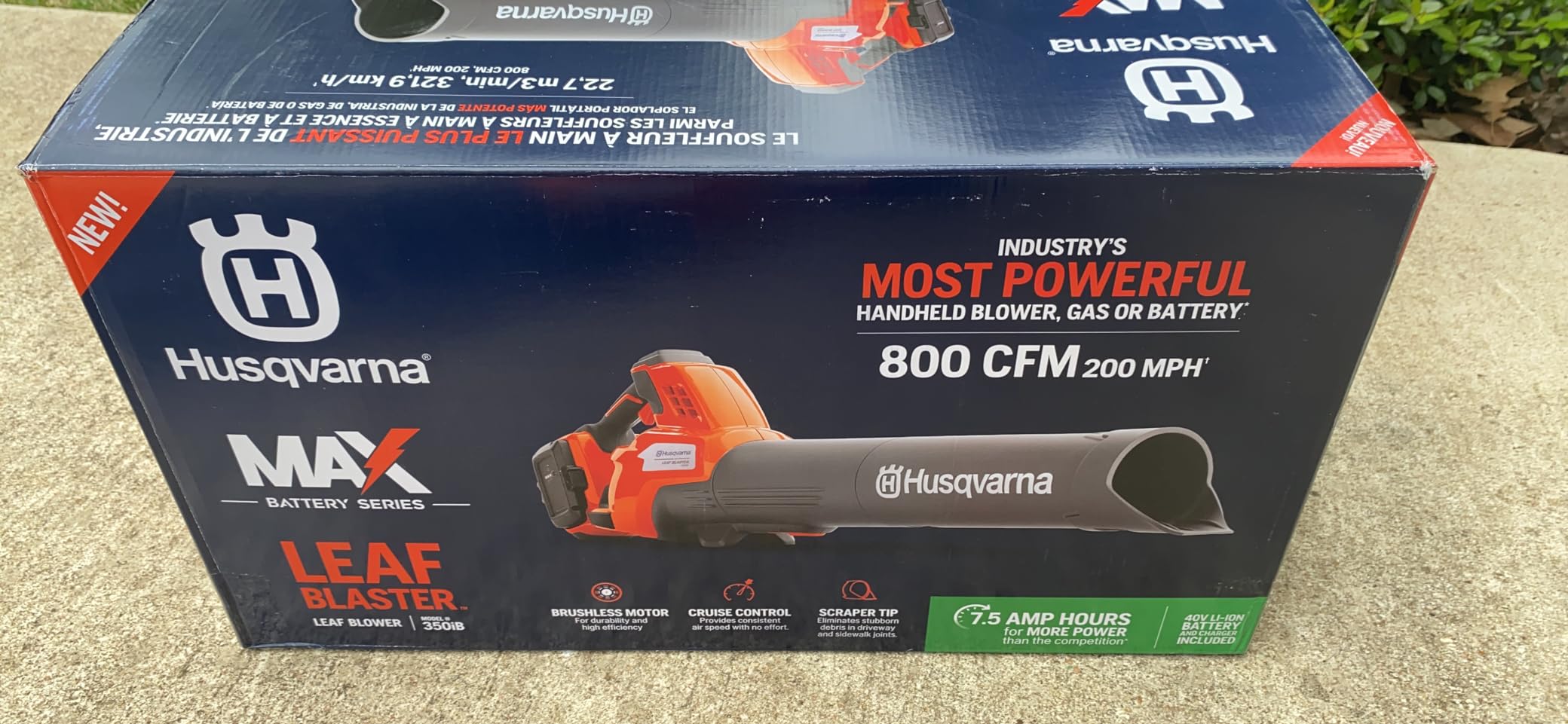
5. Husqvarna 350iB 800 CFM Blower: Best for Daily Professional-Style Use
Husqvarna Leaf Blaster 350iB Leaf Blower Cordless, with Battery and Charger
800 CFM air flow
200 MPH wind speed
10 lb with battery
65 dB published
Pros
- 800 CFM and 200 MPH from a brushless motor
- Power boost adds roughly 20 percent more output
- Built-in debris scraper loosens wet sticky leaves
- Fully variable trigger with cruise control
- Quiet enough that some owners skip ear protection
Cons
- About 10 lb with the battery in hand
- No shoulder strap included in the box
- Additional battery is expensive on its own
- Turbo drains the pack quickly
- Slower charging than comparable 40V rivals
This is the highest published air volume in the group at 800 CFM, paired with 200 MPH, and it is the pick for people who clear wet debris every week rather than twice a year. The fully variable trigger is the detail owners praise most, because it makes light garage work possible in a way a two-speed gas blower never allowed.
Two wet-leaf-specific features stand out. Power boost mode adds roughly 20 percent more output for stubborn debris, and the built-in debris scraper is designed to loosen wet, sticky leaves before you blow them. Reviewers regularly compare this machine favorably to their former gas blowers.
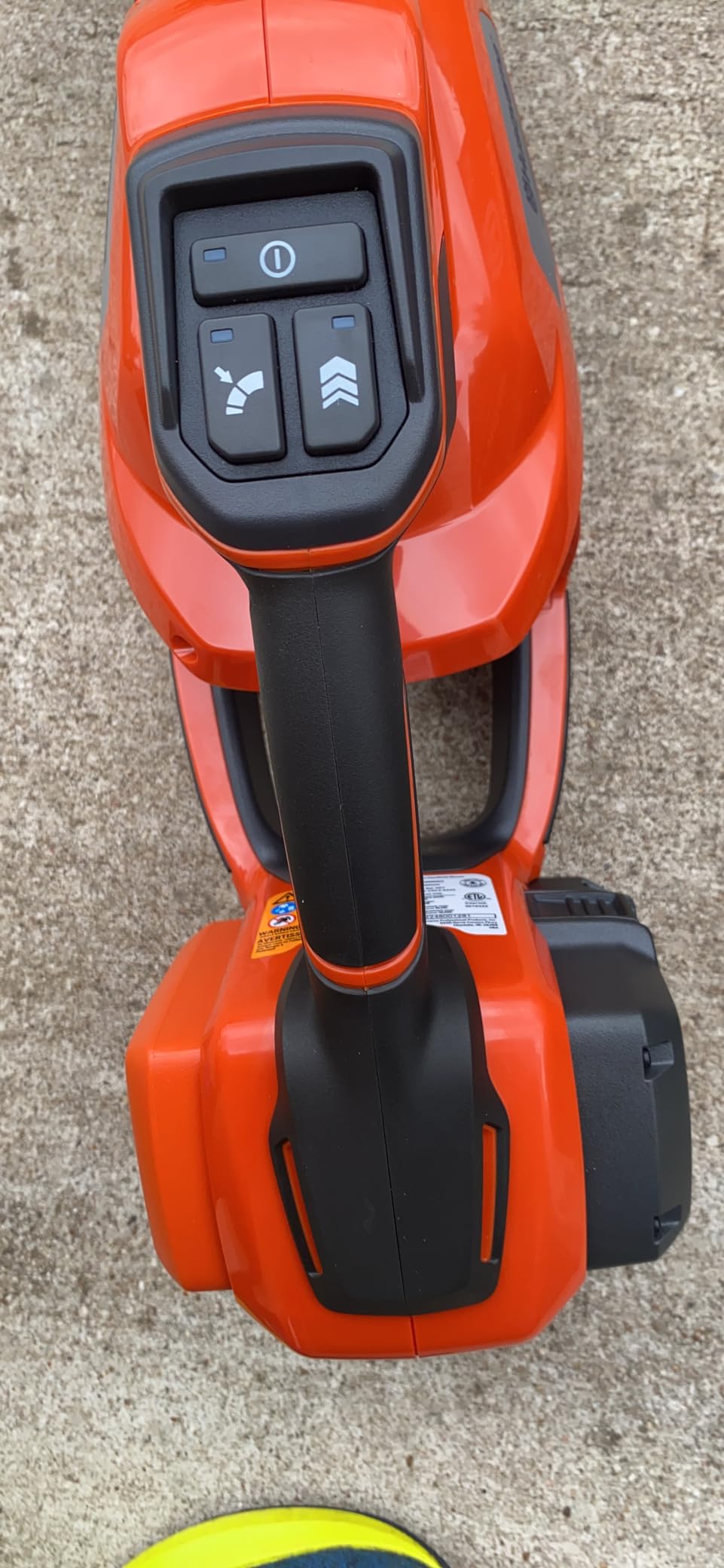
At a published 65 dB it is also quieter than most gas equipment, and some owners report not needing ear protection at all. The keypad start and dedicated power-on button prevent the accidental blow-off that plagues handhelds.
Weight is the single most repeated complaint. At roughly 10 lb with the battery installed and no strap in the box, it gets tiring, and users immediately ask for a shoulder strap or backpack frame they have to buy separately. A small number of reviewers also report battery or charger failures within months and a difficult support path.
Who the Husqvarna 350iB fits
It fits landscaping crews and property managers who need wide, variable output across mixed jobs in a single session. The 800 CFM ceiling also fits owners of half-acre-plus lots with mature oak and maple.
The variable trigger with cruise control suits long runs where a locked setting would waste battery. If you already run Husqvarna 40V BLi30 equipment, the included 7.5Ah pack is a large capacity that carries well past the average pack size in this group.
Where it falls short
Skip it for small patios, for users with wrist or shoulder issues, or if you need a single machine for delicate low-speed work and heavy wet clearing without a mode that does both. The weight without a strap is the deciding factor for most single-hand users.
Households that already own other platforms should read our large yard cordless blower picks before committing.
6. Greenworks 40V 550 CFM Brushless Blower: Best for Reusing Existing Packs
Greenworks 40V Electric Leaf Blower, 550 CFM, 4.0 Ah Battery and Charger
550 CFM air volume
130 MPH wind speed
5.1 lb bare tool weight
78 dB published
Pros
- 550 CFM and 130 MPH clears wet leaves and gravel
- Pack fits 75+ Greenworks 40V tools
- Variable trigger plus a turbo button
- Rear intake no longer grabs loose clothing
- 78 dB suits early morning cleanup
Cons
- Full recharge takes about two hours
- Turbo noticeably shortens runtime
- Some owners report packs refusing to recharge
- Can feel heavy for smaller users after long sessions
The wet-leaf story here is the 78 dB figure. Among the picks that publish a noise number, this is the quietest, and reviewers specifically call out that it is quiet enough for early-morning cleanup. Wet-leaf work happens on damp mornings when neighbors are most likely to object, so that matters.
Power is adequate rather than spectacular: 550 CFM and 130 MPH. Owners running Greenworks 40V equipment rate it highly for extending that platform cheaply into leaf clearing, and they confirm wet leaves and twigs are well handled on both high and turbo settings.
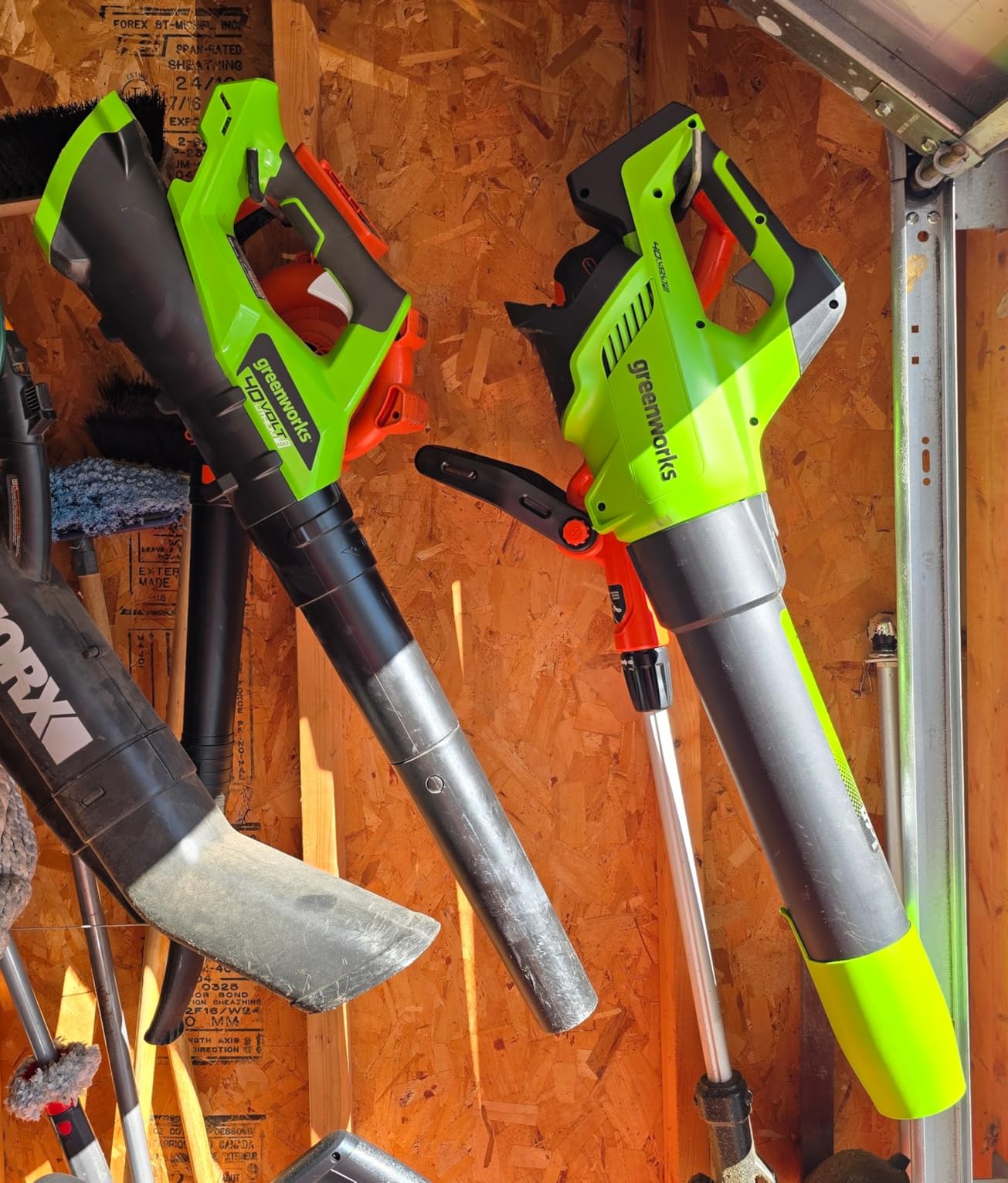
The 5.1 lb body and cruise control reduce arm fatigue, and the rear intake placement avoids the shirt-grabbing problem several competing designs have. A charge-level button on the pack removes the guesswork about whether you have enough for another pass.
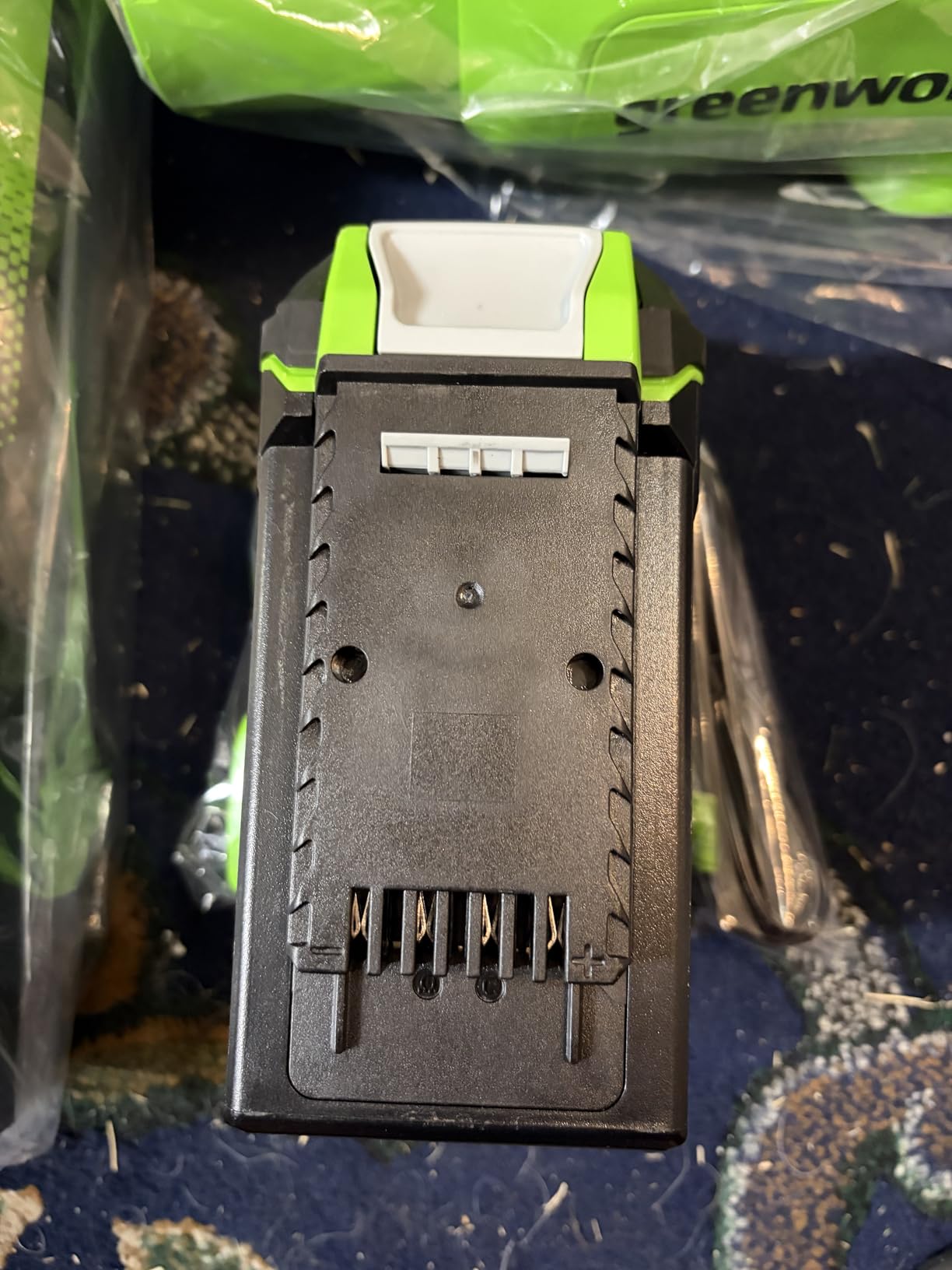
Runtime is the tradeoff: about 20 minutes on the included 4.0Ah pack, with turbo shortening that noticeably, and a full recharge taking roughly two hours. A few owners report Greenworks 40V packs that failed and would not recharge, which tempers otherwise strong sentiment.
Who the Greenworks 40V blower fits
It fits owners of Greenworks 40V mowers and trimmers who want one pack family across the whole yard. It also fits noise-sensitive households cleaning up at first light on weekend mornings.
It is the sensible pick for scattered leaves on a driveway or patio rather than a deep mat on a lawn, where the extra air speed of a 200 MPH machine would pay off.
Where it falls short
Skip it for deep soaked mats, for properties where two-hour recharge cycles will interrupt the job, or if you have no existing Greenworks 40V tools and would be buying a platform from scratch.
If you already run a 40V platform from another brand, the cross-brand comparison matters more than any single spec; our battery powered leaf blower picks break down the platforms side by side.
7. Greenworks 80V 770 CFM Axial Blower: Best for Big Yards
Greenworks 80V Electric Leaf Blower, 770 CFM, 4.0 Ah Battery and Charger
770 CFM air volume
180 MPH wind force
6 lb bare tool weight
74 dB published
Pros
- 770 CFM and 180 MPH from a brushless motor
- Variable speed from 20 to 180 MPH with cruise control
- 6 lb frame runs about 30 percent lighter than gas
- 74 dB suits neighborhood cleanup
- 4.0Ah pack and fast charger included
Cons
- Fewer reviews than 40V and premium rivals
- 80V packs and chargers cost more than 40V
- 80-minute runtime figure comes from a 50 percent load test
This is the endurance pick. Buyers describe the 770 CFM and 180 MPH output as comparable to a 27cc gas engine, at 6 lb and roughly 30 percent lighter than gas blowers, with zero emissions and a published 74 dB. That combination is why it appears in large-property discussions.
Variable speed runs from 20 to 180 MPH with cruise control, which reviewers call out as the feature that makes sustained work less tiring. Wide speed range means you can sort leaves without pinning the trigger, and turbo handles the wet pile when you get to it.
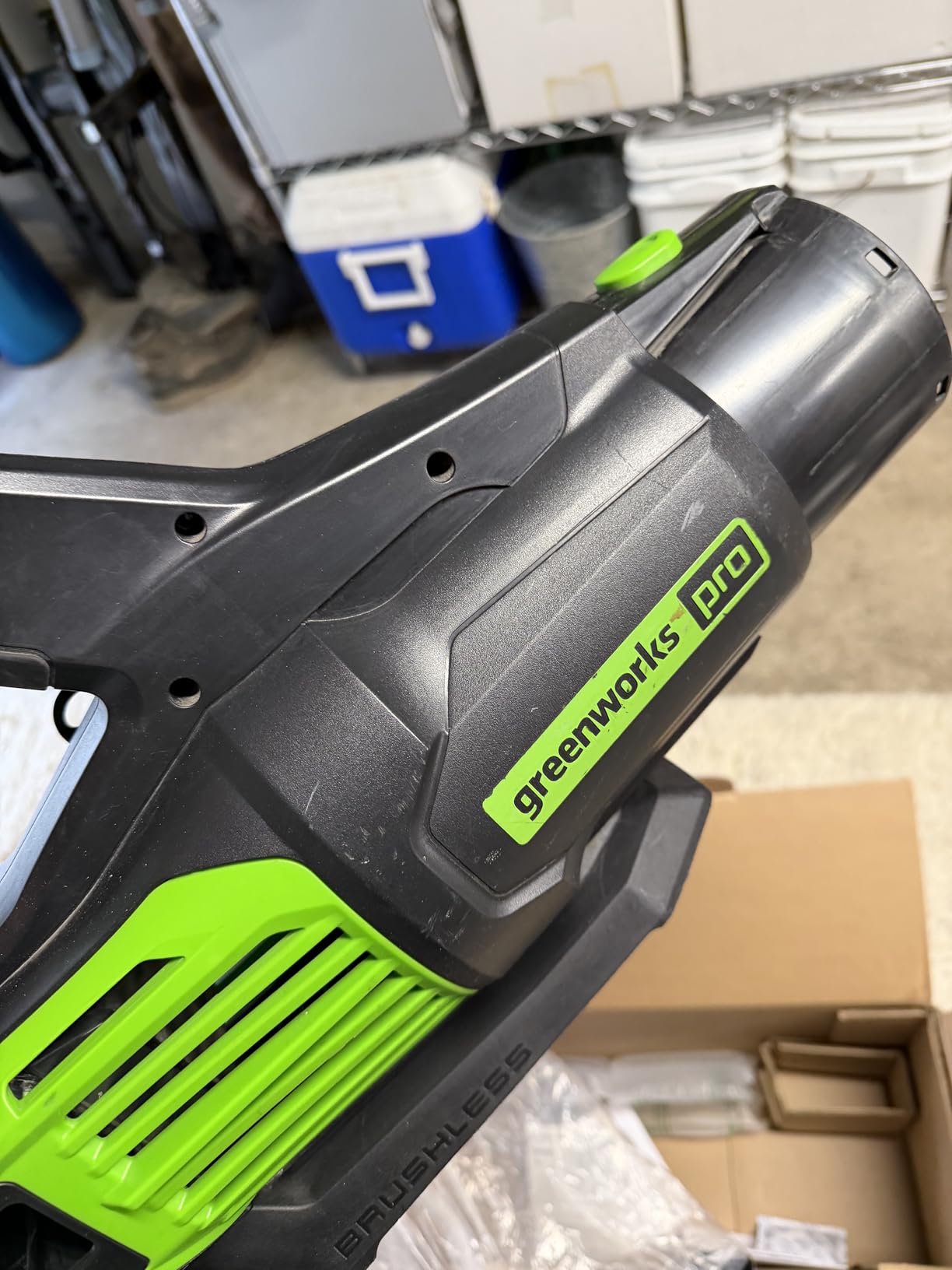
The brushless motor is claimed at about 30 percent more torque than a brushed motor and a 50 percent longer lifespan, and the axial housing is the same design language Greenworks uses on its higher-end machines.
Be careful with the runtime figure. The 80 minutes per charge published for the included 4.0Ah pack is a tested figure at 50 percent load, so heavy wet-leaf work at high and turbo settings will run shorter than that. And the 80V platform carries a higher cost per pack than the 40V alternatives, which matters if you need more than one.
Who the Greenworks 80V fits
It fits owners of half-acre to acre properties with mature trees and long leaf seasons, and crews who want gas-class output without exhaust or fuel handling. The 74 dB figure keeps it viable in neighborhoods.
It also fits buyers who value the range: 20 MPH for careful work, 180 MPH for soaked mats, all from one tool. If you already own Greenworks 80V equipment, this extends that platform rather than starting a new one.
Where it falls short
Skip it if the leaf load is light and you will rarely run turbo, since the 80V pack cost is hard to justify on occasional use. Buyers who need long-term durability confidence should also note this listing carries fewer reviews than its 40V sibling and the premium blowers here.
Owners who need a carry system should compare against our backpack blower recommendations.
8. FAOGO RL-008 Cordless Leaf Blower: Best for Light Duty and Low Weight
990,000 RPM Cordless Leaf Blower with 2 Batteries & Charger – Electric Handheld Blower, Lightweight, Double Run Time for Lawn, Yard, Patio, Garden Cleaning Green 1
990000 RPM turbo motor claim
Two batteries plus charger
26+ minutes total runtime
Storage bag included
Pros
- Very light with an anti-slip one-hand grip
- Two batteries and a charger in the box
- Storage bag and two extension interfaces included
- Battery overheat protection while charging
- Handles light snow plus patios and gardens
Cons
- No published CFM or MPH figure to compare
- 26+ minutes total is short for a large yard
- Review history is short and new
- Headline specification is RPM rather than airflow
We include this one with a clear caveat. Its 4.9 average across 309 reviews is the highest in the group, and owners love the weight, the dual batteries and the included storage bag. But it publishes no CFM and no MPH figure, so there is no way to place it against the other seven on the metric that matters most for wet leaves.
The headline claim is a 990000 RPM turbo motor, marketed as three times stronger than standard models in the same line. RPM is a motor-speed number, not an airflow number, and it cannot be converted into CFM without knowing the fan diameter and housing geometry, which the brand does not publish.

What owners actually praise is practical: it is lighter than a laptop, the anti-slip ergonomic grip supports one-handed use, and the two extension interfaces reach roofs and gutters. Reviewers point to it as an easy tool suitable for a range of users including older people.
The most common limitation reported is total runtime of roughly 26 minutes across both packs, which is short for anything beyond a patio. Owners also note the absence of standard airflow ratings, which is exactly the transparency gap that makes comparison hard.
Who the FAOGO RL-008 fits
It fits users who prioritize weight and price above everything, need a one-hand tool for a patio, car or light snow, and want the storage bag and extra batteries included. The 4.9 rating reflects how well it serves that narrower job.
It also fits anyone already holding compatible packs who just wants a second body for occasional wet-leaf touch-ups around a small area.
Where it falls short
Skip it for a matted wet lawn, for any property where 26 minutes of total runtime forces a second session, or if you need to compare the tool on air speed before buying. With no published airflow figure, you are buying on marketing language rather than data.
The 990,000 RPM marketing pattern shows up across unbranded marketplace blowers and is one of the most common reasons we exclude products entirely. This one survived only because the review base and included accessories are genuinely strong.
CFM vs MPH for Wet Leaves: What Actually Moves a Soaked Mat
Rank on air speed for wet leaves, and use air volume as the second filter. Here is how the eight picks sort when you line up published figures.
At the top on air speed: Husqvarna 350iB and EWORK both publish 200 MPH, with EGO LB7654 also publishing 200 MPH in turbo. Greenworks 80V publishes 180 MPH. Greenworks 40V publishes 130 MPH. Milwaukee M18 FUEL publishes 120 MPH. The YOOVL publishes no MPH figure at all, and the FAOGO publishes no CFM or MPH at all.
On air volume the ranking reshuffles: Husqvarna 800 CFM, Greenworks 80V 770 CFM, EGO 765 CFM, EWORK 700 CFM, YOOVL up to 650 CFM, Greenworks 40V 550 CFM, Milwaukee 450 CFM.
The inversion worth noticing: the Greenworks 80V and the EGO LB7654 sit close on volume but differ by 20 MPH on speed. In dry-leaf terms that gap is invisible. In wet-leaf terms it is the whole job, because the EGO is getting under the mat while the Greenworks is still pushing volume at it.
Milwaukee is the reverse case. Its 450 CFM is the lowest here and its 120 MPH is the second lowest, yet owners report it handling wet leaves well. The explanation is weight and platform, not specs. At 6.7 lb you can hold the nozzle where the airflow is most useful for longer, and on a single M18 pack you can afford to work in short bursts rather than conserving.
Newtons of blowing force would be the cleanest single comparison metric, since it blends speed and volume, but only one brand in this group publishes it, so it does not help you choose across the field.
Battery Runtime and Platform Choices for Wet-Leaf Work
Runtime is where wet-leaf jobs actually break down, because turbo is the setting the job demands and turbo is the most expensive power draw on the tool.
Published figures show the spread. The EGO LB7654 runs about 15 minutes on turbo per charge. The Milwaukee M18 FUEL drains a pack in roughly 10 to 15 minutes at full speed. Greenworks 40V gives about 20 minutes on the included 4.0Ah pack, with turbo shortening that noticeably. The Greenworks 80V publishes up to 80 minutes, but that is a tested 50 percent load figure rather than a heavy wet-leaf number.
Multiply that out for a single driveway. Four 10-minute turbo bursts on the Milwaukee, four pack changes. On the EGO, four 15-minute bursts. On the Greenworks 80V, far fewer swaps under mixed load. The unit that looks slow on paper may finish the job first.
Platform matters as much as capacity. If you already own Milwaukee M18 packs, the M18 FUEL is the strongest wet-leaf answer you can buy without new batteries. The same logic applies to DeWalt 20V MAX, Makita 18V LXT, Ryobi 40V and EGO 56V ARC Lithium ecosystems, even where we did not list a unit from that brand in the top slots.
On the 20V versus 40V question: a 20V platform such as the EWORK or YOOVL can publish 200 MPH and 700 CFM, so voltage alone does not decide wet-leaf capability. What 20V gives up is headroom on deeply stacked piles and the capacity to hold turbo for long stretches, because the packs are physically smaller.
Plan on two packs minimum for any wet-leaf session, and keep a third charging if the leaf mat is thick. Budget for a spare pack rather than a faster charger, since downtime on wet work is pack count, not charge speed.
How to Blow Wet Leaves: 5 Steps That Save Battery
Technique changes how much turbo you need. Five steps, in order.
Wait for a partial dry window if you can. Leaves that have drained but not re-wet are dramatically easier to move than leaves that are still soaked. Even a few hours of wind helps.
Work with the wind, not against it. Blowing into a wind makes you push the mat back into the pile. Quarter into the wind and let it do half the work.
Attack the edge of the mat first. Start at the perimeter and peel the layer back in a wave. Loading the whole pile at once creates a heap too heavy to move.
Keep the nozzle low and angled forward. A low pass along the surface gets under the leaf. Angling down pushes onto the grass and lifts nothing.
Use turbo in bursts, not continuously. Sweep at medium speed, then burst to turbo only when the load stalls. Holding turbo on the whole pass is how a 15-minute pack becomes a 6-minute one.
Owners on forums consistently report that multiple passes are required for leaves matted into the lawn regardless of blower. Power changes how many passes; it does not remove them.
What Manufacturers Do Not Tell You About Wet Leaves
No manufacturer publishes a wet-debris rating. There is no standard test, no minimum air-speed threshold for saturated leaves, and no category on any spec sheet for wet material. Every recommendation in this roundup is therefore built on published air speed, air volume and weight, plus owner reports, and we are not inventing a threshold the industry does not provide.
Second, peak MPH and peak CFM are measured separately on almost every machine in this group. A headline like 200 MPH and 765 CFM describes two different test conditions, not one simultaneous output.
Third, advertised runtime is rarely a wet-leaf runtime. Published figures are typically a low or 50 percent load. Turbo at full output on a soaked mat draws far more than that.
Fourth, RPM is not airflow. Blower listings that lead with a million-plus RPM figure are describing motor speed, not how much air leaves the nozzle, and the two cannot be compared across brands.
Finally, leaf depth is the real limiting variable. Owners report a long-term Ryobi user describing the tool as moving wet leaves as long as they are not stacked too deep. No amount of CFM fixes a pile that is two feet tall, and that is a raking or mulching job.
Buying Guide: Matching a Blower to Your Yard and Leaf Load
Before you buy anything, measure the leaf layer. Under roughly half an inch on a lawn, a mulch-mow pass handles it and a blower is unnecessary. Piled, matted or deep leaves want a rake, a mulcher or a 3-in-1 vac, not more air speed.
For a scatter of wet leaves on a driveway or patio under a quarter acre, light weight matters more than output. The EWORK at 4.2 lb and the Greenworks 40V at 5.1 lb are the practical choices, and the Milwaukee at 6.7 lb is a good middle.
For a suburban lot with mature trees and a real soaked mat, go after air speed. The EGO LB7654 and Husqvarna 350iB both publish 200 MPH, and they handle the job differently: the EGO has more volume, the Husqvarna more control and a scraper.
For half an acre and up, or for anyone doing this weekly, weight stops being a preference and becomes an injury risk. That is where a backpack format or the 6 lb Greenworks 80V makes sense, and where gas equipment still competes on endurance. Multi-hour sessions on a single battery are where cordless still loses.
Noise tolerance should drive your choice if you plan early-morning work. Among picks with published figures, the Greenworks 40V at 78 dB is quietest on paper, and the EGO at 64 dB and Husqvarna at 65 dB sit at the low end of the high-output class. Treat published dB as a relative comparison rather than a neighborhood prediction.
Handheld versus backpack is a fatigue decision. Handhelds win on price, storage and car use. Backpacks win on anything past an hour of continuous wet-leaf work, because the load moves from your wrist to your shoulders. Our backpack guide covers that format in more detail.
Finally, buy the platform you can grow. Two packs on the platform you already own beats one premium blower on a platform you have to start from scratch, and it is the filter that forum buyers apply first.
Frequently Asked Questions
Do leaf blowers work with wet leaves?
Yes, but only if the blower publishes enough air speed. Wet leaves are heavier than dry ones and adhere to the surface beneath them, so high-CFM low-speed air pushes them around instead of moving them. Blower air speed of 180 MPH or more is the practical threshold for soaked mats, and leaf depth is the real limit once a pile gets deep.
Is CFM or MPH more important for wet leaves?
MPH matters more. CFM tells you how much air moves, which sweeps loose dry debris, while MPH tells you how fast air leaves the nozzle, which gets underneath a wet leaf and breaks its grip on the grass. Rank on air speed first, then use CFM as the second filter. Note that peak MPH and peak CFM are rarely measured at the same setting.
Can you use a leaf blower when leaves are wet?
You can, with two conditions. First, run the nozzle low and angled forward so air gets under the leaf rather than pushing down on it. Second, budget for pack swaps, because turbo on wet material drains a battery far faster than published low-load runtime figures suggest. Attack the edge of the mat first rather than the center.
What are the key differences between a 20V and 40V leaf blower?
A 40V pack holds roughly twice the energy of a 20V pack, so it runs longer at turbo and has more headroom on deeply stacked wet material. A 20V blower can still publish 200 MPH and 700 CFM, so voltage alone does not decide capability. Choose 20V if you need low weight and dual-pack swaps, and 40V if you clear heavy soaked mats in one pass.
Is it better to rake leaves or use a blower?
If the layer is under roughly half an inch and matted into a lawn, a mulch-mow pass is better and faster than blowing. Rake or mulch piles that are deep enough to stand in. Blower only when the leaves are scattered on a hard surface, or when the layer is thin enough to move in one or two passes without undoing your grass work.
Can you vacuum wet leaves with a leaf vacuum?
Yes, but expect clogging on wet material and watch the impeller. Wet leaves are heavier, so bags fill faster and the tube clogs sooner than in dry conditions. Stop and clear the tube rather than pushing through, and empty the bag before it packs solid. Owners report impeller damage on several vacuum-mulch models when run with wet debris.
Final Verdict: Best Cordless Leaf Blowers for Wet Leaves in 2026
Our pick for the best cordless leaf blowers for wet leaves is the Milwaukee M18 FUEL 120 MPH blower. It pairs enough air speed to shear a damp mat with the lightest body in the high-output class, and if you own M18 packs already it is the fastest path to a working wet-leaf setup.
Take the EGO LB7654 when you want the highest air speed and do not mind holding the turbo button. Take the EWORK when 200 MPH at 4.2 lb matters more than platform growth. Take the Husqvarna 350iB for weekly work you cannot put down.
Before any of them, check your leaf depth. If the mat is thin and scattered, almost any of these will do the job.


