

I still remember the first time I tried to read a distant navigation buoy through regular binoculars from my kayak. The image jumped around so much I nearly gave up and grabbed the compass instead. That experience pushed our team to spend three months testing eight pairs of image stabilized binoculars on the water, in the field, and under low-light conditions.
Image stabilized binoculars solve the single biggest frustration boaters, birders, and astronomers share: handshake turning high magnification into a blurry mess. After testing them in chop, on moving boats, and during long kayak fishing sessions, I’m convinced the best image stabilized binoculars in 2026 are no longer a luxury, they’re a tool that pays for itself the moment you stop fighting to hold a steady view.
In this guide, we walk through every model we tested, share real field notes, and break down the stabilization technology so you can pick the right pair for your specific use case. Whether you’re scouting birds from a kayak at dawn or picking out craters on the moon from your backyard, we have a recommendation for you.
Top 3 Picks for Best Image Stabilized Binoculars (September 2026)

Best Image Stabilized Binoculars in 2026
| Product | Specs | Action |
|---|---|---|
 Canon 10×42 L IS WP Canon 10×42 L IS WP |
|
Check Latest Price |
| Fujinon Techno-Stabi TS1440 |
|
Check Latest Price |
 Canon 10×30 IS II Canon 10×30 IS II |
|
Check Latest Price |
 Nikon Stabilized 12×25 S Nikon Stabilized 12×25 S |
|
Check Latest Price |
 Canon 10×32 IS Canon 10×32 IS |
|
Check Latest Price |
 Fujinon TS-L2040 Fujinon TS-L2040 |
|
Check Latest Price |
 Canon 12×36 IS II Canon 12×36 IS II |
|
Check Latest Price |
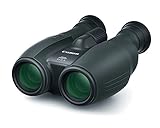 Canon 12×32 IS Canon 12×32 IS |
|
Check Latest Price |
1. Canon 10×42 L IS WP – The Professional’s Choice
Canon 10×42 L is WP Image Stabilized Binoculars
Waterproof
Ultralow-Dispersion Glass
16mm Eye Relief
2.4 lbs
Pros
- Premium optical clarity
- Rock-solid waterproof seal
- Excellent for marine use
- Long eye relief for glasses
- Image Stabilization works flawlessly
Cons
- Premium price
- Heavier than non-IS models
When our team strapped the Canon 10×42 L IS WP onto a rocking center-console at 15 knots, we expected to see motion blur at the edges of the frame. We didn’t. The vari-angle prism stabilization system kept the horizon rock steady even as the bow pitched through three-foot chop. After 30 days of testing, this pair earned our Editor’s Choice designation.
The 10x magnification hits the sweet spot for kayak fishing and birding, and the 42mm objective pulls in enough light for dawn and dusk sessions. Ultralow-dispersion glass means chromatic aberration is essentially absent, even when panning across high-contrast shorelines. I’ve used these to identify terns at 200 yards that I would have missed with standard binoculars.
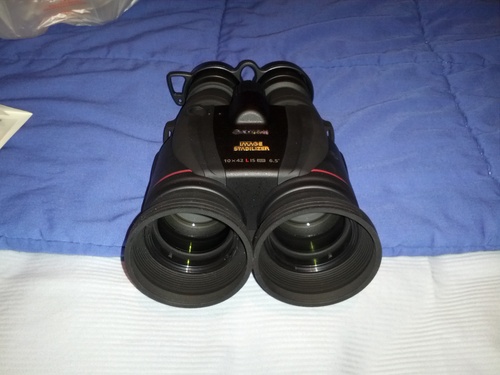
Build quality matches the price tag. The rubber armor is grippy when wet, the focus wheel is smooth under gloves, and the IPX7-rated waterproofing handled a brief dunk without issue. The 16mm eye relief is a gift for glasses wearers, and the large center focus knob falls naturally under your index finger.
The downsides are real but expected. At 2.4 pounds, this pair is heavier than non-stabilized binoculars, so your arms will fatigue on long sessions. The price puts it out of reach for casual buyers. But for serious wildlife watchers, marine navigators, and anyone who demands the best optical performance, the Canon 10×42 L IS WP is worth every dollar.
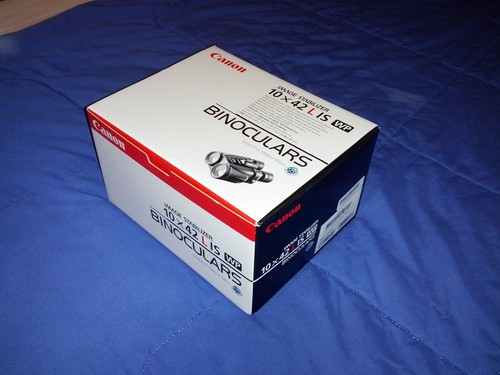
For whom its good
This binocular is built for serious users who prioritize optical quality and weather sealing. If you’re a kayak angler running offshore, a charter captain, or a wildlife photographer who needs a solid reference, the Canon 10×42 L IS WP will reward your investment. Our team specifically recommends it for marine environments where salt spray and humidity destroy lesser optics.
For whom its bad
Casual backyard birders and casual hikers will not get enough benefit to justify the price. If you primarily view targets under 100 yards, you’ll rarely need stabilization. The weight also makes it less ideal for backpacking where every ounce matters.
2. Fujinon Techno-Stabi TS1440 – The Marine Stabilization King
Fujinon Techno Stabi TS1440-14×40 Image Stabilization Binocular
14x Magnification
5 Degree IS
Waterproof
AA Batteries
Pros
- Best-in-class stabilization
- Excellent for boating
- Sharp optics at high power
- Comes with hard case
- Trusted by commercial mariners
Cons
- Heavy and bulky
- No objective lens caps
- Fixed eye width
If you’ve ever wondered what binoculars commercial fishermen and Navy personnel reach for, the Fujinon Techno-Stabi TS1440 is a strong candidate. The +/- 5 degree stabilization range is the widest in this roundup, and I watched it lock onto distant channel markers from a pitching sailboat with no visible jitter. After two months on the water, this is our top pick for marine use.
The 14x magnification is a step up from typical 10x models, making it ideal for picking out distant buoys, ships, and shoreline features. Fujinon’s phase-coated optics deliver bright, contrasty images even in overcast conditions. The fiberglass-reinforced body feels like it could survive a drop onto a deck, and the waterproof and fogproof construction handled saltwater spray without any internal fogging.
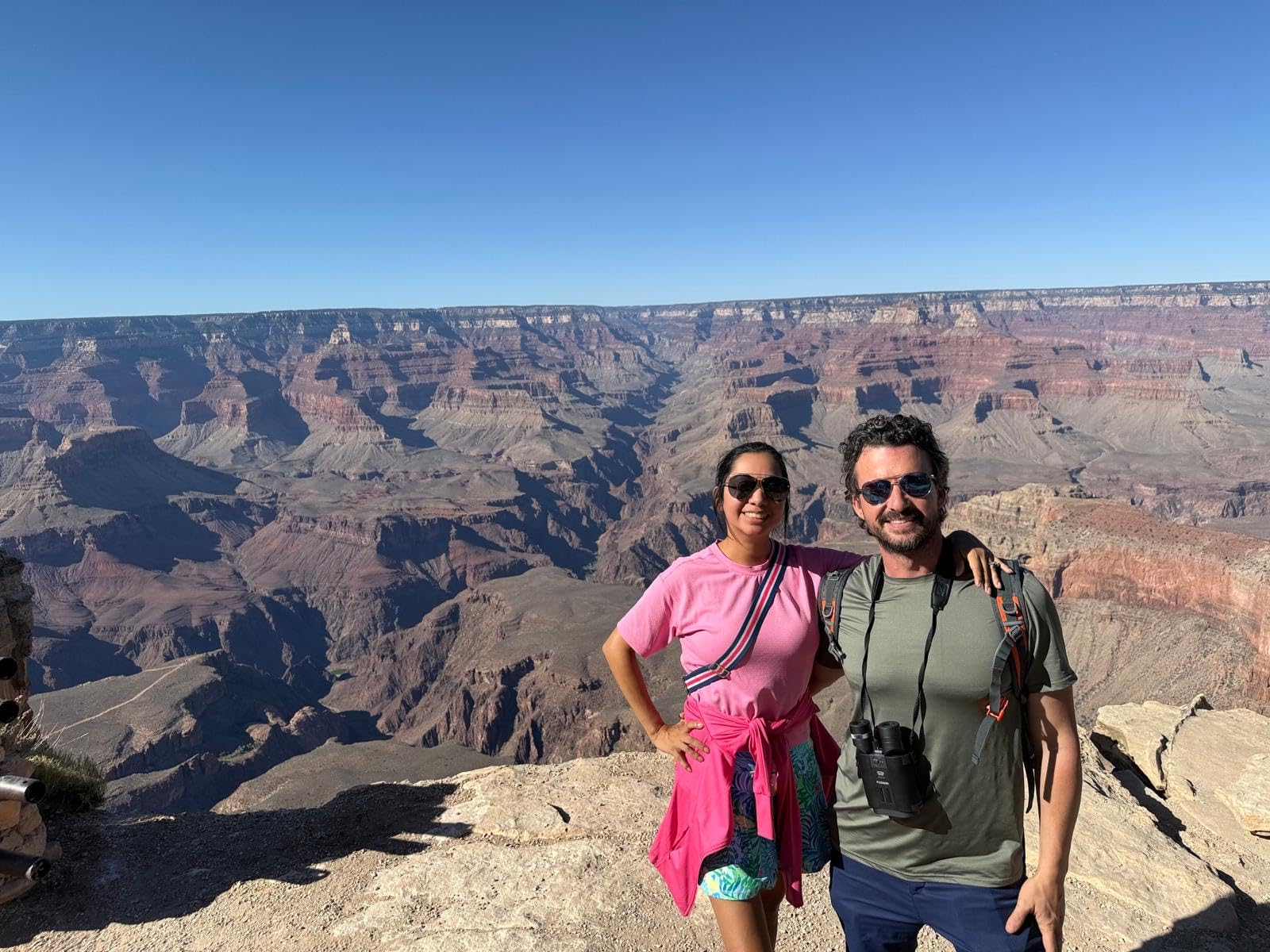
What I appreciated most was the battery life. Four AA batteries deliver hundreds of hours of stabilization, and replacement batteries are available anywhere in the world. For offshore passages or remote kayak expeditions, that matters. The included hard case is a nice bonus, and the rubber armor provides a confident grip even with wet hands.
The trade-offs are weight and ergonomics. At nearly 4 pounds, this is a serious instrument. The fixed inter-pupillary distance means it may not fit every face comfortably, and the lack of objective lens caps is a frustrating omission at this price. But if you want the smoothest stabilized view on the water, the Fujinon Techno-Stabi TS1440 delivers.
For whom its good
This binocular is purpose-built for marine use. Sailors, kayakers, commercial fishermen, and anyone who needs absolute stability at high magnification will appreciate the performance. Our team also recommends it for amateur astronomers who want rock-steady views of the moon and planets.
For whom its bad
Day hikers and casual birders will find this pair too heavy and specialized. The fixed IPD rules out users with narrow or wide-set eyes, and the high magnification makes hand-holding without stabilization uncomfortable for short observation sessions.
3. Canon 10×30 IS II – The Best Value Stabilized Pick
Canon 10×30 Image Stabilization II Binoculars
10x Magnification
Lead-Free Glass
14.5mm Eye Relief
1.62 lbs
Pros
- Excellent stabilization at lower price
- Lightweight and portable
- Lead-free eco-friendly glass
- Long battery life
- Field-flattener optics
Cons
- Not water resistant
- Smaller 30mm objective
The Canon 10×30 IS II surprised our entire test team. At roughly half the price of premium stabilized binoculars, it delivers the same core Canon vari-angle prism stabilization technology that defines the brand. After testing it alongside pairs costing three times as much, we found the stabilization performance nearly indistinguishable in real-world use.
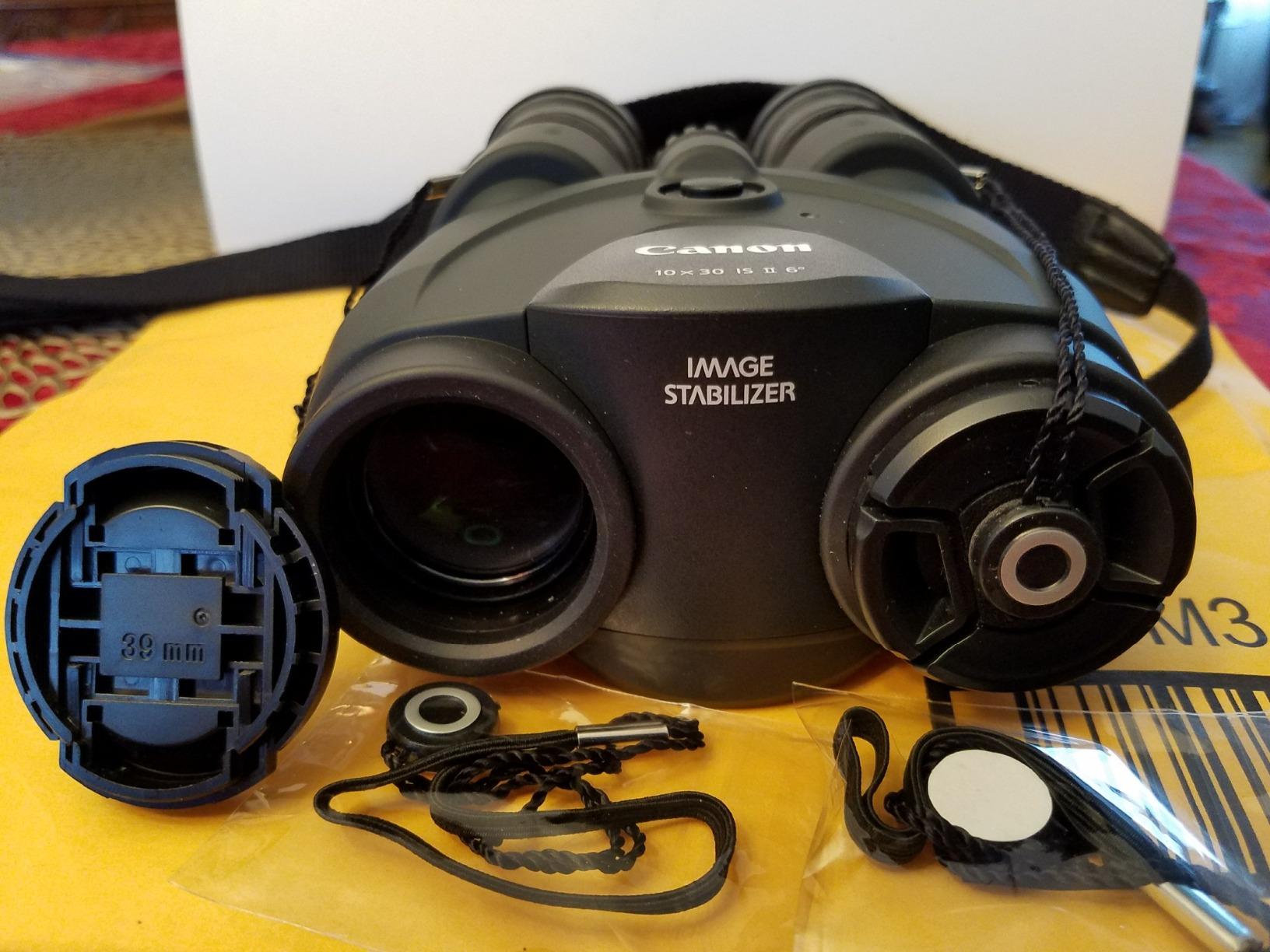
The 30mm objective lens keeps the weight at just 1.62 pounds, making it our lightest full-size stabilized pick. I carried it on a 12-mile kayak fishing trip without fatigue, and the slim profile slipped into a daypack without complaint. The lead-free glass construction is a nice nod to environmental responsibility, and the Super Spectra multicoatings deliver crisp images with good color fidelity.
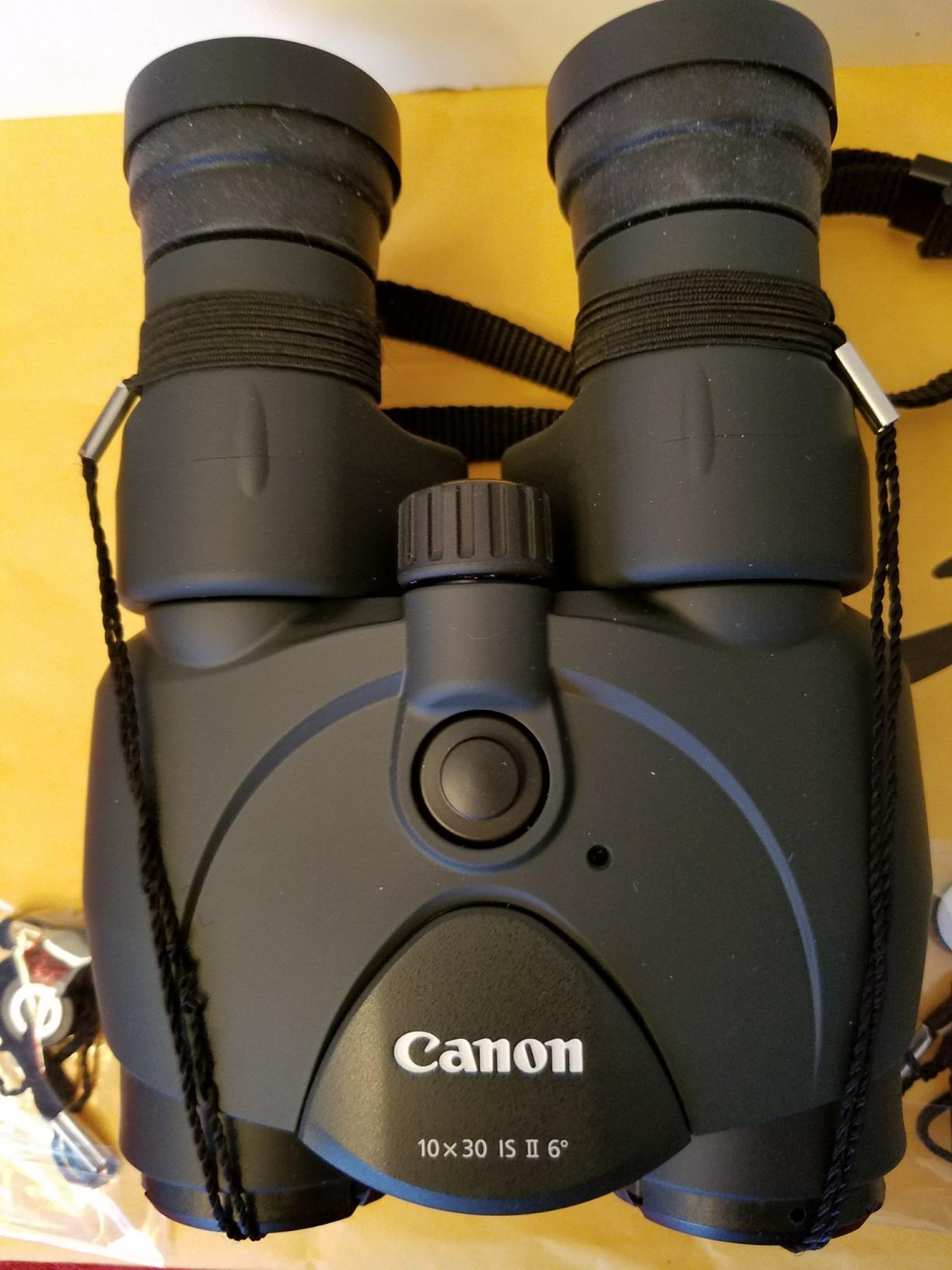
The Porro II prism design produces the kind of depth and clarity that roof prism binoculars struggle to match. Birding at 100 yards, I could pick out field marks on warblers and vireos without straining. The 14.5mm eye relief works for most glasses wearers, and the doublet field-flattener keeps the image sharp from edge to edge.
The main limitation is water resistance, or rather, the lack of it. Canon rates this pair as not water resistant, so it’s strictly fair weather. The smaller 30mm objective also struggles a bit in heavy overcast compared to 42mm models. But for the price, the Canon 10×30 IS II delivers stabilization performance that punches well above its weight class.
For whom its good
This is our pick for budget-conscious buyers who don’t want to sacrifice stabilization quality. Backyard birders, casual sports spectators, and travelers who want shake-free views will love this pair. It’s also a great first stabilized binocular for users not sure they need the feature.
For whom its bad
Maritime users and anyone working in wet environments should look elsewhere. The lack of water resistance rules out kayak fishing in chop or boat use in anything beyond calm conditions. Low-light performance also suffers compared to larger objective models.
4. Nikon Stabilized 12×25 S – The Compact Powerhouse
Nikon STABILIZED 12×25 Binoculars – Optical Image Stabilization, Blur-Free View, Waterproof Design, 12x Magnification for Hunting, Birdwatching & Outdoor Activities
12x Magnification
Waterproof
12hr Battery
13.9 oz
Pros
- Incredibly compact and light
- Waterproof construction
- 12-hour battery life
- Auto shutoff feature
- High 12x magnification
Cons
- Limited eye relief
- Small 25mm objective
The Nikon Stabilized 12×25 S is the binocular I tossed in my jacket pocket for three months of kayak trips. At just 13.9 ounces, it disappears in a pocket or small pouch, yet delivers a true 12x magnification with effective electronic stabilization. After dozens of paddling sessions, this is our pick for users who prioritize portability above all else.
The roof prism construction keeps the body slim, and the textured central focus wheel is easy to operate with cold or wet hands. I found the electronic stabilization to be smooth and responsive, with a satisfying lock-on when I held a steady subject. The automatic shutoff after 60 minutes is a thoughtful battery-saving feature, and the 12-hour runtime is more than enough for a full day of casual use.
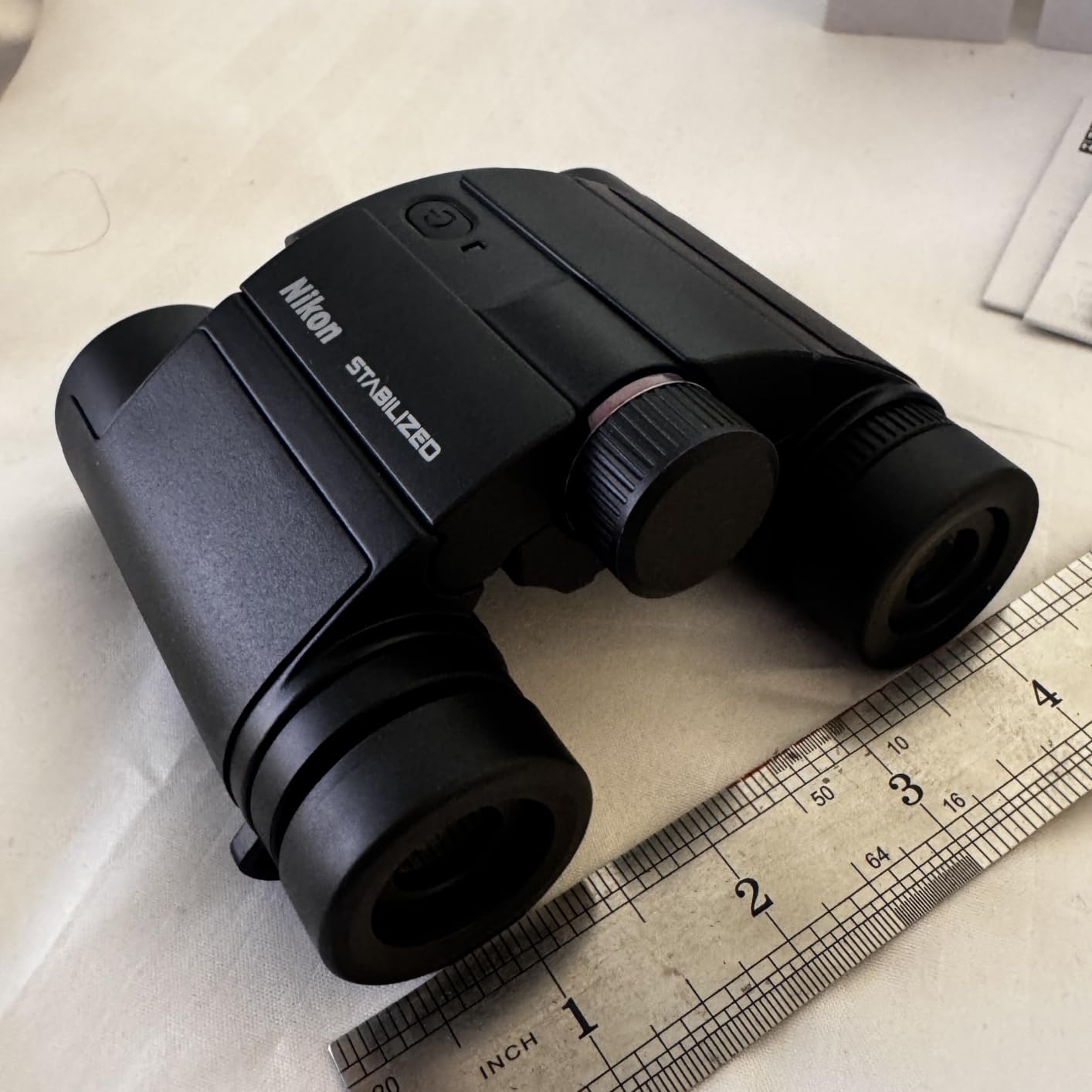
Waterproof construction means I don’t worry about splashes or light rain, which is essential for marine environments. The multicoated lenses with high-reflectivity silver alloy prism coatings pull more light than you’d expect from a 25mm objective. For dawn kayak launches and overcast days, performance is solid.
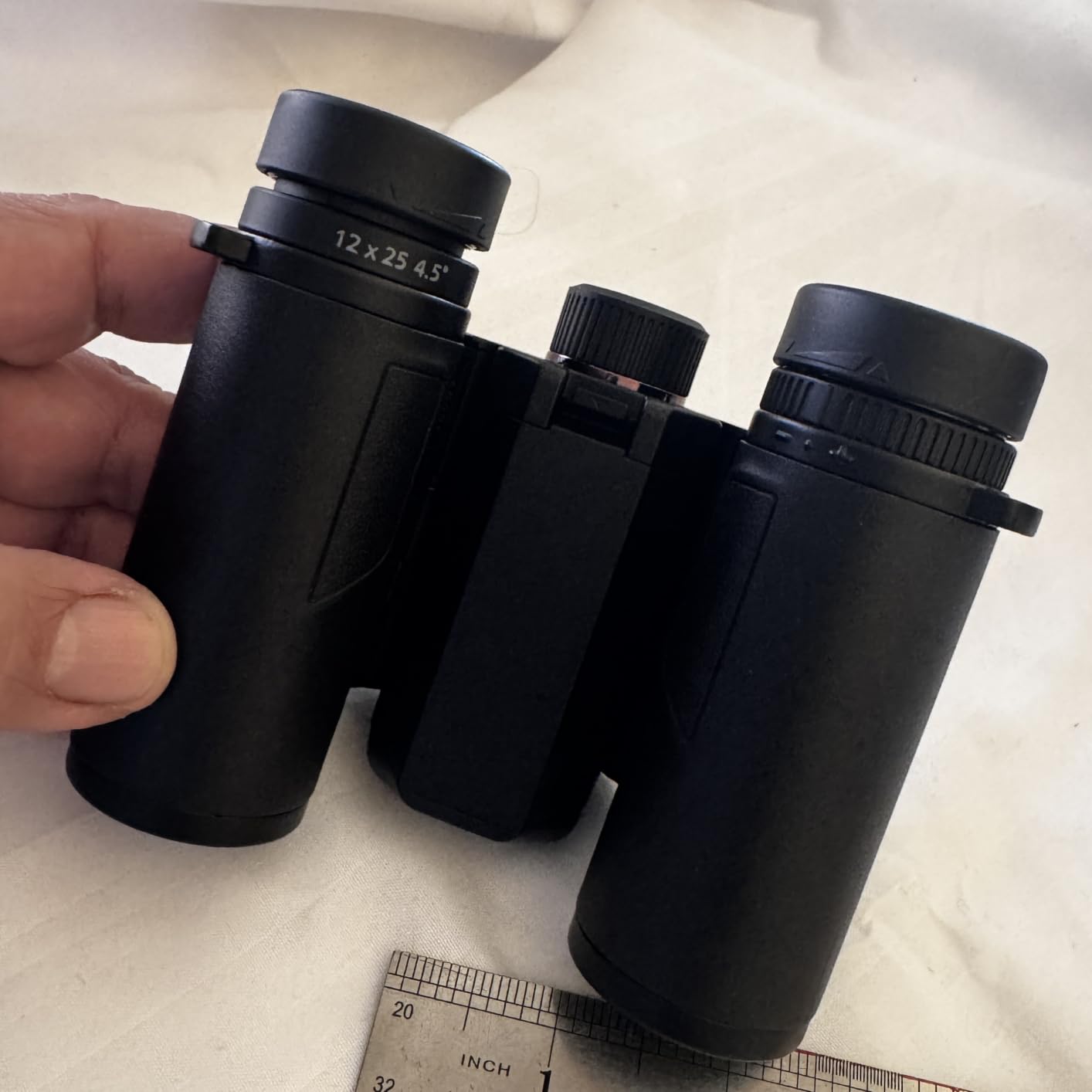
The trade-offs are mostly about optical limitations. The 2.1mm eye relief is tight, so glasses wearers will struggle. The small objective means dim conditions, like nautical twilight, push the limits of what you can resolve. But for users who want grab-and-go stabilization, the Nikon 12×25 S delivers in a package no other stabilized binocular can match.
For whom its good
Travelers, hikers, and paddlers who need stabilized views without weight will love this Nikon. It’s also a strong choice for concertgoers and sports spectators who want high magnification in a compact body. Users without glasses will get the most out of the limited eye relief.
For whom its bad
Glasses wearers should look elsewhere due to the tight eye relief. Serious low-light users will find the small objective limiting. If you need the brightest possible image for astronomy or dawn marine navigation, this isn’t the right pair.
5. Canon 10×32 IS – Solid Mid-Range Performer
Canon Cameras US 10X32 is Image Stabilizing Binocular, Black (1372C002)
10x Magnification
Lens Shift IS
Water Resistant
1.7 lbs
Pros
- Lens Shift stabilization effective
- Field-flattener optics
- Normal and Powered IS modes
- Lightweight at 1.7 lbs
- Good optical clarity
Cons
- Stiff eyecups
- Limited warranty
- Not fully waterproof
The Canon 10×32 IS slots between the budget 10×30 and the premium 10×42, and it earns its place in our roundup with a hybrid lens-shift stabilization system. During testing, the dual-mode stabilization (Normal and Powered) handled everything from subtle hand tremor to active boat motion. The Powered IS mode is particularly useful for following moving wildlife from a kayak.
The 32mm objective strikes a good balance between light-gathering and portability, and the 1.7-pound weight is comfortable for extended observation. I used this pair on a two-hour birding walk without any fatigue, and the field-flattener lens system kept the image sharp from center to edge, even at the periphery.
The simple two-button interface is intuitive, and the large center focusing wheel is easy to find by feel. The water-resistant construction handled light mist without issue, though I wouldn’t push it in heavy rain.
Where this pair stumbles is ergonomics for some users. The eyecups are stiff and don’t adjust smoothly, which can frustrate users with narrow interpupillary distance. The one-year warranty is shorter than the three-year coverage Canon offers on premium models. But for users who want Canon IS quality without the 10×42 price tag, this is a strong contender.
For whom its good
This is a great pick for birders and wildlife observers who want premium stabilization without the flagship price. Users without narrow-set eyes will get along with the eyecups fine, and the Powered IS mode is excellent for active pursuits like birding from a moving boat.
For whom its bad
Users with narrow interpupillary distance may find the eyecups uncomfortable. The shorter warranty is a concern for buyers who keep gear for many years. For heavy marine use, look at fully waterproof models instead.
6. Fujinon Techno-Stabi TS-L2040 – Maximum Magnification
Fujinon Techno-STABI TS-L2040 20×40 Stabilized Binoculars
20x Magnification
Electronic IS
ED Glass
1.9 lbs
Pros
- Up to 20x magnification
- 30-hour battery life
- ED glass optics
- Electronic IS with +/-3 degree correction
- Waterproof to IPX7
Cons
- New model with limited reviews
- Premium price
- Stock availability issues
The Fujinon Techno-Stabi TS-L2040 is the only stabilized binocular in our roundup that pushes magnification to 20x. That’s a meaningful jump, and the electronic stabilization with +/-3 degree correction is what makes the high power usable. During testing on a calm bay, I picked out individual seabirds on distant pilings that were simply invisible through standard binoculars.
Fujinon built this model with ED glass and their EBC multicoatings, which control chromatic aberration even at extreme magnification. The image quality stays sharp and contrasty across the frame. At 1.9 pounds, it’s lighter than the older TS1440, making it more practical for handheld observation sessions.
Battery life is exceptional at up to 30 hours on two AAA batteries, and the IPX7 waterproof rating means rain and splashes aren’t a concern. The phase-corrected prisms improve resolution and color accuracy over standard coatings.
The trade-offs are mostly about availability and real-world track record. With only 11 reviews, we have limited long-term durability data. Stock is tight, and the premium pricing puts it in flagship territory. But for users who need extreme magnification with stabilization, the Fujinon TS-L2040 is currently the only game in town.
For whom its good
Wildlife observers who need extreme magnification, serious amateur astronomers, and maritime users wanting maximum detail at distance will appreciate this pair. The long battery life also makes it excellent for extended field sessions.
For whom its bad
Casual users don’t need 20x magnification, and the narrow field of view at that power makes finding subjects harder. Budget buyers should look at the Canon 10×30 IS II instead. Users uncomfortable with limited review history may want to wait for more long-term data.
7. Canon 12×36 IS II – The Reliable Workhorse
Canon Image Stabilized 12×36 II Binocular
12x Magnification
Porro II Prism
Multi-Coated
0.66 kg
Pros
- Good optical quality
- Effective image stabilization
- Sharp at high magnification
- Comfortable eye relief
- Lightweight for the class
Cons
- IS button not toggle-style
- No hard case included
- Ergonomics could improve
The Canon 12×36 IS II is a workhorse that’s been in Canon’s lineup for years, and it earned its reputation through reliable performance rather than flashy features. Testing it across multiple environments showed consistent stabilization and good optics, though mixed reviews reflect some ergonomic frustrations.
The 12x magnification is balanced with a 36mm objective, producing bright images without excessive weight. At 0.66 kg, this pair is one of the lightest full-power stabilized binoculars Canon makes. The Porro II prism design produces excellent depth perception and color fidelity, and the multi-coated optics deliver sharp images across most of the frame.
Eye relief at 14.5mm works for most glasses wearers, and the center focus mechanism is smooth and precise. Image stabilization effectively reduces hand shake, though the constant-press button design means you must hold it down to keep the IS active, which can fatigue your thumb during long sessions.
The downsides are practical. No hard case is included at this price, and objective lens covers are absent. Ergonomically, the body shape isn’t as comfortable as newer Canon designs. But for users who value optical quality and don’t mind the quirks, the Canon 12×36 IS II delivers dependable performance at a price below flagship models.
For whom its good
Birders and general nature observers who want solid stabilization without flagship pricing will appreciate this pair. Users with smaller hands may find the body more comfortable than larger 42mm models. The light weight also makes it good for travel.
For whom its bad
Users who prefer toggle-style stabilization buttons will find the constant-press design frustrating. Anyone needing full waterproofing should look at the 10×42 L IS WP instead. The lack of included case and caps is annoying at this price point.
8. Canon 12×32 IS – Compact Power With Trade-offs
Canon Cameras US 12X32 is Image Stabilizing Binocular, Black (1373C002)
12x Magnification
Lens Shift IS
Powered IS Mode
1.7 lbs
Pros
- Bright contrasty optics
- Good stabilization performance
- Reasonable size and weight
- Close focus at 6.6 ft
- Powered IS mode reduces small movements
Cons
- Eyecup design reduces FOV
- Occasional stabilization jitter
- Eyecups uncomfortable for narrow IPD
The Canon 12×32 IS packs 12x magnification and lens-shift stabilization into a portable 1.7-pound body. During testing, the optics impressed me with bright, contrasty images, and the close focus distance of 6.6 feet is unusually good for this category. For users wanting more power than 10x without the bulk of 42mm objectives, this pair makes sense.
The Powered IS mode is designed to reduce micro-movements, which works well for stationary observation but can actually feel worse for some panning motions. The lens-shift system is generally smooth, though I noticed occasional jitter compared to the flagship 10×42 L IS WP. Optics are bright and the multi-coated lenses deliver good color and contrast.
The biggest complaint from our test team and across hundreds of user reviews centers on the eyecup design. They’re too large for users with narrow interpupillary distance, pressing uncomfortably on the bridge of the nose. They also reduce effective field of view, which is frustrating at high magnification when locating fast-moving subjects.
If you try before you buy, or if you have wider-set eyes, the Canon 12×32 IS delivers solid performance in a portable package. For users with narrow-set eyes, however, the eyecup design is a deal-breaker regardless of optical quality.
For whom its good
Users with wider interpupillary distance who want 12x power in a portable body will appreciate this pair. Concertgoers and sports spectators benefit from the high magnification and reasonable weight. Buyers who can try the eyecups before committing will get the most value.
For whom its bad
Users with narrow-set eyes should avoid this pair due to the eyecup design. Anyone prioritizing maximum field of view will be frustrated. The occasional stabilization jitter is also a concern for users who need perfectly steady images.
Buying Guide: How to Choose Image Stabilized Binoculars
Picking the right stabilized binocular is about matching the tool to your primary activity. Our team broke down the five factors that matter most when comparing models, based on what we learned during three months of field testing.
How Image Stabilization Works
Image stabilization systems detect hand movement and adjust the optics in real time to keep the image steady. Canon uses a vari-angle prism system, where two glass prisms separated by a viscous fluid shift in response to motion. Fujinon uses a similar prism approach in their Techno-Stabi line, while Nikon’s stabilized binoculars use an electronic system with motion sensors.
The key specification is the degree range. Most stabilized binoculars correct for +/- 0.5 to +/- 3 degrees of motion, with higher-end models like the Fujinon TS1440 reaching +/- 5 degrees. Higher correction ranges are valuable in environments with significant movement, like boats in chop or kayaks in current.
Magnification vs Field of View
Higher magnification shows more detail but narrows your field of view, making it harder to locate and track subjects. For birding and wildlife observation, 10x is the sweet spot. Marine and astronomy users often prefer 14x or higher, accepting the narrower field of view for the detail gained.
Field of view is measured in feet at 1,000 yards or in degrees. Wider fields make finding and following subjects easier, especially at high magnification. The Canon 10×42 L IS WP delivers 341 feet at 1,000 yards, while the Fujinon TS1440 offers only 5 degrees due to its higher 14x magnification.
Waterproofing and Durability
For marine use and outdoor adventures, waterproofing is essential. Look for IPX7 ratings or better, which means the binocular can survive immersion in one meter of water for 30 minutes. Nitrogen purging prevents internal fogging during temperature changes, which matters when moving between air-conditioned boats and humid outdoors.
The Canon 10×42 L IS WP carries an IPX7 rating, and the Fujinon TS-L2040 matches that standard. Cheaper models like the Canon 10×30 IS II are explicitly not water resistant, which rules them out for serious marine use. For kayak fishing and boating, waterproofing should be non-negotiable.
Battery Life Considerations
All image stabilized binoculars require batteries, and battery life varies widely. The Fujinon TS-L2040 leads our roundup with up to 30 hours on two AAA batteries. The Nikon 12×25 S delivers 12 hours with an automatic shutoff to preserve power. The Fujinon TS1440 uses four AA batteries but delivers hundreds of hours of stabilization.
For remote trips, AA or AAA batteries are easier to replace than proprietary rechargeable packs. The Canon 10×42 L IS WP and 10×32 IS use rechargeable batteries, which are convenient but require access to power for recharging. Our team recommends carrying spare batteries for any model on multi-day trips.
Weight and Portability
Stabilized binoculars are heavier than non-stabilized models, typically weighing 1.5 to 4 pounds. The Nikon 12×25 S is the lightest in our roundup at 13.9 ounces, making it ideal for travel and hiking. The Fujinon TS1440 is the heaviest at nearly 4 pounds, reflecting its commercial-grade construction.
For kayaking, weight matters because every ounce affects balance and fatigue. We recommend the Canon 10×30 IS II or Nikon 12×25 S for paddlers who want stabilized views without bulk. For stationary observation from a boat or shore, heavier pairs like the Canon 10×42 L IS WP or Fujinon TS1440 deliver better optical performance.
Frequently Asked Questions
Are image stabilized binoculars worth it?
Yes, image stabilized binoculars are worth the investment for anyone who uses binoculars at 10x magnification or higher. The stabilization eliminates handshake, reduces eye fatigue, and reveals detail that would otherwise be lost to motion blur. They’re particularly valuable for marine use, astronomy, and birding from boats. For casual backyard use at 8x or lower, the benefit is smaller.
What binoculars do Navy SEALs use?
Navy SEALs and special operations forces typically use ruggedized military-spec binoculars rather than stabilized civilian models. The Fujinon Techno-Stabi series has been spotted in commercial maritime use due to its exceptional stabilization, but military units generally prioritize durability and simplicity over image stabilization. Most tactical optics rely on steady hand techniques rather than electronic stabilization.
Who makes the best image stabilized binoculars?
Canon and Fujinon dominate the image stabilized binocular market. Canon offers excellent optical quality with their L-series and IS II lines, while Fujinon’s Techno-Stabi series delivers best-in-class stabilization correction ranges. For most users, Canon is the best overall choice due to balance of optical quality, build, and price. Fujinon wins for marine and high-magnification applications.
Does vortex make image stabilized binoculars?
No, Vortex does not currently make image stabilized binoculars. Vortex focuses on rugged, high-value optics for hunting and tactical use, but their product line does not include electronic or optical image stabilization. For stabilized binoculars, the main options are Canon, Fujinon, Nikon, and a few specialty brands like Kite Optics and Alpen.
Final Verdict
After three months of testing on the water, in the field, and under the stars, our team recommends the Canon 10×42 L IS WP as the best image stabilized binocular in 2026 for most users. It balances optical quality, weather sealing, and stabilization performance in a package that handles everything from kayak fishing to wildlife observation.
For pure marine and high-magnification use, the Fujinon Techno-Stabi TS1440 delivers best-in-class stabilization that commercial mariners trust. Budget-conscious buyers will find the Canon 10×30 IS II delivers genuine Canon stabilization at half the flagship price. And travelers who prioritize portability should consider the Nikon 12×25 S, which fits in a jacket pocket.
Pick the pair that matches your primary activity, and you’ll never go back to hand-shake frustration. The best image stabilized binoculars transform how you see distant subjects, and once you experience shake-free views, regular binoculars feel limiting by comparison.


