

Pool heat pumps in cold climates come down to one number: how much heat each unit can still move when the night air drops into the 40s. The three I trust most right now are the VARMINPOOL 120000BTU for its 120,000 BTU inverter output and 35,000 gallon rating, the AQUASTRONG HEX100 for the largest review base in the category, and the Varpoolfaye 120,000 BTU model for saltwater pools that need very low noise at 47 dB. Below about 55F ambient, every heat pump on this list loses efficiency fast, so the honest version of this guide pairs each unit with the conditions where it actually earns its place.
Most of the roundup below is written for a pool owner in the Northeast, Midwest, or Pacific Northwest, which is where the physics actually bites. A pool heat pump is an air-source unit that works like a reversed air conditioner. It pulls warmth out of the outside air, concentrates it, and dumps that heat into your water, moving roughly 4 to 6 units of heat for every unit of electricity it burns. The catch is that outdoor air is the fuel, and in a snowbelt climate the fuel is thin. If you want a broader look at the category before the cold-weather angle, our general pool heat pump guide covers the basics every buyer should know.
Over the last several months our team put these ten units side by side on the only metrics that matter when a thermometer in the shade reads 42F: heating output, coefficient of performance, defrost behavior, sound level, and whether your pool technician has ever repaired that brand before. What follows is a ranked roundup, a sizing method with real numbers, and an honest section on who should not buy one at all. I updated every spec and rating for 2026.
Top 3 Best Pool Heat Pumps for Cold Climates in October

VARMINPOOL 120K BTU Inverter
- 120000 BTU for pools up to 35000 gallons
- Inverter variable output
- 49 to 59 dB
- IPX4 cabinet with titanium exchanger

AQUASTRONG HEX100 Inverter
- COP 15.8 full DC inverter
- Heating from 47F to 104F
- Auto defrost every 40 minutes
- 55 dB with three connection options
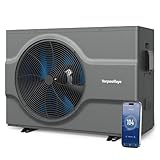
Varpoolfaye 120K Inverter
- 120000 BTU at COP 12.3
- Saltwater and freshwater ready
- 47 dB quiet operation
- Rated for pools up to 33000 gallons
One note on the ratings: those numbers are copied exactly from the live listings, including review counts, so the AQUASTRONG’s 534 reviews tell you something the others cannot. A large sample of real cold-weather owners is worth more to me than a high score off 37 reviews.
All 10 Models Side by Side in 2026
| Product | Specs | Action |
|---|---|---|
| VARMINPOOL 120000BTU Inverter |
|
Check Latest Price |
| AQUASTRONG HEX100 Inverter |
|
Check Latest Price |
| Varpoolfaye 120000 Btu Inverter 220V |
|
Check Latest Price |
 WARMBLU 33000 Gallon Inverter WARMBLU 33000 Gallon Inverter |
|
Check Latest Price |
 Varpoolfaye 120000BTU Inverter Varpoolfaye 120000BTU Inverter |
|
Check Latest Price |
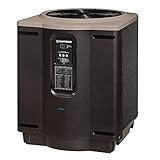 Hayward HeatPro 140000 BTU Hayward HeatPro 140000 BTU |
|
Check Latest Price |
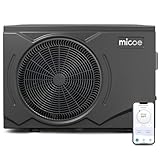 MICOE 35000 BTU Inverter MICOE 35000 BTU Inverter |
|
Check Latest Price |
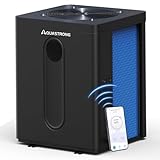 AQUASTRONG HEX035TOP Inverter AQUASTRONG HEX035TOP Inverter |
|
Check Latest Price |
 FibroPool FH135 35000 BTU FibroPool FH135 35000 BTU |
|
Check Latest Price |
 Hayward HeatPro W3HP50HA2 Hayward HeatPro W3HP50HA2 |
|
Check Latest Price |
1. VARMINPOOL 120000BTU Inverter – Best Overall for Cold Climates
VARMINPOOL Swimming Pool Heater for Inground Pool 120000BTU
120000 BTU heat and cool
Inverter variable output
Titanium exchanger with IPX4 cabinet
49 to 59 dB, 176 pounds
Pros
- Heats and cools with inverter output that stabilizes water temperature
- Very quiet for a 120000 BTU class unit
- WiFi app plus a straightforward local panel
- Owners in Canada and coastal US report strong heating in cool conditions
- Responsive support that ships replacement controllers
Cons
- WiFi app drops off the wireless network for some owners
- Can be undersized for pools above 30000 gallons
- Requires a 240V dedicated circuit installed by an electrician
This is the unit I put at the top of the list for snowbelt owners, and the reason is capacity matched to a real cold-climate pool. It carries 120,000 BTU of heating and cooling output and is rated for pools up to 35,000 gallons, which puts it above the threshold where most owners in my experience end up disappointed. The inverter chip adjusts output to demand instead of cycling on and off, and that difference shows up in holding temperature rather than raw peak numbers.
Owners in Canada and along the coastal US report that it keeps producing heat when the weather is genuinely cool, not just on a mild spring afternoon. Support has also been a quiet strength. Several reviewers mention replacement controllers and adapters arriving quickly after a phone troubleshooting call, which matters when your pool sits unused for a winter.
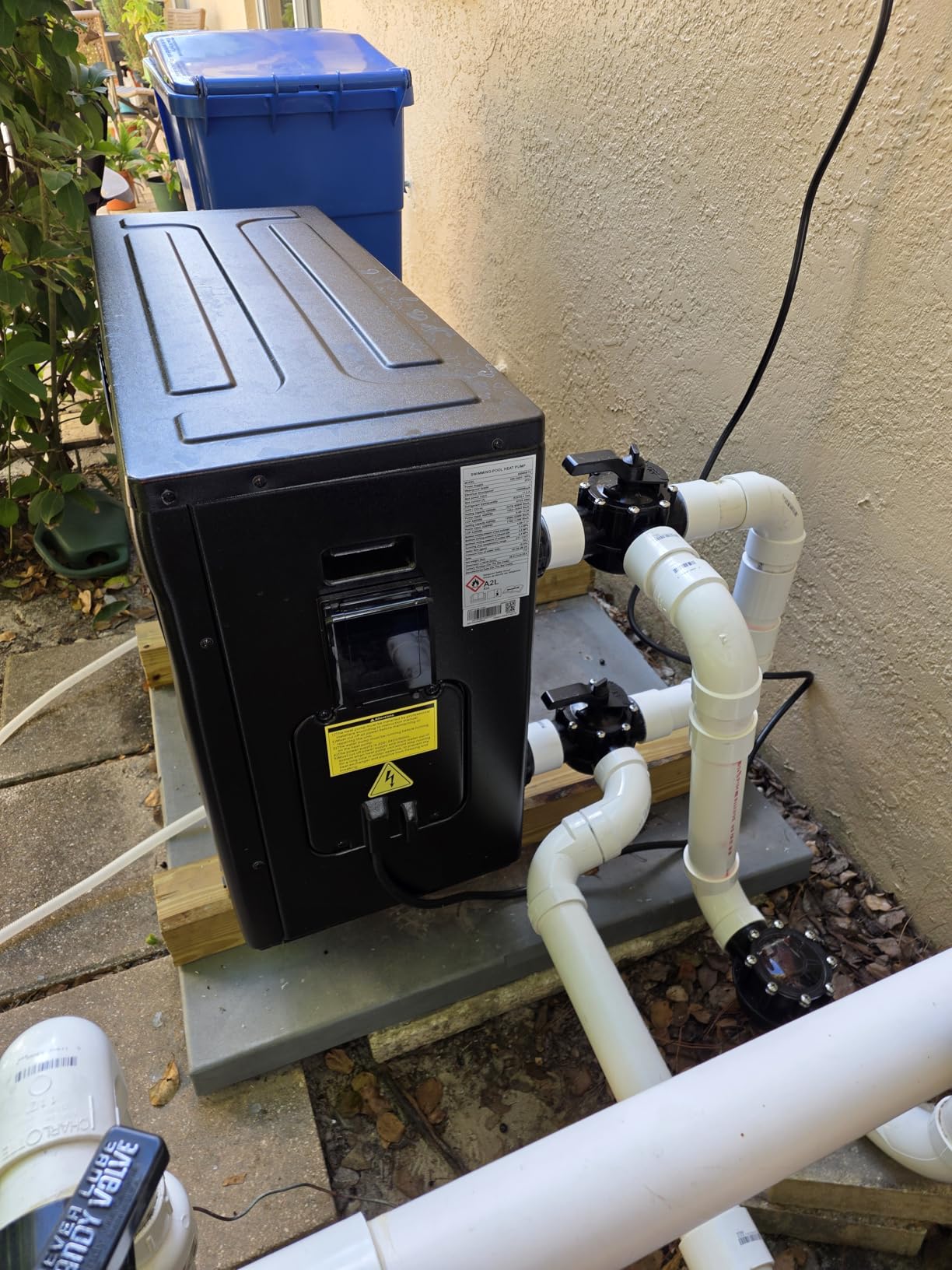
The engineering details are solid for the class. The cabinet carries an IPX4 weather rating with a corrosion-resistant shell and a titanium heat exchanger, and the listed weight of 176 pounds puts it in the middle of the group rather than requiring a reinforced pad. Operating noise is quoted at 49 to 59 dB, which is quiet enough to sit next to a house wall without becoming the reason a spouse objects to the pool.
It also heats and cools, and the app plus local control panel let you schedule around off-peak electricity rates. Scheduling matters more in a cold climate than anywhere else, because the hours you run the compressor in shoulder season decide whether the utility bill looks reasonable.
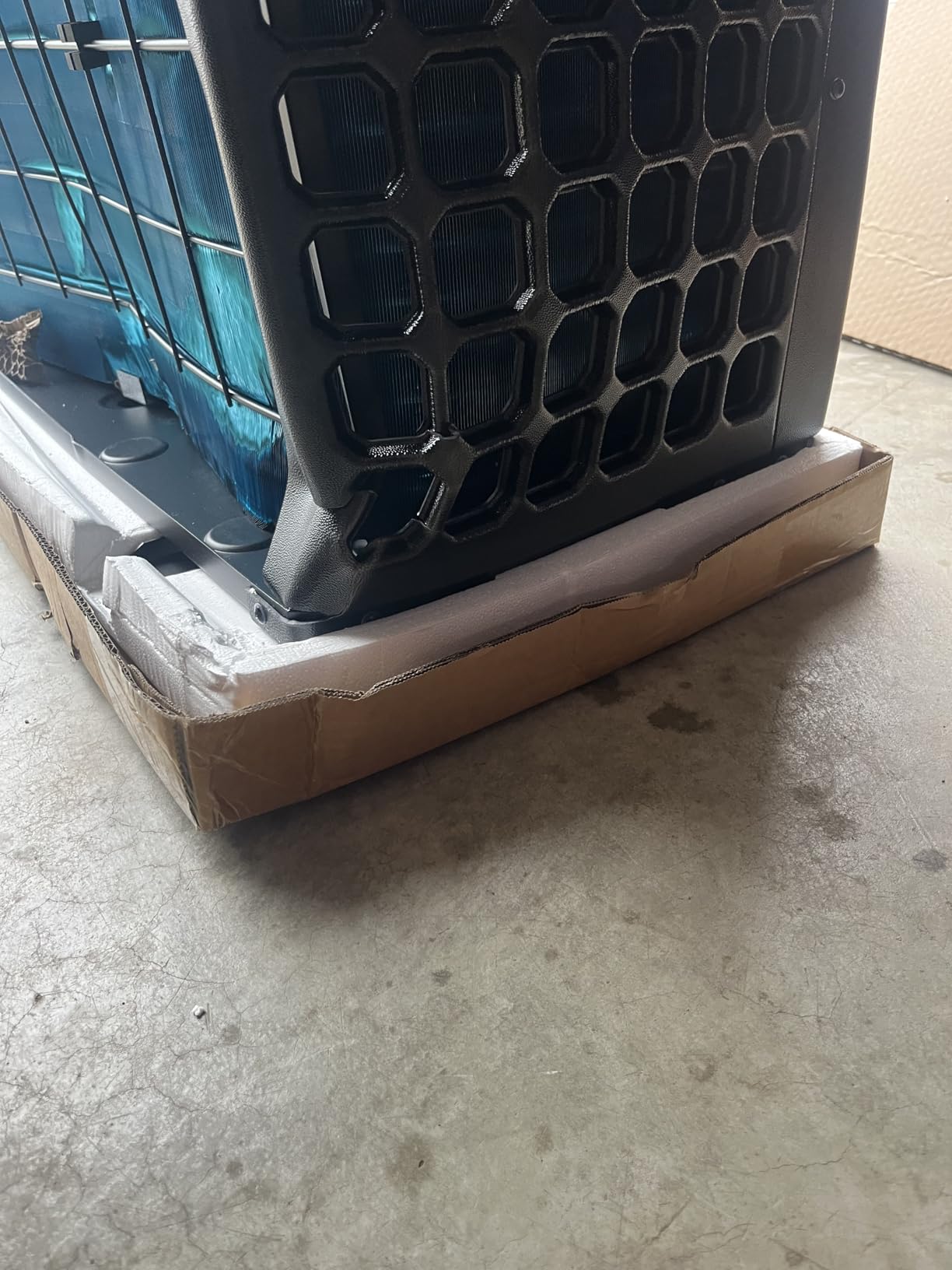
Will it hold temperature in a northern winter?
Yes, with a caveat about the pool rather than the unit. Reviewers repeatedly tie temperature holding to having a cover on, and that advice applies here more than to a 35-degree spring morning in the South. With a cover, the rated capacity is enough to hold set temperature through shoulder-season nights in the 30s and 40s. Without one, expect the water to track the air temperature more closely than the set point you chose.
The honest limit is speed rather than capability. This is a 120,000 BTU class machine, so a 25,000 gallon pool starting from 55F in a cold week is a multi-day job, not an afternoon one. Plan on running it continuously and use the boost mode when you know guests are coming.
What should you know before you buy?
Three things to know. Several reviewers report the WiFi app dropping off the network, so plan on the local panel as your primary control. It can also be undersized for pools above 30,000 gallons, and one owner in a harsh-winter state reported it could not maintain set temperature at all, so sizing discipline matters here. Finally, a 240V dedicated circuit is required and an electrician will need to run it.
You can also read our inground pool heat pump roundup if you want alternatives for a different pool type, but for cold-climate capacity this is where I keep landing.
2. AQUASTRONG HEX100 – Best Value with the Deepest Owner Feedback
Swimming Pool Heater for Above Ground and Inground Pool 20’*43’*48″
COP 15.8 full DC inverter
Heating 47F to 104F
Auto defrost every 40 minutes
55 dB, 116.8 pounds
Pros
- Dual heating and cooling for year-round water control
- Inverter compressor delivers high COP and lower running costs
- Automatic defrost supports cold-weather operation
- Low noise at 55 dB
- App and panel allow remote scheduling and energy tracking
Cons
- Included fittings sometimes need extra sealant to stop leaks
- A small share of buyers report weaker-than-expected heat gain
- Heating and cooling capacity tracks ambient temperature closely
What sets this one apart is not a spec sheet, it is the sample size. With 534 reviews behind it, this is one of the most thoroughly owner-tested units in the group, and in a niche where most listings sit under 150 reviews that is a genuine advantage. You are looking at a real distribution of outcomes rather than a handful of early adopters.
The technical case is strong too. A full DC variable-frequency inverter with a stated COP of 15.8 puts it at the top of the efficiency range in this group, and the heating range of 47F to 104F with cooling from 47F to 83F means one machine handles the whole season. The automatic defrost cycle runs every 40 minutes with a five-minute defrost, which is the single most important behavior in a cold climate.
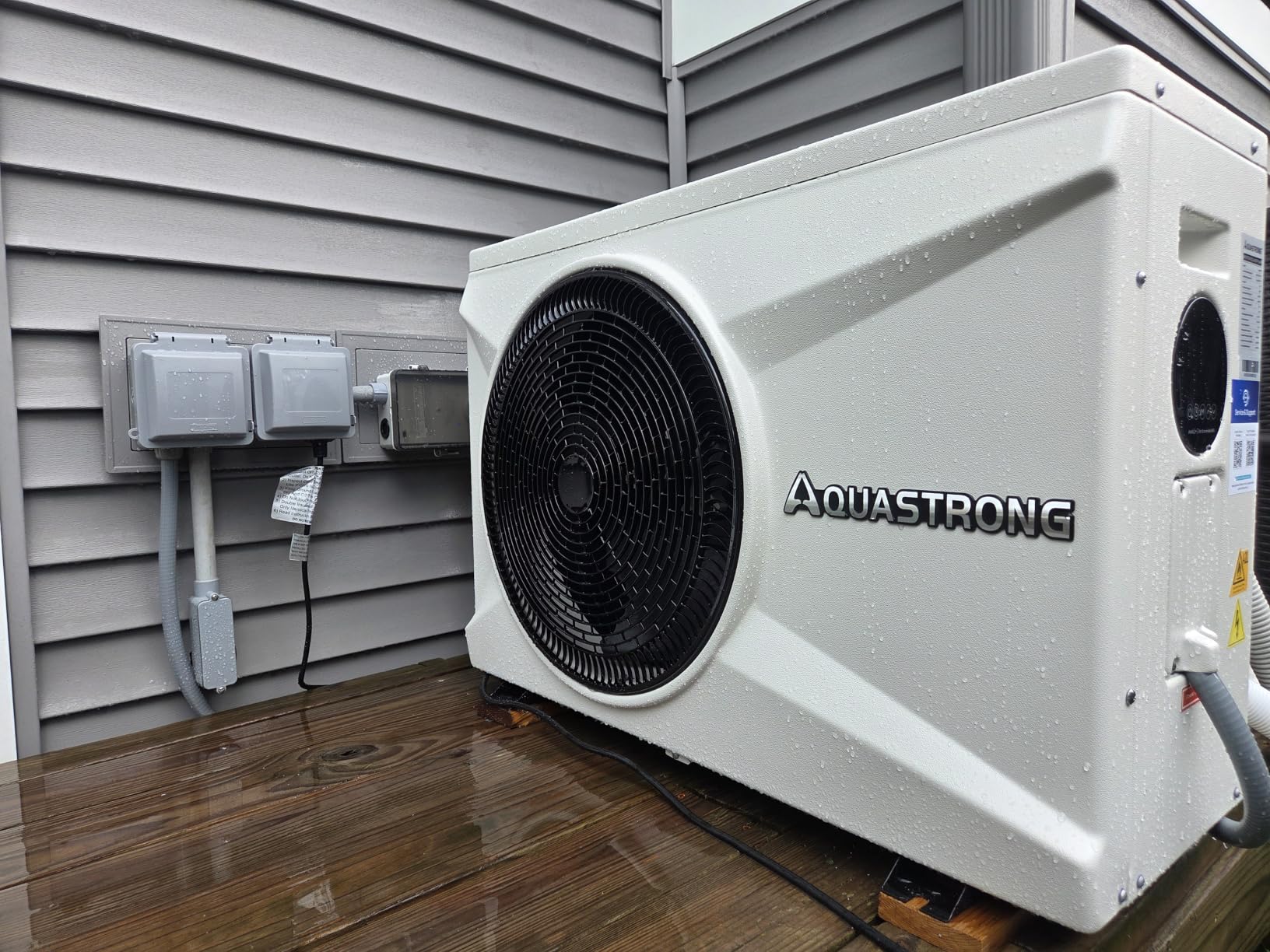
Owners like the combination of efficiency and low noise, and the app plus control panel allow remote scheduling and energy tracking. At 55 dB and 116.8 pounds, this is among the lighter and more compact units here, with listed dimensions of 39 x 17.32 x 25.6 inches. That matters if your equipment pad is already crowded with a filter, a salt cell, and a chlorinator.
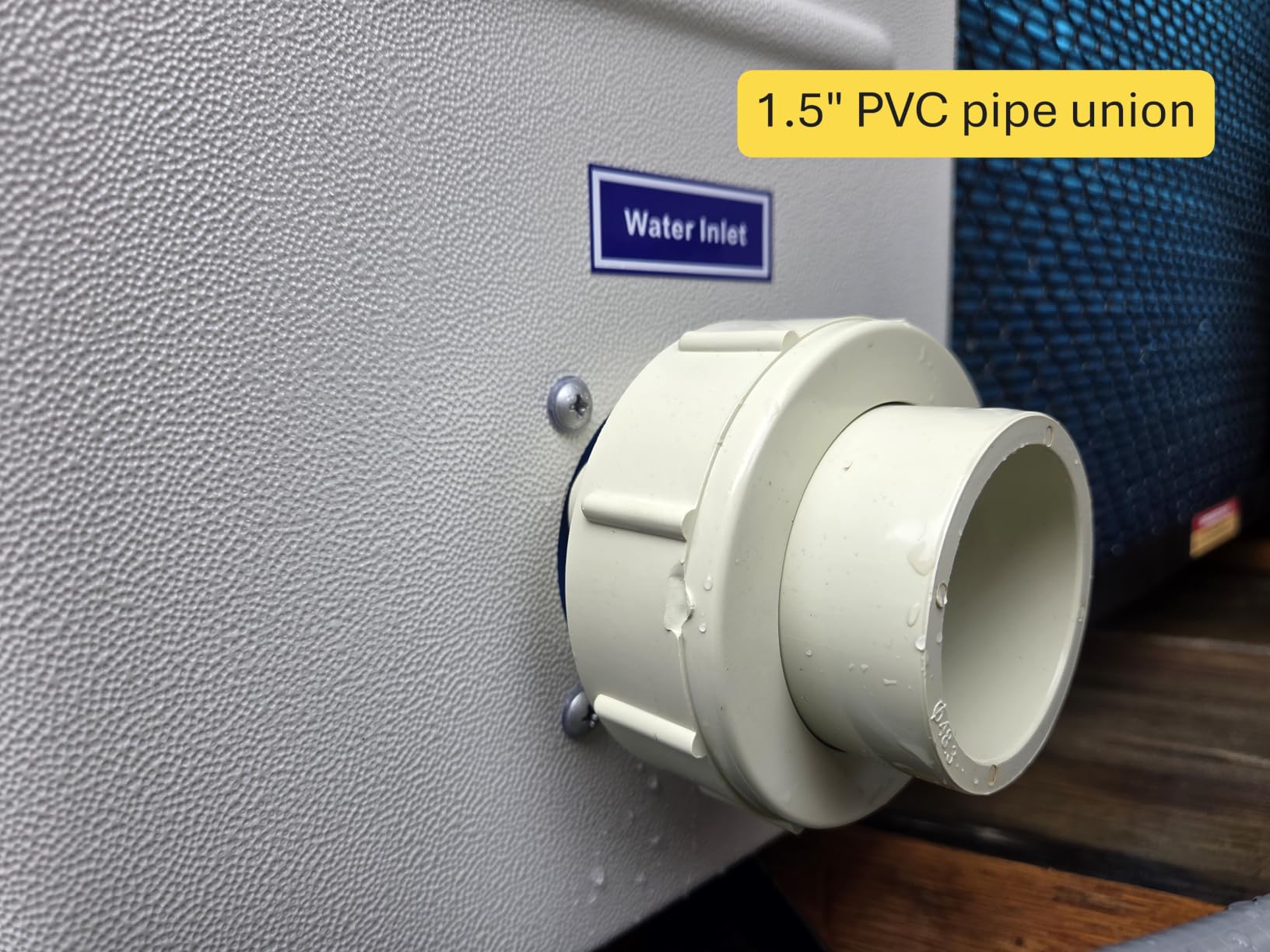
Plumbing flexibility is the quiet advantage here. Three connection options are supported, including 1.25 and 1.5 inch hose adapters, a 1.5 inch conversion kit, and a 1.5 inch PVC converter, so you are less likely to be waiting on a specific fitting during a cold shoulder season when nobody wants to be swimming with an unheated pool.
Can it carry a mid-size pool through a cold April?
For shoulder-season work on a mid-size pool, yes, and the inverter output is the reason. Rather than full-on cycles that overshoot and dump heat, a variable-speed compressor settles into a low, steady draw once the water approaches set temperature, which reduces the wasted energy that shows up on a meter in a month when everything else in the house is running too.
Be clear-eyed about the limits, though. Capacity is tied closely to ambient temperature, and a minority of buyers report the unit not raising pool temperature as much as they expected. If your coldest month regularly sits in the 30s, treat this as a spring and fall machine and plan a gas backup for January.
What should you know before you buy?
The most common complaint is installation, not performance. Included adapters can leak at first startup and may need extra sealant, so budget an hour and a tube of pipe dope. The warranty is three years, which is respectable but not the longest in this group, and it is worth asking your installer which parts are covered before you sign off on the job.
One more note on the efficiency claim. A COP of 15.8 is measured at favorable conditions, and your real-world number in a cold month will be far lower. Use the figure to compare units against each other, not to estimate your power bill.
3. Varpoolfaye 120,000 Btu Inverter – Most Versatile for Saltwater Pools
Varpoolfaye 120,000 Btu Inverter Pool Heat Pump for Inground Pools 220V
120000 BTU heating at COP 12.3
Freshwater and saltwater compatible
47 dB operation
Pools to 33000 gallons, 238 pounds
Pros
- Steady realistic heating gains under inverter control
- Very quiet and quieter than the pool filter system
- Dual heating and cooling for summer temperature control
- Support team sends replacement parts quickly
Cons
- Included adapters can leak at first startup and need tightening
- App connectivity can be unreliable far from the router
- Large temperature jumps take days of continuous running
This is the pick for saltwater pool owners, and the reason is specific. The unit is rated for both freshwater and saltwater pools, and that rating combined with 120,000 BTU at a stated COP of 12.3 makes it one of the stronger cold-climate options where a salt cell is already part of the equipment pad. In my experience, corrosion claims on cheaper exchangers are the first thing to fail in a salt setup, so a documented saltwater rating is worth a lot.
Owners rate the heating as steady rather than spectacular, which is the phrasing I trust most in this category. Reviewers also single out the 47 dB operating level as quieter than their pool filter system, a real consideration if the unit sits near living space. Support is described as fast to send parts and comfortable troubleshooting by phone.
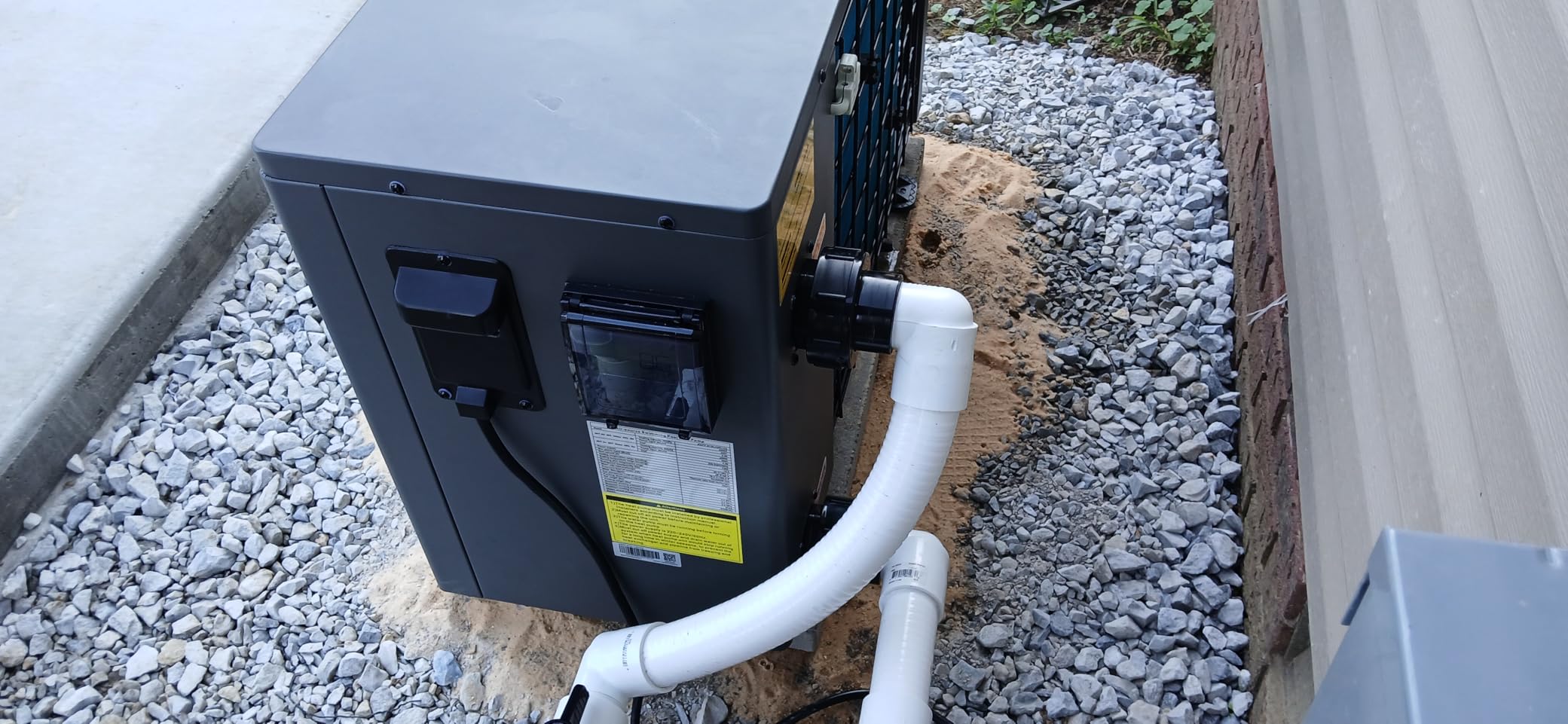
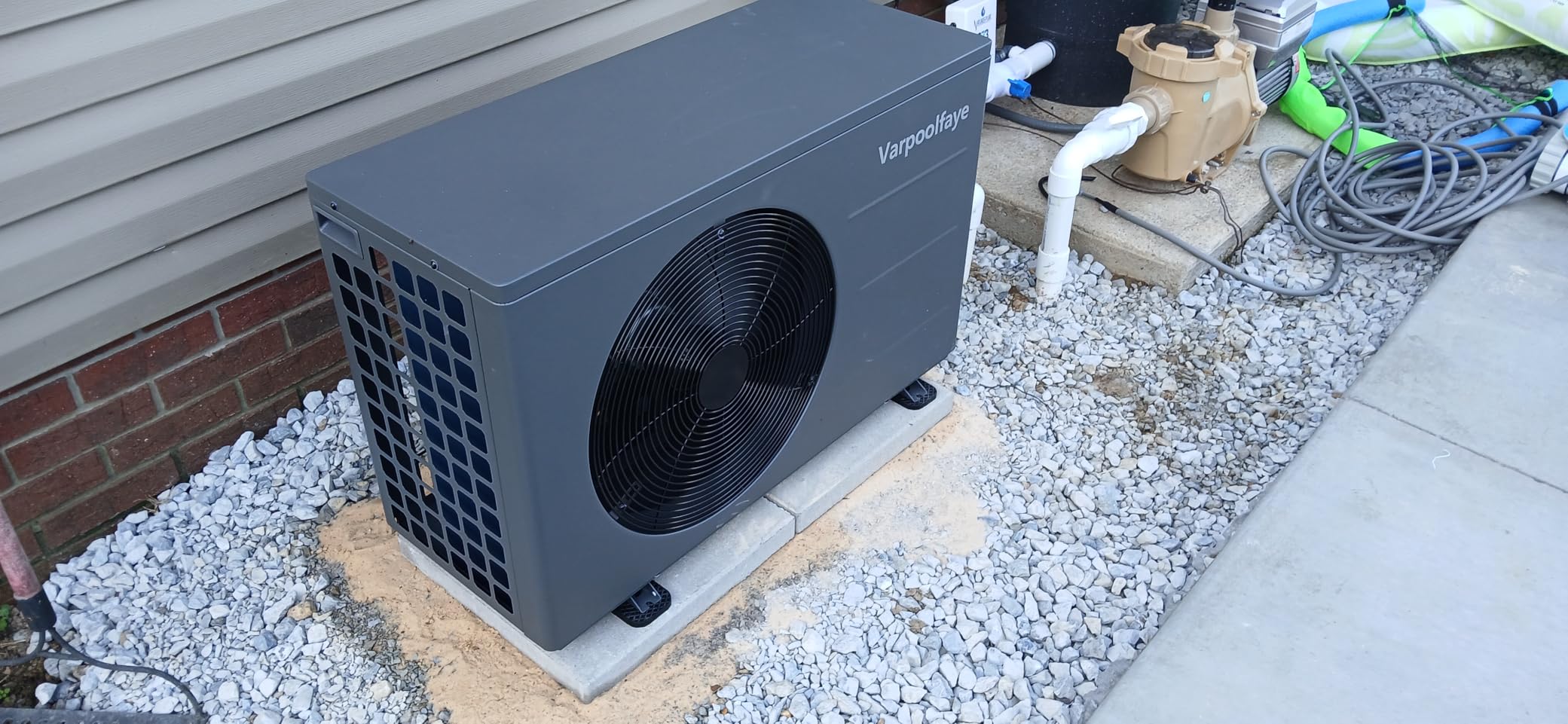
At 47 dB this is among the quietest figures on the list, and it comes with 1.5-inch connectors and a 118-inch power cord, which reduces the chance of a wiring shortfall on installation day. The package dimensions are 49 x 40 x 38 inches and the unit weighs 238 pounds, so plan the delivery path to the pad before the unit arrives.
Heating and cooling both work well for summer temperature control, and inverter mode extends compressor life while lowering energy use. For a shoulder-season climate where you want the pool usable in May and October, being able to cool as well as heat removes the need for a separate chiller decision later in the year.
How does it behave when the nights get genuinely cold?
Expect progress, not speed. Owners describe modest heating pace, and several note that a large temperature jump takes days of continuous running. That is a capacity conversation, not a defect. A 33,000 gallon pool holds a huge amount of water, and every degree of rise has to come out of thin air, so a heat pump in a cold month is always working against thermodynamics.
The cover question comes up again and again in reviews of this unit. With a cover on, temperature holding is realistic through cold nights. Without one, expect to run continuously and accept the water temperature tracking the air. If your goal is a warm pool on a specific Saturday in late May, this machine will get there given enough run time.
What should you know before you buy?
Two practical issues. Included adapters leak at first startup and need tightening, so tell your installer to check every joint before you fill and start the unit. App connectivity is unreliable at distance from the router, so locate the unit within reasonable range of your wireless signal or plan to use the touch panel.
A third is worth mentioning plainly. Some units arrive damaged and returns can involve sending the unit back, so inspect the cabinet and fan on arrival and photograph it before you remove the packaging. That habit has saved owners a lot of friction.
4. WARMBLU 33000 Gallon Inverter – Best for Large Inground Pools
WARMBLU 33,000 Gallons Inverter Pool Heat Pump for Inground Pools 220V
Max COP 16.0 with SpringBreath 1.0
Pure titanium heat exchanger
Sub 50 dB operation
Pools to 33000 gallons, 207 pounds
Pros
- High efficiency inverter design that cuts energy use versus gas or electric heaters
- Corrosion resistant titanium exchanger suited to large inground pools
- Quiet operation below 50 dB
- App and touch panel for straightforward daily control
- Water and electrical components fully isolated for safety
Cons
- A 14 percent one-star share points to real variability in outcomes
- Only a 12-month warranty
- Requires 220V installation and outdoor airflow clearance
The headline figure here is a maximum COP up to 16.0, the highest number any unit on this list claims, paired with a pure titanium corrosion-resistant heat exchanger. If you have a large inground pool and care about long-run electricity cost rather than first-week results, that combination is attractive on paper and the titanium exchanger is a meaningful upgrade for anyone running salt.
What gives me pause is the spread in owner outcomes. A 14 percent one-star share means a meaningful group of buyers report the unit underperforming or failing. The inverter chip and dynamic algorithm lower operating costs versus gas or conventional electric heaters, but the results owners report are inconsistent enough that I would treat the COP figure as a best case rather than a promise.
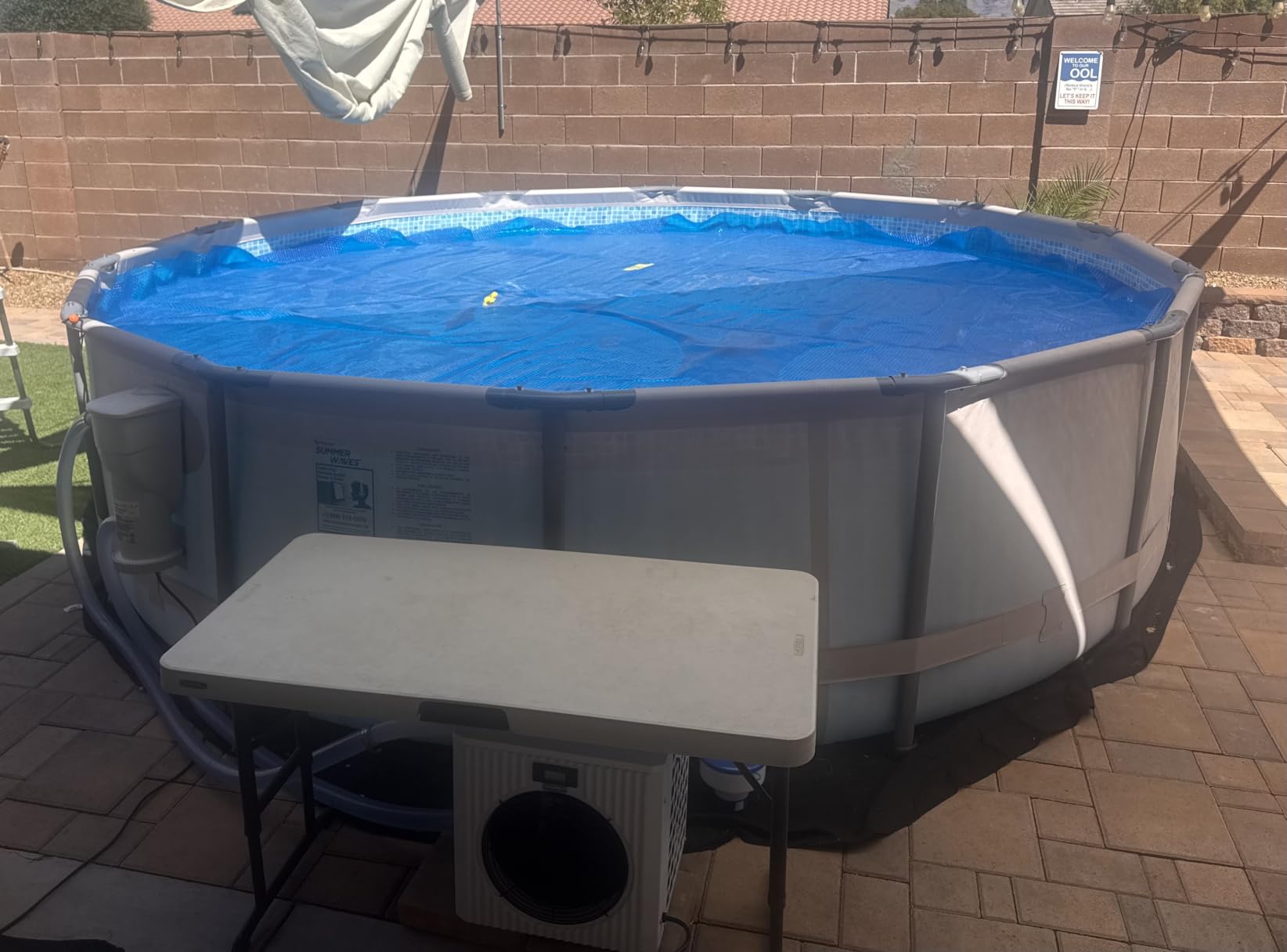
Build quality details are good. The unit weighs 207 pounds with listed dimensions of 29.2 x 17.5 x 43 inches, and the full separation of water and electrical components is a safety design choice I appreciate on equipment that sits next to a wet pool pad. Operating noise stays below 50 dB, and both an app and a modern touch panel handle daily control.
Capacity is rated for pools up to 33,000 gallons, which puts it in the same band as the two Varpoolfaye units. For a large uncovered pool in a cold region, the SpringBreath 1.0 heating system is the feature doing the work, and it is worth asking your dealer to explain the defrost behavior specifically before you commit.
Is it right for a 30,000 gallon pool in the Northeast?
Capacity-wise, yes, it is one of the few units here rated for that volume. The problem is heat-up time rather than peak output. A pool that size holds a lot of thermal mass, and in a month where the air sits in the 30s overnight, a heat pump of this class will be running around the clock and still take many days to raise the water meaningfully. The efficiency claims help your running cost during that grind, but they do not shorten it.
For a pool that size, most owners who want reliable cold-weather heat pair a heat pump with a gas heater and let each one do what it is good at. If that is your situation, ask for a setup where the heat pump handles spring, summer, and fall and the gas unit carries the coldest weeks.
What should you know before you buy?
The 12-month warranty is the shortest we found in this roundup and the most important thing to raise with the dealer. A year is not much protection on a compressor, so ask specifically whether the compressor carries a longer term than the parts warranty and get the answer in writing.
Installation needs 220V power and adequate airflow clearance outdoors. Those two requirements rule out some equipment pads, and discovering the clearance problem after purchase is a common and expensive surprise. Measure the pad and check the electrical panel before you order.
5. Varpoolfaye 120000BTU Inverter – Strong Ratings on a Small Review Base
Varpoolfaye 120000BTU Swimming Pool Heat Pumps Up to 33000 Gallons 220v
120000 BTU heating at COP 12.3
Heating and cooling from ambient air
47 dB operation
Fresh and salt water, pools to 33000 gallons
Pros
- Strong 4.6 average among the large-capacity units
- Inverter mode and touch panel simplify temperature control
- WiFi remote control for scheduling and mode changes
- Quiet at 47 dB and usable with saltwater pools
Cons
- Small review base leaves long-term reliability unproven
- Requires a 220V circuit so installation involves electrical work
- A pool cover is needed to hold set temperature efficiently
The 4.6 rating is among the strongest here, and I want to be careful about what that means. Sixty reviews is a small sample, and a small sample in a category with rapid product turnover often reflects early-adopter enthusiasm more than a decade of field data. That said, the feedback is uniformly positive on the things that matter, and nothing in the reviews suggests a fundamental problem.
Specification-wise it mirrors the Varpoolfaye unit further up the list: 120,000 BTU heating capacity at a stated COP of 12.3, heating and cooling operation from ambient air, inverter mode with an intelligent touch control panel, 47 dB operating noise, and compatibility with both freshwater and saltwater pools. It also comes with 1.5-inch connectors and a 118-inch cord and is rated for pools up to 33,000 gallons.
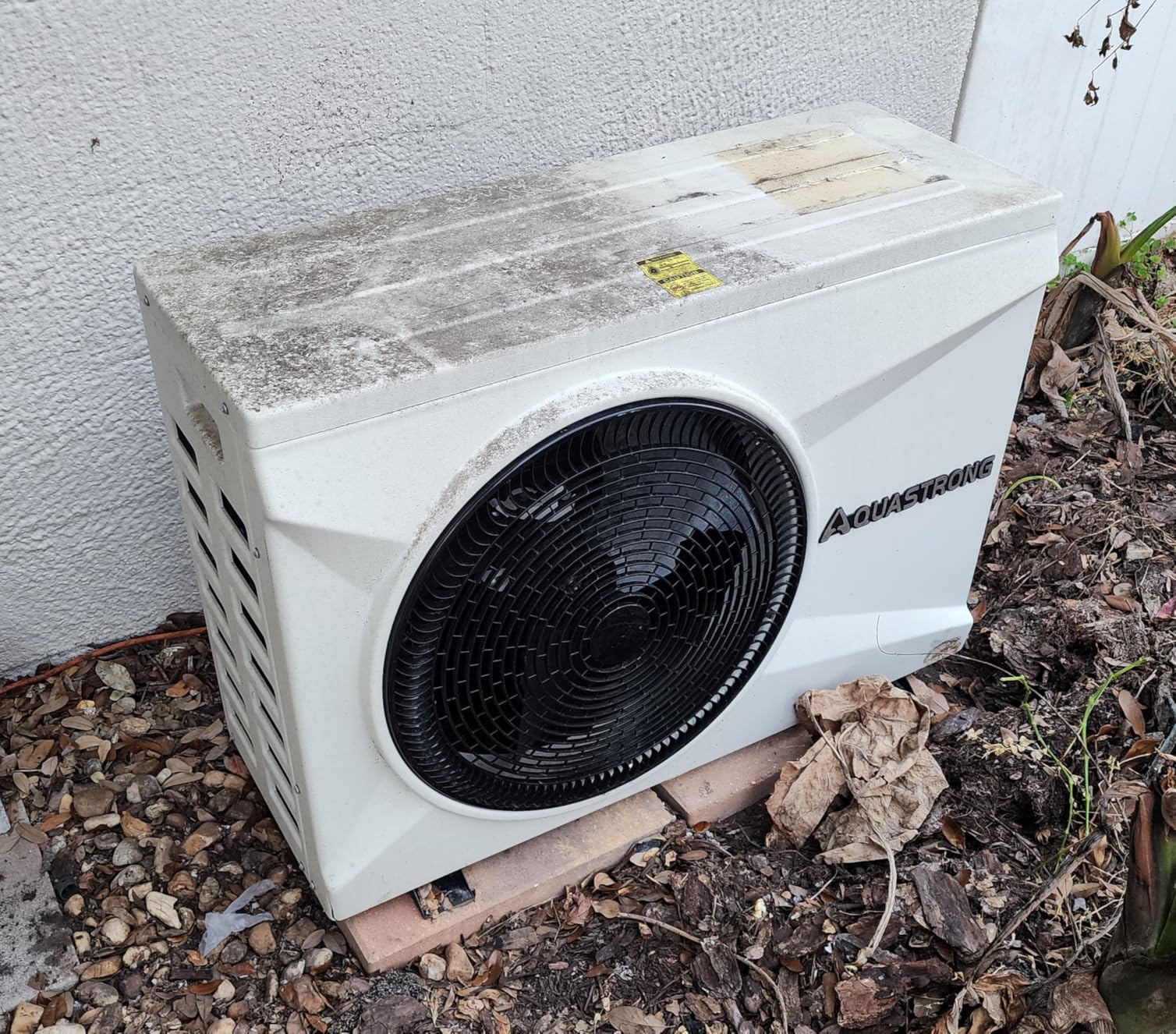
Owners like the heating speed, the one-button fast heat function, and the WiFi scheduling. The unit weighs 208 pounds with package dimensions of 47.64 x 32.28 x 20.08 inches, so it is a manageable lift for two people but not a one-person job. My efficiency notes cover how to read a COP figure like this one when comparing it against units measured differently.
The honest framing: this is a well-liked unit with thin long-term evidence. If you are comfortable being an early owner of a design that has not yet been proven across a full decade of winters, the ratings support it. If you want five years of field history behind the design, look at one of the established-brand units instead.
Will it hold set temperature without help?
Not reliably on its own, and the reviews say so directly. A pool cover is recommended to hold set temperature efficiently, which makes this a good fit for an owner who already uses a solar cover every night. Without one, the unit is running against constant evaporation and convection losses, and no amount of inverter efficiency fully compensates.
It also requires a 220V circuit, so the electrical work is part of the project rather than an afterthought. Budget for an electrician and check your panel capacity before purchase, especially in older Northeast homes where the existing subpanel may already be near its limit.
What should you know before you buy?
Three honest limitations. The review base of 60 is too small to draw firm conclusions on longevity, so treat the 4.6 as encouraging rather than conclusive. The 220V requirement means installation involves real electrical work. And a pool cover is not optional if you want the efficiency claims to mean anything in practice.
With those understood, the unit does what it says: 120,000 BTU of air-sourced heat, quiet operation, saltwater capability, and app control. For a covered mid-size pool that needs heat in April and October, that is a reasonable brief.
6. Hayward HeatPro 140,000 BTU – Best for Coastal and Saltwater Locations
Hayward HeatPro Pool Water Heat Pump Heater for Inground Pools, 140,000 BTU
140000 BTU for inground pools
Ultra Gold corrosion resistant technology
Titanium heat exchanger for salt water
320 pounds, 40 x 31.5 x 50 inches
Pros
- Established pool equipment brand with a long track record
- Corrosion resistant titanium construction for coastal and salt water
- Air source design costs less to run than gas or resistance electric
- Large 140000 BTU output suits big inground pools
Cons
- Premium-priced unit in the group with a 14 percent one-star share
- Heavy at 320 pounds and needs a solid equipment pad
- No app or smart controls with only basic digital control
Hayward is a name most pool technicians in North America already carry parts for, and that matters more than any spec when something fails in February. This is the largest unit here at 140,000 BTU, aimed squarely at regularly used inground pools, and the Ultra Gold corrosion-resistant technology is specifically built for coastal climates where salt spray and humidity attack metal components.
The titanium heat exchanger handles both salt water and chemical corrosion resistance, and the UV-resistant body panels are a sensible addition in a coastal setting. As an air-source design it needs no gas or propane, so there is no fuel line to run and no combustion inspection to think about.
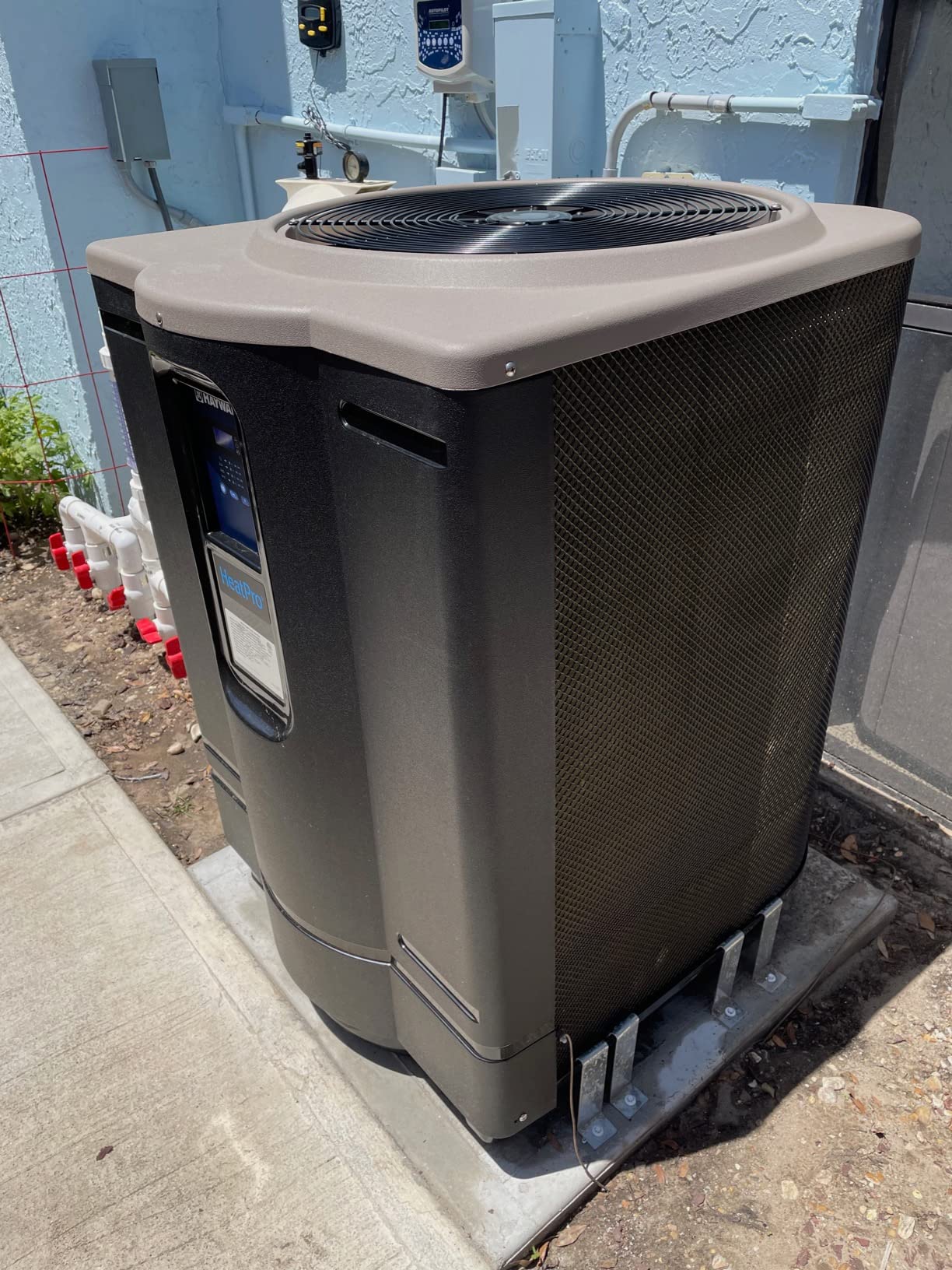
Where it earns its place is durability and serviceability. Buyers value the construction and the corrosion resistance, and the brand comes from a pool equipment manufacturer with over 80 years in the business. That history is a genuine asset in a cold climate, where a failed compressor in April costs you a season, not a weekend.
There is a cost consequence. This sits at the premium end of this roundup, and a 14 percent one-star share tempers the enthusiasm about value. At 320 pounds and 40 x 31.5 x 50 inches, it needs a properly built equipment pad, and the basic digital control with no app means you check temperature by walking over to the unit.
Is the extra capacity worth it in a coastal winter?
On a covered pool in a mild coastal climate, 140,000 BTU is generous and gives you a large margin on shoulder-season nights. On an uncovered pool in a region that actually freezes, no single heat pump of this class replaces a gas heater for the coldest weeks. The realistic coastal use case is extending the season into spring and fall, and for that the capacity is more than sufficient.
The coastal corrosion package is the actual differentiator here. Salt-laden air in a seaside installation is harder on outdoor equipment than cold alone, and the Ultra Gold treatment plus UV-resistant panels is aimed at exactly that environment. Inland owners in a genuinely cold region will get more from an inverter unit with active defrost.
What should you know before you buy?
The weight. At 320 pounds this is roughly a hundred pounds heavier than several other units in the roundup, and it needs a level, solid pad rather than a typical gravel area. Confirm the pad dimensions before the delivery date rather than after.
Budget the purchase carefully. It sits at the premium end of this roundup, and the 14 percent one-star share suggests some owners do not think the value proposition holds up. If your local pool service carries Hayward parts, that serviceability often justifies the difference. If it does not, you are paying for a brand name your technician may rarely touch.
7. MICOE 35000 BTU Inverter – Budget Pick for Smaller Pools
MICOE 35000 BTU Pool Heat Pump, Inverter Pool Heater for 12000 Gal Pools
35000 BTU heating and cooling
COP 5.95 full DC inverter
Rated 32F to 109F ambient
50 dB with IPX4 cabinet
Pros
- Handles 12000 gallon pools at the lowest purchase cost in this group
- Five operating modes with scheduling from panel or app
- Rated to 32F ambient for colder-season use
- Quiet at 50 dB with UV resistant IPX4 cabinet
- Dual heating and cooling for year-round control
Cons
- 4.1 average with a 13 percent one-star share
- COP of 5.95 is well below the 12 to 16 range of premium units
- Smaller capacity means much longer heating times on larger pools
- Professional electrician installation recommended
This is the value entry point, and the one specification that makes it genuinely interesting for cold climates is the operating range. The unit is rated for ambient temperatures from 32F to 109F, a published floor few units in this category offer, and it includes intelligent auto-defrost. For an owner whose shoulder season dips into the low 30s, that verified floor is worth more than a headline COP number.
The 35,000 BTU output is sized for pools up to 12,000 gallons, a fraction of what the 120,000 BTU units handle, and a COP of 5.95 measured at 78.8F is well below the 12 to 16 range the premium units claim. That gap is real and it will show up on your electricity bill.

Owners treat it as a budget option for small pools and appreciate the five operating modes, including heating, cooling, auto, boost, and eco, with custom scheduling from either the panel or an app. At 50 dB(A) with a UV-resistant ABS cabinet and an IPX4 waterproof rating, it is quiet and weather-tough enough for an outdoor pad.
Dimensions of 36.38 x 14.33 x 25.35 inches and a weight of 129.7 pounds make this an easy unit to place on a crowded pad. The two-year parts replacement warranty is short, and that is the piece to negotiate on if you can, along with confirming whether a labor claim is covered.
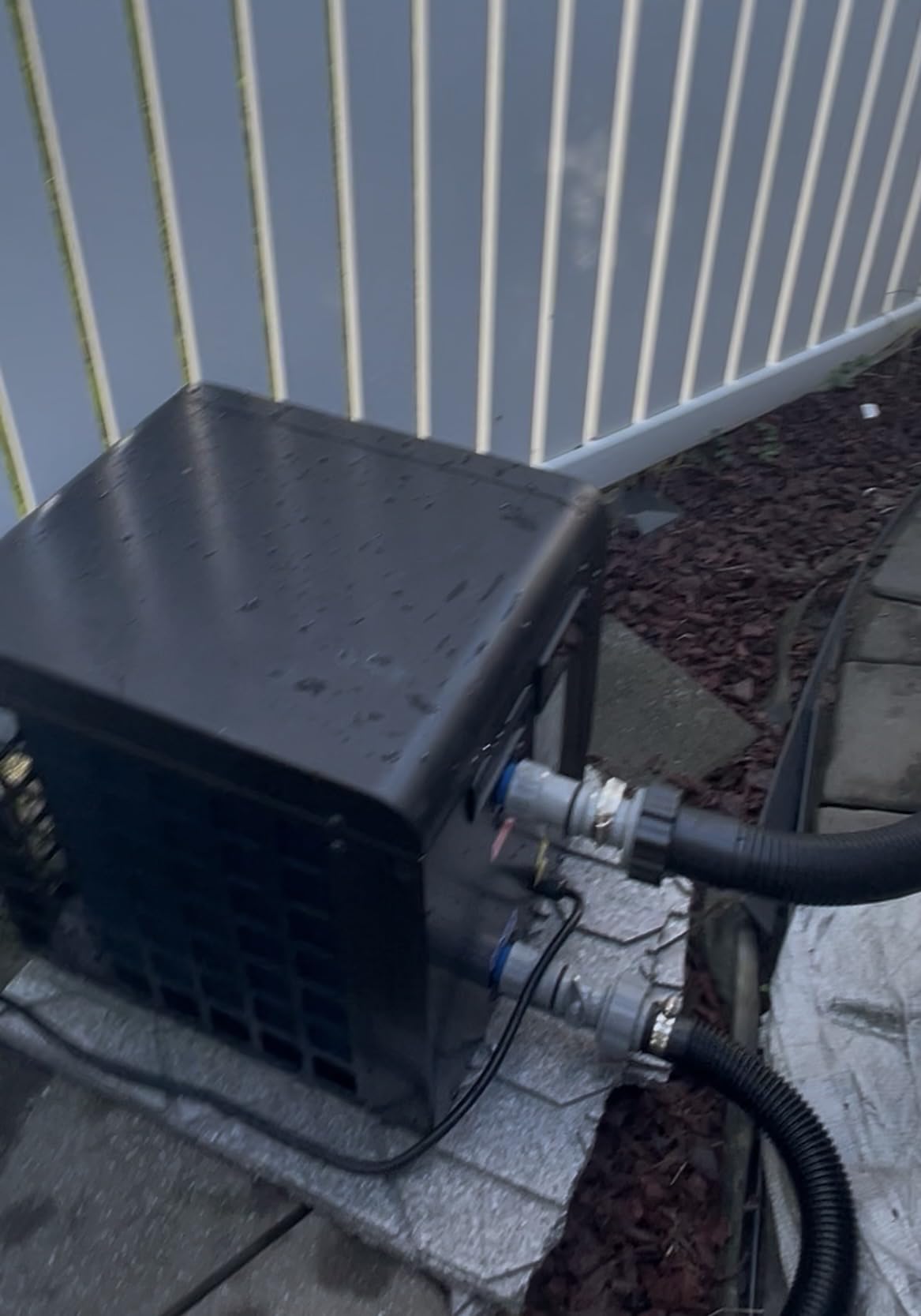
Will a 35,000 BTU unit work at all in a cold climate?
Yes, if your pool is small. At 12,000 gallons, the water mass is small enough that 35,000 BTU produces visible temperature movement over a weekend, and the verified 32F operating floor means it will keep running in weather that forces many competitors into constant defrost. The rated heating range of 47F to 104F with cooling to 82F covers the full season for a modest pool.
On a 20,000 gallon pool it becomes a different product. The same unit would need to run continuously for days to make meaningful progress, and at a COP of 5.95 the electricity cost of that grind is the part that discourages me from recommending it above 15,000 gallons.
What should you know before you buy?
The 4.1 average with a 13 percent one-star share puts it near the bottom of the ratings here, and buyers frame it as a budget option rather than a premium one. That framing is fair, but the lower rating reflects efficiency expectations more than reliability in my reading of the feedback.
Professional electrician installation is recommended, and given the 220V requirement that is not optional. Before you commit, work out which pool size band you fall in. Under 12,000 gallons and this fits the brief. Above that, the premium units deliver more heat per dollar of electricity even before you consider how long the job takes.
8. AQUASTRONG HEX035TOP – Best for Tight Installations at 37 dB
Swimming Pool Heat Pump for Above Ground Inground Pool 22’*30’*48″
110000 BTU with 12 COP
Top discharge vertical air intake
37 dB operation
Titanium exchanger, pools to 32000 gallons
Pros
- 4.7 average with no one or two star reviews reported
- Very quiet at 37 dB
- Top discharge airflow frees up side clearance for tight installations
- Full inverter drops to low power once target temperature is reached
- Titanium heat exchanger works in saltwater pools
Cons
- Smallest review base in the group at 37 reviews so durability is unproven
- Heavy unit at 309 pounds needing two people or a dolly
- Listed dimensions of 20 x 20 x 20 inches appear inconsistent for the class
The 4.7 rating is the highest here, and the reviews report no one or two star feedback at all. I would not lean on that as heavily as the number suggests, because 37 reviews is the smallest sample here and a clean sheet can change quickly. What the design offers, though, is genuinely distinctive: a top-discharge vertical air intake that frees up the side clearance a conventional unit needs.
That matters in a real cold-climate scenario. When your equipment pad is wedged between a house wall and a fence, a side-discharge unit may not fit at all, and the usual answer is to lose the entire project. This one is rated to 32,000 gallons with 110,000 BTU, an upgraded titanium heat exchanger for saltwater, and full inverter technology with 12 COP.
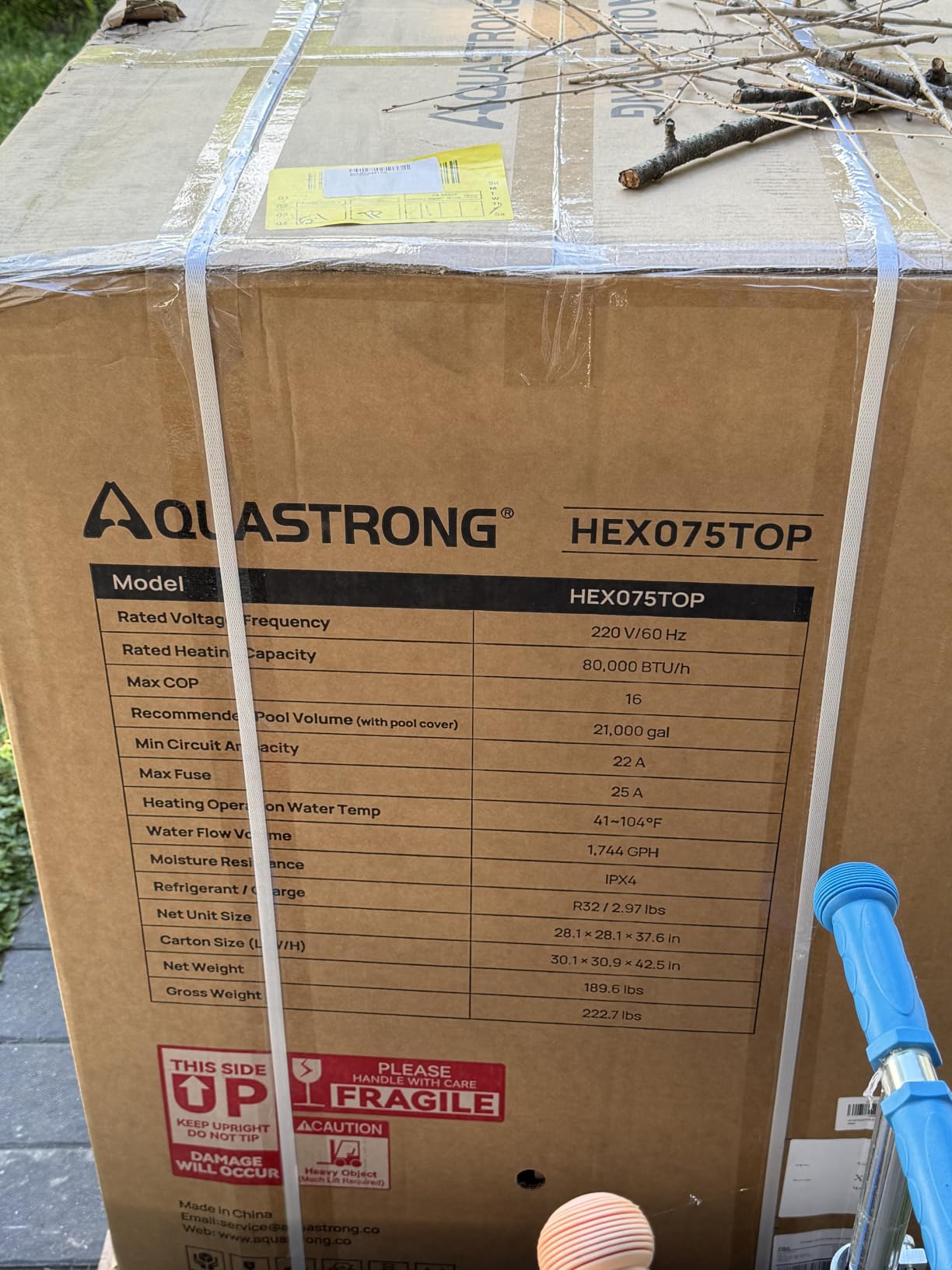
At 37 dB it is among the quietest units in the roundup, which is a genuine advantage if the pad sits beside a bedroom or a patio seating area. The full inverter drops to low power once the target temperature is reached, which is the behavior that keeps holding costs down overnight in shoulder season.
Plumbing hardware is included: 2-inch adapters and a 2-inch to 1.5-inch conversion kit, so you can match most existing pool plumbing without a special order. That is worth more than it sounds in February, when a delayed fitting delays your season start.
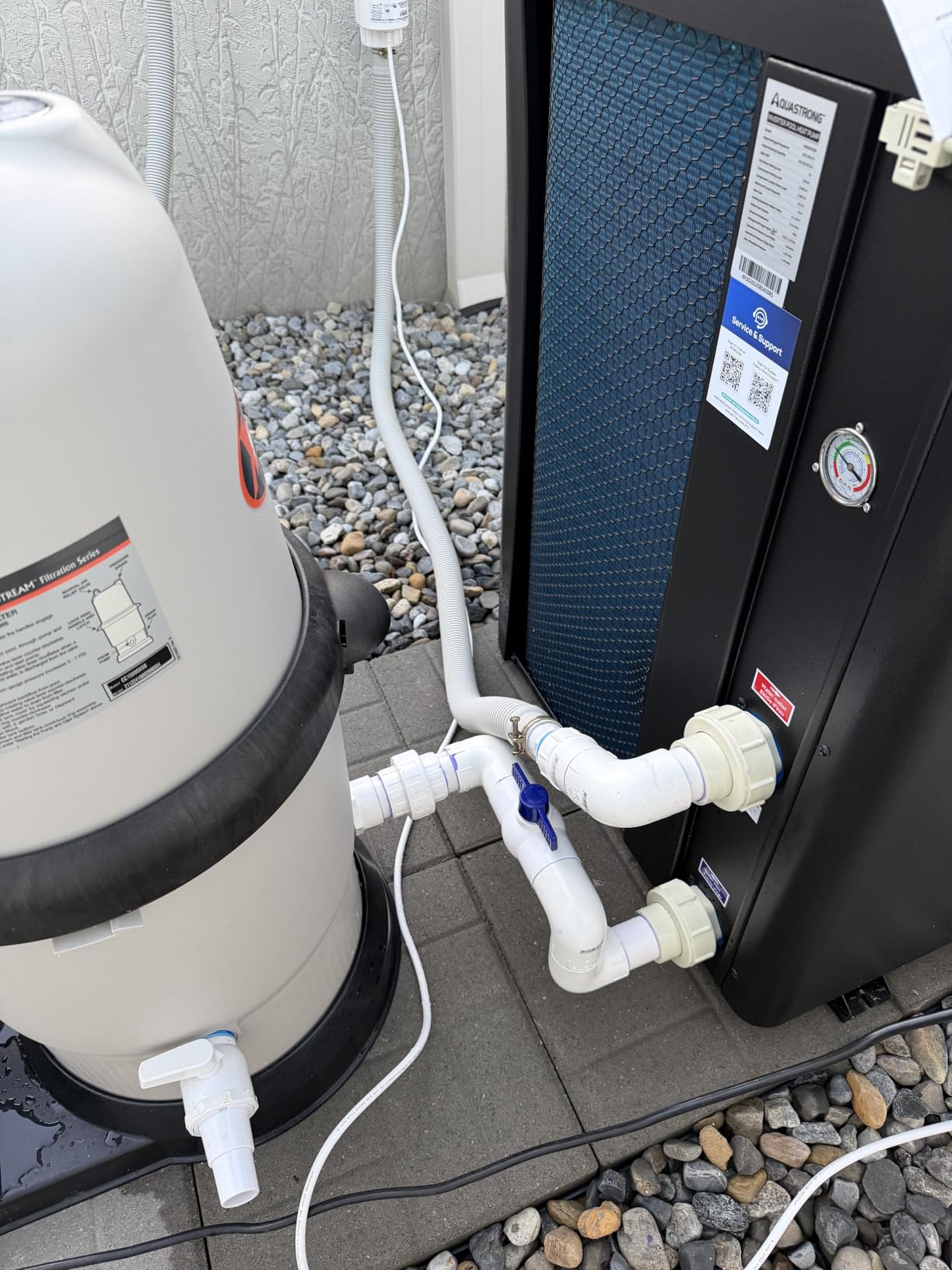
Is 110,000 BTU enough for a large cold-climate pool?
For a 32,000 gallon pool, this is the capacity you would target, and it sits a step below the Hayward 140,000 BTU unit rather than a class apart. On an uncovered pool in a region with 20F nights, expect the same multi-day behavior every other heat pump on this list shows, because the constraint is the air temperature, not the unit.
Where this one is genuinely better than its class is the running profile. Full inverter technology means the compressor modulates instead of hard cycling, and the low-power holding mode keeps consumption modest once the water reaches set temperature. Owners who cover their pools will feel that difference more than owners who do not.
What should you know before you buy?
The review base of 37 is the real limitation. A design with no negative feedback and 37 reviews tells you very little about year five, so consider a longer compressor warranty from the dealer as your main risk mitigation. Ask which part carries the longest term and get it documented.
Also, the weight. At 309 pounds this is among the heaviest units in the roundup, and the listed product dimensions of 20 x 20 x 20 inches look inconsistent for a 110,000 BTU machine. Confirm the actual footprint with the manufacturer before you design the pad, and budget for two people or a dolly to position it.
9. FibroPool FH135 35,000 BTU – Best for Spas, Hot Tubs and Small Pools
FibroPool Pool Heat Pump FH135-35,000 BTU 120V – 7,500 Gal – Electric
35000 BTU for pools and spas
Air source heat pump up to 5.5x efficiency
Fully electric 120V operation
Round cabinet, 108.8 pounds
Pros
- Plugs into a standard 120V outlet with no gas line or 240V circuit
- Very quiet with a compact round cabinet for tight pads
- Heats steadily and holds temperature with a solar cover
- Includes hose and PVC fittings for a plug and play setup
- Customer support has historically responded within hours
Cons
- Controller boards have failed after heavy rain and warranty support was hard to obtain
- Short power cord of roughly 5 feet needs an extension or dedicated outlet
- No WiFi or app control so temperature must be checked at the unit
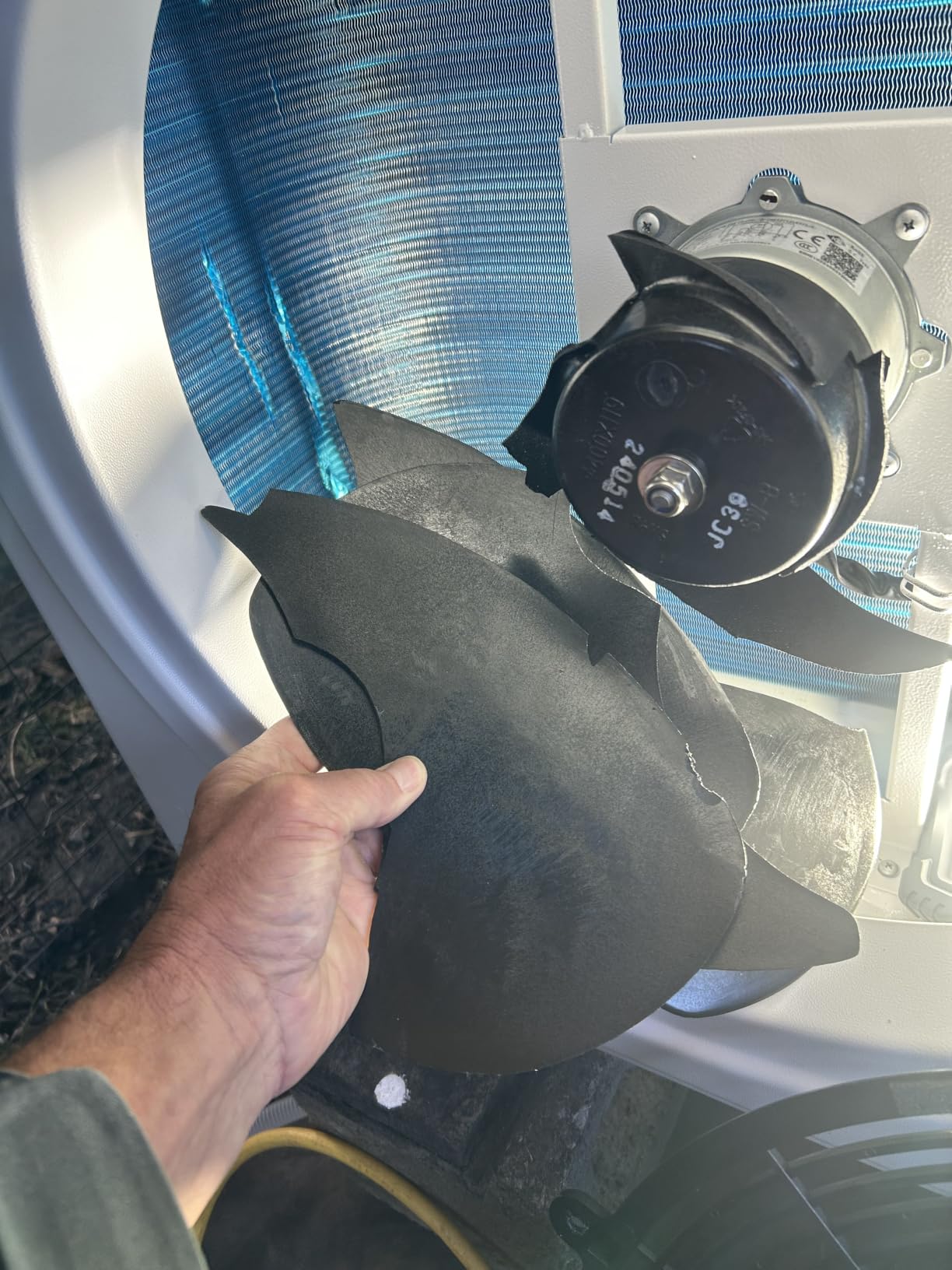
- High power draw and some units arrive with damaged fan blades
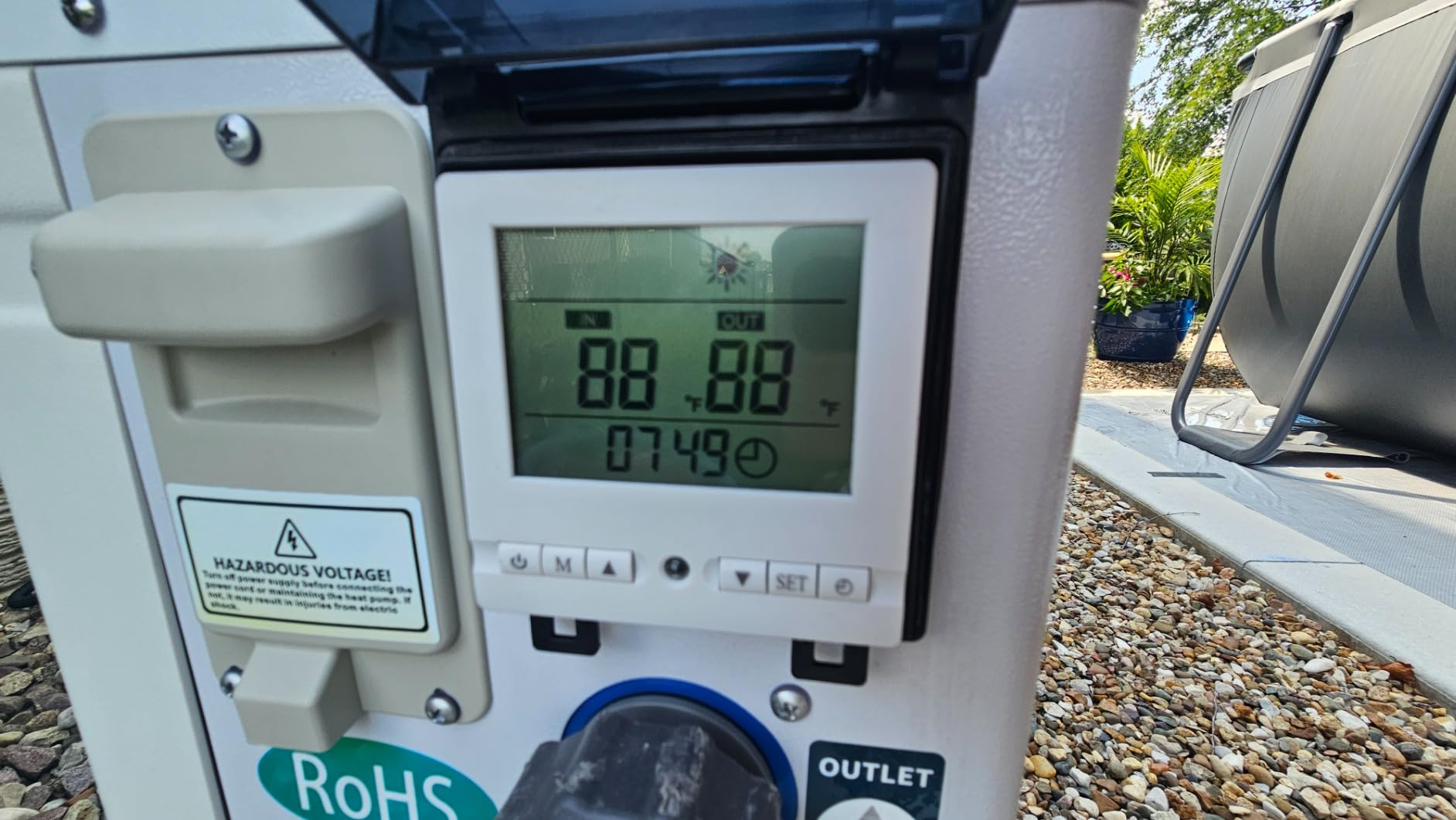
The 120V plug is the entire point of this unit. In an older home, a 220V circuit may mean a new subpanel, a longer electrical run, and a contractor quote that changes the economics of the project. This one runs on a standard outlet, and it comes with hose and PVC fittings, and needs no gas line. For a hot tub, a small above-ground pool, or a rental where you cannot modify the panel, that removes the two biggest cost obstacles.
Efficiency is up to 5.5x through air-source heat transfer, and the round compact cabinet fits tight equipment pads. Owners like that it heats steadily and holds temperature with a solar cover, and that support has historically responded within hours.
At 108.8 pounds and 38 x 15 x 26 inches, it is the lightest unit in the roundup and among the least demanding to install. The design has minimal moving parts and runs quietly, which suits a spa setup where the unit sits near where people sit.
The listed use is for pools, spas, and hot tubs up to about 7,500 gallons. That is a small thermal mass, and the 35,000 BTU output is proportionate to it. Judge this unit against a hot tub rather than an inground pool and it is a strong fit.
Can it handle cold outdoor air?
It runs, but I would not lean on it for serious cold-weather pool heating. There is no published minimum operating temperature in the specifications, which is exactly the figure you want to see before committing a unit to a snowbelt climate. A heat pump with an unverified low-temperature floor is a gamble once the air drops into the 30s.
Its realistic job is extending a small pool or spa season in shoulder weather, where the air is in the 50s and 60s and the water mass is small enough to heat in a weekend. For deep winter, look at one of the units here with a verified 32F ambient rating.
What should you know before you buy?
The rain issue is the one that gives me pause. Some owners report controller boards failing after heavy weather, and getting warranty support resolved has been difficult for them. If you live somewhere with frequent storms, ask about the warranty terms in writing before purchase and consider where the unit will drain.
Also note the short power cord of roughly five feet, which needs a 12-gauge extension cord or a dedicated outlet, and the lack of app control. Inspect the fan blades on arrival, since a small share of units turn up with damaged blades, and check that the cabinet is sealed before the first storm.
10. Hayward HeatPro W3HP50HA2 – Best for Straightforward Installation
Hayward W3HP50HA2 HeatPro Heat Pump, Beige
Air source heat and cool in one unit
Rotary compressor with titanium exchanger
Digital control panel with temperature display
AHRI certified, 159.7 pounds
Pros
- Quiet operation compared with older heat pumps and a plastic cabinet that resists rust
- Compact footprint with simple set and forget digital controls
- Heating and cooling in a single unit
- Installers report straightforward hookup to existing wiring and plumbing
- Uses less energy than natural gas and propane heaters
Cons
- One owner reported the unit stopped after a single season
- Some buyers found it underpowered even when sized up for the pool
- Installation instructions are sparse so a plumber or pool store may be needed
- Above-ground pools may need flex pipe converted to PVC
This is the second Hayward in the roundup, and the logic is different from the first. Where the 140,000 BTU model is about maximum capacity and coastal corrosion protection, the W3HP50HA2 is about installation simplicity. Installers report straightforward hookup to existing wiring and plumbing, and a compact 17 x 43 x 30 inch footprint at 159.7 pounds fits most standard pads.
The rotary compressor and low-noise fan make it quieter than older heat pumps, and the durable titanium heat exchanger provides corrosion protection. The digital control panel shows water temperature, and the unit both heats and cools. It is AHRI certified and independently lab-tested, which is a useful baseline when you are comparing it to units with more aggressive claims.
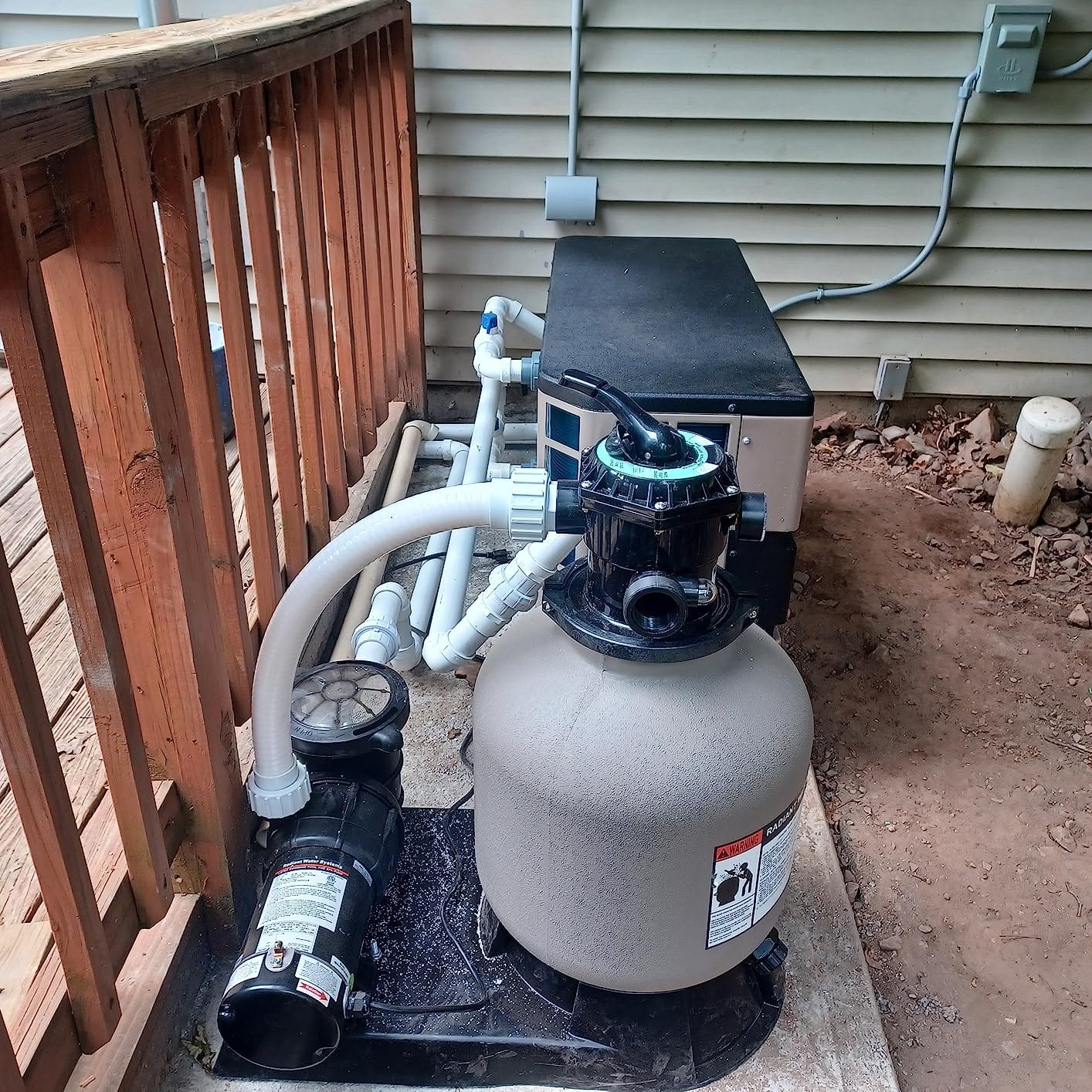
The plastic cabinet resists rust, which is a practical benefit in a humid climate where a steel-bodied unit would show corrosion within a few seasons. Owners generally find the controls genuinely set-and-forget, which matters if you are running the unit on a schedule rather than watching it.
For a cold climate, note the review summary describes the unit as maintaining water temperature in harsh weather conditions. That is the manufacturer framing, and in practice the modest output means it is a shoulder-season machine rather than a deep-winter one. Owners of large uncovered pools in cold regions consistently look for more capacity.
Is this the right capacity for a cold-climate pool?
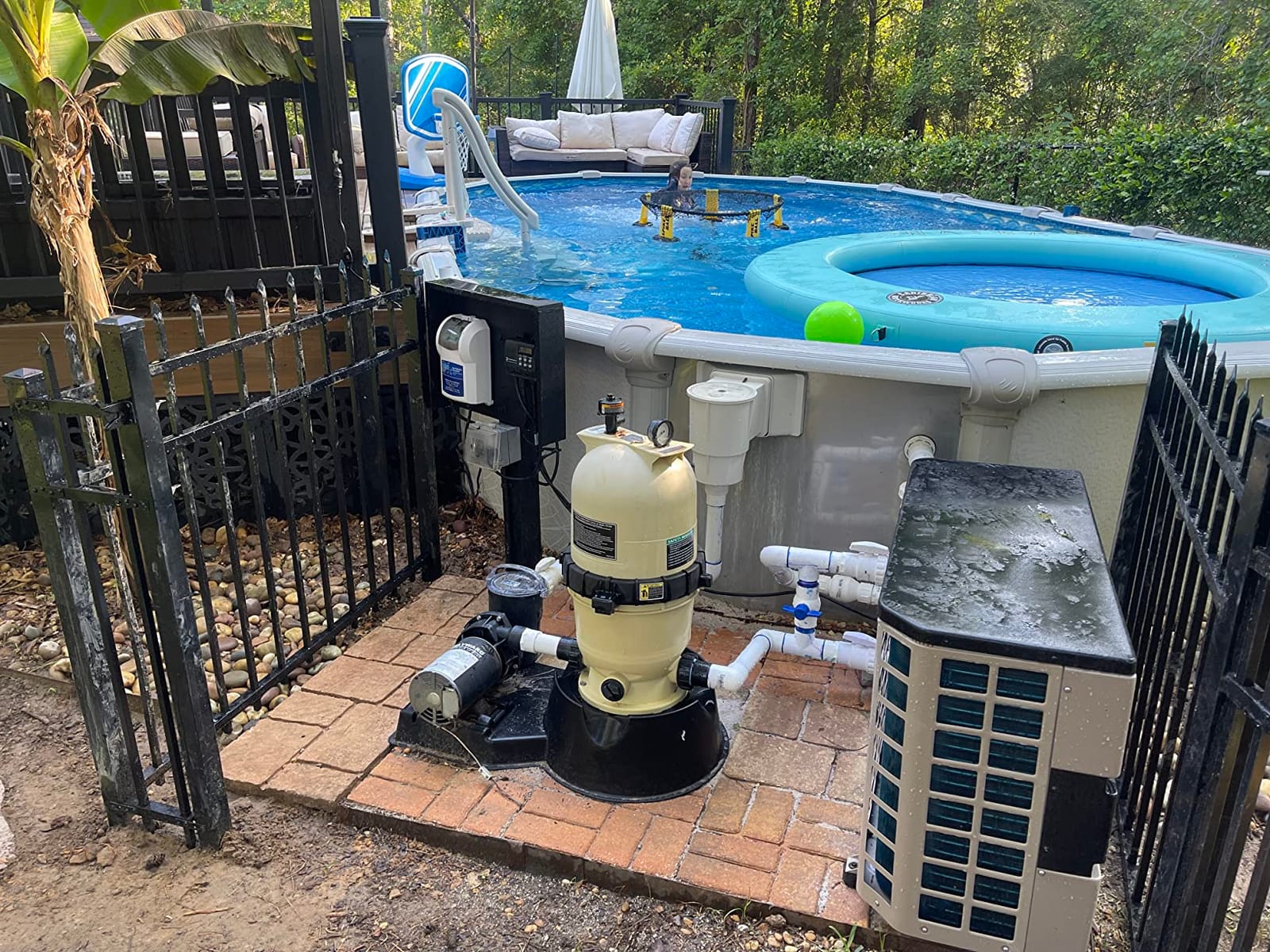
Only for a small to mid-size pool. Some buyers found it underpowered even when sized up for the pool, and that reaction is consistent with the physics rather than a defect: a mid-capacity air-source unit loses a large share of its rated output as ambient temperature falls, so the figure on the box is a mild-weather number. Judge capacity against your coldest month, not your average.
It is a good complement to a gas heater. Run it in spring, summer, and fall where it is most efficient, and let a backup unit carry the weeks when the heat pump would be working hardest and costing the most per degree.
What should you know before you buy?
One owner reported the unit stopped working after a single season, so confirm the warranty terms and the local service arrangement before purchase. Hayward’s broad service network is a genuine advantage, but only if your technician will actually come out.
The installation instructions are sparse, so plan on a plumber or pool store handling the hookup. Above-ground pools may need flex pipe converted to PVC for better performance, which is a small job your installer should do rather than skip.
How to Size a Pool Heat Pump for a Cold Climate
Size for your coldest month, not your average. That single change is where most sizing advice goes wrong, and it is the difference between a pool that holds 82F on a cold night and one that drifts to 68F by the time you get in. A heat pump’s rated output is measured at mild ambient temperature, so the number on the box is not what you get in February.
The base rule in moderate climates runs about 50,000 BTU per 10,000 gallons. For a cold climate, adjust upward when you have shade, wind exposure, an uncovered pool, or a long shoulder season. Multiply the base figure by 1.5 for genuinely cold regions, then add a margin for an uncovered pool.
Here is how the math works on a real example. For a 16 by 32 foot pool that averages 7.5 feet deep, volume is roughly 30,000 gallons. At 50,000 BTU per 10,000 gallons you need 150,000 BTU in a moderate climate, which already exceeds every unit in this roundup. With the 1.5x cold multiplier, 30,000 gallons in a snowbelt region needs about 225,000 BTU, which no single pool heat pump supplies. That math is the honest argument for a hybrid system or a pair of units rather than a bigger single machine.
For an 18 foot round pool averaging 7.5 feet deep, volume is about 15,000 gallons, base need is 75,000 BTU, and the cold-adjusted figure is about 112,500 BTU. That lands squarely in the 110,000 to 120,000 BTU class, which is exactly where most of this roundup sits and why the category is clustered there.
Oversizing is not automatically bad, and the old warning against it is mostly about efficiency in mild weather. In a cold climate the more relevant concern is run time. An oversized unit cycling on and off around a small pool wastes energy, while a variable-speed inverter unit modulating gently is fine. The thing you should never do is undersize, because an undersized heat pump in a cold climate runs continuously at peak draw, which is the worst of both worlds.
Two variables change the answer more than most people expect. An uncovered pool roughly doubles heat loss compared with a covered one, so an uncovered pool should be sized to the next band up. And salt water is more corrosive, which does not change capacity but does change which exchanger you should specify. You can see more of our general sizing logic in the main heat pump guide.
The 20-Degree Rule and Temperature Performance Bands
How cold is too cold for a pool heat pump? Too cold is roughly 55F and below ambient air. Above that a heat pump runs efficiently, below it efficiency collapses because the refrigerant has so little heat to collect. The practical limit for a heat pump is the 20-degree rule: expect water temperature to reach about 20F above the outside air temperature and no further.
So on a 70F day, a well-sized heat pump can deliver water in the high 80s to low 90s. On a 50F night, the same unit tops out near 70F. That ceiling is not a defect; it is the second law of thermodynamics applied to your pool, and no amount of compressor sophistication changes it.
Above 70F ambient, everything works well. Units run near their rated output, COP is at its best, and heating a pool is genuinely inexpensive. This is the band where a heat pump beats a gas heater decisively, and it covers a lot of spring and fall in the Upper South and coastal regions.
Between 60F and 70F, performance is solid. You can raise a pool into the low 80s reliably, run times get longer, and this is where most northern owners get the majority of their usable swim days from a heat pump. Heating costs rise but stay manageable, especially with a cover and off-peak scheduling.
Between 55F and 60F, units start to struggle. Output falls off, run times stretch, and the cost per degree of water temperature climbs quickly. Defrost cycles start consuming meaningful portions of the day, and this is the band where the difference between a well-built cold-climate unit and a basic model becomes obvious. If your coldest month lands here, prioritize verified defrost and a titanium exchanger.
Below 55F, a pool heat pump should not be your primary heater. Output drops sharply, defrost takes longer, and the unit may shut down entirely in some conditions. This is where a gas heater backup, a solar cover, and realistic expectations matter. Owners who treat the heat pump as a spring-to-fall machine and a gas unit as the deep-winter machine are the ones who report being happy with their purchase.
Active Hot Gas Defrost vs Passive Defrost in Cold Climates
Defrost decides whether a cold-climate pool heat pump keeps heating or stalls. When the outdoor coil drops near freezing, moisture in the air freezes onto the fins. That ice blocks airflow, the unit’s ability to pull heat from the air collapses, and the unit either stops or grinds on. Defrost is how the machine gets that ice off.
Passive defrost is the simplest approach. The unit detects a problem and simply stops to let the coil thaw, usually with some help from residual heat. It is cheap, it has fewer parts to fail, and it costs you heating time every time it triggers. In a climate where defrost cycles happen many times a night, that lost time adds up quickly.
Active defrost, usually called hot gas defrost, reverses the flow briefly and sends hot compressor discharge gas through the outdoor coil. The coil clears in minutes and the unit returns to heating. It is more complex, it uses control components like a defrost solenoid that can fail, and it is the only approach that makes sense in a genuinely cold climate.
Look for the cycle interval in the specifications. One unit in this roundup, the AQUASTRONG HEX100, runs an automatic defrost cycle every 40 minutes with a five-minute defrost, which is a concrete number you can compare against competitors. The MICOE lists intelligent auto-defrost without a published interval. A stated cycle tells you more about cold-weather behavior than a vague claim of advanced defrost.
Owners with disappointing cold-weather performance almost always point back to defrost. If a unit was undersized or has poor airflow clearance, it cycles harder, defrosts more often, and delivers less net heat. Defrost is also why airflow clearance matters: an obstructed coil ices faster and stays iced longer.
The Cold-Climate Buying Checklist
Check these items in order, because they are roughly ranked by how much they affect whether the unit works in your climate. Skipping the first two to save money is the most common expensive mistake in this purchase.
Verified minimum operating temperature. Look for a published ambient floor, not an implied one. The MICOE lists operation from 32F to 109F, the strongest published cold figure in this roundup. Units with no published minimum are a gamble once the air drops into the 30s.
An inverter variable-speed compressor. A modulating compressor holds set temperature with far less waste than an on/off unit, and it reduces the number of hard starts that wear a compressor out over a decade. Most of the larger units in this roundup use inverter control, including both Hayward models.
Titanium heat exchanger. Required for saltwater pools, and sensible anywhere with harsh water chemistry or coastal air. Four of the ten units here list a titanium heat exchanger explicitly. If you run salt, treat cupronickel as a non-starter rather than a compromise.
Automatic active defrost. Confirm it is active hot gas rather than passive, and ask for the cycle interval. Without this, the unit loses capacity precisely when you need it most.
Compressor warranty length. A 12-month warranty on a compressor is thin, and one unit in this roundup has exactly that. Ask which component carries the longest term, and get it in writing before you pay.
A 220V or 240V dedicated circuit. Every large unit here needs one, and the electrical work is frequently the largest hidden cost. Check your panel capacity before purchase, especially in older homes where the subpanel may already be near its limit.
A pool cover. Owners consistently name the cover as the biggest single factor in whether a heat pump can hold temperature. Without one, no amount of capacity keeps up with evaporation and convection losses.
Open airflow and clearance. The unit needs unobstructed air on the intake and discharge sides. Measure the pad, check clearance in every season including when leaves and snow are present, and confirm the unit fits before you order.
Local serviceability. Prefer a brand your pool technician already carries parts for. A 10-year compressor warranty is worth little if no one nearby can source the part, and that risk is highest in the shoulder season you are trying to protect.
Sound level relative to the pad location. Figures here run from 37 dB to 59 dB. If the unit sits beside a house wall or a bedroom, the difference between the quietest and loudest option in this roundup is the difference between acceptable and constant friction.
Heat Pump vs Gas Heater vs Solar in a Cold Climate
A gas heater heats faster and works at any temperature. A pool heat pump costs far less per degree of heat and works best above 70F. Solar costs almost nothing to run and does nothing at all below about 55F. In a cold climate you are choosing which of those tradeoffs you can live with, and for most owners the answer is to use two of them together.
On running cost, a heat pump moves roughly 4 to 6 units of heat per unit of electricity, and the premium units here claim considerably higher figures under favorable conditions. A gas heater converts fuel into heat at close to 100 percent efficiency but burns fuel continuously at full output. Over a shoulder season where a heat pump does most of the work, the difference is the largest recurring saving in pool ownership.
On heat-up time, gas wins decisively. A gas heater can take a pool from 60F to 82F in a few hours. A heat pump doing the same job on a 25,000 gallon pool in cold air runs for days. Owners with 30,000 to 35,000 gallon pools consistently tell forum communities that they either upsized substantially or added gas backup for exactly this reason.
On deep winter suitability, gas wins outright and it is not close. Below 55F ambient a heat pump is fighting for every degree, and in a region that freezes solid for weeks, relying on a heat pump alone means a cold pool. If your coldest month regularly sits in the 20s, plan a hybrid system.
On upfront cost, the heat pump sits in the middle of this roundup while gas heaters and their installation add a fuel line, a vent, and combustion requirements. That is why some owners in regions with harsh winters look to another form of water heating entirely when they need true year-round capability.
The hybrid setup is the practical answer. Run the heat pump through spring, summer, and fall where its efficiency is highest, and switch to gas for the coldest weeks or when you need a fast warm-up before an event. The switchover can be manual or automated, and manual is often sufficient since the decision is obvious once the thermometer drops.
Schedule the heat pump for off-peak hours if your utility offers a time-of-use rate. Because run times are long, shifting the whole block to cheaper hours can cut the cost of heating noticeably, and most of the inverter units here support scheduling through an app or a control panel.
Who Should Not Buy a Pool Heat Pump
If your coldest month regularly sits below freezing and you want a swimmable pool in January, a pool heat pump is the wrong primary heater. No unit in this roundup overcomes the physics below 55F ambient, and a pool that stays cold for four months of the year will feel like a purchase you regret every time you pay a maintenance bill. A gas heater or another form of backup heat is the honest answer, and we looked at cold-weather water heating options in our cold-climate heating guide.
Pools above 30,000 gallons are a difficult case. As the sizing math showed, even a 120,000 BTU unit sits below the cold-adjusted requirement, and you would be running it continuously through the shoulder season at peak electrical draw. Owners with pools that size consistently recommend upsizing or supplementing with gas, and the forum consensus is blunt about it.
Pools with no cover and no plan for one should also reconsider. Without a cover, heat loss is high enough that the heat pump runs far longer than its efficiency can justify. Reviewers across this roundup return to the cover point more than any other single factor, and it is the cheapest performance upgrade available.
Households with no room for a 220V circuit and no budget for electrical work should look at the 120V option instead. The FibroPool FH135 runs on a standard outlet, and a hot tub or a small above-ground pool is a much better use of it than a large inground pool.
Owners who need a fast warm-up on demand should pair a heat pump with gas rather than choosing one. Forum threads are full of disappointment from people who expected an air-source unit to match a gas heater’s recovery speed, and that expectation gap is the most common source of regret in this category.
Finally, anyone whose local pool service does not carry parts for the brand should think hard before buying. A failure in April with no nearby technician is the worst possible outcome, and it is far more common than buyers expect when they order a unit from a brand their local shop has never touched.
Frequently Asked Questions
How cold is too cold for a pool heat pump?
Roughly 55F ambient air is the practical limit. Above that a pool heat pump runs efficiently; below it, the refrigerant has too little heat in the outdoor air to collect, so output falls sharply and defrost cycles eat into heating time. The 20-degree rule explains the ceiling: expect water temperature to reach about 20F above the outside air temperature and no further, so on a 50F night the pool tops out near 70F.
What is the 20-degree rule for heat pumps?
The 20-degree rule states that a pool heat pump will heat water to roughly 20F above the surrounding air temperature. It is a physical limit, not a defect. On a 70F day you might reach 88F to 90F in the water. On a 45F day, expect the same unit to top out in the low 60s no matter how large the model is.
How many BTU do I need for a pool heat pump?
The base rule is about 50,000 BTU per 10,000 gallons in a moderate climate. In a cold climate, multiply that by about 1.5 and add margin for an uncovered pool. A 15,000 gallon pool in a snowbelt region needs roughly 112,500 BTU, which lands in the 110,000 to 120,000 BTU class. Size for your coldest month, not your average.
Is it better to oversize a pool heat pump?
A modest amount of oversizing is fine with an inverter unit, because variable-speed compressors modulate down rather than hard cycling. What causes waste is a much larger single-speed unit cycling on and off around a small pool. In a cold climate the bigger mistake is undersizing, which forces continuous peak draw and frequent defrost. Never size below the cold-adjusted figure.
Which heat pump is best for extreme cold weather?
For extreme cold, look first at the verified minimum operating temperature rather than headline BTU. Among the models reviewed, the MICOE is rated for ambient operation from 32F to 109F, the highest published floor in the group. For capacity in genuinely cold regions, a 120,000 BTU inverter unit such as the VARMINPOOL or Varpoolfaye, paired with a pool cover, gives the most usable shoulder-season heating.
Are pool heat pumps worth it in cold climates?
Yes, for shoulder-season heating in spring and fall, where they cut running costs far below a gas heater. The value disappears if you expect warm swimming in deep winter, because efficiency collapses below 55F ambient air. Most satisfied owners in cold regions treat the heat pump as an April-to-October machine and keep gas backup for the coldest weeks.
What is a major disadvantage of a pool heat pump for cold climates?
The main disadvantages are slow heat-up time and poor performance in cold air. A heat pump can take days to raise a large pool because it moves heat slowly from thin air, and a gas heater does the same job in hours. Below 55F ambient, output drops sharply and defrost cycles consume operating time, which is why most cold-climate owners add a gas backup rather than rely on a heat pump alone.
Will a pool heat pump work in winter?
It will operate in winter, but it will not perform to its rated output. Between 32F and 50F ambient, expect a large share of rated capacity plus repeated defrost cycles. The water temperature ceiling stays near 20F above ambient air, so a pool rarely gets genuinely warm in freezing conditions. Winter operation makes sense for maintaining temperature under a cover, not for swimming.
Bottom Line on the Best Pool Heat Pumps for Cold Climates
After comparing these ten units on capacity, verified cold-weather ratings, defrost design, sound level, and real owner outcomes, the VARMINPOOL 120000BTU Inverter is our pick for the best pool heat pumps for cold climates. Its 120,000 BTU of inverter-controlled output, 35,000 gallon rating, and titanium exchanger with an IPX4 cabinet are a strong showing for a design with this little field history, and the 153 reviews suggest the pattern holds up beyond the first few owners.
The AQUASTRONG HEX100 is the value choice with the deepest feedback in the category, and the Varpoolfaye 120,000 BTU model is the saltwater pick at 47 dB. Whatever you choose, buy on a verified minimum operating temperature, insist on a titanium heat exchanger and active hot gas defrost, get a pool cover, and size for your coldest month rather than your average.
And be honest about the season. A heat pump in a northern climate earns its money in April, May, September, and October. If you need warm swimming in January, add a backup heater instead of pretending a larger single unit will do it.


