

A trellis net is the cheapest piece of equipment in a grow tent and the one that changes your canopy the most. We spent weeks hanging, tensioning, cutting and re-hanging every net in this roundup inside 2×2, 2×4 and 4×4 tents, and what surprised us was how much the difference comes down to mesh size and how honestly the net is sized. The best trellis nets for grow tents are not the priciest ones. They are the ones that reach the tent walls, stay flat under weight, and do not abrade tender stems.
This roundup covers ten nets that all earned their place, from the heavily reviewed VIVOSUN 4×4 to the only 5×5 option we found. We rated each one on the things that actually matter in a tent: footprint, mesh opening size, how the net behaves when a plant pushes against it, and whether the included hooks let you move the net up and down as the canopy fills. If you are still choosing a tent, start with our guide to the best grow tents for small spaces so you know the footprint you are netting.
We also pulled apart the questions grow forums keep asking, because the advice out there is thin and often contradictory. Mesh size, install timing, and whether an elastic net can hold a real canopy are the three that come up constantly, and we answer each one inside the relevant section. For garden-scale netting used outdoors and on raised beds, our separate heavy duty garden trellis picks cover a different set of needs.
What Is a Grow Tent Trellis Net?
The best material for trellis netting is soft elastic cord wrapped in a fabric sheath, usually polyester or nylon. A 3 mm elastic core gives you stretch, and the sheath keeps the cord from cutting into stems. Rigid plastic mesh, cattle panel fencing and PVC frames all work for training, but soft sheathed cord is the safest choice for delicate growth.
A grow tent trellis net is a flat grid of sheathed elastic cord that hangs from the tent frame at a set height. Stems are threaded up through the mesh and gently pulled outward, so as the plant grows it fills the net and forms a flat canopy instead of a single tall tower.
That flat canopy is the whole point. Light reaches the lower and outer bud sites instead of only the top, branches that would snap under heavy flower get supported, and trimming a uniform crop at harvest becomes a much shorter job. The net is a training tool more than a support tool, and it works best once a plant has something worth training.
Top 3 Trellis Nets for Grow Tents in 2026

VIVOSUN 4×4 Elastic Trellis…
- 3mm elastic cord in a fabric cover
- 3.9 in mesh squares
- 4 rustproof S-hooks
- Cuttable and foldable

AC Infinity 4×4 Elastic…
- Elastic rubber cord in polyester
- Non-abrasive mesh cells
- Steel hooks for height adjustment

BSTPCOO 4×4 Heavy Duty…
- 3.5 in mesh squares
- Polyethylene and rubber build
- 4 S-hooks and 16 ties
All 10 Trellis Nets Compared in October
| Product | Specs | Action |
|---|---|---|
| VIVOSUN 4×4 Elastic Trellis Net with 4 Hooks |
|
Check Latest Price |
| AC Infinity Elastic Trellis Netting for 4×4 Grow Tents |
|
Check Latest Price |
| BSTPCOO 4×4 Heavy Duty Elastic Trellis Net |
|
Check Latest Price |
 TORINALITAL Grow Tent Trellis Netting 2×4 Ft TORINALITAL Grow Tent Trellis Netting 2×4 Ft |
|
Check Latest Price |
 yeystone Trellis Netting Scrog Net 4×4 ft yeystone Trellis Netting Scrog Net 4×4 ft |
|
Check Latest Price |
 HOMEANING 2 Pack Grow Tent Trellis Netting 4x4Ft HOMEANING 2 Pack Grow Tent Trellis Netting 4x4Ft |
|
Check Latest Price |
 Generic 4×4 Elastic Plant Trellis Net 2-Pack Generic 4×4 Elastic Plant Trellis Net 2-Pack |
|
Check Latest Price |
 iPower Elastic Trellis Netting for 4x4FT Grow Room iPower Elastic Trellis Netting for 4x4FT Grow Room |
|
Check Latest Price |
 JZTang Elastic Trellis Netting 2×4 FT Scrog Net 2-Pack JZTang Elastic Trellis Netting 2×4 FT Scrog Net 2-Pack |
|
Check Latest Price |
 GBACHOOSE 5×5 ft Elastic Trellis Netting GBACHOOSE 5×5 ft Elastic Trellis Netting |
|
Check Latest Price |
1. VIVOSUN 4×4 Elastic Trellis Net with 4 Hooks: Best Overall
VIVOSUN 4 x 4Ft. Elastic Trellis Netting with 4 Hooks for Climbing Plants, Vegetables, Fruits, and Flowers, 1-Pack
3mm elastic cord in a fabric cover
3.9 in mesh squares
4 rustproof S-hooks
Weighs 0.21 kg
Pros
- Large 3.9 in mesh makes pruning and harvesting easy
- 3mm elastic cord stretches and holds heavy plant weight
- Four rustproof S-hooks included for quick attachment
- Cuttable and foldable for compact storage
Cons
- Loose weave can let vigorous vines slip through
- Mesh edges can curl after repeated cutting
This is the net we kept coming back to. It stretches to a true 4×4, the 3 mm cord has enough body to hold a plant that is actively filling the canopy, and the 3.9 inch openings are wide enough that you can get a whole hand and a pair of scissors through them without fighting the mesh. That opening size is the quiet advantage. Narrow mesh looks tidier on paper and becomes a genuine nuisance during trimming.
It weighs 0.21 kg, so moving it up as the canopy grows takes one person and no tools. The four S-hooks clip straight onto standard tent frames, and because it is 22 mm wide the hooks sit at the corners without needing extra tie points.
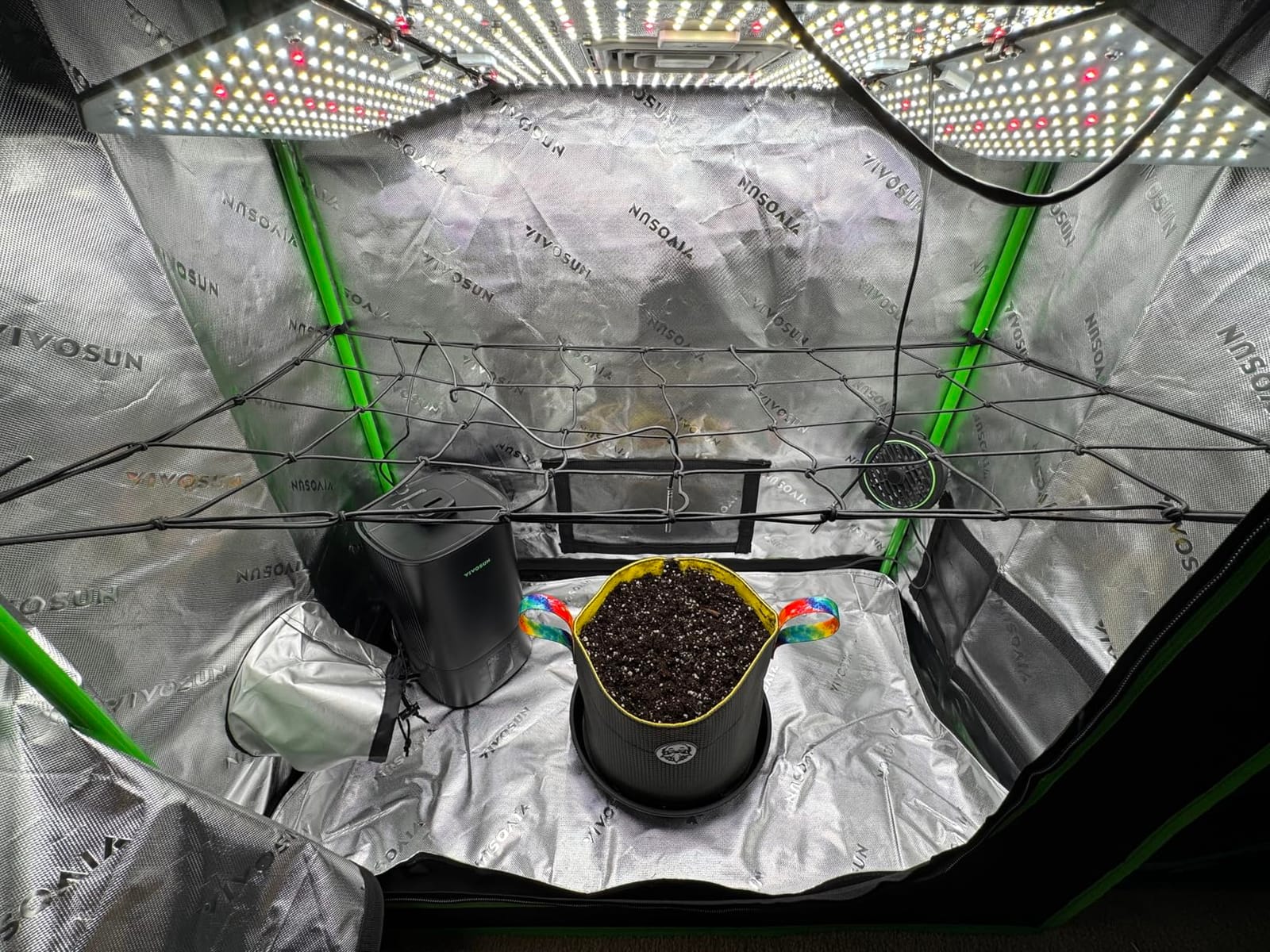
One thing that does not get enough attention is that a net you can cut is a net you can resize. If your 4×4 tent has a center pole eating usable space, trim the net and re-tie it around the pole rather than trying to stretch a square net over an obstacle. Reviewers report buying multiple sizes from the same line, which tells you the family covers smaller tents too.
Because the cord is elastic rather than fixed, a very fast vine can push straight through the openings instead of training along the net. That is a real limitation on aggressive growth, though it rarely matters on the tomato and vine crops most people net in the first place.
What you are getting for the money
A finished 4×4 square of sheathed elastic cord with four hooks, not a roll you have to cut and hem yourself. That matters more than it sounds, because raw cut ends fray and a frayed end under tension eventually snaps.
The fabric sheath is the other quiet win. Bare rubber cord abrades stems, and sheathless nets are the reason some growers report scarred petioles after a cycle.
Who should skip it
Skip it if you run a 2×2 tent and want something less oversized, or if your plants are aggressive enough to grow straight through 3.9 inch openings. If you plan a true SCROG with a rigid frame, this net will not hold canopy out to the tent walls the way framed mesh does.
2. AC Infinity Elastic Trellis Netting for 4×4 Grow Tents: Best Premium Build
AC Infinity Elastic Trellis Netting for 4×4 Grow Tents
Elastic rubber cords in polyester
Non-abrasive mesh cells
Steel hooks
Stretches to 4x4 ft
Pros
- Elastic rubber cord in a polyester shroud carries heavy fruiting crops
- Non-abrasive cells protect stems and allow hand access for pruning
- Steel hooks make height adjustment on the frame quick
- Available in sizes covering 2x2 through 5x5 tents
Cons
- Green cord is hard to see against dense foliage
- Loose weave lets fast vines push through rather than train
This is the most refined net in the group and it shows in the small things. The elastic rubber cords are shrouded in high-quality polyester rather than a thin fabric sleeve, the mesh cells are shaped to be non-abrasive, and the steel hooks clip directly to the tent frame so you can move the net in seconds as the canopy rises.
It weighs 0.25 kg and lists at 31.5 by 31.5 inches, which is the net at rest rather than at full stretch. Once tensioned it covers a 4×4 footprint. If you own more than one tent, the same line runs from 2×2 up to 5×5, which removes the sizing guesswork entirely.
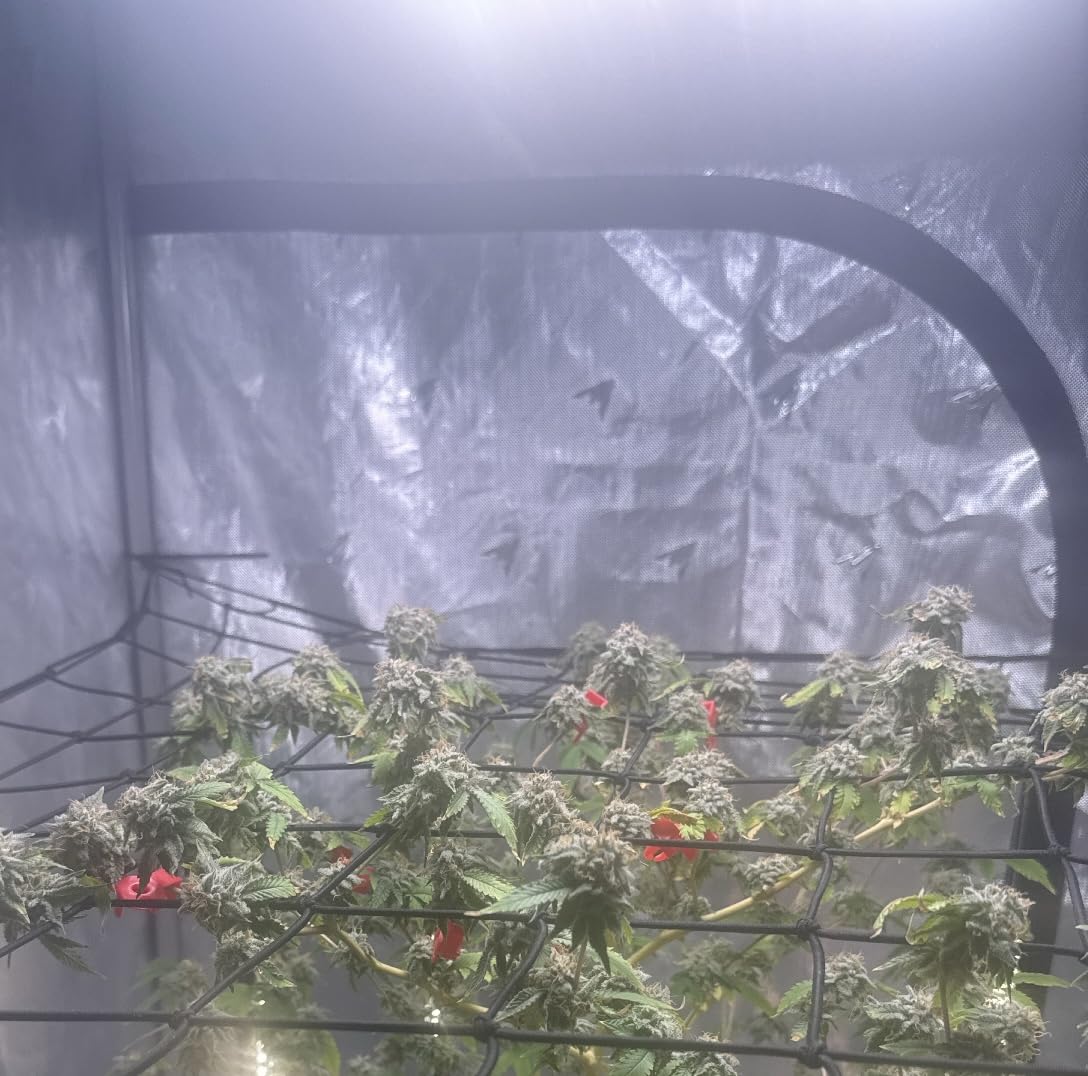
The cord here is noticeably more forgiving than most commodity nets. Reviewers consistently point out that it carries heavy fruit and bud loads without dropping them, which is the failure mode that ruins cheaper nets late in a cycle. Just over 3,000 reviews averaging 4.6 stars, with 81 percent five-star ratings, is the strongest volume of feedback in this roundup.
The green cord is a design decision rather than an accident. It blends into a canopy instead of catching your eye every time you open the tent, though it does make the net harder to spot against dense foliage when you are trying to thread a late branch.
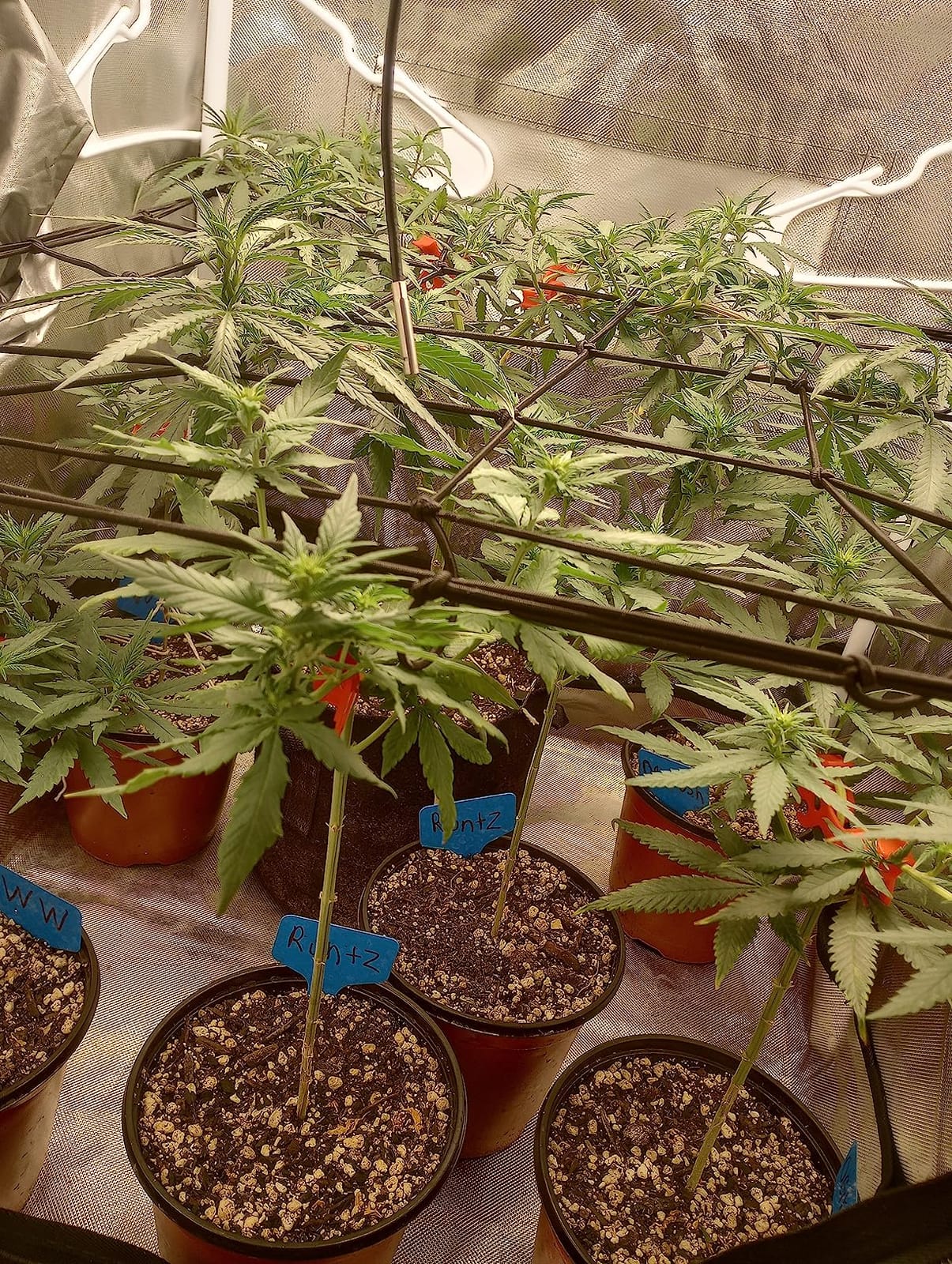
Why the steel hooks are the deciding feature
Every net in this list hangs from something. Steel hooks let this one move between heights without retying anything, so a net installed early can stay useful as the plant fills the space underneath it.
The non-abrasive cell profile is the second differentiator. It is the reason this net suits plants with soft, fast-growing stems that would mark against a stiffer weave.
Who should skip it
Skip it if budget is the deciding factor, since equivalent coverage exists for noticeably less. It is also the wrong tool for anyone chasing rigid SCROG control right out to the tent walls, because an elastic net is built to flex, not to hold a fixed plane.
3. BSTPCOO 4×4 Heavy Duty Elastic Trellis Net: Best Value for a 4×4
BSTPCOO 4×4 Trellis Net for Grow Tent,Heavy Duty Elastic Trellis Netting
3.5 in mesh squares
Polyethylene and rubber build
4 S-hooks and 16 ties
Weighs 0.24 kg
Pros
- Flexible net bounces back after stretching instead of staying slack
- Soft cord does not cut tender stems
- Hooks let the mesh collapse down to fit smaller tents
- Useful as a cargo net too
Cons
- Stretches beyond the labelled footprint and can sag in a 2x4
- Some nets arrive twisted and need straightening
What sets this one apart is the extra hardware. Four S-hooks is standard, but 16 ties in the box is not, and those ties are what you use to pull the perimeter tight once the net is up. More anchor points is the simplest way to stop sag, and most sag complaints trace back to too few anchor points rather than weak cord.
At 3.5 inch the mesh sits between the VIVOSUN and the coarser nets, which makes it a sensible middle ground. You get enough openings to work in comfortably, but small enough that a young branch actually catches and holds instead of sliding through.
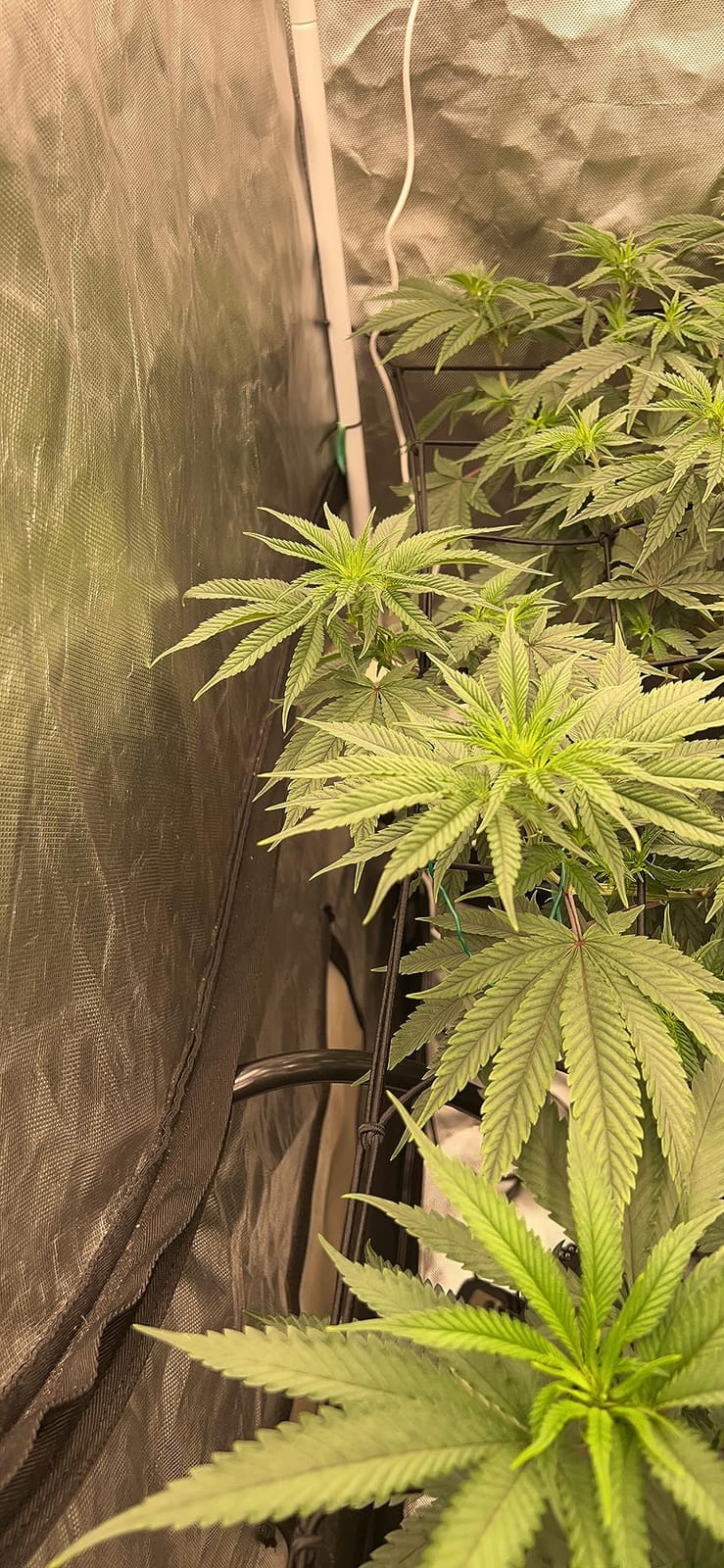
The 617 reviews at 4.5 stars describe a net that is sturdy, easy to set up and soft on stems. The one recurring complaint is over-stretching. Owners report it settling larger than the labelled 4×4, so in a smaller tent it can look loose until you tension it down with the included ties.
A second minor issue: some nets arrive twisted inside the packaging. Untwisting takes a few minutes in the hands before hanging and makes a real difference to how flat the net sits.
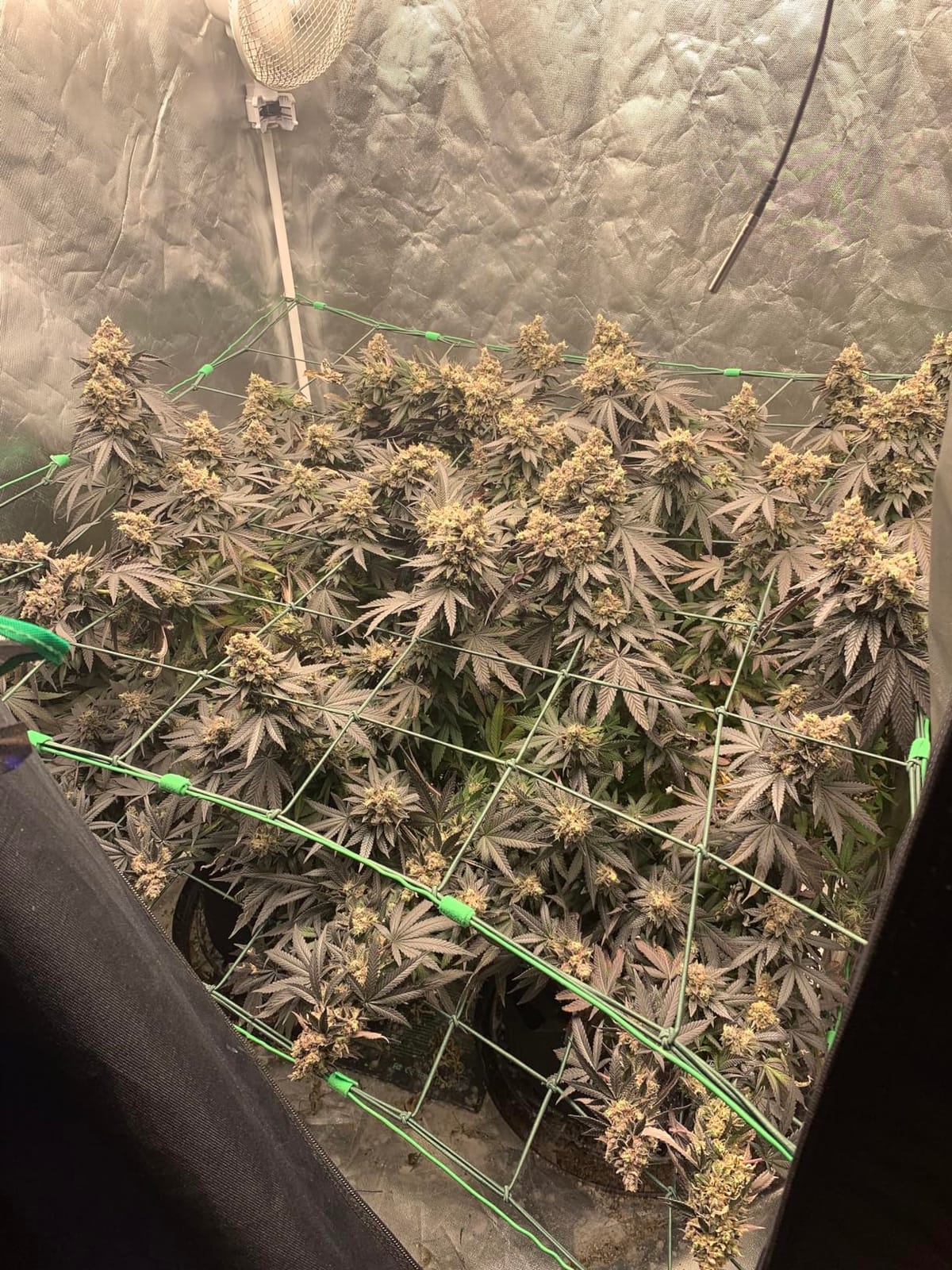
When the extra ties actually matter
Four corner hooks suspend a net. They do not tension the middle of it, and a net that is only supported at four points dips in the centre exactly where your plant is heaviest. The 16 ties let you pull the edges and mid-span to a flatter plane.
Multi-tent growers also report using two of these stacked at different heights for a layered canopy, which the collapsible design makes easy to swap.
Who should skip it
Skip it if you want a precise fixed cell count, since the openings are formed by the weave rather than a fixed grid. Be cautious in a 2×4 as well, because the over-stretch complaint shows up most in tents smaller than the label.
4. TORINALITAL Grow Tent Trellis Netting 2×4 Ft: Best for 2×4 and Narrow Tents
Grow Tent Trellis Netting 2×4 Ft, Elastic Netting with Steel Hooks
Elastic polyester cord
Steel hooks
Non-abrasive cells
Stretches to 2x4 ft
Pros
- Elastic polyester cord handles heavy climbing vegetables
- Steel hooks allow height adjustment inside the tent
- Non-abrasive cells keep stems undamaged
- Multi-pack format suits double-netting a tent
Cons
- Loose weave lets aggressive vines grow through rather than train
- Needs even tensioning or it sags
Most of the nets in this list are square. This one stretches to 2×4, which is exactly the footprint of a long narrow tent, so it reaches wall to wall instead of leaving a gap down each side. For a rectangular tent that is the difference between a canopy that fills the space and a canopy that spills over the edges.
The steel hooks clip to the tent frame and let you reposition the net without tools. It weighs 0.23 kg, so a single person can raise it as the plants grow.
With 459 reviews at 4.6 stars and 77 percent five-star ratings, the feedback concentrates on solid elastic support, stem-friendly cells and value for what it does. Owners using it for cucumbers, peas and other fruiting climbers report it carrying weight well once tensioned.
How to get a flat plane out of a 2×4
Rectangular nets are more prone to a diagonal sag because the span is longer in one direction. Hook all four corners, then add a mid-span tie so the net stops dipping in the middle. That single tie fixes most of the sag complaints owners report.
Because the mesh is loose, work in early rather than late. A branch threaded into place while it is still flexible will stay put; the same branch added to a mature canopy tends to grow through instead.
Who should skip it
Skip it if you have a square tent, where a rectangular net leaves corners uncovered. It is also a poor fit for a rigid SCROG plan, and growers who want an exact cell count will not find one here.
5. yeystone Trellis Netting, Scrog Net 4×4 ft: Best Stretch Range
Trellis Netting, Scrog Net 4×4 ft, Heavy-Duty, Grow Tent Accessories, 1 Pcs
3 mm elastic nylon cord
4x4 in mesh
Stretches 2.6 to 4x4 ft
Weighs 0.17 kg
Pros
- Very light at 0.17 kg and still supports climbing vines
- Stretches from roughly 2.6 ft all the way to 4x4 ft
- 4x4 in mesh gives good airflow and pruning access
- Works indoors
- outdoors or as a cargo net
Cons
- Stretches past 4x4 in practice and can pull tent walls inward
- Weave is not perfectly even once tensioned
The widest stretch range in the roundup makes this the most forgiving net to buy. It comes down to a compact 2.6 by 2.6 foot square and stretches to a full 4×4, so one net covers a small tent, a large tent, or anything in between. That removes the sizing anxiety that drives so many purchasing mistakes.
At 0.17 kg it is the second-lightest net here, and the 4×4 inch openings keep airflow moving through the canopy while still giving you hand access for pruning. Four hooks are included and it is listed as compatible with most major grow tent brands.
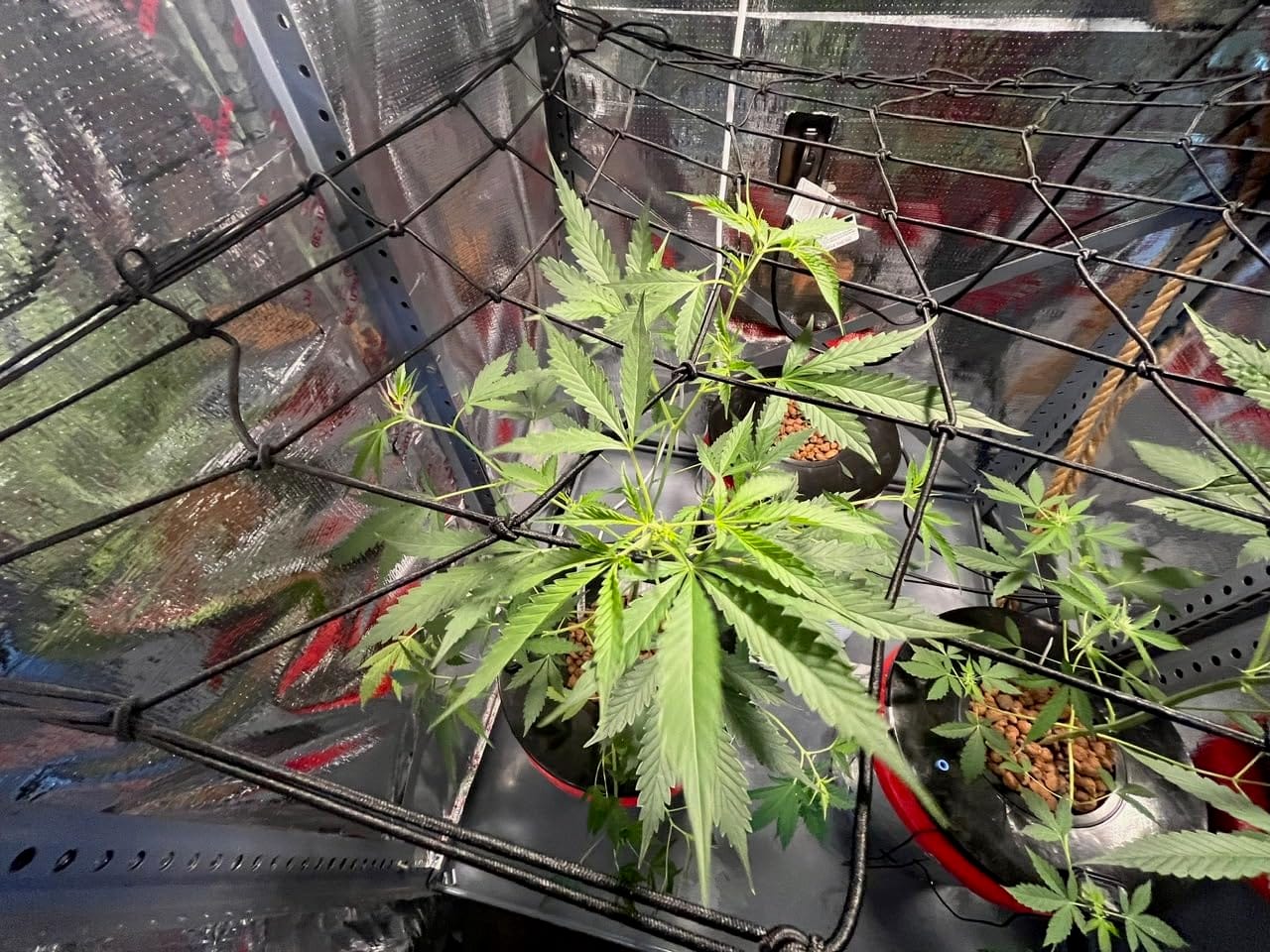
With 561 reviews at 4.5 stars, owners like the low cost and how well it reaches a full 4×4. The consistent caution is that it will stretch past 4×4 if you force it, which can pull the tent walls inward. If you hang it in a true 4×4 tent, tension it to the frame rather than pulling the corners tighter than the frame allows.
The weave is also not perfectly uniform once stretched, so it trains slightly looser than a fixed grid. For most people that is a feature. It holds the canopy without restraining a branch mid-growth.
When one net covering two sizes pays off
If your setup changes, this is the net to buy. Owners use it as a cargo net and as an outdoor garden net as readily as a grow tent net, and the stretch range means one purchase covers a 2×2 through a 4×4.
The 4×4 inch opening is a genuinely good working size. It is tight enough to catch a young branch and wide enough that you can harvest a cucumber without dismantling the canopy around it.
Who should skip it
Skip it if you need a net that holds a precise grid or one that will not pull on tent fabric. Avoid pulling it to full stretch in a 4×4 without anchoring to the frame, since that is exactly how walls get pulled inward.
6. HOMEANING 2 Pack Grow Tent Trellis Netting 4x4Ft: Best for Double-Layer Training
HOMEANING 2 Pack Grow Tent Trellis Netting 4x4Ft, Elastic Plant Netting Includes 8 Iron Hooks, Flexible Net for Grow Tents a Total of 36 Holes (White)
Two 4x4 ft nets
8 iron hooks
Anti-tangle nylon weave
36 openings per net
Pros
- Tangle-resistant weave holds heavier fruit crops
- Rounded hook heads avoid scratching fingers or stems
- Two nets can be used together for double-layer training
- Works horizontally and vertically on any frame
Cons
- Lighter-gauge cord than premium nets
- so heavy plants stretch it
- Square holes are less precise than a fixed-count grid
Two nets and eight iron hooks is the best hardware package in the roundup, and the double-net configuration is the reason to buy it. Running one net low and one high lets a plant climb into the first layer and spread into the second, which is a cheap way to fill vertical space you would otherwise leave empty.
The anti-tangle weave is worth calling out. Nets that arrive kinked snag on branches and on tent fabric every time you reach in, and this one is described by owners as resisting that. Rounded hook heads are a small detail that stops hooks from scratching stems while you work.
It is also the only white net here, and it is described as heat and cold resistant, so it works outdoors as well as in a tent. That makes it a reasonable pick for grapes, pumpkins and cucumbers in raised beds.
How to use the two-net setup
Hang the first net at the height where your plant has a few nodes, then add the second roughly a foot higher once the first has started to fill. Each hook set lets you move either net independently, so you are never forced to re-hang the whole system.
With 36 openings per net the grid is coarser than a dedicated scrog grid, so branch spacing is approximate rather than fixed. For most home growers that is plenty of control.
Who should skip it
Skip it if you are running very heavy flowering plants late in a cycle, since the lighter-gauge cord stretches more than the premium nets under load. If you need a fixed cell count for precise branch spacing, this is not it.
7. Generic 4×4 Elastic Plant Trellis Net 2-Pack: Best for Two Beds on One Tent
4 x 4 Ft Elastic Plant Trellis Net – 2-Pack Heavy Duty Garden Support Net with 4 Hooks for Grow Tents, Climbing Vegetables, Fruits & Flowers (Black)
3 mm elastic thread in a fabric cover
3.9 in mesh squares
4 rustproof S-hooks
2-pack
Pros
- Elastic material is soft and gentle on plant stems
- Easier to scrog than building a fixed DIY trellis
- Holds up well through a full outdoor season
- Very adjustable for vining crops
Cons
- Stretched size runs smaller than the label suggests
- Hook count is low relative to the 2-pack quantity
- Generic branding with no in-house support
This is the lowest-rated net in the roundup at 4.4 stars across 142 reviews, and we are including it because the core product is genuinely fine. The 3 mm elastic thread sits in a fabric cover, the 3.9 inch mesh matches the VIVOSUN, and the two-pack is a sensible way to net two beds or two tents at once.
Owners describe it as soft on stems and easy to train in, and report it holding up through a full outdoor season. If you are netting raised beds rather than a tent, that is exactly the use case it suits.
The sizing caveat that matters most
The most common complaint is that the stretched size runs smaller than the label suggests, particularly on larger variants. Measure your footprint before you hang it rather than assuming a 4×4 label covers a 4×4 tent wall to wall.
The second issue is hardware. Four hooks for a two-pack is thin, so plan to add your own ties to the mid-span to keep the plane flat. That one addition solves most of what people dislike about this net.
Who should skip it
Skip it if you want brand support behind a problem, since this is an unbranded listing with no in-house service. It is also the wrong choice if you need guaranteed coverage of a full tent footprint without adding hardware.
8. iPower Elastic Trellis Netting for 4x4FT Grow Room: Best Budget Pick
iPower Elastic Trellis Netting for 4x4FT Grow Room, Heavy-Duty Plant Net with Hooks, Flexible Hydroponics Support for Indoor Plants, Gardening, and Horticulture
6 in x 6 in mesh squares
36 growing spaces
10 anti-rust S-hooks
Elastic rope support
Pros
- Thick elastic bands hold up most foliage and heavy vines
- Ten hooks give more anchor points than most nets at this size
- Stretches to fit a 4x4 ft room as specified
- Lowest-cost 4x4 net in this roundup
Cons
- Mesh squares are large
- so thin stems slip through and training is looser
- Hooks look plastic despite the listing description
Ten hooks is the highest anchor count here, and that is the feature that earns this net its place. More attachment points is the most reliable way to keep a net flat across a wide tent, and it is the difference between a taut grid and a hammock.
It stretches to fit a 4×4 ft room and folds down for smaller tents. The thicker elastic bands are sturdy enough for most foliage and heavy vines, and it works with A-frame, horizontal and vertical brackets if you are training outside a tent.
At 140 reviews and 4.5 stars the feedback is consistent: owners like the bands and the easy stretch, and complain most about the mesh being too large and the hooks looking plastic.
What 6 inch mesh does to your workflow
At 6 by 6 inches the openings are the widest in this roundup, with 36 growing spaces per net. That gives excellent airflow and makes trimming very easy, but a thin stem can slip through and keep growing upward instead of spreading.
If your plants are young and flexible, the loose fit is a benefit because nothing gets pinched. If you are training established branches, expect to tie a few in rather than relying on the mesh alone.
Who should skip it
Skip it if fine branch control matters, because 6 inch mesh will not catch thin stems. If you care about long-term hardware durability, the hooks look like plastic despite the listing calling them anti-rust steel, so plan on adding your own anchors.
9. JZTang Elastic Trellis Netting 2×4 FT Scrog Net 2-Pack: Best Bundled Accessories
JZTang Elastic Trellis Netting for Grow Tents, 2×4 FT Scrog Net, 2-Pack
2x4 ft scrog net
3 mm cord with 3.1 in mesh
8 hooks plus tape and labels
32 openings
Pros
- Sturdy polyethylene and rubber that holds heavy fruit without bruising plants
- Best bundled accessory set including hook and loop tape and plant labels
- Stretched size fits 2x4 ft tents
- Also usable as a small cargo net
Cons
- Rectangular shape does not suit square tent walls
- Coarser 32-cell layout than dedicated scrog grids
- Loose weave can let vines grow through
The accessory bundle is the story here. Alongside two nets and eight hooks, you get a 3.3 foot hoop-and-loop tape strip and ten plant labels, which sounds trivial until you are labeling a two-bed setup and need a way to reattach the net without cutting new ties every time.
The cord is 3 mm polyethylene and rubber with 3.1 inch mesh and 32 openings. That is the tightest mesh in the roundup, and tight is what you want if your goal is branch support for heavy fruit rather than wide canopy control.
It unstretched is a compact 1.3 by 2.6 foot rectangle that stretches out to 2×4, so it stores small. Owners particularly like the tape and labels, with the main limitation being the rectangular format.
Why tight mesh suits a small tent
At 3.1 inches the openings catch small stems and young branches rather than letting them escape upward. In a 2×4 tent where you only have a handful of plants, that close control is worth more than the airy wide-mesh design used for a dense canopy.
The rectangular footprint is the trade. It fills a 2×4 tent wall to wall, but in a square tent it leaves corners uncovered, so it is the wrong shape for a 3×3 or 4×4.
Who should skip it
Skip it for square tents, and skip it if you want a precise large cell count, since 32 openings is coarser than a dedicated scrog grid. It is a niche pick for small rectangular tents, though a good one.
10. GBACHOOSE 5×5 ft Elastic Trellis Netting: Best for 5×5 Tents
GBACHOOSE 5×5 ft Elastic Trellis Netting for Grow Tent, with 100 Zip Ties
5x5 ft stretched size
15 x 15 cm mesh with 64 tie points
3 mm black elastic cord
100 zip ties included
Pros
- The only net here sized for 5x5 ft tents
- A generous pack of 100 zip ties makes securing corners and extra tie points easy
- Coated iron hooks resist rust
- Large mesh leaves plenty of room for trimming and airflow
Cons
- Higher cost per net than the 4x4 options
- Large mesh cells give looser training than finer scrog grids
- Fewer reviews
- so less long-term feedback
If your tent is 5×5, this is the only net in the roundup that covers the footprint properly. Everything else here tops out at 4×4, which in a 5×5 leaves a strip of unused space on two sides and a canopy that stops short of the walls.
It arrives flat at roughly 110 by 110 cm and stretches to 5×5, with 15 by 15 cm mesh openings and 64 tie points per net. The 100 included zip ties at 4 by 100 mm are the real story on a net this size, because anchoring a 5×5 square needs more points than four corners.
At 55 reviews the feedback pool is the smallest here, so treat the owner reports as encouraging rather than proven. What owners do report is solid build quality, coated iron hooks that resist rust, and a mesh size that makes trimming easy.
Anchor points are the whole job at this size
A 5×5 span of elastic cord sags more than a 4×4 because there is more unsupported length in the middle. The 64 tie points and 100 zip ties exist to let you pull the perimeter and cross-span down into a flat plane.
Attach along all four edges rather than at four corners, working from the centre outward. Even tension across the whole span is what keeps the canopy level.
Who should skip it
Skip it for anything under 5×5, where you would pay more for coverage you cannot use. Be aware the 15 cm openings give looser training than a fine mesh, and the thin review count means less long-term evidence than the 4×4 options.
How to Choose a Trellis Net: Mesh Size, Tent Size and Material
Mesh size is the decision most buyers get wrong. Roughly 4 inch openings, around 10 cm, are the sweet spot for most indoor work: branches catch and hold, airflow stays strong, and your hands still fit through for pruning. Roughly 6 inch openings, around 15 cm, give better airflow and easier trimming but let thin stems slide out, so training is looser. Growers who work with smaller openings report them being frustrating to train through, which is why 10 cm is generally preferred over 5 cm for tent work.
Tent footprint is the second decision, and the rule is simple. Measure the usable floor area, subtract anything a center pole or equipment occupies, and choose a net that stretches to at least that footprint. A net that falls short of the walls means branches spill over the edge and light goes to waste. A 2×2 tent wants a 2×2 or 3×3 net, a 2×4 wants a 2×4, a 3×3 or 4×4 wants a 4×4, and a 5×5 needs a 5×5.
Material comes third and matters less than people expect. Sheathed elastic cord is the right answer for nearly every indoor case because it stretches, holds weight and will not cut stems. Rigid plastic mesh is stiffer and does not stretch, which makes it harder to install and easier to abrade. If you are matching nets to tents rather than nets to plants, our 4×4 grow tent picks cover the sizes most net buyers are working with.
Finally, count the hardware. Four hooks suspend a net. More than four, plus ties or zip ties, is what keeps it flat. If a listing shows only corner hooks, plan to add mid-span anchors yourself, because a net that hangs from four points will dip in the middle exactly where your plant is heaviest.
How to Install a Trellis Net in a Grow Tent
Timing is the first step, not the last. Put the net up when the plant has roughly four to six nodes and has not yet stretched into a single tall stem. Installed earlier than that and you are training a plant with nothing to train. Installed later and you are bending woody stems that will not cooperate.
Wait for four to six nodes. This is the point where the plant has enough branching structure to spread and has not yet hardened.
Measure and match the footprint. Choose a net that reaches at least the usable tent area. If it is oversized, cut it rather than forcing it.
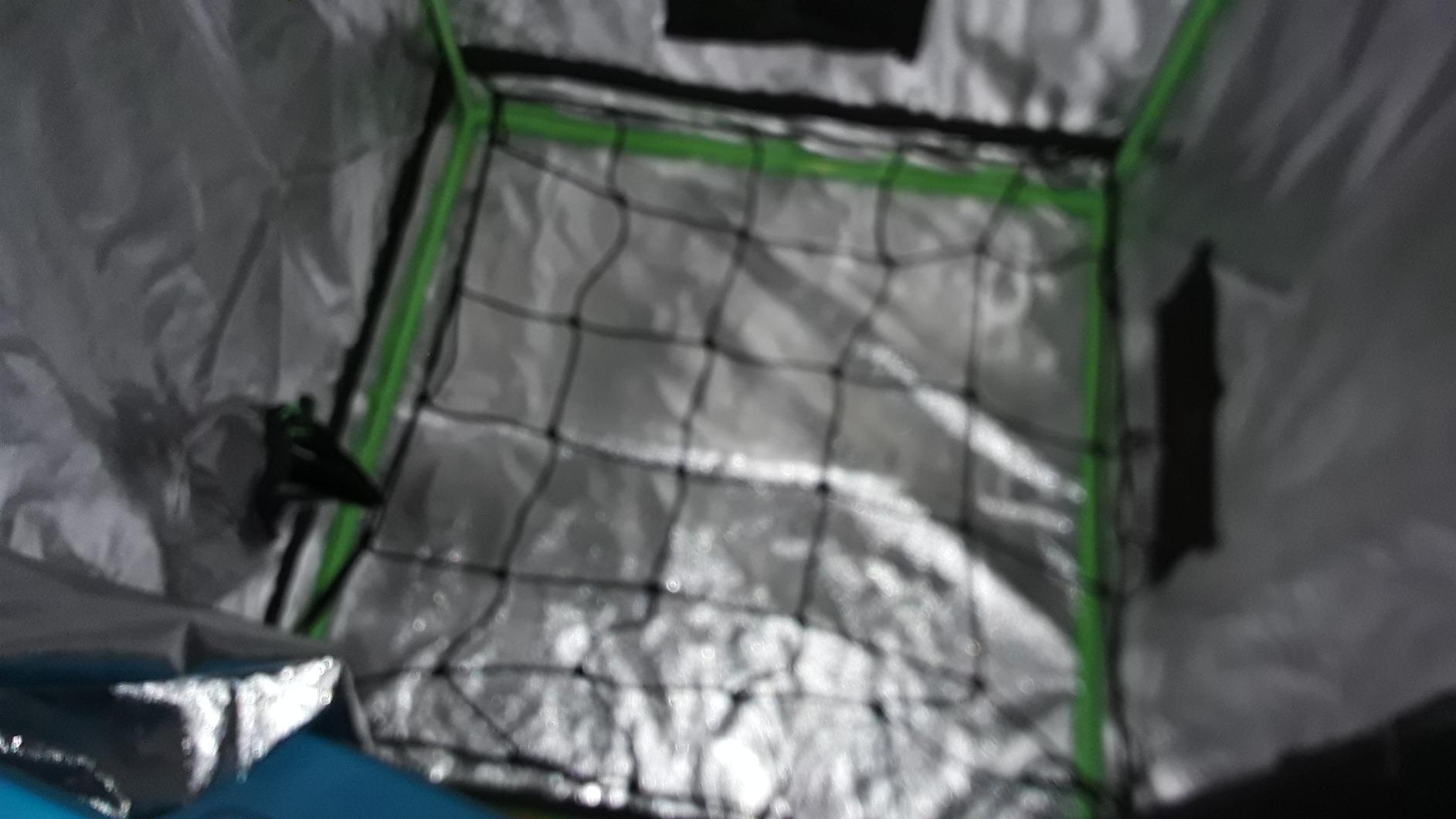
Hook the corners first, then the mid-span. Tension evenly from the centre outward. A net pulled tight at four corners and loose in the middle will sag.
Work around the tent, not in a spiral. Thread each branch up and out as you go so the canopy builds evenly instead of one-sided.
Leave one corner free if the net fights you. A slightly smaller net hung with tension beats a correctly sized one dragged tight.
If your tent has a center pole, do not stretch a square net over it. Cut the net into two panels and hang each on its own set of hooks, which is exactly what a cuttable net is designed for.
Before You Buy: DIY Alternatives to Trellis Netting
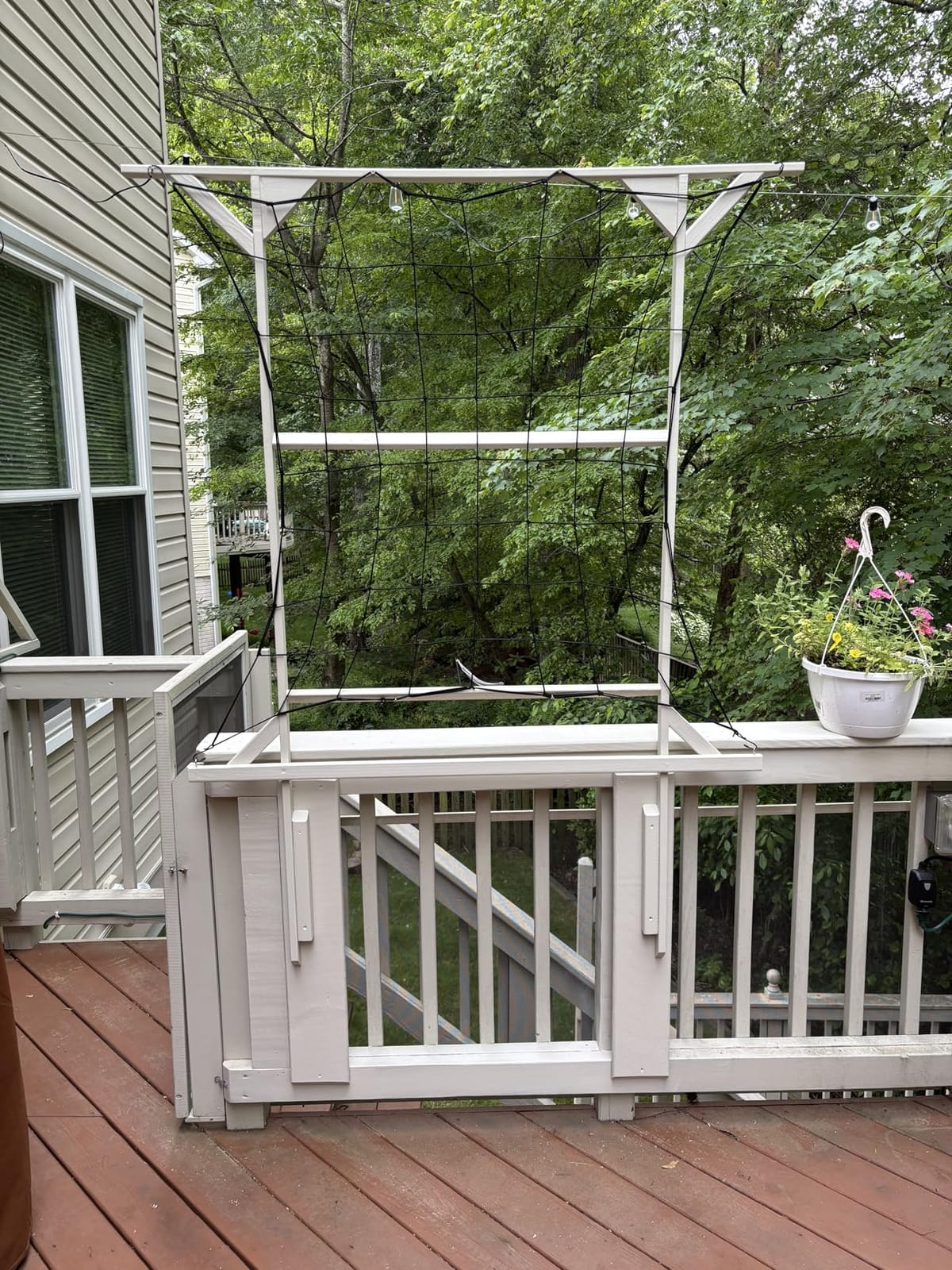
Plastic-coated chain-link barrier fencing cable-tied to a wooden frame is the most commonly recommended DIY option on grow forums, and it takes about half an hour to build. Growers on percysgrowroom.com describe it as the top answer for anyone who wants a true SCROG without buying a net, and it does reach the tent walls in a way an elastic net cannot.
For branch support rather than full canopy control, cheaper options work well. A first-timer on forum.growweedeasy.com reported success with wire drying racks and bamboo chopsticks, with plants handling bent stems without trouble. Concrete reinforcing mesh, available at most home improvement stores, is another recurring recommendation, particularly for anyone who cannot find cattle panels. Twine strung across the frame works for lighter growth.
On metal versus wooden trellises, the answer depends on what you are building. Metal frames, including PVC and cattle panel, hold shape under weight and resist humidity better. Wooden frames are easier to cut and modify and cost less, but they need more support points and can move as the tent flexes. Neither is better for stems, since the surface the plant touches matters more than the frame material.
Honest advice: if you are only spreading a few branches in a small tent, you may not need a net at all. Stakes, clips and a simple frame do the same job for a fraction of the effort. A net earns its place when you are filling a canopy across a whole tent footprint.
Frequently Asked Questions
What is the best material for trellis netting?
Soft elastic cord wrapped in a fabric sheath, usually polyester or nylon, is the best material for grow tent trellis netting. A 3 mm elastic core gives the stretch needed to fill a canopy, and the sheath prevents the cord from abrading tender stems. Rigid plastic mesh and PVC-framed screens hold a fixed plane but are harder to install and more likely to mark plants.
When should I put up a trellis net?
Install the net when your plant has roughly four to six nodes and has not yet stretched into a single tall stem. At that stage the branches are still flexible, so they bend into the mesh without damage. Installed earlier you are training a plant with nothing to train, and installed later you risk snapping already hardened stems.
What size trellis net do I need for my grow tent?
Match the net to the usable footprint of your tent rather than its nominal size. A 2×2 tent wants a 2×2 or 3×3 net, a 2×4 wants a 2×4, a 3×3 or 4×4 wants a 4×4, and a 5×5 needs a 5×5. Subtract anything a center pole or equipment occupies, and remember that a net which falls short of the walls wastes canopy space and light.
Is 4 inch or 6 inch mesh better for a grow tent?
Four inch openings, roughly 10 cm, suit most indoor grow tents. Branches catch and hold in the mesh, airflow stays strong, and your hands still fit through for pruning. Six inch openings, roughly 15 cm, improve airflow and make trimming easier but let thin stems slip through, so training is looser and the plant may grow straight through instead of spreading.
What can I use instead of netting?
Plastic-coated chain-link barrier fencing cable-tied to a wooden frame is the most popular DIY alternative and takes about half an hour. For lighter branch support, wire drying racks, bamboo chopsticks, concrete reinforcing mesh, garden twine and even plant stakes all work. A framed PVC screen with mesh is the DIY option that reaches the tent walls and gives true SCROG control.
Which Trellis Net Should You Buy?
For most people, the VIVOSUN 4×4 is the right buy. It reaches a true 4×4, its 3.9 inch mesh is comfortable to work in, and the sheathed cord is soft enough not to mark stems. It is also the most reviewed net in the roundup by a wide margin, which means more of the surprises have already been found by someone else.
Buy the AC Infinity net instead if you want the best hardware and the most forgiving cord, especially if you own more than one tent. Buy the BSTPCOO if you want extra tie points to tension a flat plane, the TORINALITAL or JZTang for a 2×4 tent, and the GBACHOOSE if your tent is 5×5.
Whatever you choose, match the net to the tent footprint, hang it at four to six nodes, and anchor the mid-span. Those three steps matter more than the brand on the box. Check the latest listings for each of our best trellis nets for grow tents in 2026 and pick the one that fits your footprint.


