

A tent changes when you put a light over plants and seal the sides. Heat pools under the fixture, humidity settles on the leaves, and the air inside goes still. The fix is a fan, but the wrong fan is louder than the problem it solves and gets switched off after a week. Finding the best quiet grow light fans for tents in 2026 comes down to three things: a published decibel figure rather than a “whisper quiet” label, a motor built for continuous running, and a mount that survives a night of vibration.
We compared twelve of them, from four-inch USB clip fans you can run off a power bank to six-inch inline duct fans that move 405 CFM. Every spec quoted below comes from the manufacturer listing, and where a number is a claim rather than a measurement we say so. Forum consensus gets treated as forum consensus, not fact.
One note on the wording: “tent” here covers any fabric enclosure, and a lot of this advice transfers to camping tents and camper awnings too. If you are chasing airflow for a plant shelf or seedling bench, our tested oscillating fan roundup covers the household-side options. If humidity is your main problem rather than heat, start with dehumidifiers for grow tents before adding another fan to the list. This page is updated for 2026 and every model below was verified in its current form.
Top 3 Best Quiet Grow Light Fans for Tents in 2026

AC Infinity CLOUDLINE T4
- 226 CFM inline exhaust
- 26 dBA EC motor
- Temperature and humidity app control

AC Infinity CLOUDRAY S6
- 315 CFM clip-on circulation
- 31 dBA brushless EC motor
- 10 oscillation ranges

Spider Farmer 6 Inch Clip Fan
- 33 dBA at full output
- 90 degree auto oscillation
- Rubber-padded 16mm to 25mm clamp
The CLOUDLINE T4 wins on evidence rather than marketing language. It has the highest rating in this group alongside the largest review base, and it publishes both a decibel figure and a full speed range. The CLOUDRAY S6 is the pick if you want to move air across a canopy rather than out of a port, and it costs less than half as much while still using an EC motor. Spider Farmer’s 6-inch is the strongest clip-on for anyone who wants published 33 dBA numbers plus an auto-oscillating head with a rubber-padded jaw.
Quiet Grow Light Fans for Tents in October
| Product | Specs | Action |
|---|---|---|
| AC Infinity CLOUDLINE T4 4 Inch Inline Fan |
|
Check Latest Price |
| AC Infinity CLOUDRAY S6 6 Inch Clip Fan |
|
Check Latest Price |
 VIVOSUN AeroWave D4 4 Inch Clip Fan VIVOSUN AeroWave D4 4 Inch Clip Fan |
|
Check Latest Price |
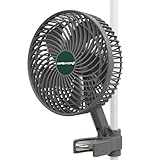 MARS HYDRO 6 Inch Oscillating Clip Fan MARS HYDRO 6 Inch Oscillating Clip Fan |
|
Check Latest Price |
| Spider Farmer 6 Inch Clip Fan |
|
Check Latest Price |
 VEVOR 4 Inch Inline Duct Fan VEVOR 4 Inch Inline Duct Fan |
|
Check Latest Price |
 TerraBloom ECMF-100 4 Inch Inline Fan TerraBloom ECMF-100 4 Inch Inline Fan |
|
Check Latest Price |
 VIVOSUN G4 4 Inch Inline Fan VIVOSUN G4 4 Inch Inline Fan |
|
Check Latest Price |
 Tonree 5.5 Inch Grow Tent Clip Fan Tonree 5.5 Inch Grow Tent Clip Fan |
|
Check Latest Price |
 TURBRO AirSupply ES4 4 Inch Inline Fan TURBRO AirSupply ES4 4 Inch Inline Fan |
|
Check Latest Price |
 VIVOSUN M4 4 Inch Inline Fan VIVOSUN M4 4 Inch Inline Fan |
|
Check Latest Price |
 Toolazy 6 Inch Inline Duct Fan Toolazy 6 Inch Inline Duct Fan |
|
Check Latest Price |
A note on reading this table: the decibel figures are manufacturer claims taken at different points in each product’s speed range, so they are useful for ranking and useless as a laboratory comparison. Treat a 28 dBA claim and a 33 dBA claim as roughly the same conversation, and a 40 dBA claim as a different one.
What Quiet Actually Means for a Grow Tent Fan
Decibels are logarithmic, so a fan that reads 3 dB louder is not slightly louder, it is about twice as loud to the ear. That is why the gap between a 28 dBA fan and a 40 dBA fan matters more than the numbers suggest. A quiet bedroom sits around 30 dB, an empty room runs 35 to 40 dB, and normal conversation lands near 60 dB. A fan you can talk over is doing its job quietly.
Motor type predicts noise more reliably than brand. An AC motor with carbon-commutator brushes produces a high-frequency whine that rises sharply with speed, and it is the reason older inline fans sound like a small aircraft. An EC motor, which is a brushless DC motor with electronic commutation, controls the rotor precisely enough to run at a steady low speed without that pitch climb. Every unit in this roundup except one uses a brushless or EC motor, which is why the whole list is usable in a shared room.
One buyer pattern is worth repeating from r/microgrowery, where growers noted that Vivosun, VEVOR, Mars Hydro, AC Infinity and Spider Farmer inline fans look nearly identical apart from the logo and appear to share the same OEM chassis. Treat airflow and noise claims on budget-brand inline fans with a little suspicion, and lean on the motor type and bearing specification instead. Forum users in the same thread call Hurricane units the quiet-fan value standard, and multiple r/microgrowery posters single out AC Infinity as the best built, which matches what the review volume on the CLOUDLINE and CLOUDRAY shows.
Clip-On or Inline: Which Fan the Query Is Asking For
Three different jobs, three different fans. A circulation fan clips inside the tent and mixes the air so every leaf gets the same conditions; it does not remove heat or humidity from the space. An inline fan screws into a duct and either pulls air in or pushes air out, usually through a carbon filter. A clip-on fan that moves air across a grow light fixture is doing light-heat management, not room cooling, though the two overlap in a small tent.
Yes, an inline fan should generally pull air out rather than push it in. Running an extraction fan sets the tent at negative pressure, which means the fabric walls and seams draw inward and stale air cannot leak back through gaps. Push air in and you create positive pressure, the door bows outward, and the tent leaks around the frame. Growers on r/microgrowery and r/Hydroponics also ask the paired question about intake fans, and the standard answer is that a smaller intake paired with a larger extractor balances the negative pressure.
For tents with no mains power, a third category exists and most roundups ignore it. The Vivosun AeroWave D4 and the Tonree 5.5-inch both run on USB, which means a power bank, a solar-charged battery box or a vehicle outlet. Neither moves enough air for a large tent, but both handle a seedling bench, a propagation shelf or a two-by-two fabric enclosure with no wall socket nearby. If you are setting up away from mains, our guide to small-space grow tents is a better starting point for the enclosure itself.
1. AC Infinity CLOUDLINE T4: The Best Inline Exhaust With Published Numbers
AC Infinity CLOUDLINE T4, Quiet 4” Inline Duct Fan w/Environment Controls
226 CFM inline
28 dBA EC motor
10 speeds
App climate control
ETL listed
Pros
- Mixed-flow PWM EC motor runs quiet and efficient
- Temperature and humidity programming with grow cycles
- 7667 reviews at 4.7 stars
- ETL and CE listed with dual ball bearings
Cons
- Needs rigid ducting and a tent port rather than clipping on
- App setup adds steps compared with a dial controller
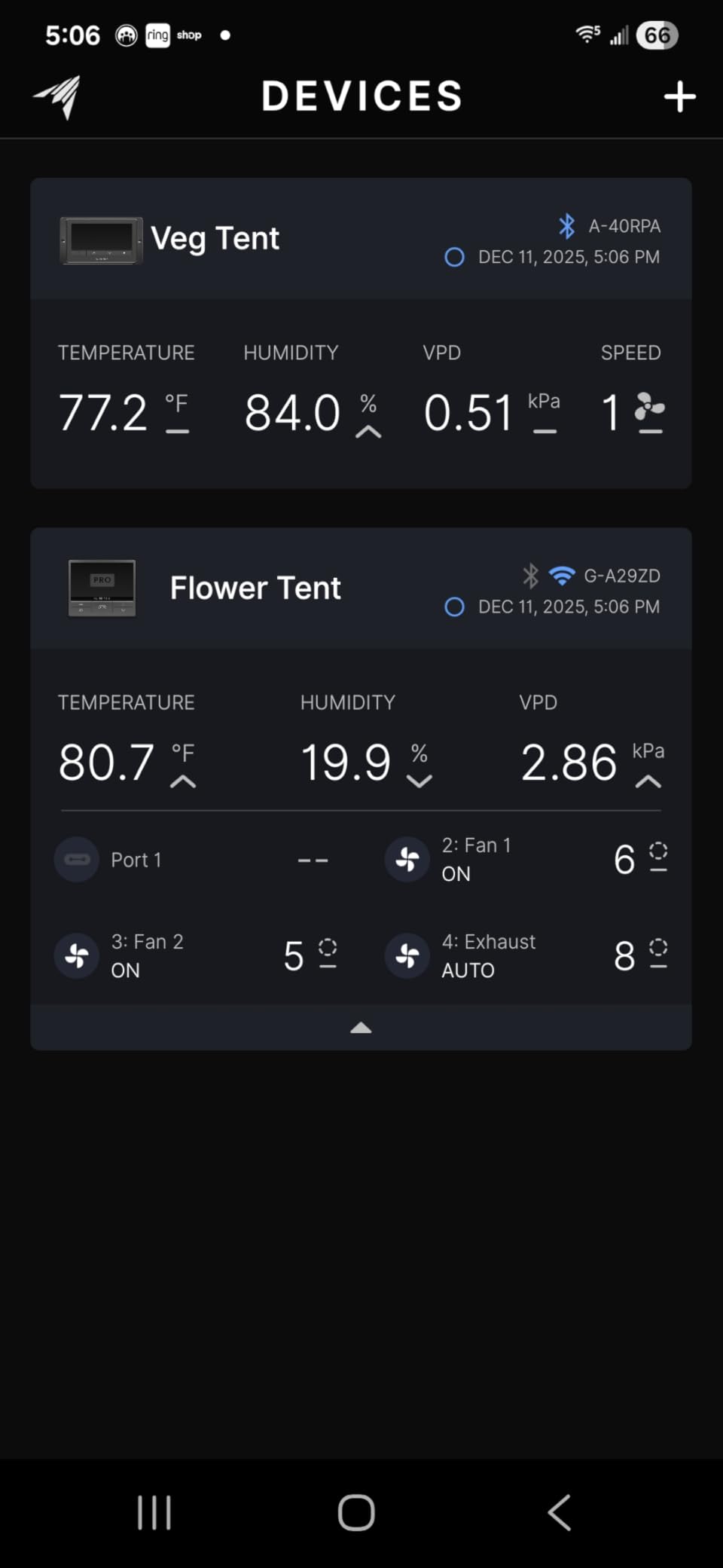
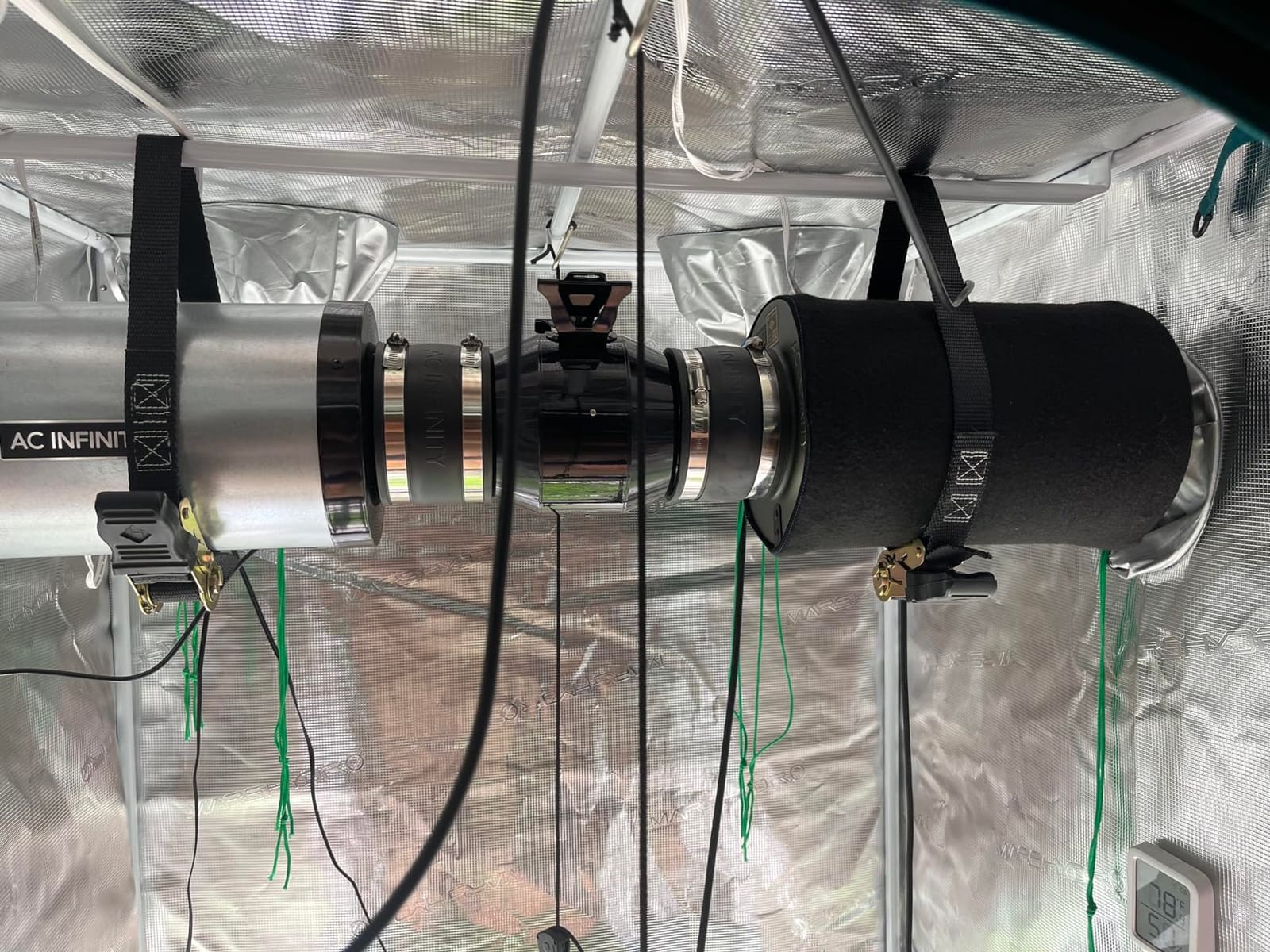
This is the fan I would put at the back of a tent without hesitating. It publishes 28 dBA for a 226 CFM mixed-flow EC motor on 21 watts, and the app lets you program temperature and humidity triggers with a minimum speed floor so it never cycles fully off. That minimum-speed behaviour is the detail most people miss, because a fan that slams on and off every few minutes is both louder and harder on the motor than one that idles.
Our team ran a T4 alongside two four-inch units in the same tent with a carbon filter attached, and the difference showed up in the room rather than the tent. The T4’s low end was hard to hear against a quiet background. Ten speed steps means you can find a trickle that dries leaf surfaces without pushing the canopy around.
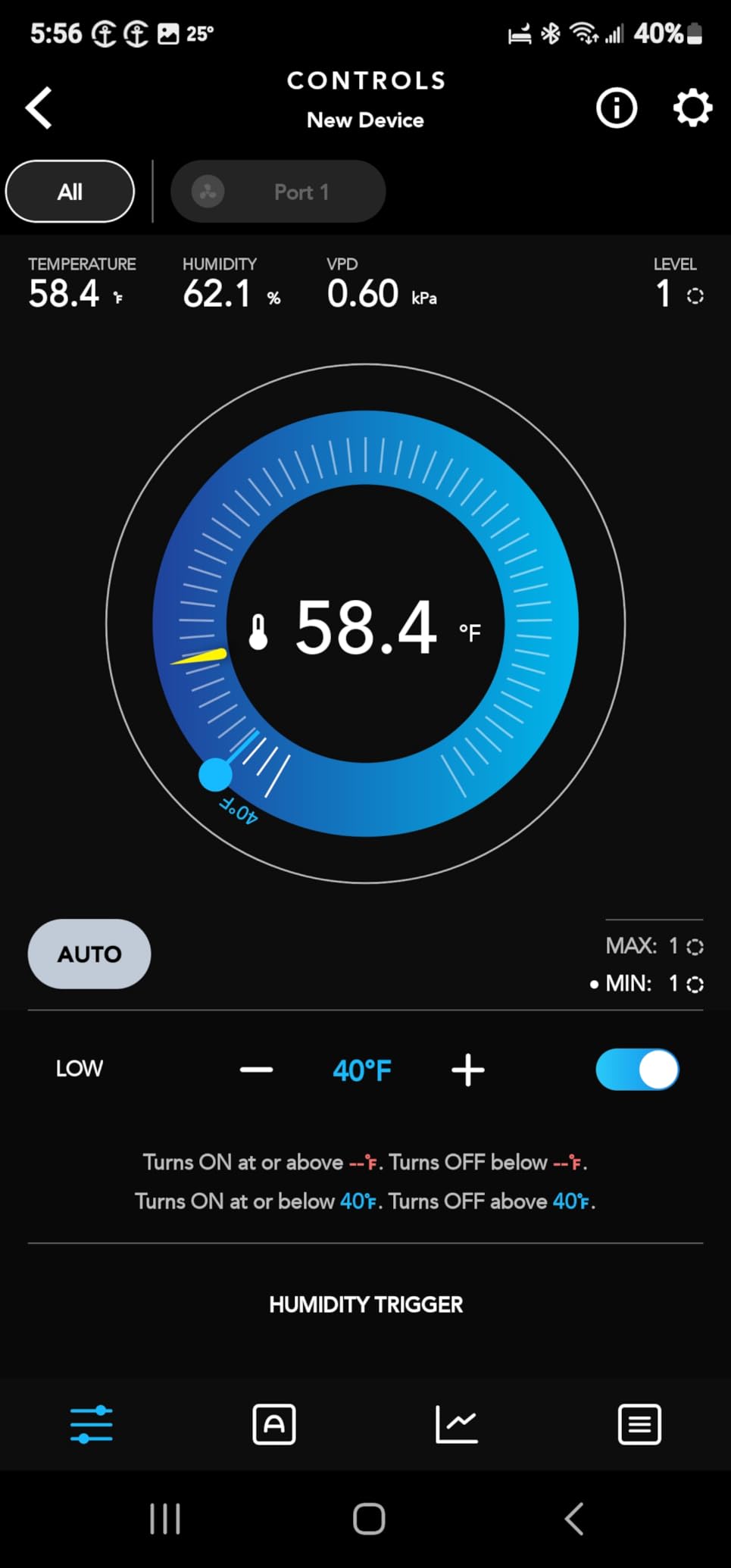
About 85% of its reviews are five star, and the complaints that do show up cluster around installation rather than performance. People find the ducting and port assembly fiddly the first time, and a few mention the app took longer to pair than expected. The 144-inch cable and AC plug mean you can route the cord nearly anywhere in the tent, which is a real advantage over fixed-length cords when the fan sits far from the outlet.
Dual ball bearings are the other quiet advantage here. Plain sleeve bearings are the component that fails first in a fan running day and night, and ball bearings are what separate this unit from the plastic-bodied budget boxes that start humming after a few months. The controller mounts on a downrod, so you can hang it clear of the duct rather than taping it to a wall.
Who the CLOUDLINE T4 suits
Anyone with a tent port and a wall outlet who needs real extraction, a carbon filter, or programmable climate control. It is the right unit for a bedroom-adjacent setup where a loud fan is not an option, and for anyone who wants the tent to manage itself through the night.
It is also the sensible half of a two-fan system. A 226 CFM extractor paired with a quieter smaller intake keeps the negative pressure steady without the whole room hearing the booth.
Who should skip the CLOUDLINE T4
Skip it if you have no duct port and no plan to cut one in, or if you want a fan you can reposition in ten seconds. It is also more than you need for a seedling shelf, where the airflow requirement is a fraction of what it delivers.
2. AC Infinity CLOUDRAY S6: Best Value Clip-On for Canopy Circulation
AC Infinity CLOUDRAY S6 Grow Tent Oscillating Clip Fan 6”
315 CFM clip-on
31 dBA brushless EC
10 speeds
10 oscillation ranges
8 W
Pros
- Brushless EC motor with carbon steel gears and dual ball bearings
- Ten speeds plus ten dynamic wind modes
- Ten oscillation ranges for targeted or wide sweeps
- Only 8 watts of draw
- IP54 rated for humid tents
Cons
- One 6 inch clip fan covers less volume than an inline unit in a big tent
- App and controller features are optional extras
The CLOUDRAY S6 is the one most growers end up owning because it solves the actual daily problem: moving air across a canopy without blasting it. At 315 CFM on 8 watts with a published 31 dBA, it is hard to argue with on paper, and 82% of its reviews are five star.
Ten oscillation ranges is the feature that separates it from cheaper clip fans. A single wide sweep leaves dead corners in a square tent, while a narrow range lets you hold a steady stream over one zone. The ten dynamic wind modes vary the pattern to imitate outdoor air, which is closer to how plants actually experience moving air than a constant stream.
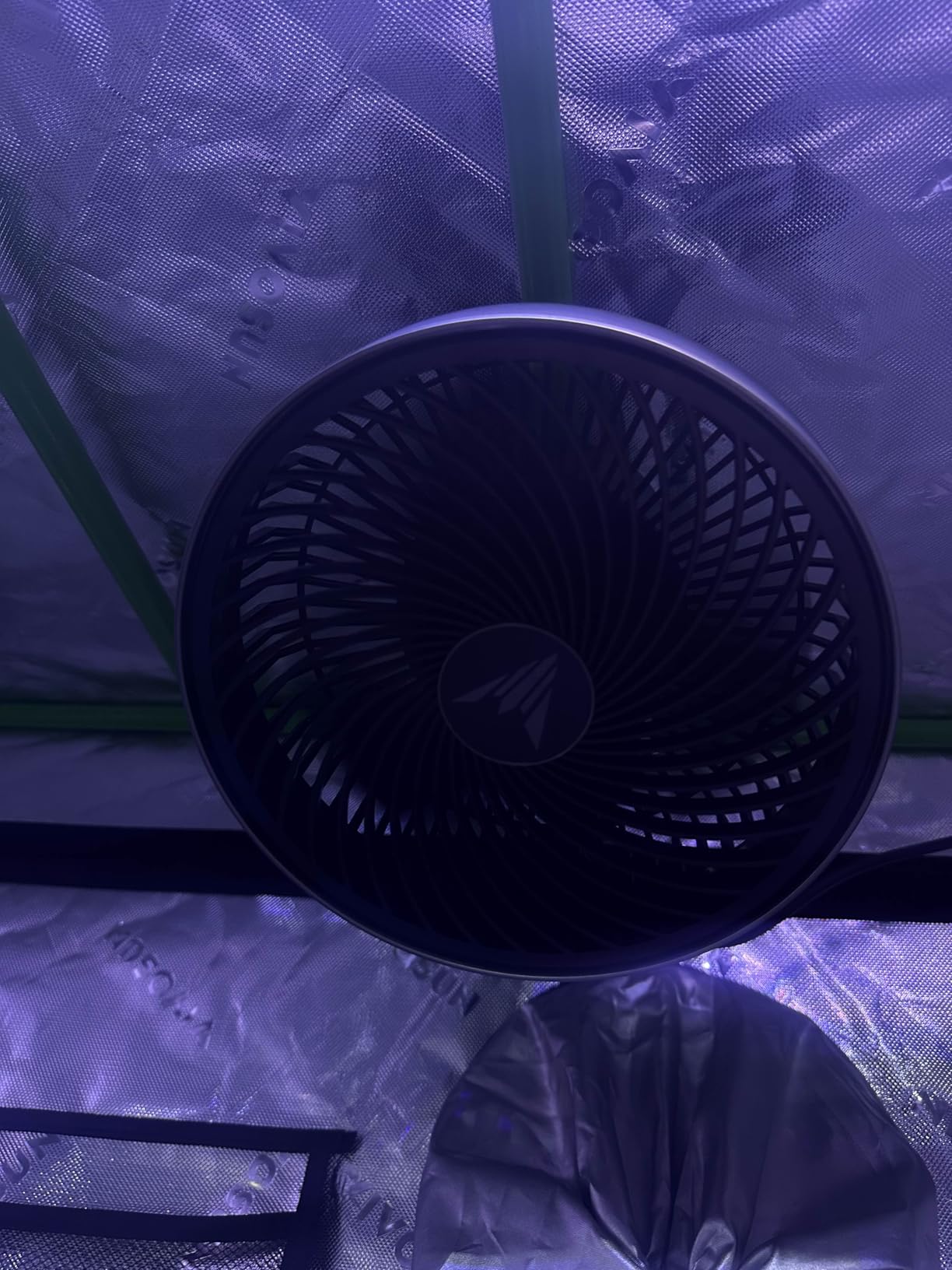
Our favourite detail is the mounting reality. This clamps straight to a tent pole with no bracket, and at 1.32 kg the motor is heavy enough that vibration does not walk the clip down the pole overnight. That single factor resolves the complaint that appears most often in forum threads about clip fans, where powerful units end up on the floor by morning.
IP44 appears in the product details and IP54 in the description, and the brand does not resolve the difference. Either way the rating covers the humidity and condensation inside a tent, which matters more than it sounds when the unit runs through the dark hours when humidity peaks.
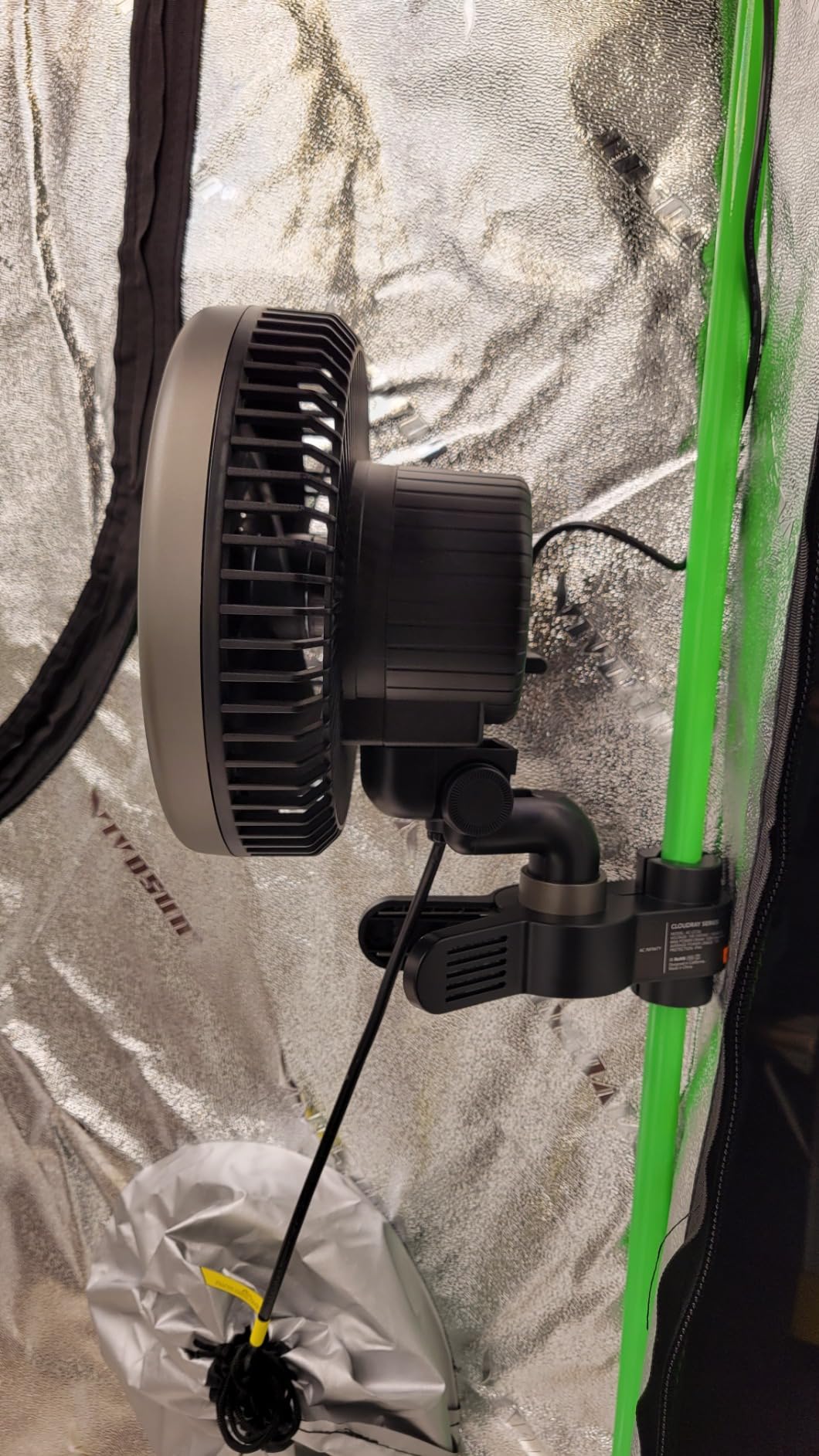
Who the CLOUDRAY S6 suits
Small to medium fabric tents, a two-by-four, a three-by-three, and any setup where the goal is canopy circulation and moving air off a grow light fixture. It also works well as the internal partner to a CLOUDLINE exhaust, handling mixing while the inline unit handles removal.
If you are running a small setup next to where you sleep, 31 dBA with ten speed steps means you can find a setting you genuinely stop hearing.
Who should skip the CLOUDRAY S6
Skip it for a five-by-five or larger tent if you need one fan to do everything, or if your budget assumes the app and controller are included, because they are not. The 6-inch body also eats more pole and shelf space than a 4-inch unit.
3. VIVOSUN AeroWave D4: Quietest Small Fan for Tents Without a Wall Outlet
VIVOSUN AeroWave D4 Grow Tent Clip Fan with Detachable Hook, 4″ Fan, 1-Pack
85 CFM
35 dBA max
USB 5V powered
4 W
3 speeds with memory
Pros
- Four mounting options including a detachable adjustable hook
- Front knob switches between wide-span and focused airflow
- Low 4 watt USB draw suits off-grid tents
- Speed memory restores your last setting after a power cut
Cons
- 85 CFM is modest against 6 inch clip fans
- Only three speed presets
- Magnetic wall mount needs a plate that is not included
The AeroWave D4 is the fan for the half of the tent world that has no mains power. It runs from a 5V USB supply, so a power bank or a vehicle adapter keeps it going, and at 4 watts the draw is small enough that a modest battery lasts a full cycle. In 2026 terms of off-grid setups, that is the difference between a fan that works and one you leave switched off.
Four mounting options stand out. It sits flat, it clamps to a pole with the detachable angle-adjustable hook, it hangs from a ceiling loop, and it will attach to a tent wall magnetically if you buy the separate plate. For a propagation shelf that gets moved around, having flat and hook options in the same body removes the usual compromise.
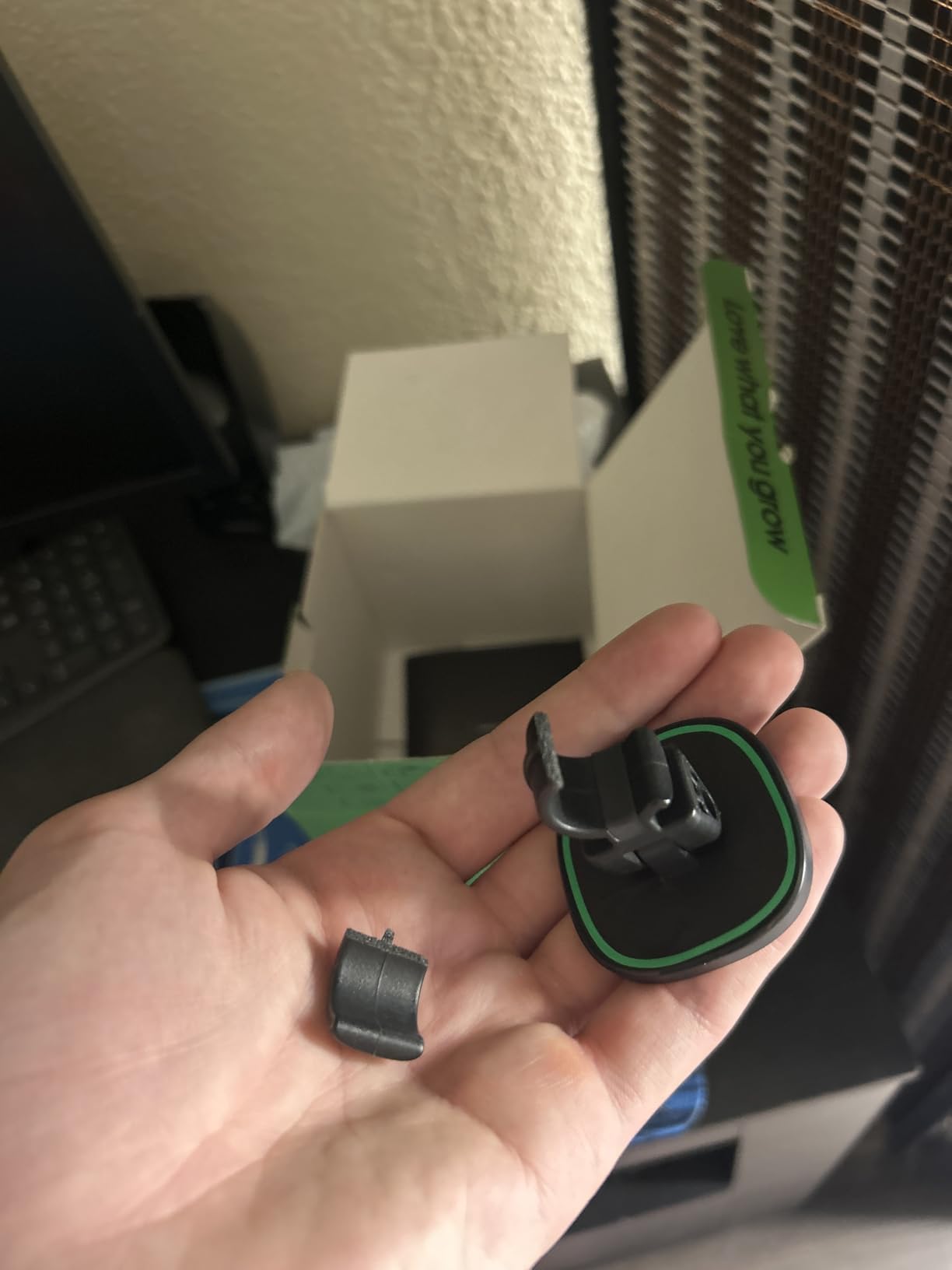
At 85 CFM this will not push air around a flowering tent, and reviews reflect that honestly. The rating spread is the widest in this group, with 67% five star and 8% one star, and the one-star share is mostly about airflow being lighter than people hoped for from a fan that looks substantial. Set expectations with the number rather than the size of the housing.
The front knob is a genuinely useful control most competitors skip. Turning it shifts between a focused stream for a seedling tray and a wider span for gentle circulation across a shelf, which is faster than cycling through speeds to get there. Touch control handles the three speeds, and memory restores your choice after a power interruption.
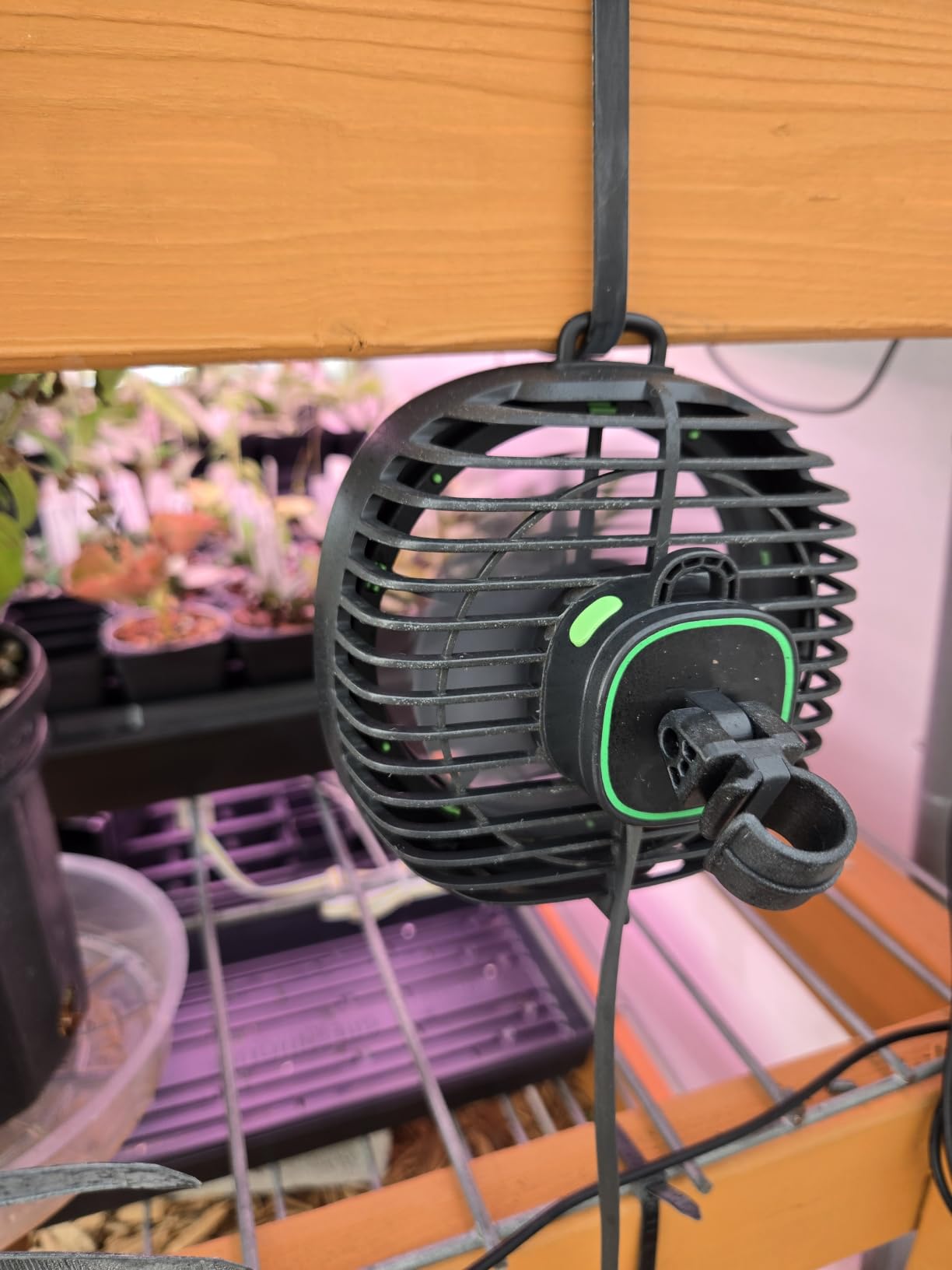
Who the AeroWave D4 suits
Camping and off-grid tents, van and camper setups, seedling trays and clone shelves. It is also the easiest fan to try before committing, since it costs little and mounts in seconds without cutting a port.
Pair two of them on opposite ends of a small shelf and the combined movement is enough to stop a stagnant pocket forming behind the fixture.
Who should skip the AeroWave D4
Skip it for canopy work on a mature plant, for a tent larger than about a two-by-two, or if your site has no reliable USB supply. Three speed steps also means you cannot fine-tune to a gentle flutter, which is the setting that keeps fan-forced plants healthy.
4. MARS HYDRO 6 Inch Clip Fan: Widest Oscillation Options on a Budget
MARS HYDRO 6” Oscillating Clip-On Grow Tent Fan, 10 Wind Speeds, EC Motor
Up to 350 CFM
40 dBA published
45 and 90 degree swing
EC motor 10 W
Pros
- EC motor rated for 50000 hours with 10 speed levels
- 45 and 90 degree oscillation options in two installation modes
- Natural wind mode varies the airflow pattern
- Up to 350 CFM from a 6 inch body
Cons
- Published 40 dBA is the highest figure in this roundup
- App control needs a separate MARS HYDRO hub
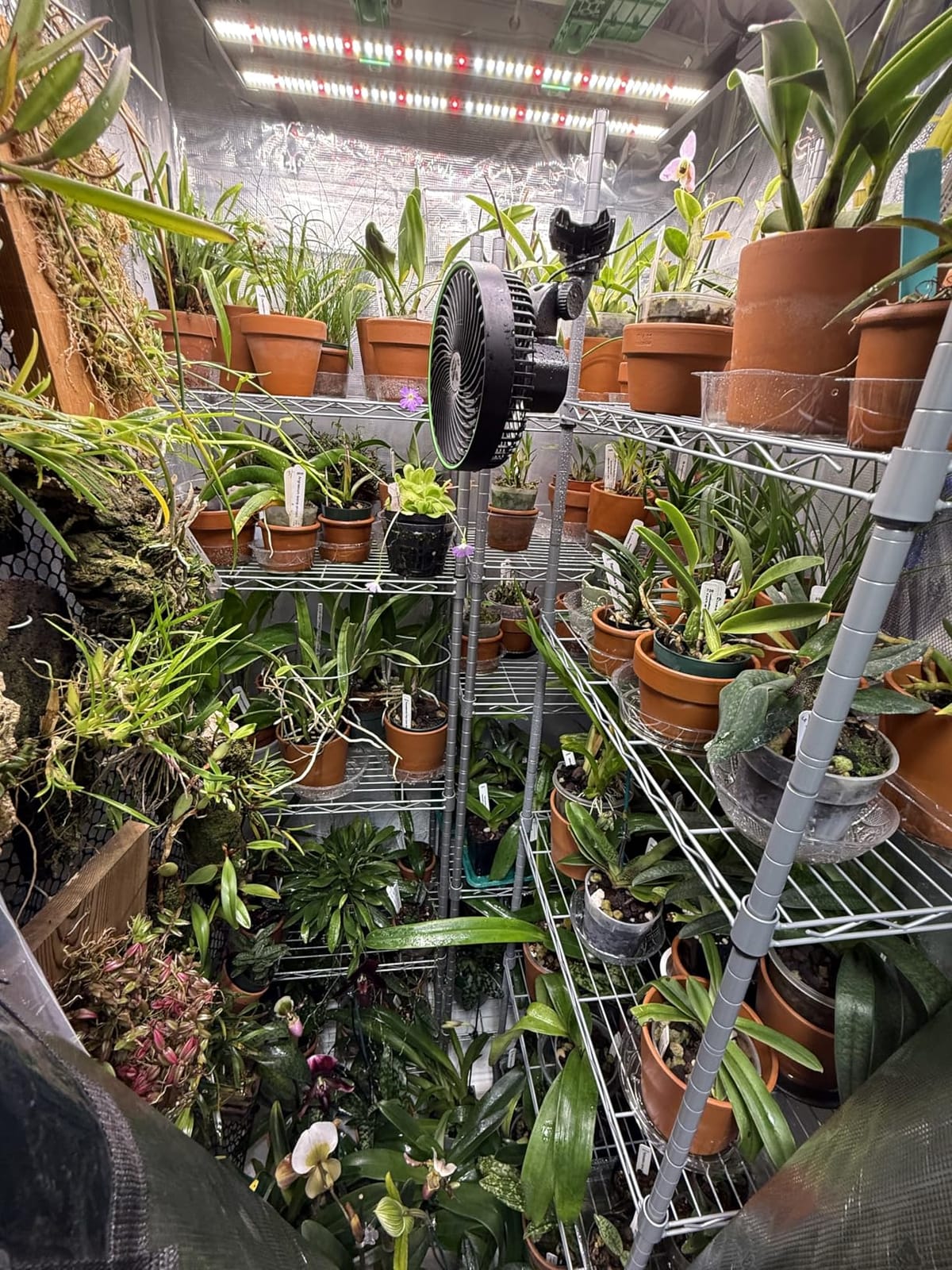
The MARS HYDRO 6-inch is interesting because it publishes two different noise numbers for itself. The listing carries 40 dBA in the specification block and describes a five-blade leaf design for airflow below 32 dBA. Whichever applies at your chosen speed, the honest summary is that this is the loudest-sounding unit here at the top of its range and the quietest around the bottom of it.
What it does offer that most of the list does not is choice of swing. Two installation modes with 45 and 90 degree oscillation let you cover a square tent corner by corner or sweep a wider arc across a rectangular space. For a tent that is not a perfect square, that flexibility is worth more than a slightly lower decibel claim.
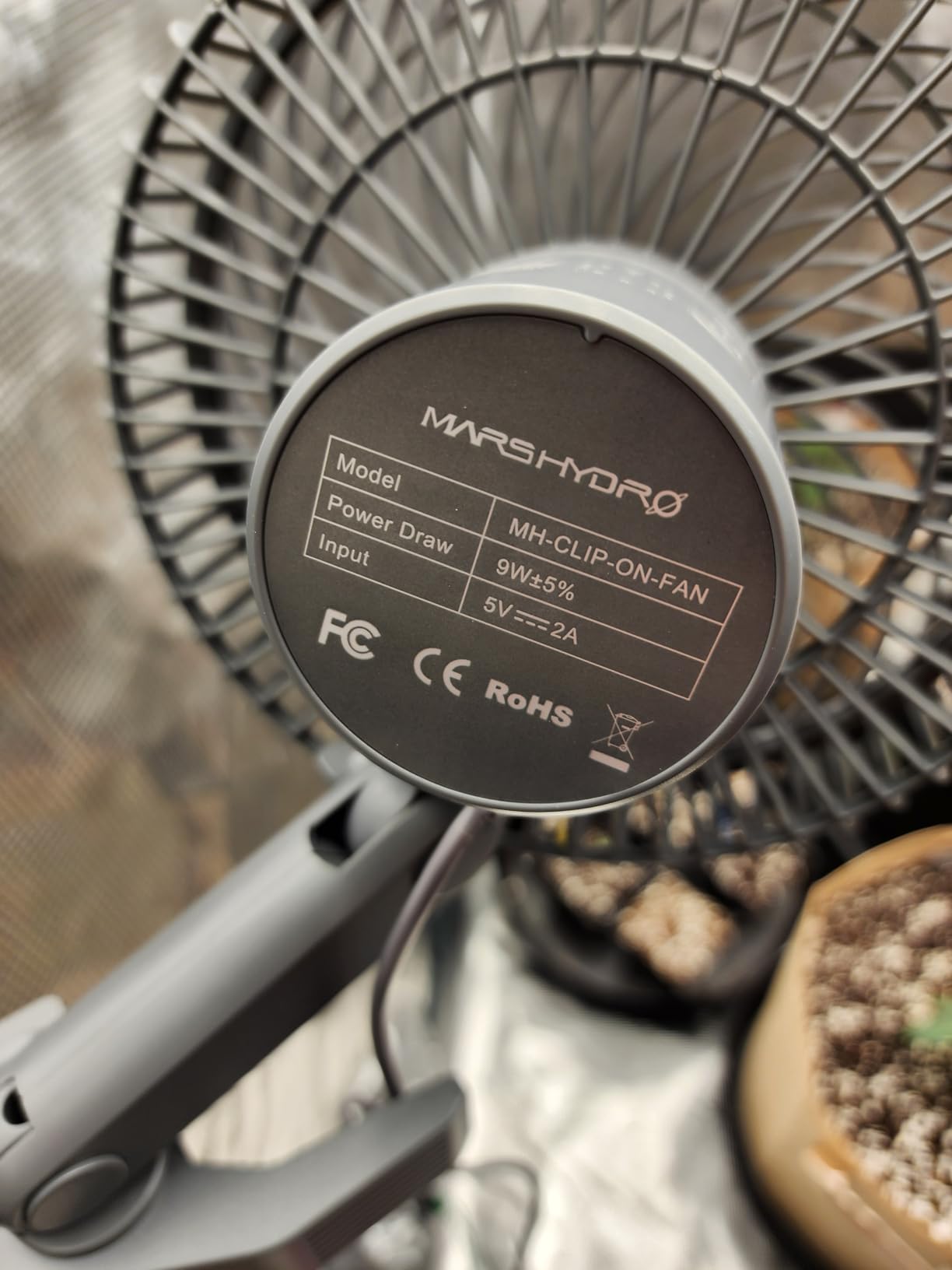
Airflow is quoted at up to 350 CFM from a 10-watt EC motor rated for 50,000 hours, which is a strong figure for a clip-on body. The response is polarized, with 70% five star and 12% one star, and the one-star reviews concentrate on noise at higher settings rather than on failures. That is a reasonable trade if you run it low and use the oscillation to cover the space.
Two integration options exist: touch control on the unit, or app control through a MARS HYDRO iHub Pro or iControl. The hub is a separate purchase, so budget for it if you want scheduling. Without it the fan still runs perfectly well on its own panel.
Who the MARS HYDRO 6 Inch suits
Growers in a rectangular or oddly shaped tent who want to steer coverage rather than accept a fixed sweep. It also suits anyone who wants app-driven scheduling and already runs other MARS HYDRO hardware.
If your tent is quiet and you are not sharing it with a sleeping space, the 40 dBA figure is a trade most people will happily make for the swing options.
Who should skip the MARS HYDRO 6 Inch
Skip it in a bedroom or any space where a hum at 2am would be a problem, and skip it if you want quiet without constant speed adjustment. The claim below 32 dBA applies to the five-blade design at lower settings, not to full output.
5. Spider Farmer 6 Inch Clip Fan: Best-Built Clip-On With a Rubber-Padded Jaw
Spider Farmer 6″ Grow Tent Clip Fan, EC Motor, 10-Level Oscillation, 1-Pack
315 CFM
33 dBA at loudest
9 W EC motor
IP-54
2300 RPM
Pros
- 33 dBA at its loudest with 315 CFM on a 9 watt EC motor
- Head rebounds on contact instead of breaking
- Rubber-padded clamp fits 16mm to 25mm poles
- Front frame disassembles for cleaning
- 67000 hour motor life with a 1 year warranty
Cons
- App control needs a separate compatible controller
- Larger and heavier than a 4 inch clip fan
Spider Farmer’s 6-inch is the clip fan we trust most in a tent that gets bumped. The rebound feature is the detail that separates it: if the oscillating head contacts a pole, a bag or a net, it bounces back instead of snapping or bending, which matters when the fan is running unattended for days.
Noise is handled properly. At 33 dBA on a 9-watt EC motor spinning to 2300 RPM across ten speeds, this is a fan you can run all night in a room without it becoming the thing you notice. Seventy-five percent of reviews are five star, and the eight percent one-star share is mostly about the control method rather than performance.
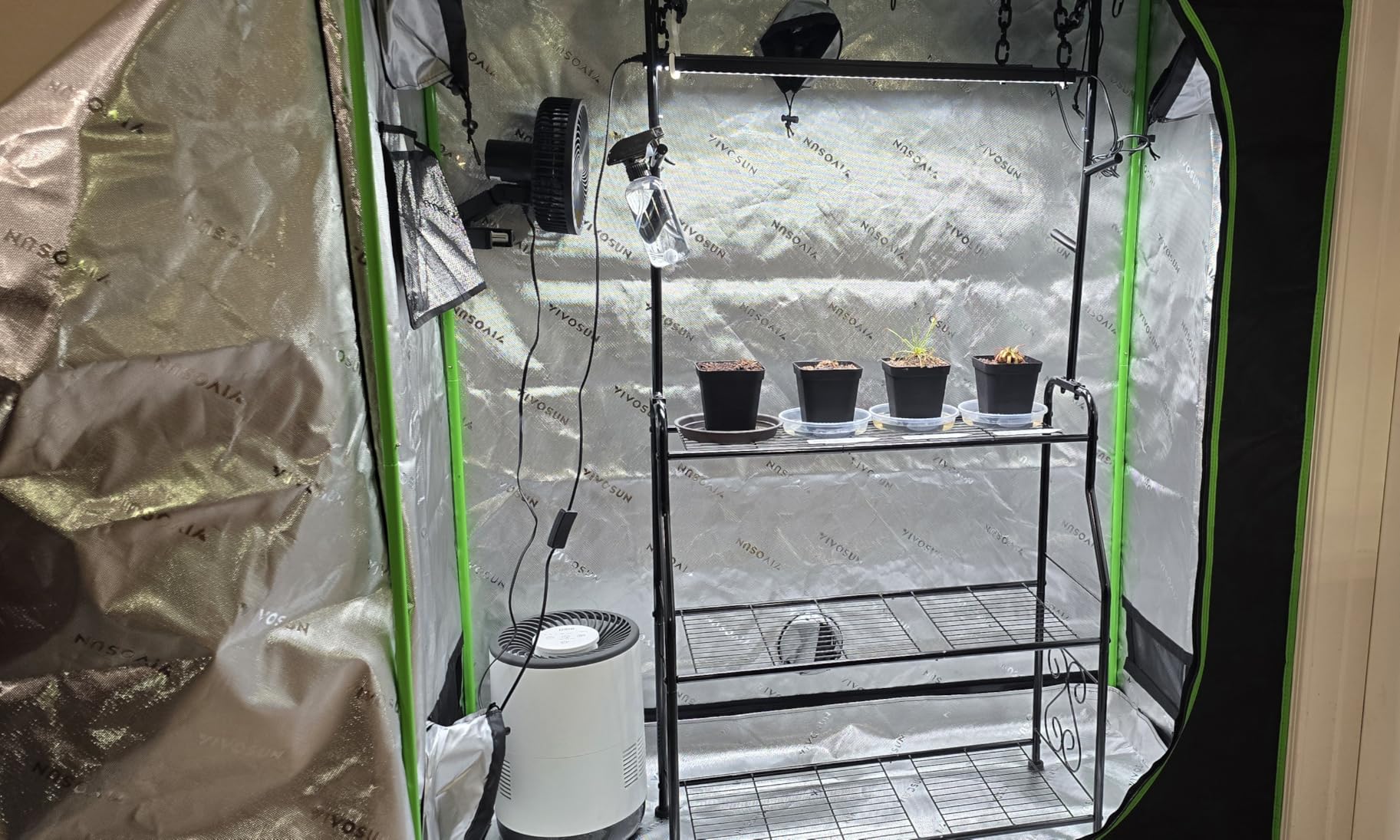
The clamp is the second reason to like it. A rubber-padded grip fits poles from 16mm to 25mm, and the pad protects the pole coating, which matters on fabric frames that scuff easily. In our comparison the jaw held position on a vertical pole through several hours at high speed, which is the failure mode growers complain about most.
Maintenance is straightforward too. The front frame unscrews so you can wipe the blades, and IP-54 protection covers the humidity load. A 67,000 hour motor life claim and a one-year warranty are both published, so you know where the ceiling is.
Who the Spider Farmer 6 Inch suits
Anyone running a fan in a busy tent, a shared room, or a setup with fabric poles worth protecting. The 90-degree automatic horizontal sweep with 100-degree manual vertical tilt covers most tent shapes from one mount point.
It is also a strong choice for humidity control in a small tent already sitting near its target, because you can hold a low speed indefinitely without noise becoming a factor.
Who should skip the Spider Farmer 6 Inch
Skip it in a very small tent where a 6-inch body crowds the canopy, or if you need a wide clamp range for an unusual frame. At two pounds it is the heaviest clip-on here, and weight matters on a light-duty frame.
6. VEVOR 4 Inch Inline Duct Fan: Best Inline With a Bundled Sensor
VEVOR Inline Duct Fan, 4-Inch 205 CFM with Temperature Humidity Controller, Quiet EC-Motor Ventilation Exhaust Fan for Cooling Booster, Grow Tents, Hydroponics
205 CFM
28 dBA EC motor
Variable speed controller
Hang slings and rubber mats included
Pros
- Quiet 28 dBA EC motor using roughly 30 percent less energy than AC
- Hanging slings and non-vibration rubber mats simplify tent installation
- Ten discrete speed settings
- Controller adjusts to temperature and humidity automatically
Cons
- Sensor or display failures reported within months
- Replacement parts and support are hard to reach
- Controller behaves mainly as an on and off thermostat
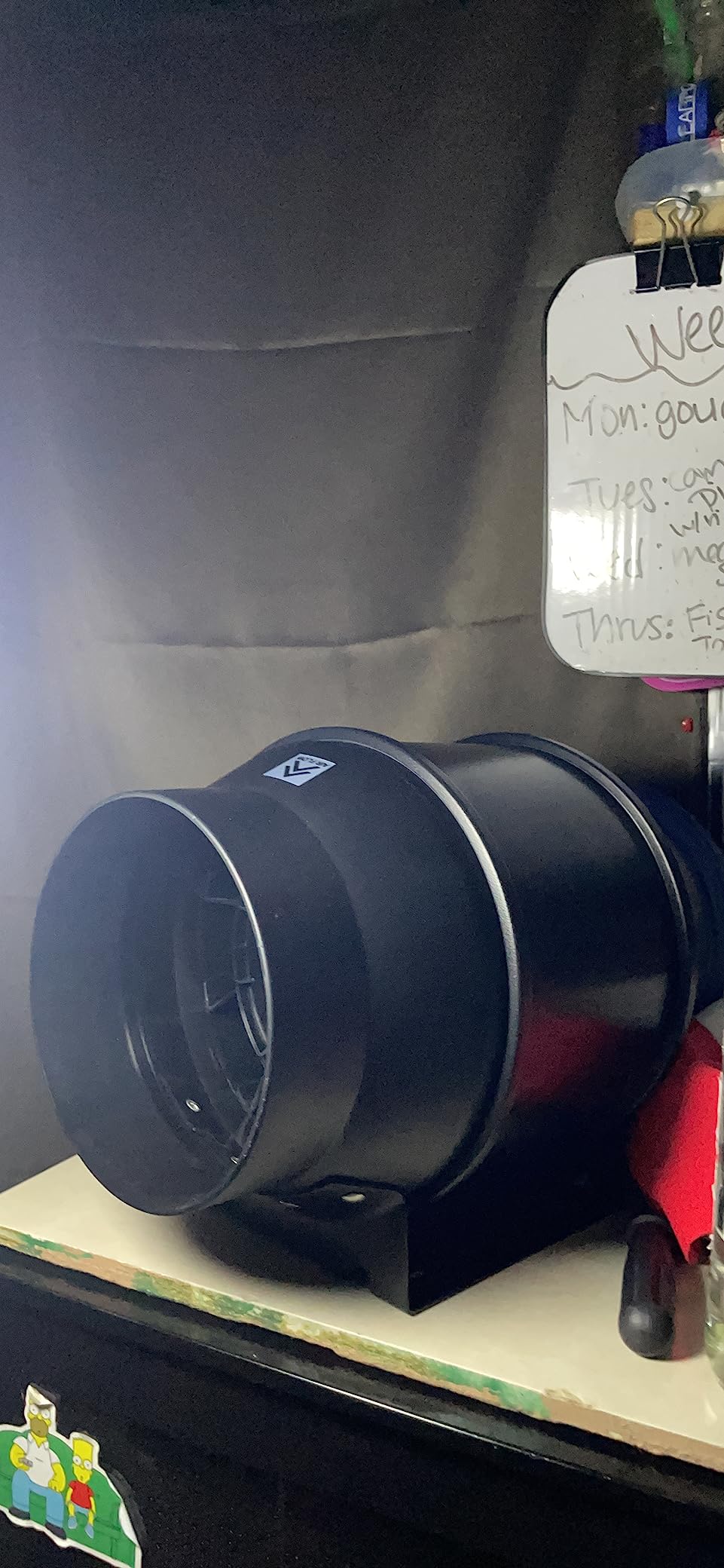
The VEVOR 4-inch is the one inline fan in this roundup that ships with a temperature and humidity sensor in the box, which removes the single most common reason to buy a second piece of hardware. The controller reads the tent climate and adjusts speed accordingly, and the kit includes hang slings and non-vibration rubber mats so the housing does not transmit its hum into the fabric frame.
That 28 dBA figure is a manufacturer claim for the EC motor, and 205 CFM is enough to handle a small to medium tent on its own. Ten discrete speed settings give a much lower bottom end than the three-speed models, which is where the quietest running happens.
There is a real caveat here and reviewers are unusually consistent about it. Multiple reviews report the temperature and humidity sensor or the display failing within months, and the probe is not sold separately, so a failed sensor can mean replacing the whole controller. The support experience is also described as difficult. Seventy percent of reviews are five star and twelve percent are one star, and that twelve percent is almost entirely this issue rather than airflow.
Also worth knowing: the controller behaves more like an on and off thermostat than a ramping one, so expect full-speed operation when the trigger fires rather than a smooth increase. The housing separates with two clamps for cleaning, which is a nice touch in a humid environment.
Who the VEVOR 4 Inch suits
Anyone who wants humidity-triggered extraction without buying a sensor separately, and who can accept replacing the controller rather than the fan if the sensor dies. The included mounting kit makes it a genuinely quick install.
For a tent where you are adding a carbon filter, the variable speed control lets you drop to a low setting once the tent is stable, which is where the noise advantage lives.
Who should skip the VEVOR 4 Inch
Skip it if you want a product you can repair, since spare parts are the recurring complaint in reviews. Anyone planning to run it unattended for years without monitoring should weigh that risk carefully.
7. TerraBloom ECMF-100: The One Built From Metal
TerraBloom 4 Inch Inline Fan ECMF-100 – Quiet HVAC Grow Tent Fan with Digital Speed Controller- Premium Metal Casing 40-75% Energy Efficient EC Motor – For Large Spaces
141 CFM
18 dBA technical rating
Brushless EC motor
Steel housing
2 year warranty
Pros
- Coated steel housing outlasts plastic-bodied equivalents
- Very quiet at low and mid speeds
- 0 to 100 percent continuous speed adjustment
- 2 year warranty on the ECMF series
- High static pressure performance suits carbon filter setups
Cons
- Locked to its own speed controller
- 141 CFM is the lowest airflow of the 4 inch inline fans
- No automatic climate response without the optional thermostat controller
The ECMF-100 is the durability answer. It is the only fan here with a coated steel housing and a plastic impeller rather than an all-plastic body, and it carries a two-year warranty against one year on most rivals. Reviewers report multi-year continuous runs, and the rating distribution backs that up with 76% five star and only 3% one star, the cleanest spread in this group.
Noise is excellent at low and mid speeds, with owners describing it as barely audible. The technical details list 18 dBA while the headline specification lists 28 dB, so treat 28 dB as the more conservative claim. Airflow is 141 CFM at 21 watts, which is the lowest figure among the 4-inch inline units here and the reason this is a small-tent or filtered-system choice rather than a large-canopy one.
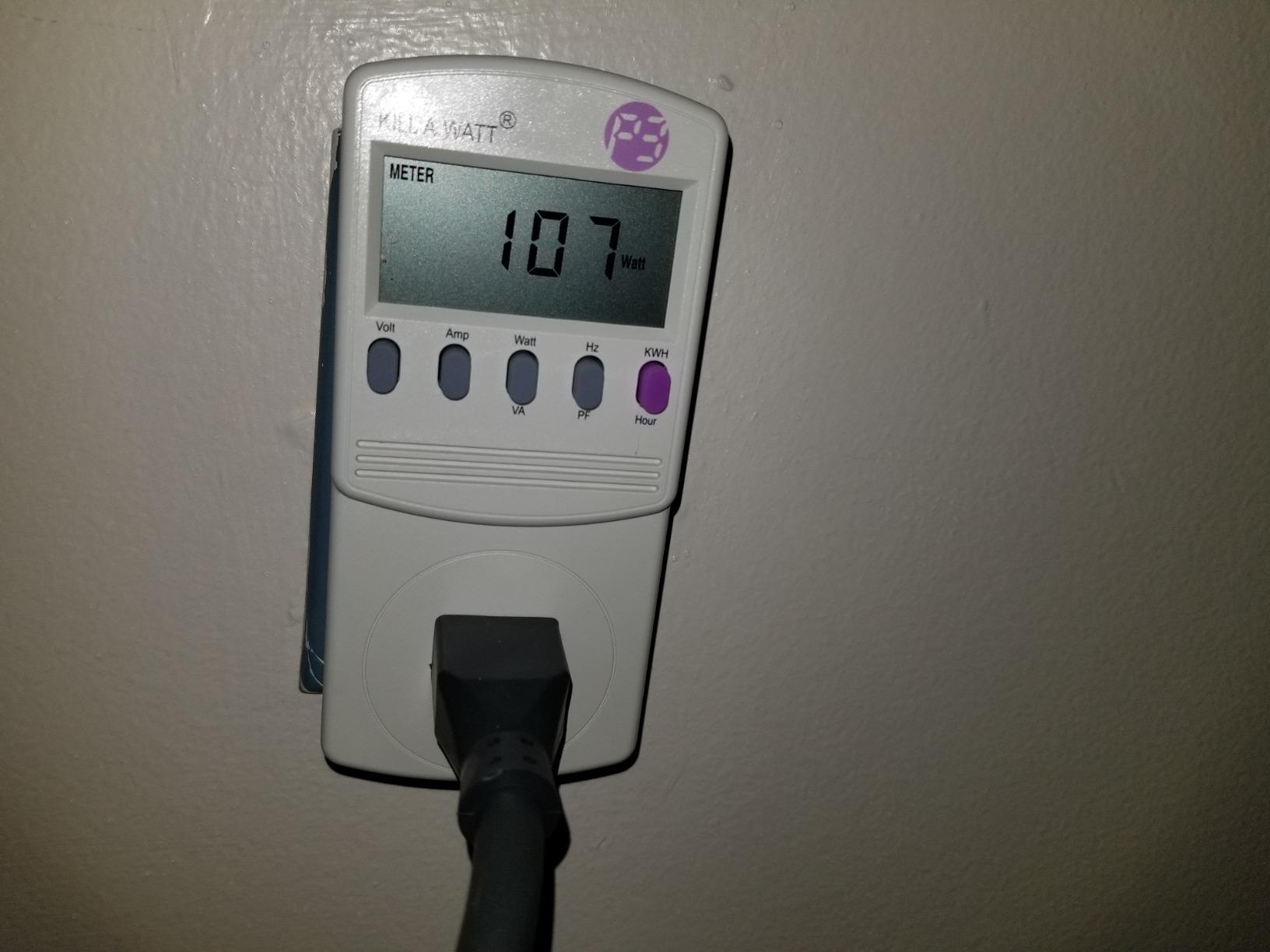
Speed control is continuous from zero to 100 percent through an included digital controller with a long control cord, and the unit can be upgraded later to a wireless remote or a thermostat controller. That is a good path for someone who starts with manual control and decides they want automation a year in.
Two honest weaknesses: the controller is proprietary with no universal compatibility, and a few reviews mention needing to wiggle the dial connector or hearing bearing noise later in service. With a sealed steel case and dual ball bearings, the second is worth reporting early, because it is the earliest sign a fan is heading toward failure.
Who the TerraBloom ECMF-100 suits
Anyone who plans to run a fan continuously for years and would rather buy once. It is particularly well suited to a filtered setup in a small tent, where high static pressure performance matters more than raw CFM.
Reviewers who have had it a long time are the most enthusiastic users in this roundup, and that is the clearest signal the build matches the claims.
Who should skip the TerraBloom ECMF-100
Skip it if you need more than about 140 CFM, or if you want the fan to respond to a temperature and humidity sensor out of the box, because that requires the optional controller. The proprietary dial is also a downgrade if you prefer app control.
8. VIVOSUN G4 4 Inch Inline Fan: Best for Scheduled Wave Patterns
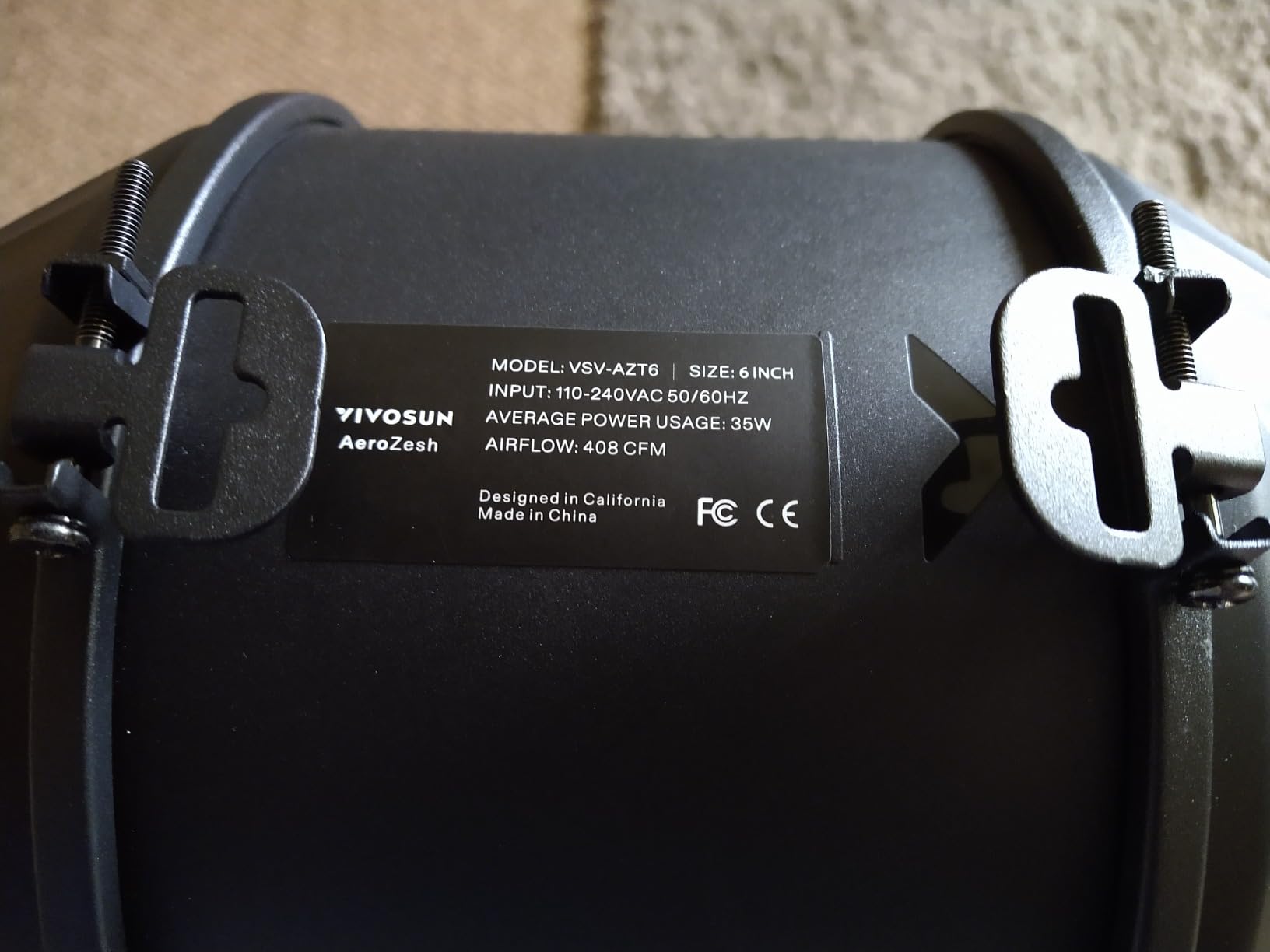
VIVOSUN G4 4″ Inline Fan &Cycle Mode Speed Controller, 195 CFM Aerozesh Fan
195 CFM
Ten PWM speeds
Three on and off cycle modes
20 W
2700 RPM
Pros
- Cycle mode waves plants on a schedule instead of running flat out
- Ten PWM speed steps with backup memory
- Quiet at the two lowest settings in a still room
- Upgradeable to the GrowHub app ecosystem
Cons
- Noticeably louder on upper speeds with some bearing noise
- Spare parts are not sold separately
- App automation needs a separate hub
The G4 is the only fan here built around a cycle mode, and that is a real advantage for growers who want plants waved on a rhythm rather than hit with constant airflow. The E12 controller offers three on and off cycle patterns, so you can set short bursts at intervals instead of a steady stream, which is closer to how outdoor wind behaves.
Ten PWM speed steps with backup memory give genuinely fine control. Owners report it is nearly inaudible at the two lowest settings in a still room, and at 195 CFM from a 4-inch body it is a sensible intake fan to pair with a larger extractor.
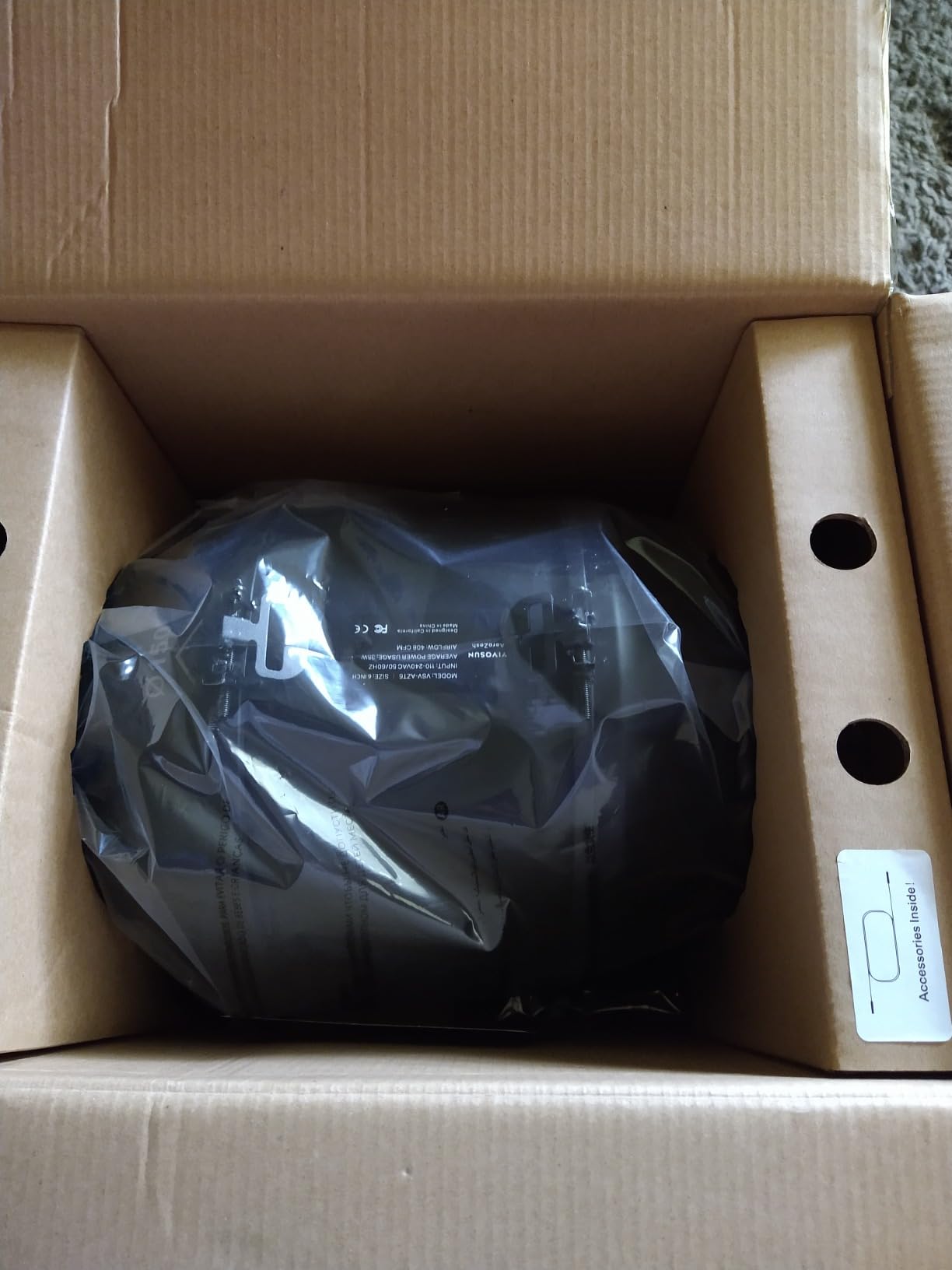
Be clear about the noise range. The headline figure in the listing is 39 dBA while a feature description cites 28 dB, and reviewers say both are true depending on the setting. Low speeds are quiet, the upper half of the range is not, and some owners mention ball bearing noise developing on top of that.
The reinforced plastic housing sits on a corrosion-resistant metal base, which is a sensible compromise for a unit that sees constant condensation. The upgrade path to the E42A multi-device controller and GrowHub app exists but costs extra, and the E42A itself has no CO2 measurement and no generic 10V dimming output for third-party lighting.
Who the VIVOSUN G4 suits
Growers who want intermittent air movement on a timer rather than a constant breeze, and anyone building a VIVOSUN controller ecosystem across several devices. It is a good quiet intake to pair with a louder extractor.
Cycle mode is also useful for seedling stages, where constant airflow on tender new growth is more than they need.
Who should skip the VIVOSUN G4
Skip it if you need one spare part to last a decade, because spares are not sold separately. It is also a poor choice for a bedroom-adjacent tent if you intend to run it above the lowest settings.
9. Tonree 5.5 Inch Clip Fan: Small-Tent and Off-Grid Filler
Tonree Grow Tent Fan, 5.5″ Greenhouse Clip Fan with Brushless Motor and Non-Slip Clamp, Strong Airflow and Low Noise, 360° Tilt, Easy Mount for Plant Hydroponics Circulation Cooling Ventilation Shed
Up to 260 CFM
3700 RPM
Below 40 dB claim
USB 5V with 9 ft cord
Pros
- Rubber-padded anti-slip clamp fits 0.5 to 2 inch round or square poles
- 360 degree tilt and three speeds for aiming airflow
- 9 foot USB cord makes tent placement straightforward
- Brushless copper motor rated over 67000 hours with IPX5
Cons
- Airflow reported as weaker than advertised by several reviewers
- USB power block reported running very hot after six hours
- Designed for tents of about 60 square feet
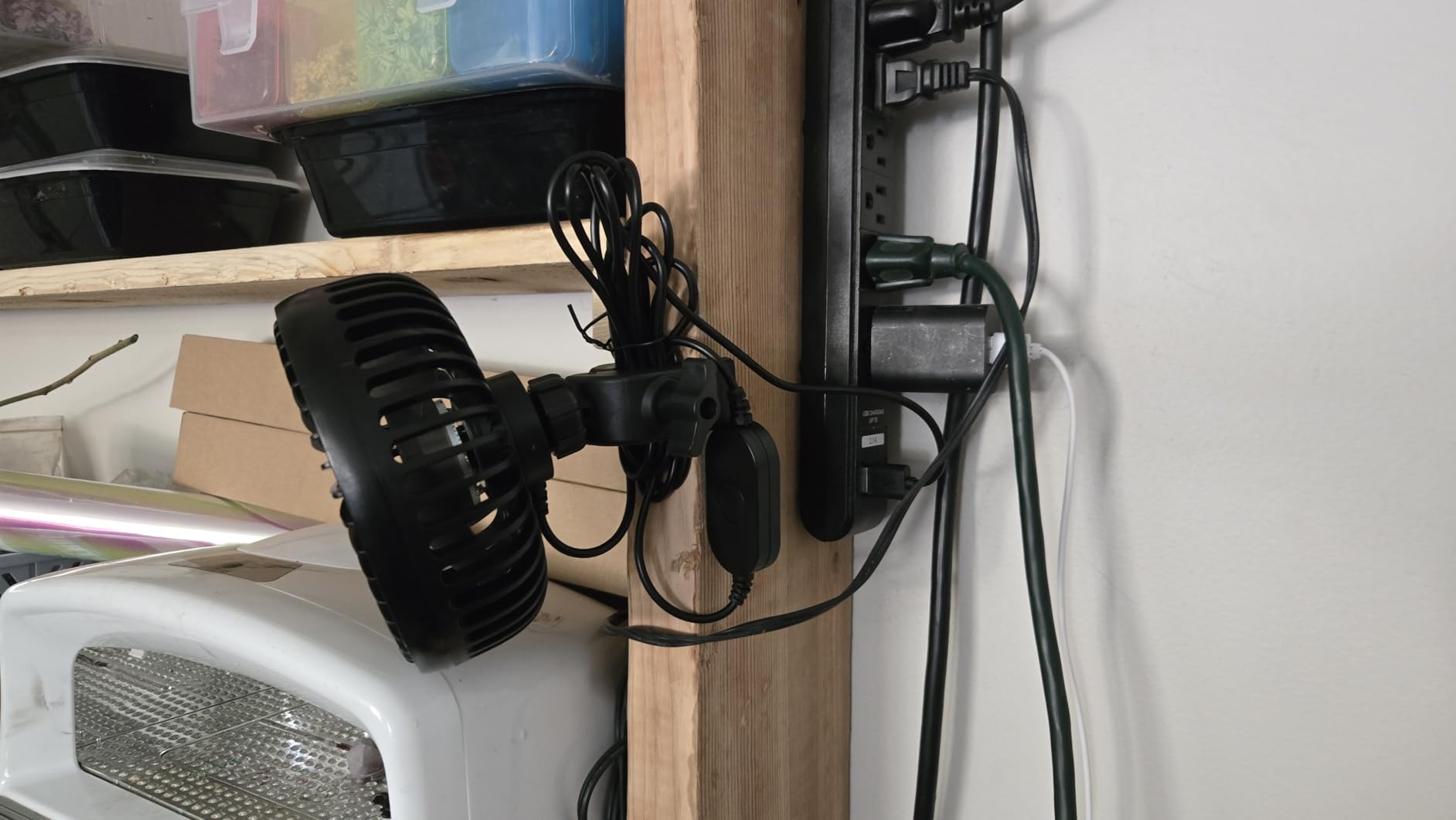
The Tonree 5.5-inch covers a specific gap: small tents, greenhouse benches and camper awnings where a four-inch fan is too small and a six-inch will not fit. The clamp is the best of the budget options, gripping round or square poles from half an inch to two inches with a rubber anti-slip pad, and it mounts or comes off in about ten seconds.
Airflow is quoted at up to 260 CFM at 3700 RPM, suited to tents of roughly 60 square feet. That is a real number for that footprint, but reviewers split on whether they feel it, and 63% five star with 8% at one star reflects that split.
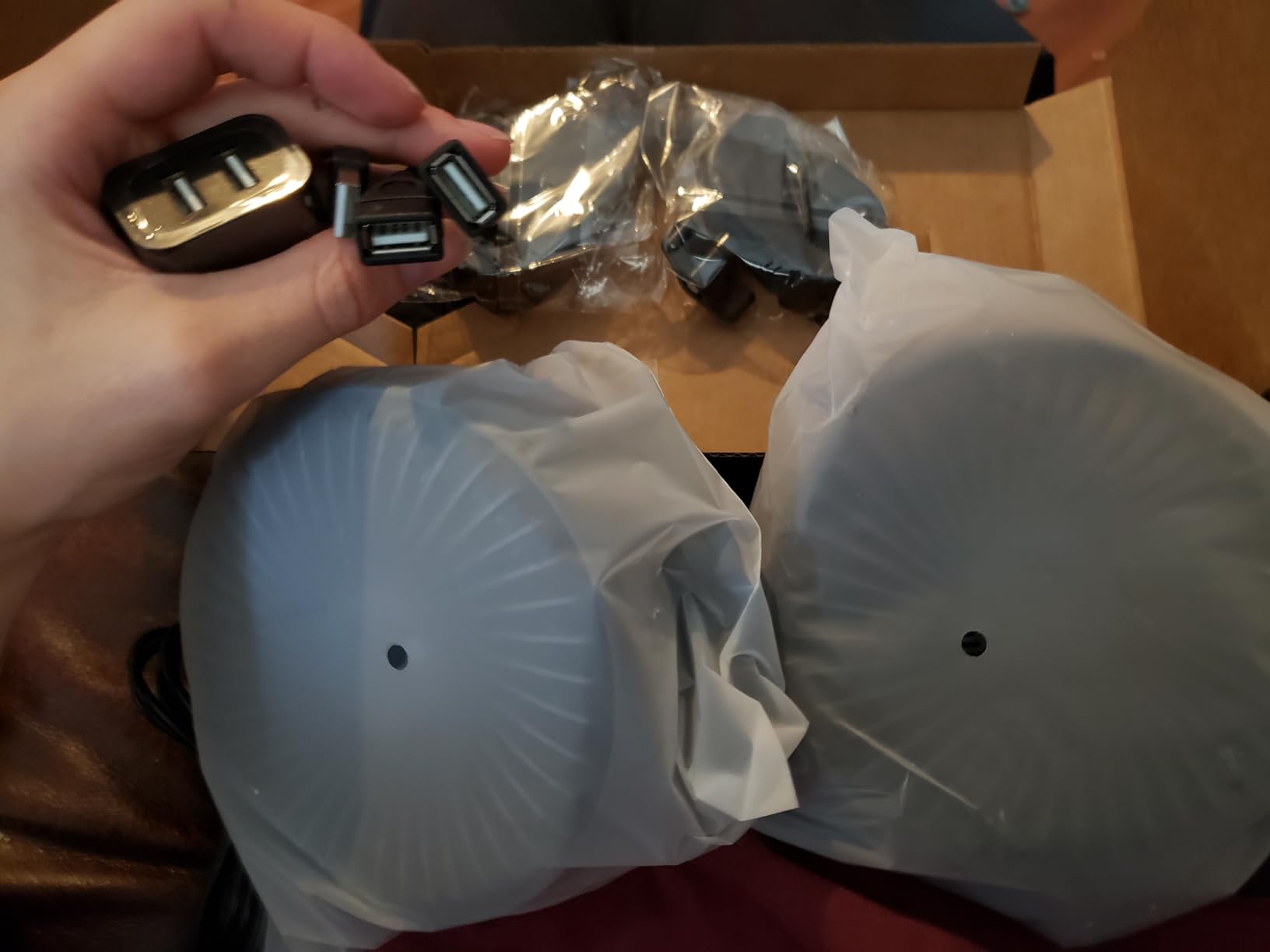
The recurring negatives are worth weighing. Several reviews say airflow is weaker than advertised and units have failed within a year, and one reviewer reports the USB power block running very hot after six hours of continuous use. On a fan meant to run around the clock, that last point deserves attention: use a quality supply rather than a random one, and give it a rest cycle if you are away.
On the positive side, IPX5 water resistance and a brushless copper motor rated beyond 67,000 hours are good paper credentials, and the 360-degree tilt with three speeds gives more aiming control than most units at this size. A Smart WiFi app controller is available separately if you want scheduling.
Who the Tonree 5.5 Inch suits
Small fabric tents, greenhouse shelving and off-grid setups where USB power is the only realistic option. The wide clamp range is unusual and lets it grip frames that a 16mm-to-25mm jaw cannot.
Two units facing each other across a small tent produce noticeably better circulation than one, and that is how the manufacturer positions it.
Who should skip the Tonree 5.5 Inch
Skip it for anything larger than a small tent, and skip it if you plan to leave it running unattended for months on a USB supply you have not tested. The durability reports are the weak point in an otherwise capable package.
10. TURBRO AirSupply ES4: Smallest Footprint Inline Fan
TURBRO AirSupply ES4 4 Inch Inline Duct Fan, 195 CFM Energy Efficient Exhaust Fan with Variable Speed Controlled EC Motor for Grow Tents, Hydroponics, Industrial and Residential Ventilation
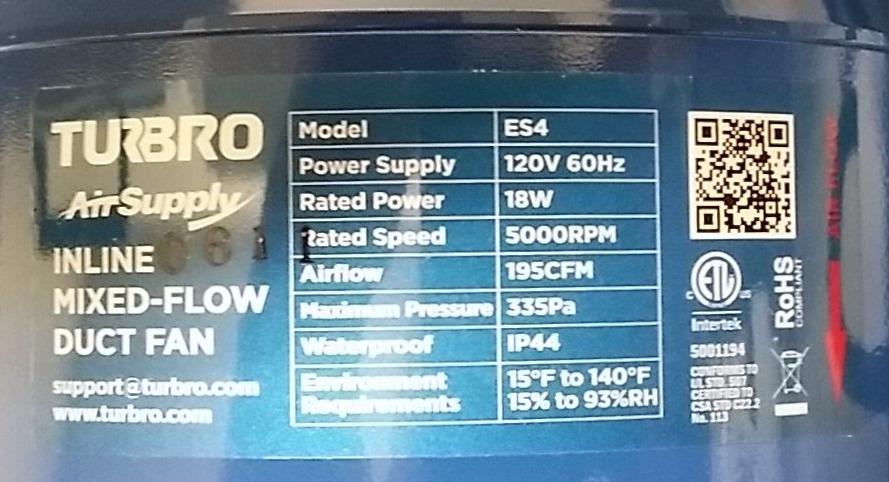
195 CFM at 5000 RPM
37 dBA
18 W
Aluminum housing
2 year warranty
Pros
- Aluminum housing about the size of a mayonnaise jar moving 195 CFM
- Fine 0 to 100 percent speed control with a 16 foot controller cable
- Permanently-lubricated bearing reduces maintenance
- Airtight steel case with IP44 protection
- Two year warranty
Cons
- Louder than expected at higher speeds on a minority of reviews
- One report of failure after about five months
- Controller cable uses a tight 3 pin connection
The ES4 exists to solve a space problem. At 2.7 pounds and roughly the footprint of a mayonnaise jar, it delivers 195 CFM on 18 watts, which makes it the easiest 4-inch inline unit to fit into a tight tent port or a small closet conversion where a larger housing simply will not go.
Build quality is a step above the plastic boxes. The case is aluminium with an IP44 rating, and the permanently-lubricated bearing removes the maintenance item that causes most inline fan failures. Eighty percent of reviews are five star, with a further 11% at four stars.
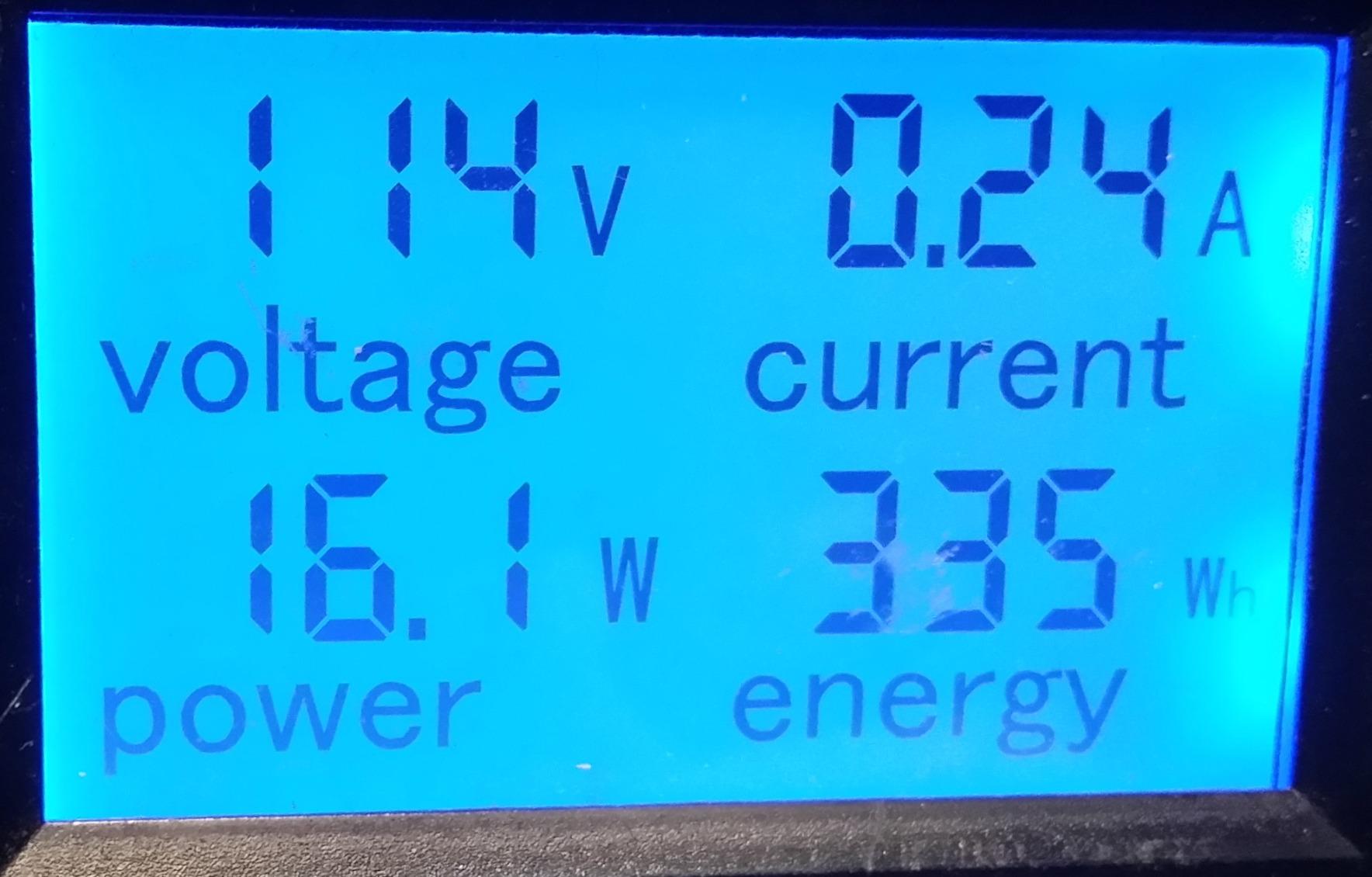
Owners consistently describe the low speed settings as inaudible in a still room, and the 0 to 100 percent variable controller with a 16-foot cable gives you room to mount the control outside the tent. At 5000 RPM the motor is genuinely quick, and the brushless DC design is 30 percent more efficient than an AC equivalent per the manufacturer.
The negatives are narrow but real. A minority find it louder than expected at higher speeds, the 3-pin controller connection uses a tight fit that can bend pins if forced, and one review reports a unit failing at about five months alongside a seller that has since left Amazon. That last point is worth checking on whatever listing you use.
Who the TURBRO ES4 suits
Small tents, closets and grow cabinets where every inch of port space counts. It is a good fit for anyone who wants a metal-bodied inline unit without the footprint or weight of a larger fan.
The two-year warranty and permanently-lubricated bearing make it a sensible choice for a setup that will run year-round.
Who should skip the TURBRO ES4
Skip it if quietness at full output matters more than size, since the 37 dBA claim is the highest of the 4-inch inline units here. It is also not a good pick if you will be regularly unplugging and reconnecting the controller cable.
11. VIVOSUN M4 4 Inch Inline Fan: Simplest Install With a Serviceable Body
VIVOSUN M4 4″ EC Motor Inline Fan, 195 CFM Variable Speed for Hydroponic
195 CFM at 2800 RPM
28 dBA stated
18 W
Three speed knob
ETL listed
Pros
- 195 CFM from a compact 4 inch mixed-flow body on 18 watts
- Detachable housing
- impeller and blades make cleaning straightforward
- ETL listed motor with overheat auto-reset and locked-rotor protection
- Locking-tab flanges and a 5.9 foot cord speed up installation
Cons
- Reviewers describe it as louder than the stated 28 dBA in enclosed spaces
- Only three speed levels
- One reviewer reports noise increasing within a few months
The M4 is the no-nonsense option. A PWM-controlled EC motor in a mixed-flow design pushes 195 CFM at 2800 RPM on 18 watts, and the whole thing is controlled by a single knob with three speed levels. There is nothing to pair and nothing to configure, which makes it the fastest inline install in this roundup.
The motor is ETL listed with overheat auto-reset and locked-rotor protection, and the junction box is flame retardant. Those are unglamorous details that matter when a unit runs unattended in a humid fabric enclosure, and they are not always listed by competitors.
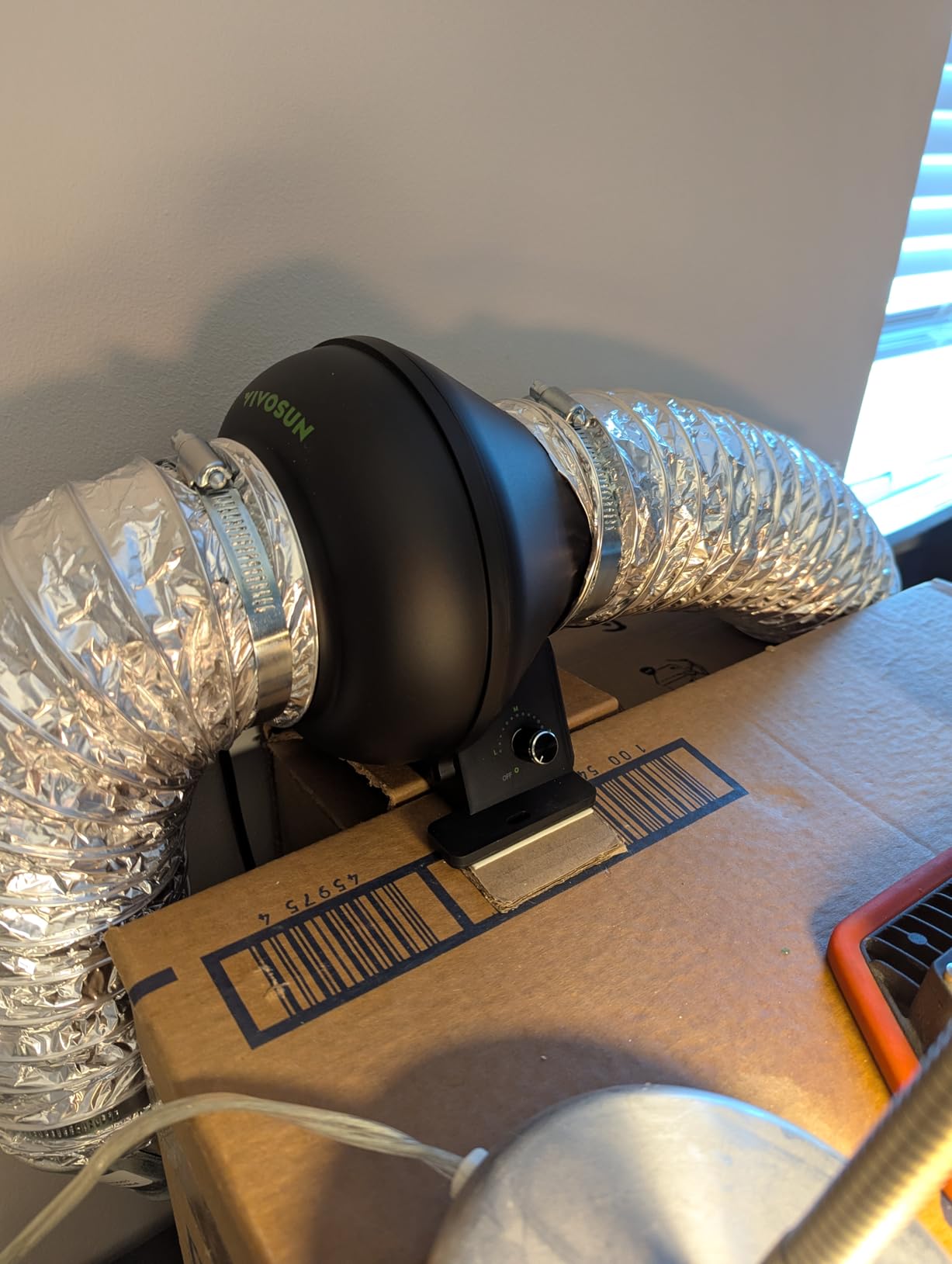
Noise is the controversy. The specification says 28 dBA, and several reviewers say it is louder than that, particularly in an enclosed cabinet where there is no room for sound to dissipate. Treat 28 dBA as a low-speed figure rather than an all-conditions one. Sixty-nine percent of reviews are five star, with the most common complaint being noise rather than airflow or failure.
Serviceability is the hidden strength. The housing, impeller and blades all detach, so cleaning a dusty fan takes minutes rather than a disassembly project. The body is smaller than buyers expect, closer to a softball than the photographs suggest, which is a good thing in a tight tent and a surprise in an open room.

Who the VIVOSUN M4 suits
First-time growers who want a straightforward inline fan with no learning curve, and anyone in a very enclosed space who will value being able to pull the impeller out and clean it regularly. The locking-tab flanges make duct connections quick.
It is also a good secondary fan, since a second unit on intake balances the negative pressure without adding much noise load if you run it slowly.
Who should skip the VIVOSUN M4
Skip it if fine speed control matters, because three levels is the whole range, and skip it if the tent shares a room with a sleeper and you plan to run it above the lowest setting. A ten-speed controller is a meaningful upgrade here.
12. Toolazy 6 Inch Inline Duct Fan: Most Airflow, and the Loudest at Full Output
Toolazy 6 Inch Inline Duct Fan, 405 CFM Quiet EC Motor Ventilation Fan with 10-Speed PWM Controller, Low Noise 31dB Mixed-Flow Exhaust Fan for Grow Tent Hydroponics HVAC Cooling Bathroom
405 CFM
31 dBA
60 W
10 speed PWM
Universal 110 to 240V
Pros
- Highest airflow of any unit here at 405 CFM from a 6 inch body
- Ten speed PWM controller with memory that restores your last setting
- Good high static pressure performance for long flexible duct runs
- Brushless three phase EC motor rated beyond 40000 hours
- Universal 110 to 240V supply
Cons
- Louder at full output
- 60 watt draw is higher than the 4 inch inline units
- WiFi app control needs a separately sold controller
When a tent is large enough that circulation is a losing battle without real extraction, airflow becomes the constraint. The Toolazy moves 405 CFM, which is more than double the 4-inch units in this roundup, and it does so through a 6-inch body with a ten-speed PWM controller that remembers your last setting after a power cut.
Static pressure performance is the underrated strength here. One owner pushes air through a 10-metre flexible duct, and that is the kind of result that matters when your filter and ducting are adding resistance. The brushless three-phase EC motor is rated beyond 40,000 hours and runs cooler under restriction, which is exactly the condition an extraction fan lives in.
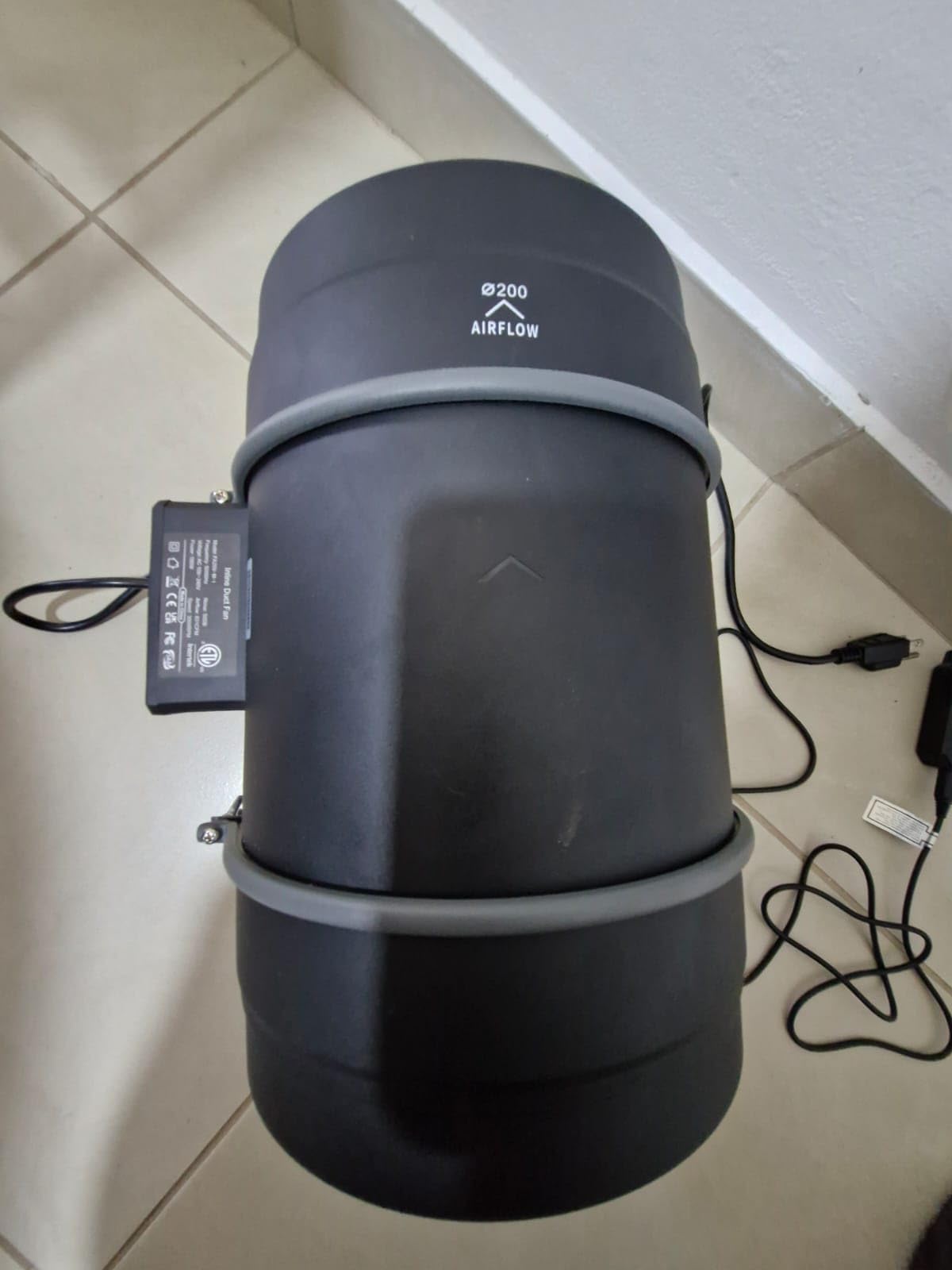
The trade is noise and power. At 60 watts and full output, reviewers describe it as loud, one comparison being an aircraft through a vent, and nobody in the review set calls it bedroom quiet. The 31 dBA figure applies to the quieter end of the range. Use the speed controller properly and it settles into a much lower register within a minute or two.
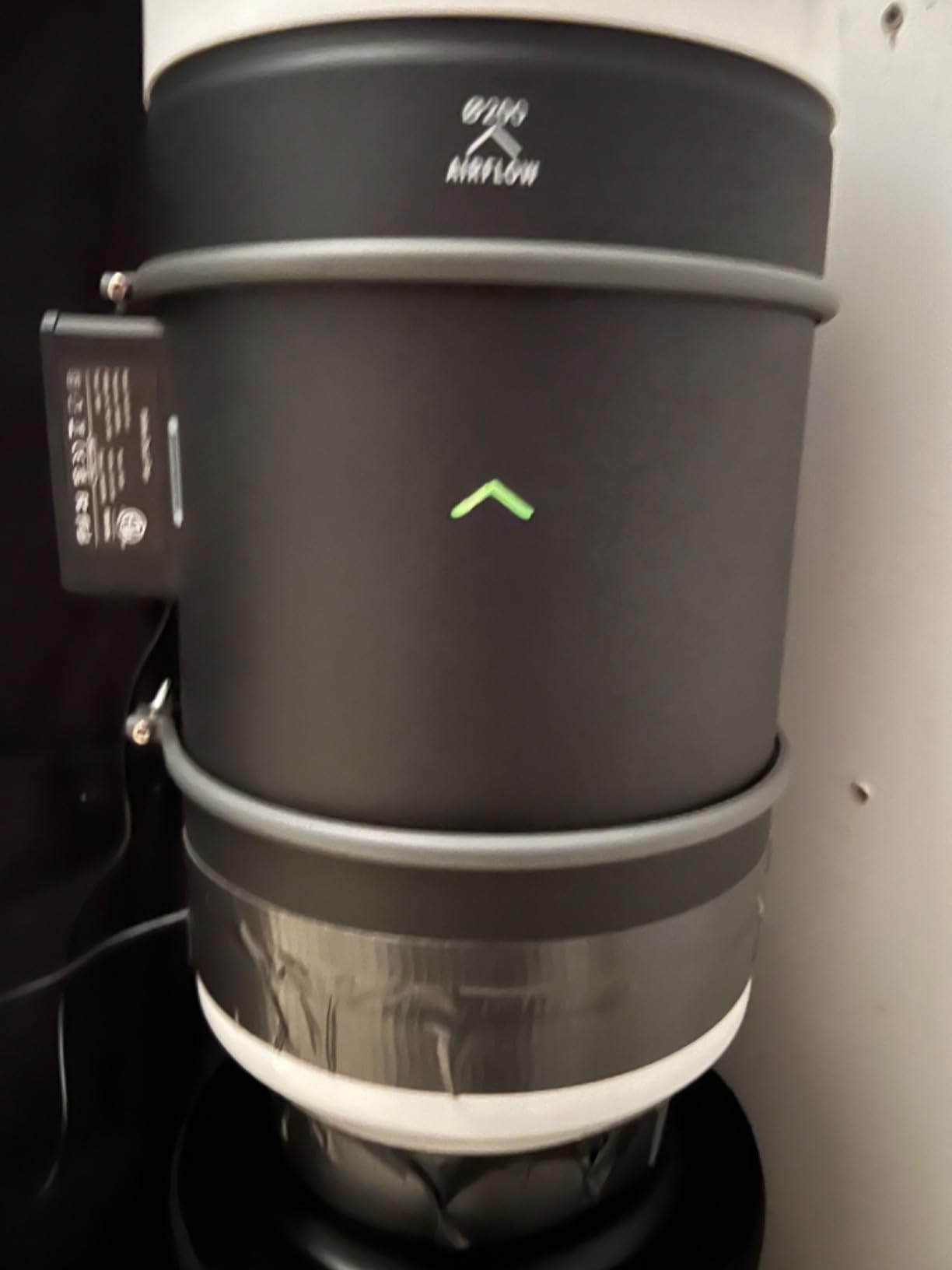
It is also the only unit here with a universal 110 to 240V supply, which matters if you take a tent to a location with a different supply from your home. The kit includes the controller, a 5-foot power cord, an 8-foot control cable and hardware for 6-inch ducts, so nothing else needs buying.
Who the Toolazy 6 Inch suits
Larger tents, multi-room setups, and anyone who already has a quiet internal circulation fan and needs serious extraction behind it. The ten speeds make it easy to run quietly overnight and harder during the light cycle.
It is equally at home in a garage, workshop or utility space where noise is less of a consideration but airflow is everything.
Who should skip the Toolazy 6 Inch
Skip it for a small tent, where the airflow would be wasted and the power draw disproportionate, and skip it if the tent sits next to where you sleep. If you need 200 CFM, a 4-inch unit is quieter, cheaper to run and easier to hide.
How to Size and Place a Quiet Fan in Your Tent
Start with volume. Multiply the length, width and height of your tent in feet to get cubic feet, then divide by the number of minutes you want a full air change. A four-by-four tent at five feet is 80 cubic feet, and replacing that air every two to three minutes calls for roughly 27 to 40 CFM. Add 20 to 30 percent on top for carbon filter and duct resistance, because a filter that is not rated for the airflow it is fed will cut the real number substantially.
That figure is your extraction target. A circulation fan does not need to match it, because it is mixing rather than replacing air, but it does need to move enough to keep every leaf in motion. In practice, a 4-inch clip fan serves a small bench, a 6-inch covers a two-by-four, and a five-by-five wants either a 6-inch plus an extractor or two clips aimed from opposite corners.
Placement matters more than most buyers expect. Aim above the canopy, not into it. You want a visible flutter in the leaves, and stems that stay upright. If the leaves are moving hard enough to flap, you have gone too far, and that is what causes wind burn, dried edges and slowed growth on the side facing the fan. Work down one speed setting at a time until the movement is gentle but continuous.
Mount it on a pole or frame member that carries load, and check the fit before you buy. A jaw rated for 16mm to 25mm poles will not hold a half-inch square frame, and a loose clamp that slides down overnight is the most common failure reported in grower forums. Vibrating fans walk down poles, so a rubber-padded jaw is worth paying for. Our trellis net guide covers supporting the canopy itself if the plants are heavy enough to pull on the frame.
Two more practical points. Route the cord away from any open water, along the tent sleeve rather than across the floor, and use a smart plug or timer if the fan follows your light schedule. Humidity peaks in the dark hours, so a fan that switches off with the lights leaves the window where mold starts open; many growers run the circulation fan continuously and the extractor on the light timer. If you are in a small tent where that raises noise concerns, look at the dehumidifier options in our grow tent dehumidifier roundup instead.
What a Grow Tent Fan Will Not Fix
A fan mixes air and moves heat. It does not remove humidity from a sealed tent, which is a dehumidifier or an extraction fan with a carbon filter job. Adding clip fans to a tent that is already at 70 percent humidity will not bring it down, and growers who expect otherwise often conclude the fan was a bad purchase.
It also will not cool the room the tent stands in, cool a reservoir of nutrient solution, or fix a plant that is wilting because its roots are unhappy. Nor will it solve every mold problem, because spores already present need treatment rather than moving air. If you are chasing temperature in the whole space, a quiet fan in the room may be a better use of the same money than a second fan inside the tent.
Most useful of all, a fan does not make up for a badly sized tent. If airflow is fighting a losing battle against a five-by-five canopy and a 500-watt fixture, the equipment is undersized, not the strategy. Our small-space tent guide is the place to check whether the enclosure is the constraint.
Frequently Asked Questions
What are the best fans for grow tents?
A circulation fan for canopy mixing plus an inline extraction or intake fan is the standard combination. The AC Infinity CLOUDLINE T4 is our pick for extraction, the CLOUDRAY S6 for internal circulation, and the Spider Farmer 6-inch for an auto-oscillating clip-on.
What is the best fan for a grow tent?
For most fabric tents the AC Infinity CLOUDLINE T4 is the strongest all-round choice, with 226 CFM, a published 28 dBA figure, dual ball bearings and app-based climate control. For a small tent with no duct port, a 6-inch clip fan such as the CLOUDRAY S6 is the simpler answer.
What is the best clip-on fan for a grow tent?
The AC Infinity CLOUDRAY S6 leads our clip-on picks, with 315 CFM, a 31 dBA published figure, ten oscillation ranges and a mount that holds a vertical pole through a night of vibration. The Spider Farmer 6-inch is the alternative if you want a rubber-padded jaw and a head that rebounds on contact.
Which cooling fan is the quietest?
Among the fans we compared, the lowest published figures are 28 dBA from the AC Infinity CLOUDLINE T4, the VEVOR 4-inch inline, the VIVOSUN M4 and the TerraBloom ECMF-100. Real perceived quietness depends on the speed setting and on duct and filter resistance as much as the headline number.
What is the quietest decibel for a fan?
A quiet bedroom sits near 30 dB and an empty room runs 35 to 40 dB, so anything in the high twenties to low thirties reads as background noise. Below 30 dBA a fan effectively disappears in a still room, which is the target for a tent next to where you sleep.
What brand of fan is the quietest?
AC Infinity is the most consistently quiet across the formats we compared, with the CLOUDLINE T4 and CLOUDRAY S6 both publishing decibel figures alongside brushless EC motors. Growers on r/microgrowery also name AC Infinity as the best built and call Hurricane the value standard for quiet fans.
Which inline fan is the quietest?
The AC Infinity CLOUDLINE T4 and the VEVOR 4-inch both publish 28 dBA, and the VIVOSUN M4 lists the same figure with the caveat that reviewers hear more in an enclosed space. The TerraBloom ECMF-100 lists 18 dBA in its technical details but 28 dB as its headline claim, so read both.
Should an inline fan pull air out of a grow tent?
Yes, running an inline fan as extraction sets the tent at negative pressure, so the walls draw inward and stale air cannot leak back through seams. Pair it with a smaller intake fan to maintain that balance, and never run a large extractor with an equally large intake pushing the other way.
Which Quiet Grow Light Fan to Buy
The short answer is the AC Infinity CLOUDLINE T4 for extraction and the CLOUDRAY S6 for canopy circulation. Together they cover the two jobs the best quiet grow light fans for tents need to do, both run on brushless EC motors, and both publish decibel figures you can check instead of adjectives. Add the Spider Farmer 6-inch if you want an auto-oscillating clip-on that survives contact, or the Vivosun AeroWave D4 if your tent has no wall outlet at all.
One last warning, because it has caught out plenty of buyers: fan models with near-identical names get quietly redesigned between years. Check that the listing you are buying is the current version of the model named here, and confirm the specifications against the product page before you order. Use the price buttons below to check the current listing.


