

If four or more people share one water line, the deciding number is not contaminant removal, it is gallons per minute at peak demand. Two showers, a dishwasher and a washer running at once pull roughly 11.5 GPM, and an undersized filter turns that moment into weak pressure and a collapsed cartridge. We compared 12 whole house water filters for large families on rated service flow, certification, media life and the maintenance a busy household will actually keep up with.
Our best overall pick is the iSpring WGB32B. It holds 15 GPM on 1-inch ports, removes up to 99% of chlorine across three 20-inch stages and carries the largest review base in the group. Where you are on municipal water and want a decade of low attention, the Aquasana Max Flow trades a larger up-front number for a million-gallon media life and a 10-year warranty.
Two questions shape every pick below. Where does your water come from, because municipal and well water fail in completely different ways. And do you want a system you service twice a year or one you forget for years, because those philosophies cost very different amounts of attention. If hardness is your main battle, read our whole house water softener roundup first.
Top 3 Best Whole House Water Filters for Large Families in 2026

iSpring WGB32B
- 15 GPM rated flow
- 3-stage 20-inch Big Blue housings
- 100000 gallon capacity
- up to 99% chlorine reduction

Express Water WH300SCKP
- 17 GPM rated flow
- freestanding stainless frame
- 3 pressure gauges
- KDF and polyphosphate media

Aquasana Max Flow
- 14.5 GPM peak flow
- 1000000 gallon capacity
- 10 year media life
- salt-free scale control
These are three different answers, not three versions of one idea. The WGB32B balances flow and contaminant breadth for municipal water, the Express Water has the most flow headroom and needs no wall mounting, and the Aquasana is the set-and-forget option for a family that does not want to open housings twice a year.
Every Whole House Filter We Compared in October
| Product | Specs | Action |
|---|---|---|
| iSpring WGB32B 3-Stage Whole House Filter |
|
Check Latest Price |
| Express Water WH300SCKP 3-Stage System |
|
Check Latest Price |
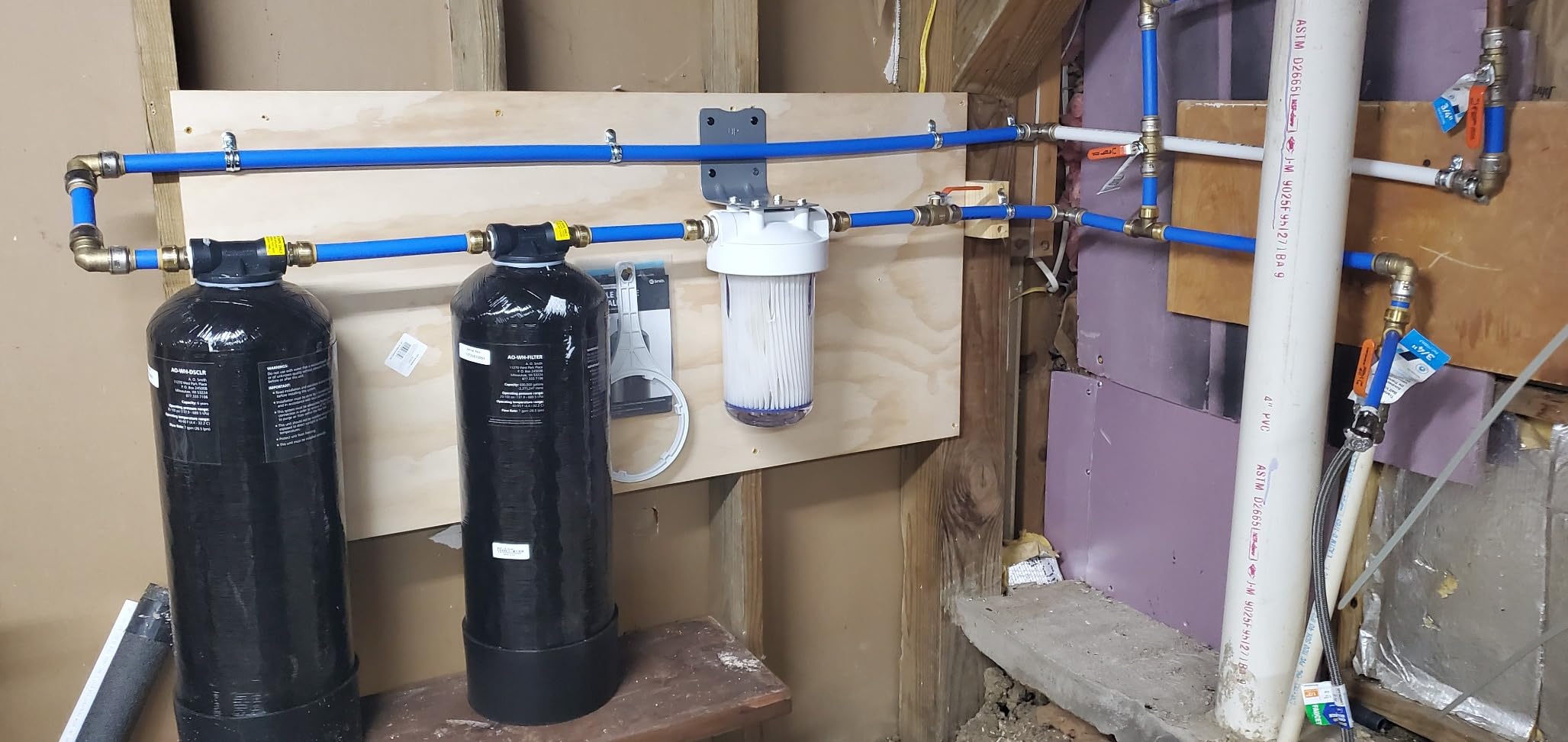
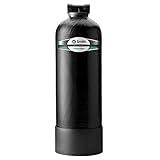 A. O. Smith 600K Gallon Whole House Filter A. O. Smith 600K Gallon Whole House Filter |
|
Check Latest Price |
 Waterdrop WHF21-PG 2-Stage Filter Waterdrop WHF21-PG 2-Stage Filter |
|
Check Latest Price |
| Aquasana Max Flow WH-1010-CT-LM |
|
Check Latest Price |
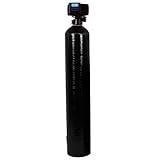 Fleck 5600 SXT Air Injection Iron Eater Fleck 5600 SXT Air Injection Iron Eater |
|
Check Latest Price |
 3M Aqua-Pure AP900 Series AP904 3M Aqua-Pure AP900 Series AP904 |
|
Check Latest Price |
 PRO+AQUA Heavy Duty Well Water Filter PRO+AQUA Heavy Duty Well Water Filter |
|
Check Latest Price |
 Water Boss WB-WH-Filter 600K Gallon Tank Water Boss WB-WH-Filter 600K Gallon Tank |
|
Check Latest Price |
 Home Master HMF3SdgFeC 3-Stage Well Filter Home Master HMF3SdgFeC 3-Stage Well Filter |
|
Check Latest Price |
 HQUA WF3-01 3-Stage Filtration System HQUA WF3-01 3-Stage Filtration System |
|
Check Latest Price |
 iSpring WCFM400K Iron and Manganese System iSpring WCFM400K Iron and Manganese System |
|
Check Latest Price |
Two things stand out there. The A. O. Smith and Water Boss tanks have the longest service interval at six years and the lowest rated service flow at 7 GPM. The 3M Aqua-Pure has the highest rated flow at 20 GPM and the narrowest scope, because it is a single carbon cartridge.
1. iSpring WGB32B 3-Stage Whole House Filter – Best Overall for Large Families
iSpring WGB32B Commercial-Grade Whole House Water Filter System
15 GPM rated flow
100000 gallon capacity
20-inch Big Blue housings
Up to 99% chlorine reduction
Pros
- 15 GPM on 1-inch NPT ports suits simultaneous fixture use
- Removes chlorine
- sediment
- rust and herbicide off-tastes
- 100000 gallon capacity is about a year of family use
- Brand replaces damaged manifolds and housings at no charge
Cons
- Housings are awkward to open and need two wrenches plus a bucket
- Heavy at 45 pounds so drywall anchors are not enough
- Annual cartridge replacement in most municipal conditions
The WGB32B is the only system here where flow rating, port size and certification all hold up together. Fifteen GPM on 1-inch NPT ports means two showers and a washer can run without starving the house.
The 5-micron polypropylene first stage catches sediment and rust, and the two coconut shell CTO carbon blocks behind it handle chlorine, taste and odor across a 100,000 gallon capacity. It runs 25 to 80 psi, needs no electricity, no drain line and no backwash, and supports water up to 300 ppm TDS.
What it will not remove is a short list that matters. There is no KDF or ion exchange stage, so lead, arsenic, iron, sulfur and PFAS pass through. It does not soften water and it does not lower TDS.
Owners who pair it with a softener behind it report the cleaner water and fewer rust stains, and iSpring’s replacement of damaged manifolds at no charge is repeatedly praised.
15 GPM is what makes it work for a big family
Rated flow is measured with margin on clean filters, so a 7 GPM unit collapses the moment two fixtures open while a 15 GPM unit does not. Port size matters just as much, because a 3/4-inch port can throttle a large filter down to small-system flow.
Who should skip it
Skip it on a private well with iron, or if hydrogen sulfide gives your water a rotten egg smell. Skip it if nobody in the house will own the annual cartridge change, and skip it if you want zero maintenance, because this is a cartridge system and always will be.
2. Express Water WH300SCKP 3-Stage System – Best Value with the Highest Rated Flow
Express Water Whole House Water Filter System, Ultimate Protection, 3-Stage
17 GPM maximum flow
100000 gallon capacity
Freestanding stainless steel frame
3 pressure gauges
Pros
- 17 GPM is the highest rated flow of the multi-cartridge systems here
- Freestanding frame needs no wall mounting
- Three gauges plus pressure release buttons simplify cartridge changes
- Covers chlorine
- heavy metals and scale in one stack
Cons
- 63 pounds and bulky for a tight mechanical room
- Six month cartridge interval is among the most frequent here
- Polyphosphate is anti-scale media and not a true softener
The WH300SCKP is the pick for a family with three or four bathrooms and no good wall to mount on. It stands on a stainless steel frame, carries three pressure gauges and runs at 17 GPM, with KDF, activated carbon and polyphosphate media in the stack.
Owners point to the monitoring hardware rather than the media. One upstream and one downstream gauge tells you when a housing is loading, and the pressure release buttons drain a housing without wrestling a full canister over a bucket. At 63 pounds it needs real floor space, so measure before you buy.
What it will not remove is where the marketing gets soft. Reviewers report clear improvement in taste and odor, but the anti-scale polyphosphate is a threshold inhibitor rather than a softener, so hard water still leaves scale behind it. No TDS reduction, no iron, no sulfur.
The 800 ppm TDS ceiling gives headroom on moderately mineralized water, and the 20 to 80 psi window is wide.
The freestanding frame is the deciding feature
Wall-mounted systems need studs and a fastener that holds 60-plus pounds. This one needs a floor, which removes the most common DIY install failure in finished older homes and lets you move the unit when you need the main shutoff.
Who should skip it
Skip it in a crawlspace or closet with less than 30 inches of depth. Skip it if your water is hard and you want a single-system answer. And skip it if a six month change interval is a problem, because in a large household that is two changes a year.
3. A. O. Smith 600K Gallon Whole House Filter – Best for Low Maintenance Over Six Years
A. O. Smith Whole House Water Filter System | 600K Gal | AO-WH-Filter
7 GPM rated service flow
600000 gallon capacity
6 year filter life
NSF/ANSI 42 certified
Pros
- Six year 600000 gallon cartridge life is the least maintenance in the group
- NSF/ANSI 42 certified at 96.9% chlorine taste and odor reduction
- No drain line
- backwashing or water waste
- Compact tank about 30 inches tall
- Shut-off valve
- nipple and hose adapter included
Cons
- 7 GPM flow and 3/4-inch ports are restrictive in four or more bathroom homes
- Does not reduce TDS
- sulfur or iron so it cannot handle well water
- Not a softening system
The A. O. Smith is the maintenance-economics answer. One fiberglass tank, 600,000 gallons of rated capacity, a six-year cartridge life and a six-year limited warranty, with no drain line and no backwash water.
It carries an NSF/ANSI 42 certification for 96.9% chlorine taste and odor reduction, and the kit includes a shut-off valve, nipple and hose adapter for a genuine DIY install. The tank is about 30 inches tall and 9 inches wide, which fits utility areas that will not take a 47-inch-wide rack.
What it will not remove is the trade-off for that six-year interval. Activated carbon handles taste and odor and little else: no TDS reduction, no sulfur, no iron, no heavy metals, no softening. The 3/4-inch ports cap real delivery below the headline figure even at good supply pressure.
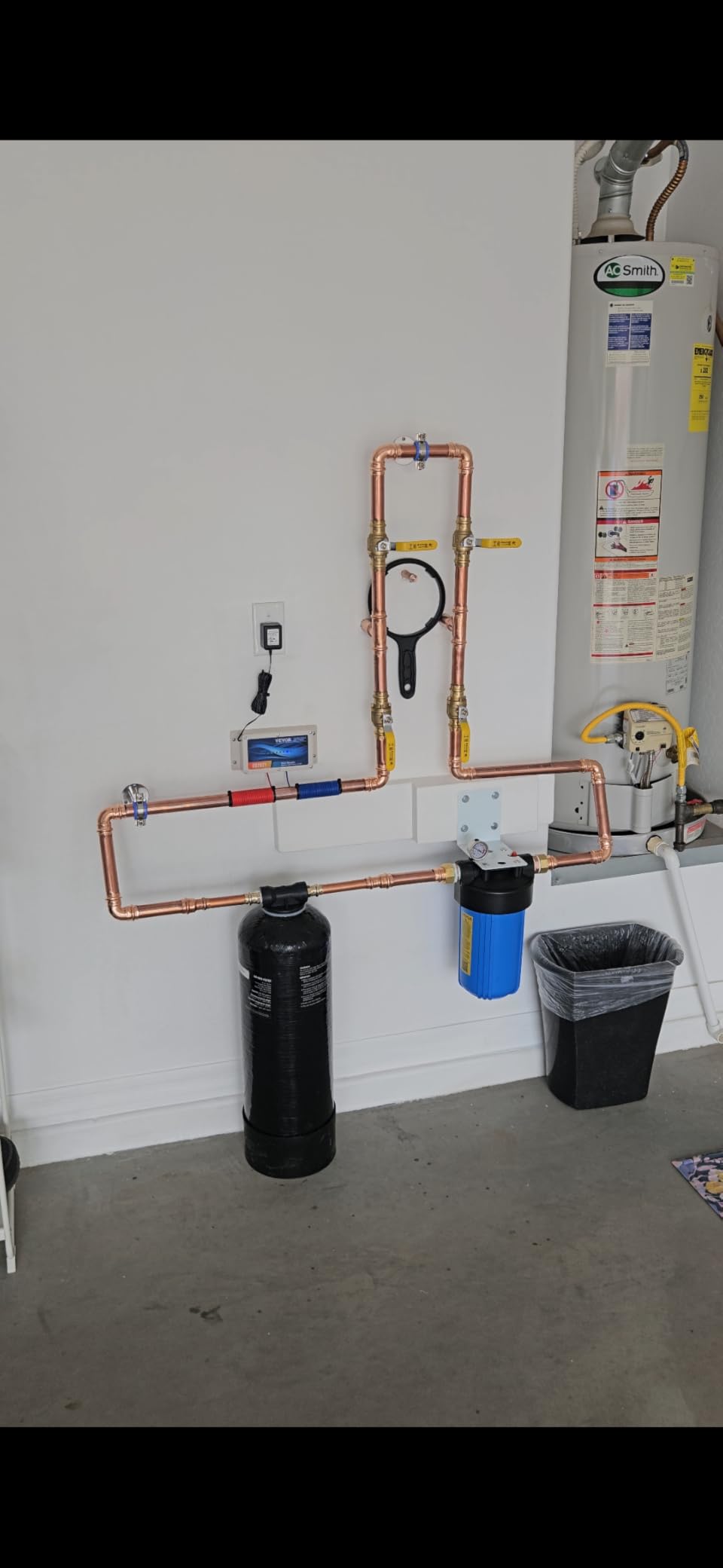
Reviewers who compared it with a cartridge stack usually come back here, because the cartridges charge twice a year in parts and a Sunday afternoon while this asks for one decision every six years.
How to live with a 7 GPM rating
Seven GPM handles one shower plus laundry and is marginal for two showers at once. Staggering the dishwasher and laundry cycles during the morning rush costs nothing and works well. The 600,000 gallon figure also assumes a city-water chlorine load, so treat six years as a ceiling rather than a schedule.
Who should skip it
Skip it if everyone showers at once before school, if you are on a well with sediment or iron, or if your goal is soft water. It also pairs well in front of a softener, because carbon ahead of resin keeps the resin bed cleaner for longer.
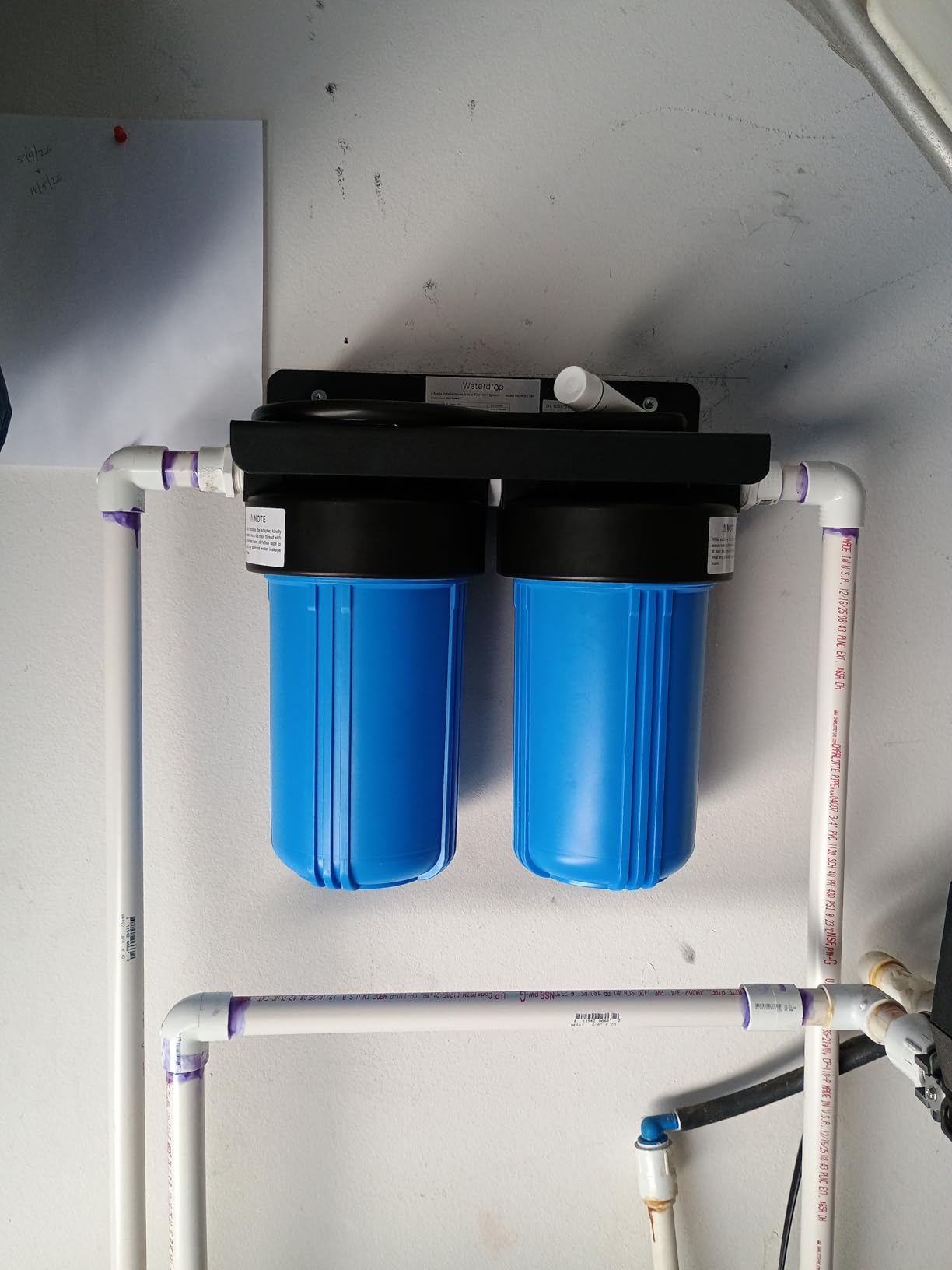
4. Waterdrop WHF21-PG 2-Stage Whole House Filter – Best Budget Entry for Extra Bathrooms
Waterdrop WHF21-PG 2-Stage Whole House Water Filter System, 5 Micron
15 GPM rated flow
50000 gallon capacity
10-inch compact housings
5 micron nominal filtration
Pros
- Compact housings fit crawlspaces and closets
- 15 GPM on 1-inch ports at the lowest price in the group
- Food-grade housing tested to 25-90 psi and 100000 water hammer cycles
- Wrench and expansion screws included for a real DIY install
Cons
- 50000 gallon capacity is the lowest rated here
- Two stages with no KDF or ion exchange media for heavy metals
- PP cartridge can need changing every 3-6 months on dirty well water
The WHF21-PG answers one question: can a family get point-of-entry filtration with real flow for very little. It runs at 15 GPM on 1-inch ports in a footprint that fits a crawlspace, pairing a polypropylene sediment stage with coconut shell granular activated carbon for 5 micron nominal filtration.
The engineering is honest. The housing is rated 25 to 90 psi and the manufacturer reports passing 100,000-plus water hammer tests, which matters in a house where a dishwasher solenoid fires. A wrench and expansion screws are included, so a competent homeowner can finish in an afternoon.
What it will not remove is a longer list than anything else here. Two stages give sediment and chlorine, with no KDF, no iron media, no softening, no TDS reduction and nothing aimed at lead or arsenic.
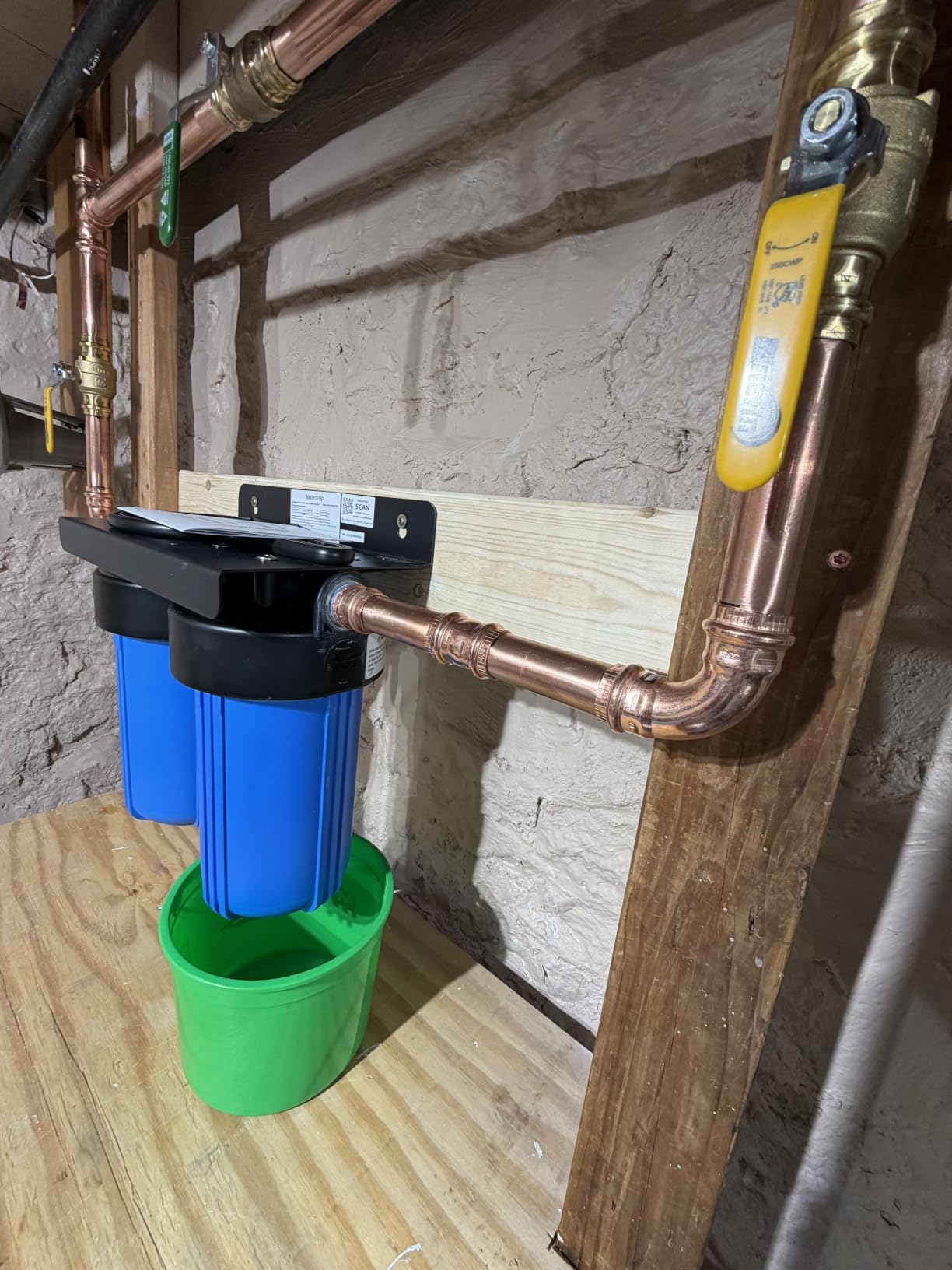
Teflon tape on copper is the detail that catches people out. Over-wrapping shortens the life of the copper, and reviews describe the fix as using the correct wrap count and a compatible sealant.
When 50000 gallons is enough
It is enough on municipal water where you want chlorine gone. It is not enough with a well or five people generating laundry volume, and on dirty well water the PP cartridge can need changing every three to six months, which turns a cheap system into an expensive one once you count parts and time.
Who should skip it
Skip it if anyone has a lead or arsenic concern, because there is no heavy-metal media in the path. Skip it if you want a set-and-forget install. Its natural role is first-stage sediment protection ahead of a UV lamp or a softener, where a cheap guard cartridge takes the abuse that would blind a pricier stage.
5. Aquasana Max Flow WH-1010-CT-LM – Premium Tank System With a 10-Year Life
Aquasana Max Flow Whole House Water Filter | Carbon & KDF | WH-1010-CT-LM
14.5 GPM peak flow
1000000 gallon capacity
10 year filter life
10 year limited warranty
Pros
- 14.5 GPM peak flow is designed for several showers at once
- Million gallon and 10 year media life with a 10 year limited warranty
- Salt-free scale control needs no salt bags or backwashing
- Low-maintenance pre-filter rated up to six months
- Reduces 97% of chlorine while keeping minerals in the water
Cons
- Highest cost in the roundup by a wide margin
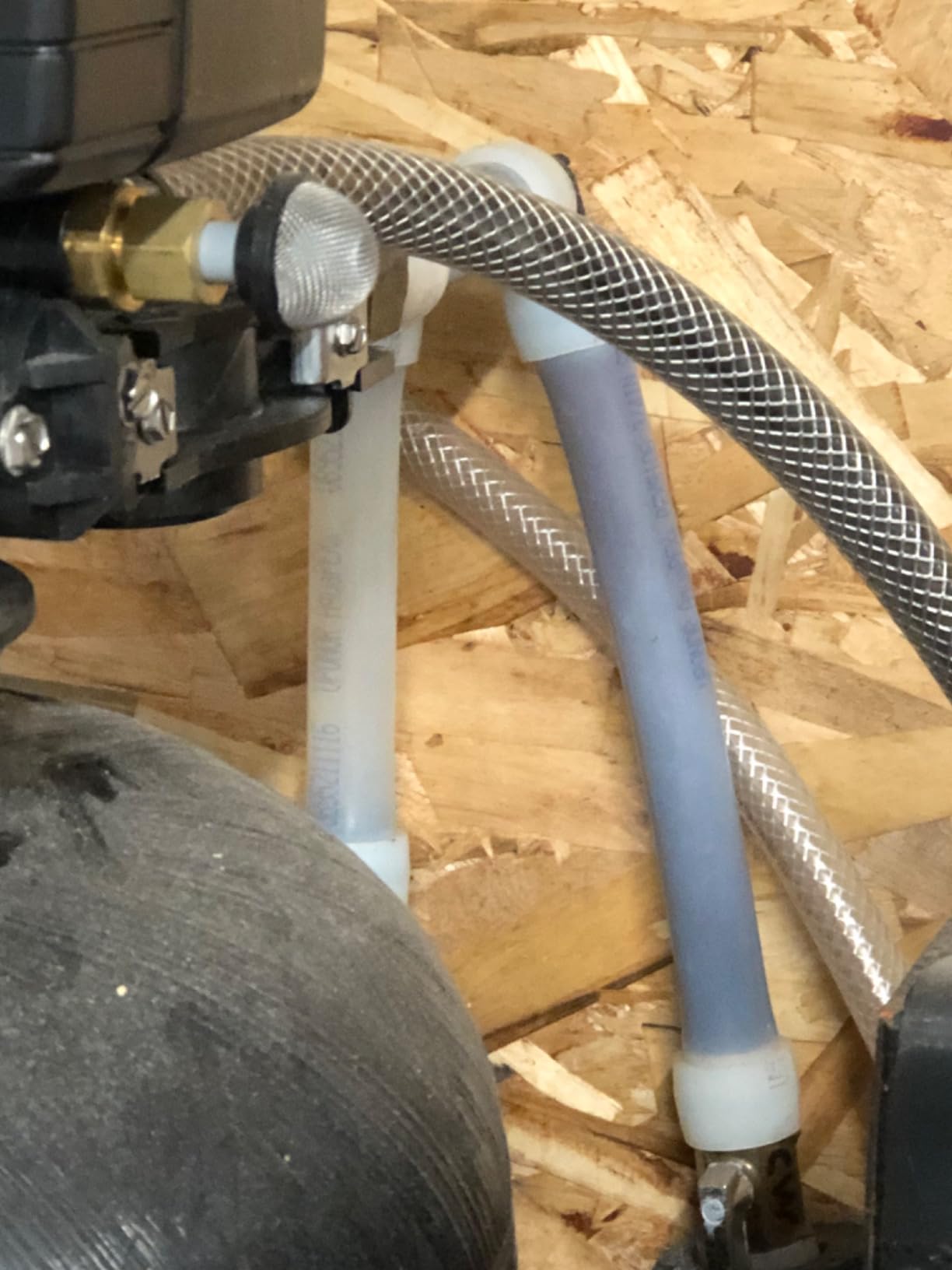
- Plastic connections at the pre and post filter housings are prone to leaking
- Warranty is void if you install it yourself
- Iron above 0.3 ppm and high alkalinity exceed its design window
The Aquasana is the long-horizon pick. Media life is one million gallons or 10 years, the warranty is 10 years, and stated running cost is well under one cent per gallon. Peak flow is 14.5 GPM, which is the number that matters for multiple bathrooms.
The stack is a 20-inch low-maintenance pre-filter, a tank with KDF and carbon, a tall salt-free conditioner and a 10-inch post-filter. Because the scale media is salt-free, there are no salt bags and no backwash to drain, which suits metered supplies and septic fields.
What it will not remove is governed by the published chemistry window: hardness under 15 gpg, alkalinity under 250 mg/L, pH below 8.3 and iron under 0.3 ppm. Exceed any of those and the media is out of its lane.
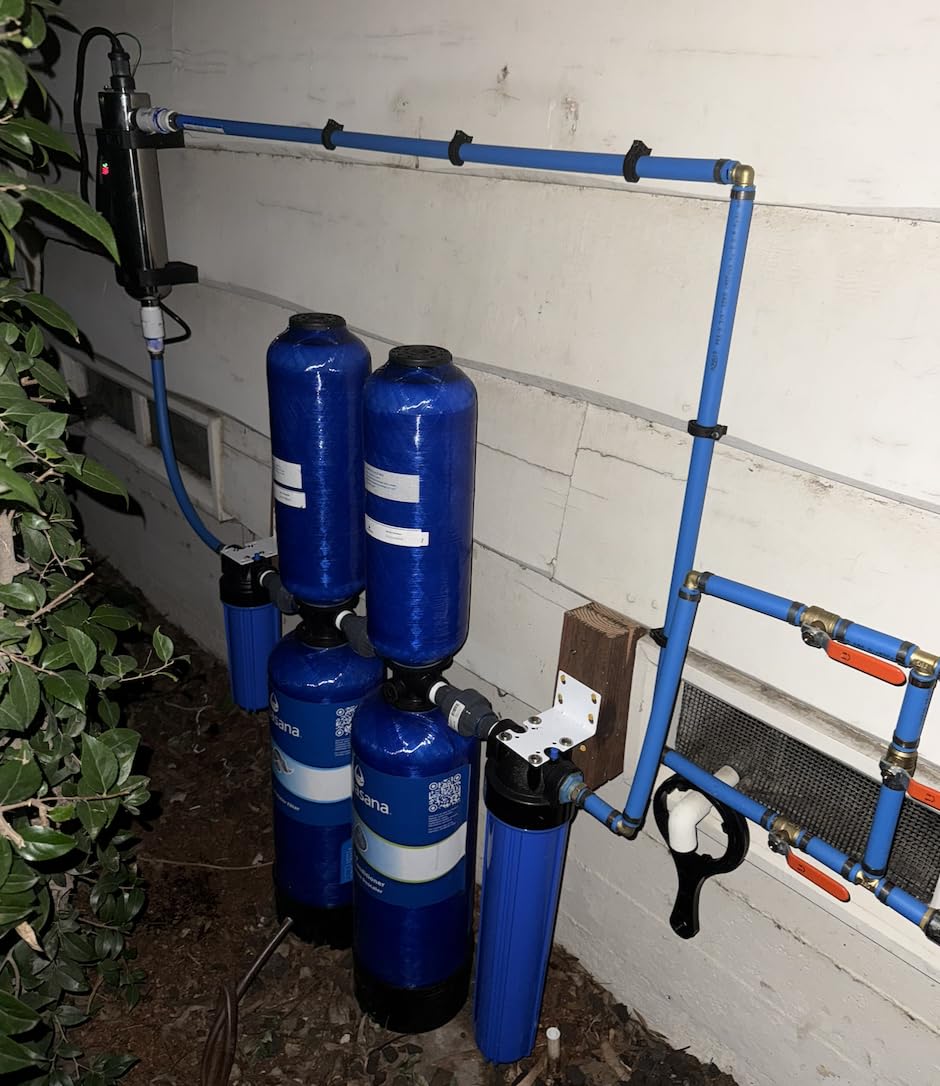
Critical reviews cluster on the plastic threaded connections at the pre and post housings, which owners report weeping and needing re-joining after a few months. The 47-inch wide, 57-inch tall footprint is also the largest in the roundup.
What the 10-year claim assumes
It assumes moderate hardness and low iron, exactly as the limits state, and it assumes you keep the pre-filter on its six-month cadence. That one cartridge is the entire maintenance obligation, and skipping it is how a million-gallon claim becomes a two-year one.
Who should skip it
Skip it if your iron is above 0.3 ppm or your water is genuinely hard, skip it if you plan to install it yourself because that voids the warranty, and skip it if the up-front number stops you. The tall conditioner uses template-assisted crystallization to convert hardness into a stable crystal, which manages scale but will not reduce hardness on a test.
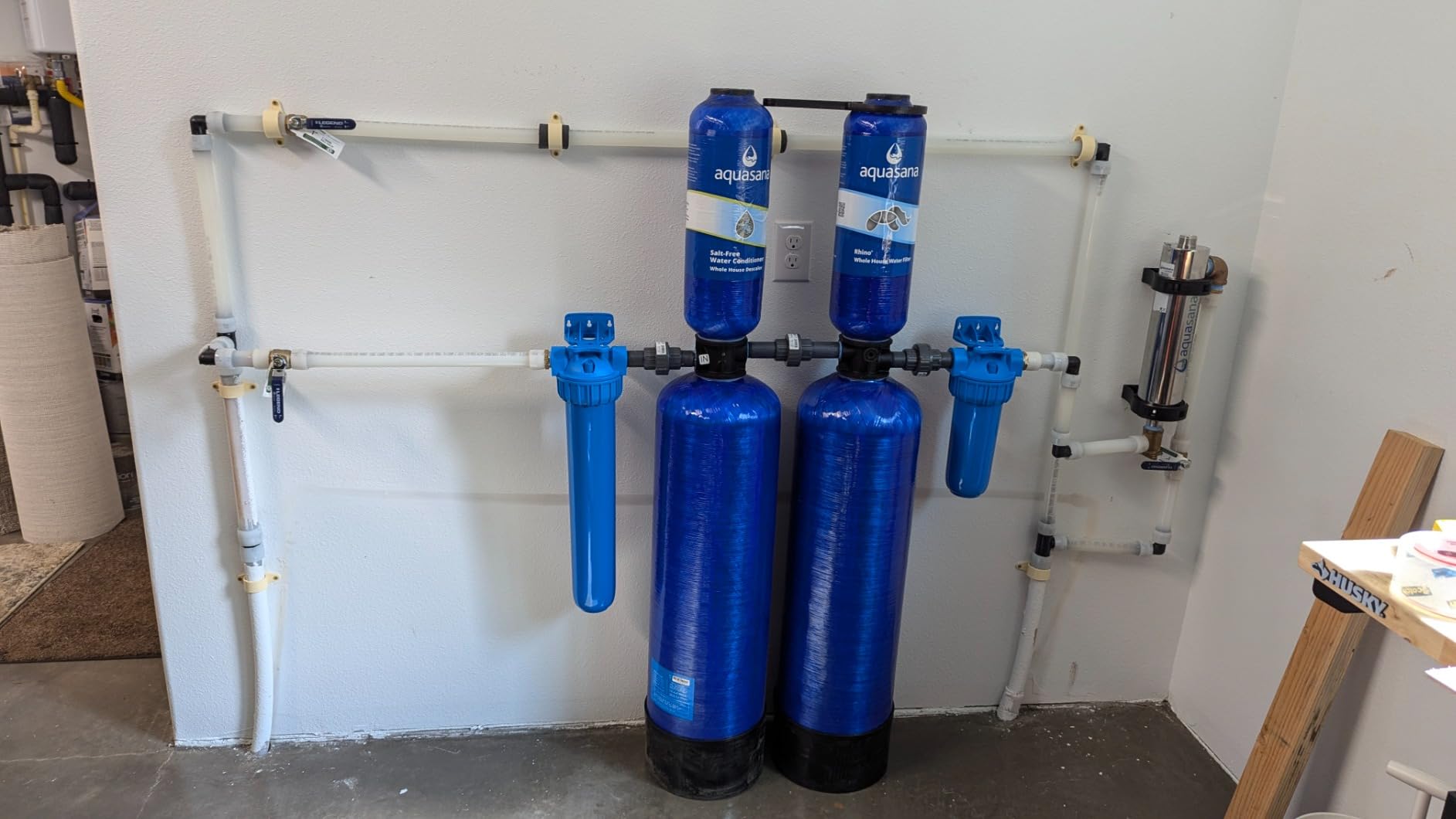
6. Fleck 5600 SXT Air Injection Iron Eater – Best for Iron and Sulfur on a Well
DuraWater Fleck 5600 SXT Air Injection Iron Eater Filter 1.5 cu ft, Black
1.5 cubic ft catalytic carbon
Fleck 5600 SXT digital air injection valve
Automatic daily backwash
1-inch bypass included
Pros
- Purpose-built for iron and manganese
- Also handles hydrogen sulfide sulfur odors
- Digital Fleck 5600 SXT valve with automatic daily backwash removes manual media changes
- Complete package with 10x54 tank
- 1.5 cubic ft catalytic carbon and 1-inch bypass
Cons
- Air injection cone can weep a small amount of water while drawing in air
- Daily backwash is water intensive and needs retuning on septic systems
- Media tank must be drained and refilled by hand at change
- Needs a pre spin-down sediment filter to keep iron flakes out of the valve
This is the dedicated well-water answer. Air injection creates an oxygen pocket that oxidizes dissolved iron so 1.5 cubic feet of Centaur catalytic carbon can filter it out, and the Fleck 5600 SXT digital valve runs an automatic daily backwash, so there is no scheduled service to forget.
Owners on well water report clear water and fixtures that stay rust-free for years, and the sulfur coverage separates it from carbon-only cartridges. Hydrogen sulfide is the contaminant that keeps sinks needing scrubbing, and a carbon tank handles it where a block often does not.
What it will not remove is hardness and dissolved solids, because nothing in the path does ion exchange. It is an iron and sulfur machine, and pairing it with a softener is normal practice rather than a compromise.
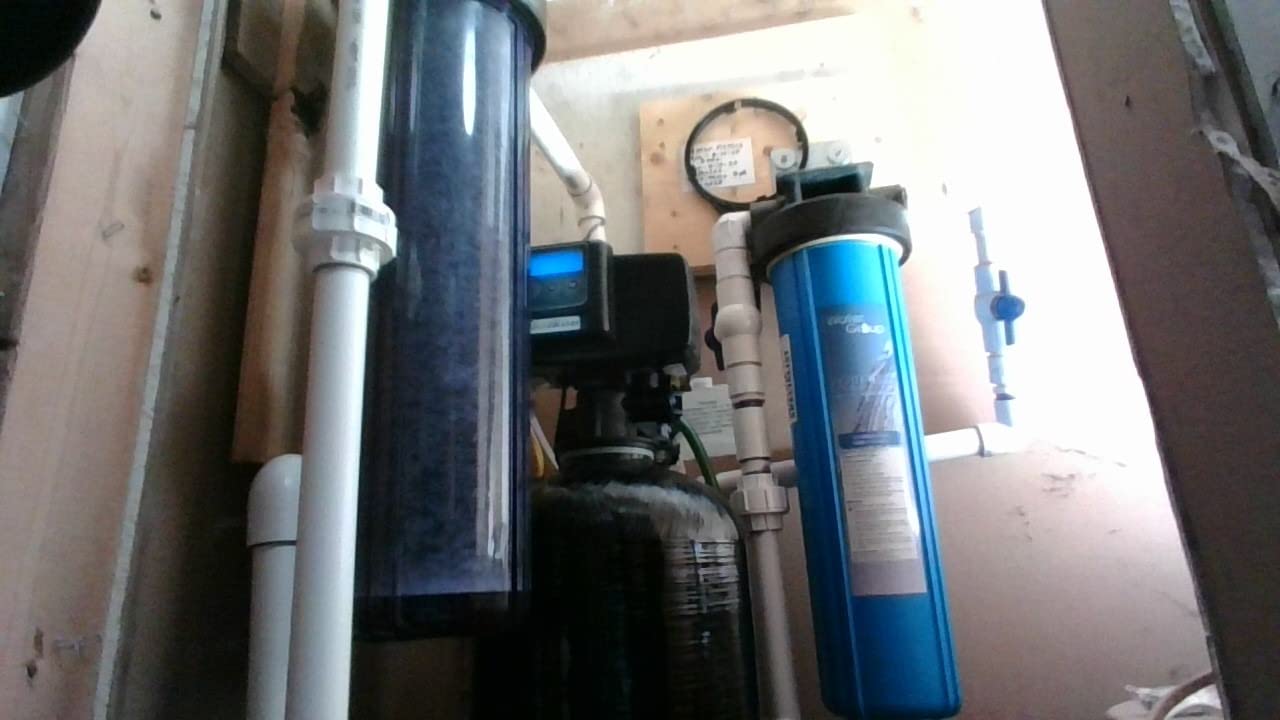
At 65 pounds and 48 inches tall it is a full-height install, and the 10×54 tank needs clearance above it for media service. Reviews note that the shipped instructions do not cover the refill procedure clearly, so find a walkthrough before your first change.
Set the backwash schedule before you move in
The default daily cycle is a starting point. High iron usually justifies daily; a light load or metered supply lets you stretch it out once you see the draw. Septic households should shorten it and watch the drain field. The small weeping from the air injection cone is normal operation, not a leak to chase with a wrench.
Who should skip it
Skip it on municipal water with no iron, skip it if you cannot provide a drain, and skip it if you will not install a spin-down sediment filter ahead of it, because iron flakes will reach the control valve and the softener behind it. A sulfur problem in the house is an argument for this unit, not against it.
7. 3M Aqua-Pure AP900 Series AP904 – Highest Flow and the Easiest Cartridge Changes
3M Aqua-Pure AP900 Series Whole House Water Filtration System AP904
Up to 20 GPM flow
100000 gallon capacity
Sanitary Quick Change cartridge
NSF/ANSI 42 and 372 certified
Pros
- Sanitary quick change means no wrench and no contact with spent media
- 20 GPM is the highest rated flow in the roundup
- 100000 gallon capacity and up to one year of filter life
- NSF/ANSI 42 and 372 certified with a 304 stainless steel head
- Lightest unit at 10.4 pounds with a slim footprint
Cons
- Single cartridge format with no dedicated heavy metal or iron media
- Does not address iron
- sulfur or TDS so it is not suited to untreated well water
- AP900 series only accepts AP917HD-S and related cartridges
- 11% one-star share driven by fitting and sizing issues
The AP904 solves the two things that annoy people most about cartridge systems. Rated flow is up to 20 GPM, the highest here, so it will not starve a large house. And the Sanitary Quick Change head means you twist the cartridge off by hand with no wrench and no contact with spent media.
It carries NSF/ANSI 42 and 372 certification on a 304 stainless steel head with 1-inch connections. The cartridge combines an activated carbon block with non-woven pleat media for a claimed 100,000 gallons and up to one year of life. At 10.4 pounds it is the easiest unit here to mount in a tight space.
What it will not remove is the limit of a single-stage design: no KDF, no iron media, no ion exchange, no sulfur, no TDS reduction. It is a sediment, taste and scale filter, and the scale inhibition is what protects a water heater.
Check the model number on your existing head before ordering a multi-year supply, because the AP900 series accepts only AP917HD-S and closely related cartridges. That closed system is a virtue if you like predictability and an annoyance if a generic cartridge tempts you.
Quick change is what fixes the maintenance habit
Most forgotten cartridges are forgotten because the change is unpleasant, and the SQC head removes that friction entirely. At 4.5 inches wide it is also the easiest unit to mount in a crawlspace return.
Who should skip it
Skip it on a private well, because one carbon and pleat cartridge is not the tool for iron, sulfur or heavy sediment. Skip it if you need heavy-metal reduction, and plan the space carefully, since a share of the negative reviews is about fitting rather than filtration.
8. PRO+AQUA Heavy Duty Well Water Filter – Broadest Well Contaminant Claims
PRO+AQUA Heavy Duty Whole House Well Water Filter System
1 cubic ft media tank
10 GPM rated flow
Programmable digital backflush
Rated for 4 or more bathrooms
Pros
- Only system here marketing 99% removal across chemicals
- VOCs
- pesticides
- iron
- H2S
- manganese
- lead
- uranium and radium
- Fully programmable digital control with customizable auto-flush intervals
- Fiberglass-lined polyethylene tank with prefilled resin
- Three connection options for retrofit flexibility
- Explicitly marketed for households of four or more
Cons
- Lowest average rating in the roundup at 4.1 with a 13% one-star share
- Does not reduce TDS
- Heavy at 91 pounds and 57 inches tall
- Automatic backflushing adds ongoing water and drain demand
On paper this is the broadest system in the roundup. The vendor claims 99% reduction across chemicals, VOCs, pesticides, iron, hydrogen sulfide, manganese, lead, uranium and radium, and it is marketed for four-plus-bathroom homes with a prefilled resin tank and programmable digital control.
That breadth claim is where the reviews get skeptical. The 4.1 average is the weakest in the group with a 13% one-star share, and the critical reviews focus on expectations a sediment-class media tank cannot meet once real iron loads are measured. Treat the list as a marketing summary and check it against your own test.
What it will not remove is stated by the manufacturer: TDS. And without a verifiable certificate number, a long list of percentages is a claim rather than a certification.
Installation friction in the negative reviews is mostly about access. A 57-inch tank on a freestanding base needs floor clearance beside the main line, and in a finished basement that often means moving a wall. The warranty is 1 year standard and 3 years with registration, so set a reminder the day it arrives.
Certification is worth more than the contaminant list
Water treatment forums converge on one instruction, which is to demand the certificate number rather than the adjective. A system certified to an NSF/ANSI standard was tested to a defined contaminant load at a defined flow, and a list of percentages with no standard attached was not.
Who should skip it
Skip it if you expect the 99% figure to cover a heavily contaminated well without testing first, and skip it if a 4.1 average with a 13% one-star share does not match your tolerance for support risk. On a well showing iron, manganese and sulfur together, a dedicated oxidation tank is the shorter path to clear water.

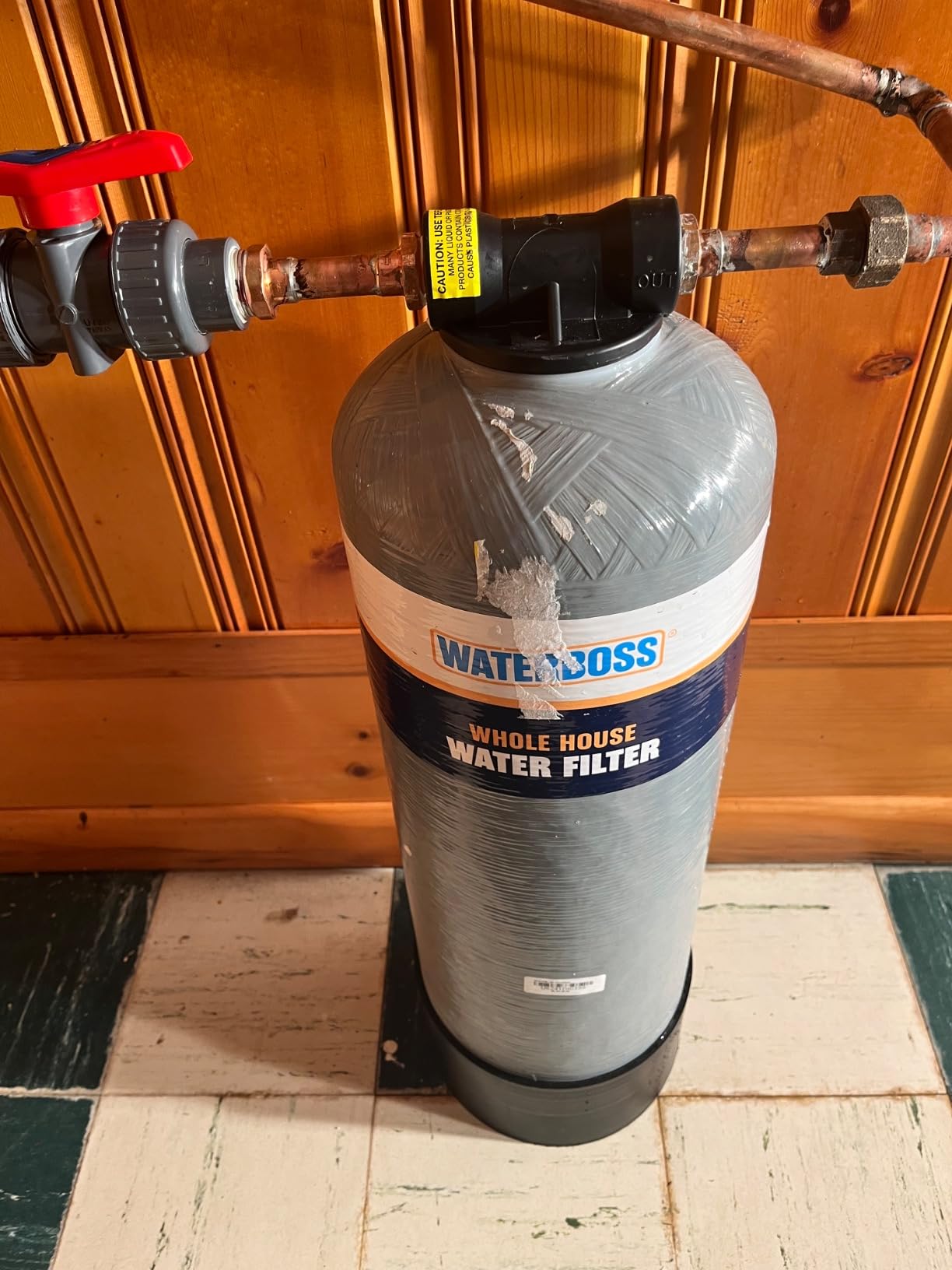
9. Water Boss WB-WH-Filter 600K Gallon Tank – Best for Septic and Metered Homes
Water Boss Whole House Water Filter System | 600K Gal | WB-WH-Filter
7 GPM rated service flow
600000 gallon capacity
6 year filter life
NSF/ANSI 42 certified
Pros
- No backflushing or drainage so it suits septic and metered water
- Compact 27-inch fiberglass tank fits small mechanical spaces
- 600000 gallon capacity and 6 year filter life
- NSF/ANSI 42 certified for 96.9% chlorine taste and odor reduction
- Rated 20-100 psi operating range
Cons
- 7 GPM flow and 3/4-inch ports restrict simultaneous use in very large homes
- Carbon media only with no iron
- sulfur or heavy metal removal
- Does not reduce TDS
- 4.0 average with a 14% one-star share
- the highest in the roundup
The Water Boss is the same architecture as the A. O. Smith tank with a smaller footprint and a smaller review base: one fiberglass tank, 600,000 gallons, a six-year cartridge life, a six-year limited warranty and NSF/ANSI 42 certification for 96.9% chlorine reduction. It measures 8.75 inches square and 27 inches tall.
Its defining virtue is that it needs no drain. No backwash, no discharge line, no water waste, across a 20 to 100 psi window. For a house on a septic field or a metered supply that is the whole decision, because every regenerating system here asks for water you pay for and land you should not use.
What it will not remove is carbon-only scope: no TDS reduction, no iron, no sulfur, no heavy metals, no softening.
The 4.0 average with a 14% one-star share is the lowest in the group, and the pattern is consistent: complaints cluster around flow limits in large homes rather than filtration failure. Judge it against your peak demand, not against the star average.
Why the no-drain design decides it
The plumbing footprint is the smallest of any option here, which is why it suits metered water and septic. At 27 inches it is also the shortest certified long-life tank we found, so it fits a mechanical closet with a low ceiling where a taller unit would not.
Who should skip it
Skip it if four or more bathrooms run showers at once, if you are on a well with iron, or if you need soft water, because activated carbon does not exchange ions and your kettle and dishwasher will still scale. If your water is hard, treat this as one layer of a stack rather than a whole answer.
10. Home Master HMF3SdgFeC 3-Stage Well Filter – Best for High Iron on a Large Well
Home Master Whole House Three Stage Water Filtration System with Fine Sediment, Iron and Carbon, Blue
15 GPM rated flow
25-10-5-1 micron sediment stages
Iron and manganese to 3 ppm combined
2000 ppm TDS tolerance
Pros
- Removes up to 95% of iron
- manganese
- sediment and chemicals to a 3 ppm combined load
- Four-layer 25-10-5-1 micron filter with high dirt holding
- 15 GPM on 1-inch ports
- well above other tank-style carbon units here
- Long-term well owners report rust staining and discoloration resolved
- Alloy steel bracket with drain valve and wrench included
Cons
- O-rings lose diameter with use and can pop out of the housing groove
- Plastic-to-copper fittings can leak if soldered near
- Sediment cartridge may need changing every 2.5 to 7 months
- Pressure can drop as filters load
The Home Master is the cartridge answer to a heavy-iron well, and the only one here running 15 GPM on 1-inch ports. The four-layer 25-10-5-1 micron sediment stack gives real dirt-holding capacity, with a vendor claim of up to 95% removal of iron, manganese, sediment and chemicals to a 3 ppm combined load.
Long-term owners on high-iron well water report rust staining, discoloration and off-tastes gone within days. The 2000 ppm TDS tolerance is the highest in the roundup, which matters on mineral-heavy wells. It is a well-water design, with city-water buyers directed to a different model.
What it will not remove is anything needing ion exchange or oxidation chemistry, and it does not soften. Reviews on 4.4 stars from long-term owners describe problems that are mechanical and solvable, not fundamental.
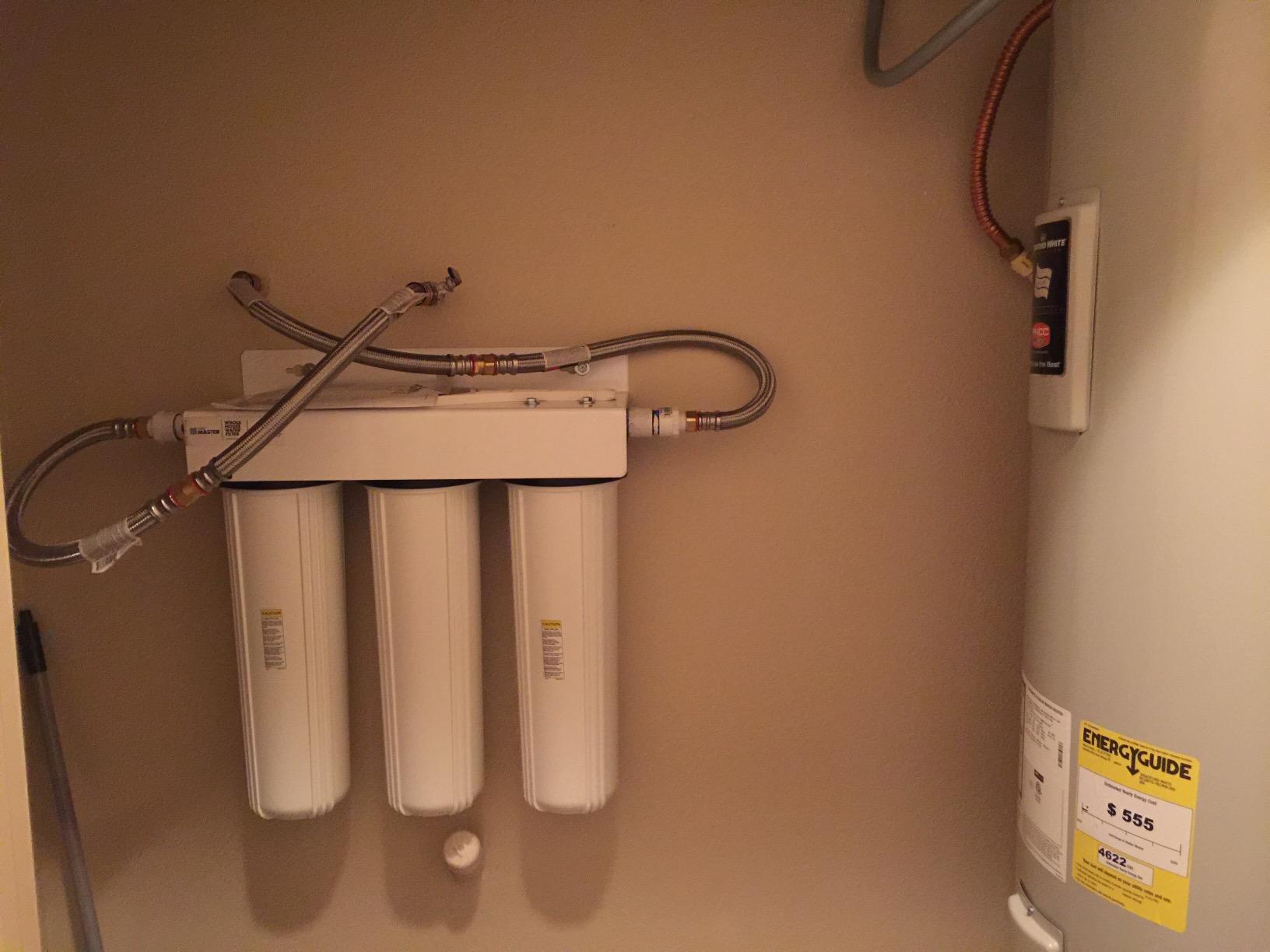
Keep spare O-rings on hand, since the most repeated complaint is a seal that stops seating in the housing groove, and sweat the copper upstream before assembly because plastic fittings do not tolerate a torch nearby.
15 GPM matters more on a well than on city water
Rural homes often run more bathrooms, outdoor spigots and irrigation on the same line, so peak demand is higher. The 2.5 to 7 month cartridge interval is the real trade, and on a heavy-iron well the low end is the realistic number. Three ppm combined is a combined load, not three ppm of each, so measure before you buy.
Who should skip it
Skip it on municipal water, skip it if nobody will own a change every few months, and skip it if you want a decade between services. Its natural position is first-stage protection in front of a softener, a UV lamp or a drinking-water membrane, and the included bracket, drain valve and wrench make a real DIY install realistic.
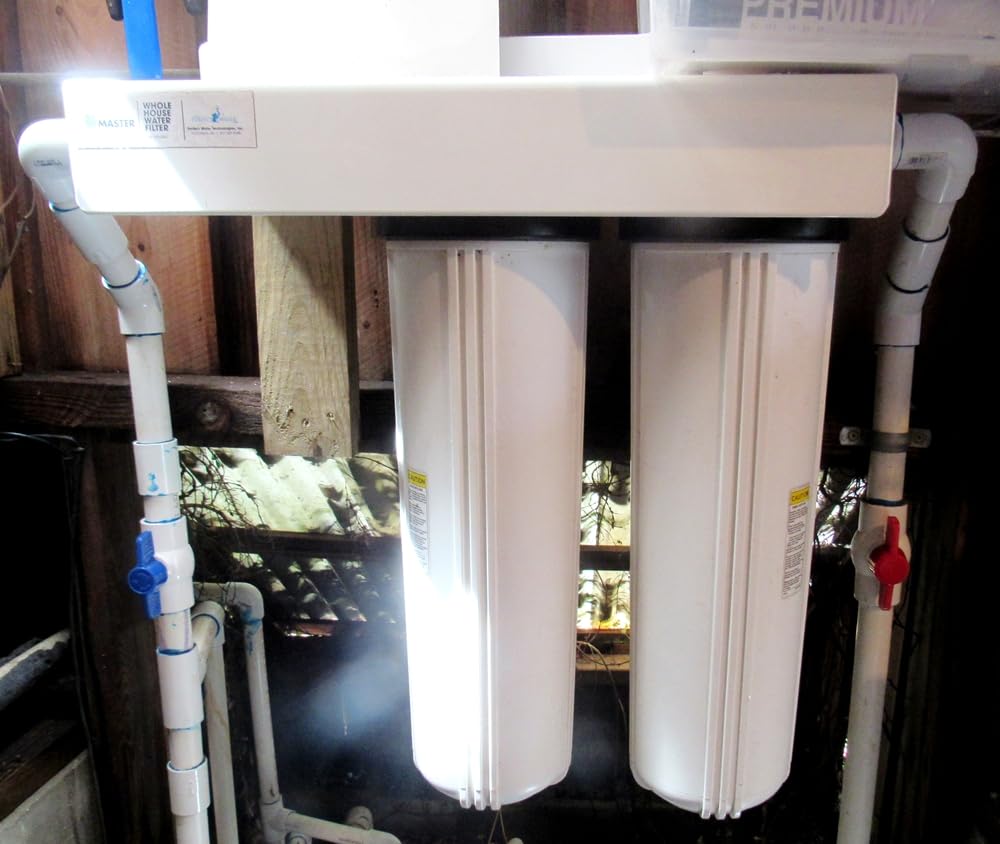
11. HQUA WF3-01 3-Stage Filtration System – Best Heavy Metal Coverage in a Cartridge Stack
HQUA WF3-01 3-Stage Whole House Water Filtration System, Reduces Heavy Metals (Lead, Mercury, Arsenic, Cadmium, Chromium), Chlorine, Sediment, Odor, and VOC’s
15 GPM rated flow
100000 gallon capacity
GAC plus KDF heavy metal stage
20 by 5.5 inch housings
Pros
- Second-highest average rating at 4.6 with 81% five-star and no two-star reviews
- GAC plus KDF stage targets lead
- mercury
- arsenic
- cadmium
- chromium and chlorine
- 15 GPM flow on a 100000 gallon capacity
- Per-filter drain valves
- gauges and purge buttons make changes cleaner
- Ships with spare gaskets
- lubricant
- fittings
- brush and a 180-day timer
Cons
- Instructions do not state that each housing needs two O-rings
- causing initial leaks
- Cartridge labels cannot be repositioned to face forward
- Brass and stainless threaded ports have been reported to weep
- Roughly 23 inch wide intake area needs clearance planning
The HQUA is the only cartridge stack here with a genuine heavy-metal stage. The middle housing holds compound granular activated carbon plus KDF media targeting lead, mercury, arsenic, cadmium, chromium and chlorine, where most competitors here offer sediment plus carbon and leave metals to a softener or membrane.
The rating distribution is the strongest in the set at 4.6 stars, 81% five-star and zero two-star reviews. The KDF stage is the reason, because owners on well and city water report clear taste, rotten-egg odor eliminated and no change in water pressure.
What it will not remove is still a real list: no softening, no TDS reduction, no iron oxidation chemistry, no disinfection. Flow direction is reversible, the range is 25 to 116 psi, and the upper temperature rating is 125 degrees F.
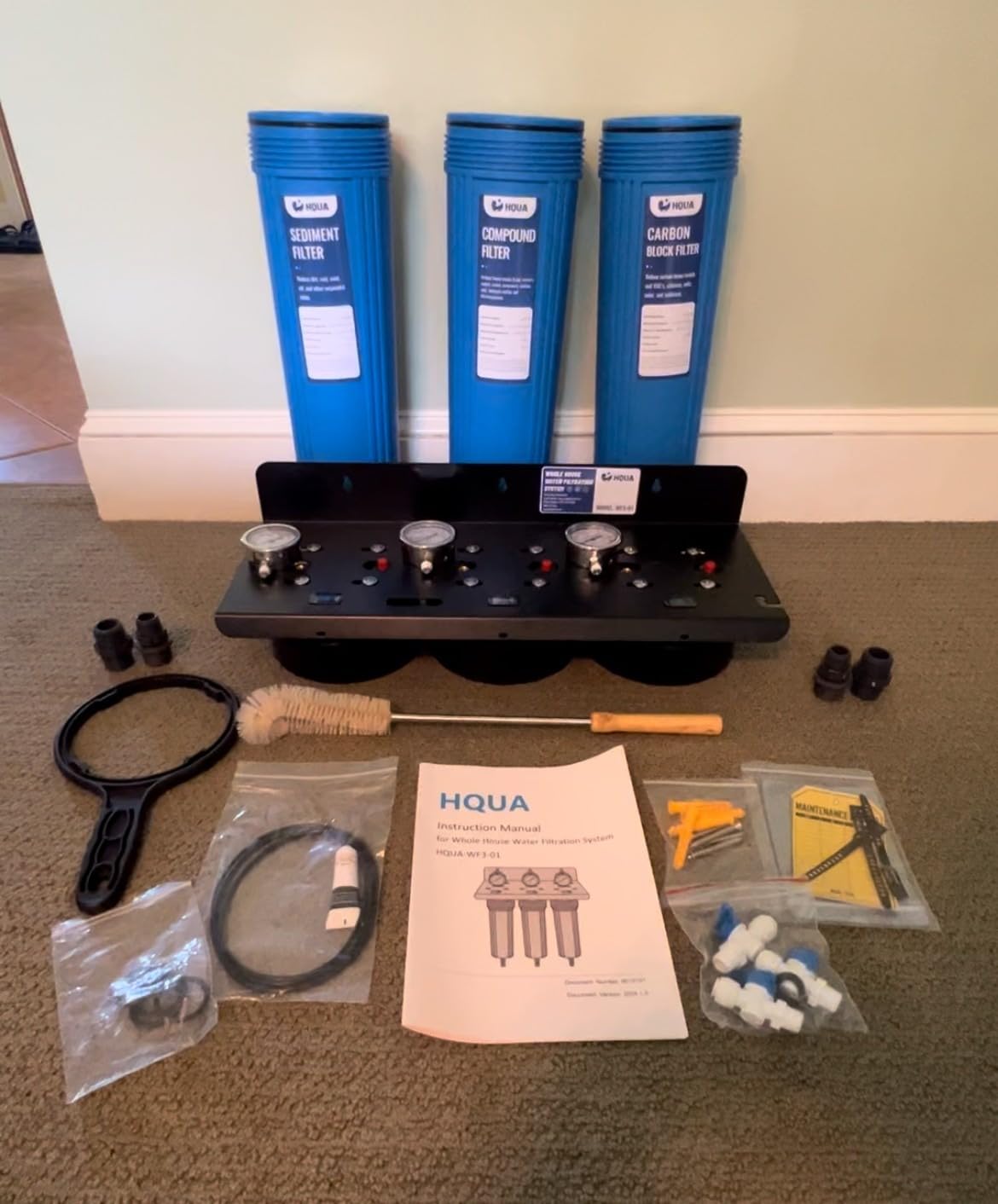
Each housing needs two O-rings and the instructions do not say so, which produces the most common install complaint in the reviews. Check every housing before you close the wall. Weeping at the molded threaded ports resolves with pipe dope or a different fitting pattern.
Where the heavy metal stage earns its place
It matters most on older plumbing with lead solder and on wells the county has not tested for arsenic, where a carbon-only system gives taste improvement and nothing else. Certification numbers matter more than stage names here, and a warranty worth checking: it is 1 year standard and 3 years with registration.
Who should skip it
Skip it under about 30 inches of clearance depth, because the assembly is 31 inches high by 23 inches wide. Skip it on hard water with no softening stage, and skip it as a well-water fix for iron. The included gauges and 180-day timers are the best monitoring in the group, though the timers are reminders rather than sensors.
12. iSpring WCFM400K Iron and Manganese System – Automated Iron Removal With No Chemicals
iSpring WCFM400K Whole House Iron and Manganese Water Filter System, Digital Control with Automatic Regeneration & Air Injection, Set & Forget Design
12 GPM rated flow
400000 gallon capacity
Automatic air injection regeneration
NSF/ANSI 61 certified media
Pros
- Automatic air injection regeneration means no manual media changes
- Uses only air with no oxidizers or chemical feed
- 12 GPM flow on a 400000 gallon capacity is the best flow to capacity ratio among the iron systems here
- Customizable auto-flush intervals and a set-and-forget digital valve
- NSF/ANSI 61 certified media
- Owners on heavy-iron wells report clear water and protected appliances
Cons
- Does not remove hydrogen sulfide and may be damaged by it
- Does not reduce TDS
- Heaviest unit in the roundup at 104 pounds and 66.8 inches tall
- Control head and threaded head cracks reported
- Automatic regeneration drains water continuously
The WCFM400K is the automated answer to iron and manganese, and the only system here that uses no chemicals at all. Air injection oxidizes dissolved iron, the digital valve regenerates the media on a schedule you set, and media life is rated at 400,000 gallons at 12 GPM.
Owners with high-iron wells describe the change as dramatic, with iron tests dropping to zero and fixtures staying rust-free. The media carries NSF/ANSI 61 certification, which is a material safety standard rather than a contaminant claim, and live-agent support replacing faulty control heads is the standout theme in the reviews.
What it will not remove is stated bluntly by the manufacturer: hydrogen sulfide, and the company directs buyers with H2S to a different model because the media can be damaged by it. It does not reduce TDS. Check your sulfur result before you buy.
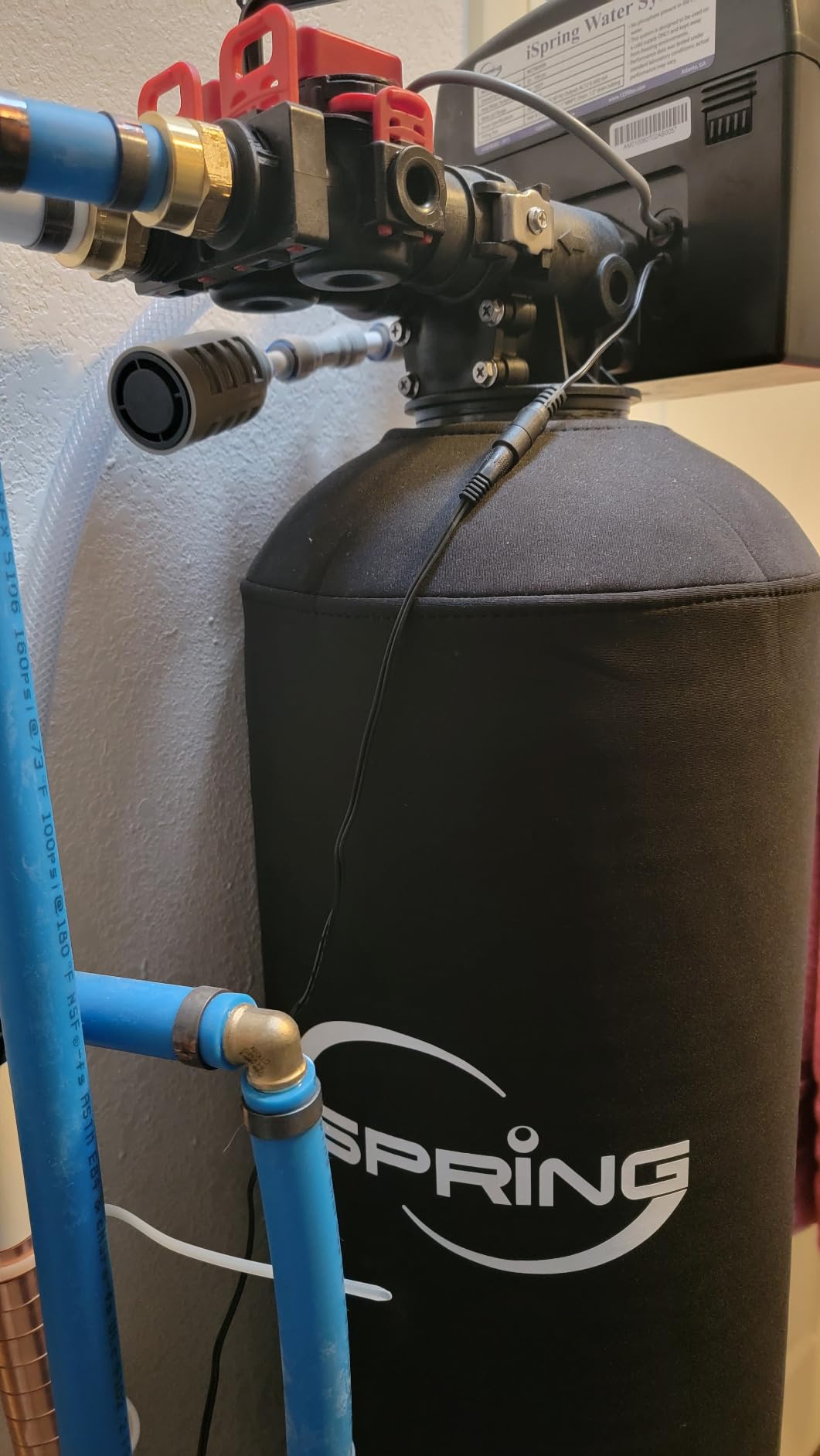
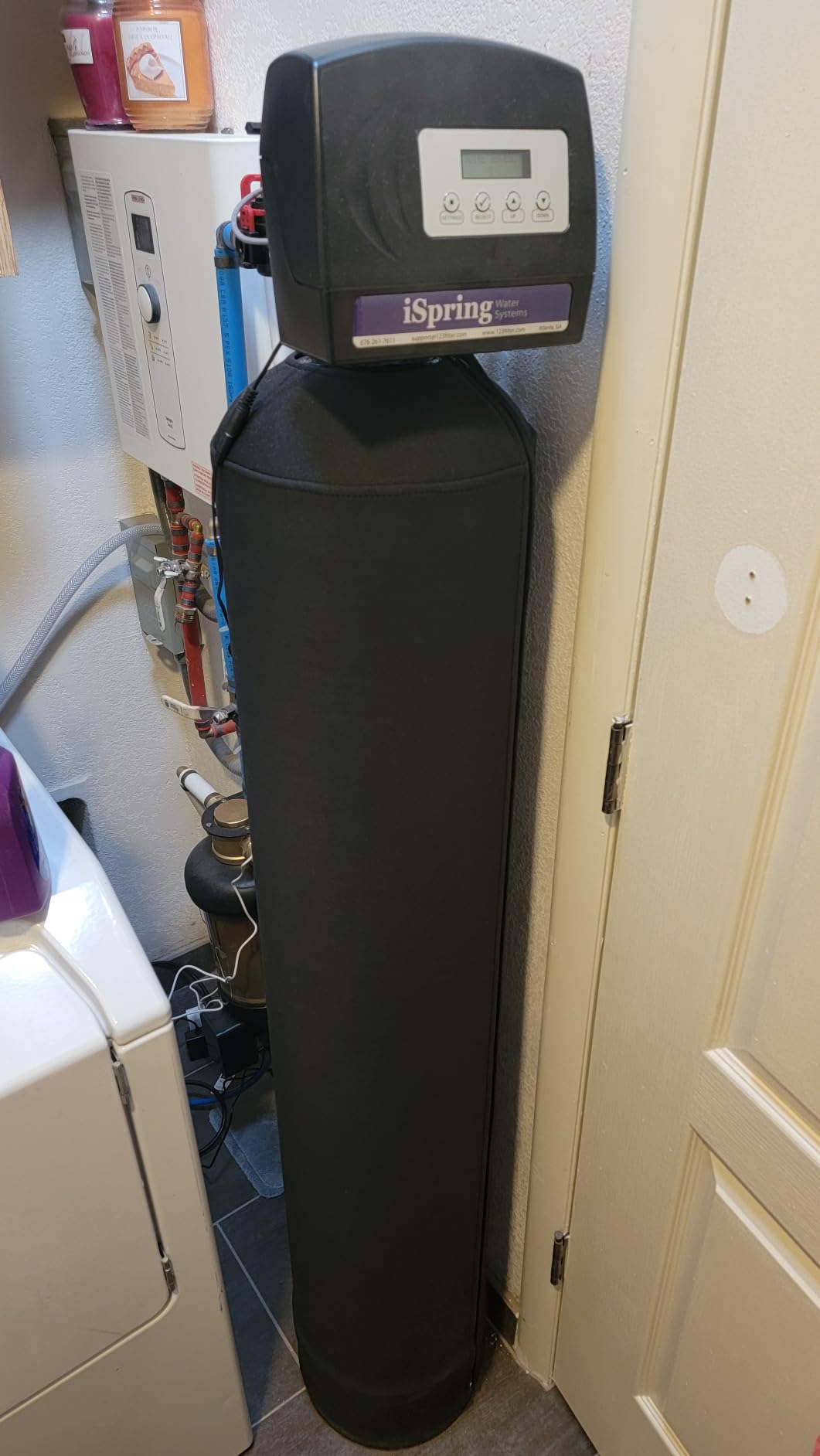
At 16.4 by 14 by 66.8 inches and 104 pounds, this is the largest and heaviest system in the roundup, and it needs a drain line. Plan the full footprint, including where the discharge goes, before you buy.
No chemicals is a real advantage
Chemical-fed iron systems need an oxidant reservoir, and a depleted reservoir produces worse water than no system at all. Air injection removes that failure mode. The tradeoff is the same as any regenerating system: it drains water on a schedule, which matters on a metered supply or a septic field. Program the auto-flush interval from your measured iron level rather than the default.
One related piece of planning: a digital control head needs power, which is the same reason many households put a standby generator on the same mechanical-room list. Our whole house standby generator picks cover that side of the equation.
Who should skip it
Skip it if your well has hydrogen sulfide, if you lack full-height clearance in a dry location, or if continuous drain discharge is unacceptable. Put a sediment spin-down ahead of it and a softener behind it, because iron carried into a resin bed shortens resin life.
How Much Flow Rate a Large Family Actually Needs
Start at 10 to 15 GPM of rated service flow and size above your calculated peak rather than at it. Rated flow is measured at a specific pressure with a clean filter, and a real family never experiences that condition.
Here is the fixture math for a four-bedroom, four-bathroom home. Two showers at roughly 2.5 GPM each is 5. A kitchen sink with a high-flow pull-down is 1.5. A dishwasher is 2. A washing machine is 3. That totals 11.5 GPM of genuine peak demand.
Add a 25 to 30 percent design margin and you are near 15 GPM. That is why a 7 GPM tank struggles in a large home, why a 15 GPM cartridge system feels effortless, and why the 20 GPM rating on the 3M unit is real headroom rather than marketing. The second half is pressure drop: every stage takes a slice of your dynamic pressure, so 1-inch ports are the minimum on a home with three or more bathrooms.
City Water or Well Water Changes the Answer Completely
On municipal water the contaminant list is short: chlorine or chloramine, sediment, taste and odor, and occasionally lead from older plumbing. Carbon plus sediment handles nearly all of it, and a softener is a separate decision driven by hardness rather than safety.
On a private well the list is longer and the consequences are worse, because nobody upstream treats the water. Iron, manganese, hydrogen sulfide, bacteria, nitrate and sediment are all plausible, and the correct stack changes completely.
Start with a test. Hardness in gpg, iron and manganese in ppm, pH and a coliform screen tell you which of the twelve systems is even a candidate, and they prevent the most common buying error in the category: a carbon filter installed on a well that needed an oxidation tank. For municipal households, a point-of-entry filter paired with an under-sink drinking filter is the sensible default, because whole-house reverse osmosis wastes several gallons per gallon produced at this scale. Our whole-system filtration comparison covers that trade in more depth.
What the NSF and ANSI Standards Actually Certify
No federal regulation governs whole house filtration, so certification is voluntary, and that is exactly why you should insist on it. NSF/ANSI 42 covers aesthetic claims such as chlorine taste, odor and sediment. NSF/ANSI 53 covers health contaminants including lead, arsenic and cryptosporidium, which is the standard that matters for any household with a child or an immunocompromised member.
NSF/ANSI 58 covers reverse osmosis and total dissolved solids reduction. NSF/ANSI 61 covers the safety of materials in contact with drinking water, which is a different claim and is often confused with contaminant reduction; in this roundup the iSpring WCFM400K media is certified to 61 and the 3M Aqua-Pure carries 42 and 372.
Verification is simple and almost nobody does it. The certificate number on a listing should be searchable in the NSF listings database, and the certificate should name the specific contaminant and the tested flow rate. A claim that says lab tested with no standard and no number is not a certification.
This is also the strongest reason to discount star ratings in this category. Several systems here sit at 4.0 to 4.3 with review counts in the low hundreds, and a handful of five-star reviews is not evidence. Certification, published flow with a pressure drop, and a warranty that does not require exclusive consumables are the signals worth weighting.
What Whole House Filters Cost and What They Cost to Run
Do not compare sticker prices. Compare the five-year cost, which is filters or media plus labour plus your own time. A cartridge stack looks cheap and often is, if you genuinely change cartridges on schedule. A 600,000 gallon tank looks expensive and can be cheaper over five years for a household of five.
Water treatment forums are consistent on one point: the sticker price understates the real cost, largely because of installation. A cut-in after the main shutoff is straightforward, but anything with a drain line, a bypass, a pressure tank or a softener in front of it is a licensed plumber job, and local code can add a permit.
Brine discharge deserves a real check. Softeners and regenerating iron systems need somewhere to discharge, and some jurisdictions and septic situations restrict it. That is a hard constraint rather than a preference, and it is why two of the systems in this roundup make a no-drain requirement a headline feature.
On difficulty, a cartridge system with 1-inch ports and a DIY design is realistic for a competent homeowner. Anything self-installed may void the warranty, as it does on the Aquasana, so read the terms before saving on labour.
How to Pick a Whole House Filter in Five Steps
Test your water. Hardness in gpg, iron and manganese in ppm, pH, and a coliform screen if you are on a well. Every other step depends on this one.
Match the contaminant to the media. Sediment needs polypropylene, chlorine and taste need carbon, chloramine needs catalytic carbon, iron and sulfur need oxidation, hardness needs ion exchange, bacteria need UV, and dissolved solids need reverse osmosis at the point of use.
Size for peak demand, not average. Sum fixture flow rates at the worst moment, add a 25 to 30 percent margin, and require 1-inch ports on a home with three or more bathrooms.
Verify the certification. Find the certificate number, confirm the standard, and check that it names the contaminant you care about and the flow it was tested at.
Model the five-year cost. Media and cartridges, labour, and the time cost of the changes you will actually make, plus drain and permit requirements.
One decision to make explicitly is whether you want a system you service twice a year or one you forget for years. Households that travel or have young children usually do better with the second approach, and the tank systems in this roundup exist for exactly that reason.
Frequently Asked Questions
What is the recommended GPM for a whole-house water filter?
For a large household of four or more, start at 10 to 15 GPM of rated service flow and size above your calculated peak. A family running two showers, a dishwasher and a washer simultaneously pulls roughly 11.5 GPM, and adding a 25 to 30 percent design margin puts you near 15 GPM. Use 1-inch ports on any home with three or more bathrooms.
How many GPM for a 4 bedroom house?
A four-bedroom house with four bathrooms typically needs about 11.5 GPM at peak and should be sized to roughly 15 GPM after a design margin. Anything rated at 7 GPM will feel restrictive when two showers run at once, which is the most common complaint about undersized whole house filters in large homes.
What is the average water flow rate for a household in GPM?
A typical household averages 2 to 5 GPM of continuous use, but peak simultaneous demand is the number that matters for filter sizing. Two showers contribute about 5 GPM, a dishwasher about 2 GPM, a washing machine about 3 GPM and a kitchen sink about 1.5 GPM, so simultaneous use in a large home can reach 11.5 GPM or more.
What are the disadvantages of a whole house water filter?
The main drawbacks are pressure drop from an undersized or multi-stage system, ongoing cartridge or media costs, installation complexity when a drain line is required, and the fact that most whole house filters do not soften water or lower total dissolved solids. None of them protect against a boil water advisory, and they can reduce pressure if filters are not changed on schedule.
How difficult is it to install a whole-house water filtration system?
A simple cartridge system with 1-inch ports and a DIY design is realistic for a competent homeowner and takes an afternoon. Systems with a drain line, a softener, a pressure tank or an air-injection valve need a licensed plumber, and self-installation can void the warranty, as it does on the Aquasana. Check local code and brine discharge rules first.
Where to Start
For most large families on municipal water, the best whole house water filters for large families start with the iSpring WGB32B. It holds 15 GPM on 1-inch ports, removes up to 99% of chlorine across three stages, and carries a review base larger than anything else we compared. If you would rather not open a housing twice a year, the Aquasana Max Flow gives a million-gallon media life and a 10-year warranty with no salt hauling.
On a well, the choice changes completely. Iron and sulfur point to the Fleck 5600 SXT or the iSpring WCFM400K, sediment and iron together point to the Home Master, and chlorine taste on city water points back to the tank systems. Test your water first, then size for your worst simultaneous moment rather than your average morning.
Every system in this 2026 roundup is listed with its rated flow, its certification and its maintenance reality, so you can match one to your household instead of guessing.


